Posts tonen met het label family. Alle posts tonen
zondag 4 december 2016
Today's Review: A Quiet Passion
Dat de Britse regisseur Terence Davies het leven van de Amerikaanse dichteres Emily Dickinson naar het witte doek vertaalde, zal geen toeval zijn. Dickinson is buiten Amerika vrij onbekend, ondanks haar nalatenschap van bijna tweeduizend gedichten. De poëte genoot tijdens haar eigen leven in de negentiende eeuw weinig erkenning voor haar werk. Van Davies kan hetzelfde gezegd worden, want hoewel zijn films altijd goed ontvangen zijn door de critici, is de omvang van zijn oeuvre bescheiden en is ook hij niet erg bekend bij het publiek. Davies geeft Dickinson alsnog een stem in het bescheiden kostuumdrama A Quiet Passion, en daarmee ook zichzelf.
Dat Dickinson (1830-1886) amper aandacht kreeg, is niet verwonderlijk, aangezien ze het grootste deel van haar leven in haar ouderlijk huis doorbracht en niet vaak onder de mensen kwam. Die beperkingen vloeiden voort uit het patriarchale, diepgelovige milieu dat haar voortbracht. Het was een verstikkende omgeving voor een rebelse, onafhankelijke dame als zijzelf, die vooral haar eigen meester wou zijn, en niet haar hele leven de wil van haar vader of echtgenoot wou volgen. Ze trouwde dan ook nooit. Ze gaf veel om haar familie en wilde niet riskeren weggetroond te worden door een man. Dit in tegenstelling tot haar vriendinnen, die ze langzaamaan uit het oog verloor vanwege zulke huwelijkse verplichtingen. Haar gedichten waren voor haar een vorm van ontsnapping uit deze mannenwereld, waarin de wens van de vrouw simpelweg nooit ter sprake kwam. Dat haar werk doorspekt was met aanklachten tegen religie en de gangbare rollenpatronen, moge duidelijk zijn.
Davies zal in Dickinson een zielsverwant herkend hebben. Zoals de dichteres slechts met de grootste moeite enkele stukken gepubliceerd kreeg - en dan ook nog in aangepaste vorm, tot haar grote woede - zo ziet ook de regisseur zich te vaak geconfronteerd met problemen rond de financiering van zijn films. Bovendien zag hij zijn moeder wegkwijnen in een huwelijk met een gewelddadige echtgenoot, een lot dat Dickinson wist te voorkomen, ook al leverde haar dat juist een leven vol eenzaamheid op. Het was een harde keuze, die veel van haar seksegenoten echter nooit kregen. Als haar schoonzus haar zegt te benijden vanwege haar schijnbare vrijheid, is dat gevoel van Dickinsons kant geheel wederzijds, want die vrijheid gaat ten koste van een gewoon leven. Toch schrijft Dickinson onverdroten voort, want het is letterlijk de enige passie die ze ooit zal kennen.
Het is ironisch dat juist Cynthia Nixon gecast werd in de rol van de alleenstaande schrijfster. Nixon is vooral bekend vanwege haar rol in Sex and the City, waarin haar personage zo'n beetje alles was wat Dickinson niet was. Davies waarschuwde Nixon vooraf dat hij een hekel had aan alles waar haar doorbraakrol voor stond, maar desondanks bleek haar casting een schot in de roos. Nixon speelt Dickinson gepast introvert, als een stille vrouw wier opstand tegen het systeem slechts tot uiting komt in haar werk. De enige stem die ze heeft en die er uiteindelijk toe doet, zit verscholen in haar poëzie. Dat weerhoudt haar er niet van om haar naasten toch stevig van repliek te dienen als de discussie over haar plaats in het leven weer oplaait. Want ze cijfert zichzelf niet weg, in tegenstelling tot haar moeder die slaafs haar man volgt. Dickinsons weigering om te trouwen en haar overgave aan haar dichtkunst vormen een persoonlijke overwinning, het doorbreken van het haar opgelegde leven. Om nog maar te zwijgen van haar weigering deel te nemen aan het heersende streng religieuze leven, in die tijd een flink schandaal. Nixon vat de persoon Dickinson en haar stille daden van feministisch verzet uitstekend en laat zo het stigma dat Sex and the City bij haar achterliet geslaagd vallen.
Het neemt niet weg dat A Quiet Passion toch de indruk van een wat stoffig kostuumdrama achterlaat. Gezien het leven dat Dickinson leidde is het niet vreemd dat de film zich hoofdzakelijk binnenshuis in donkere kamertjes afspeelt. Muziek is grotendeels afwezig, de cameravoering blijft verstild. Deze beperkte, theatrale opzet doet weliswaar recht aan Dickinsons leven, maar maakt de beleving toch wat flets. Op den duur kabbelt de film teveel voort richting melodrama, als Dickinsons moeder in een snikfestijn overlijdt, haar broer overspel pleegt met een jongere vrouw en zijzelf langzaamaan bezwijkt aan een pijnlijke nierziekte. De gevatte dialogen tussen de jongere Dickinson en haar scherp van de tongriem gesneden vriendinnen die de eerste helft van de film kenmerken, worden tegen die tijd node gemist. Die scherpzinnigheid blijft echter levend in haar gedichten die tussen de aktes door voorgedragen worden. Want ook al kabbelt Dickinsons tegendraadse leven langzaam voort naar een schijnbaar roemloos einde in dit rustige cinematische toneelstuk, onder het oppervlak van zowel de vrouw als de film bruist het van de rebelse, levenslustige energie.
donderdag 10 november 2016
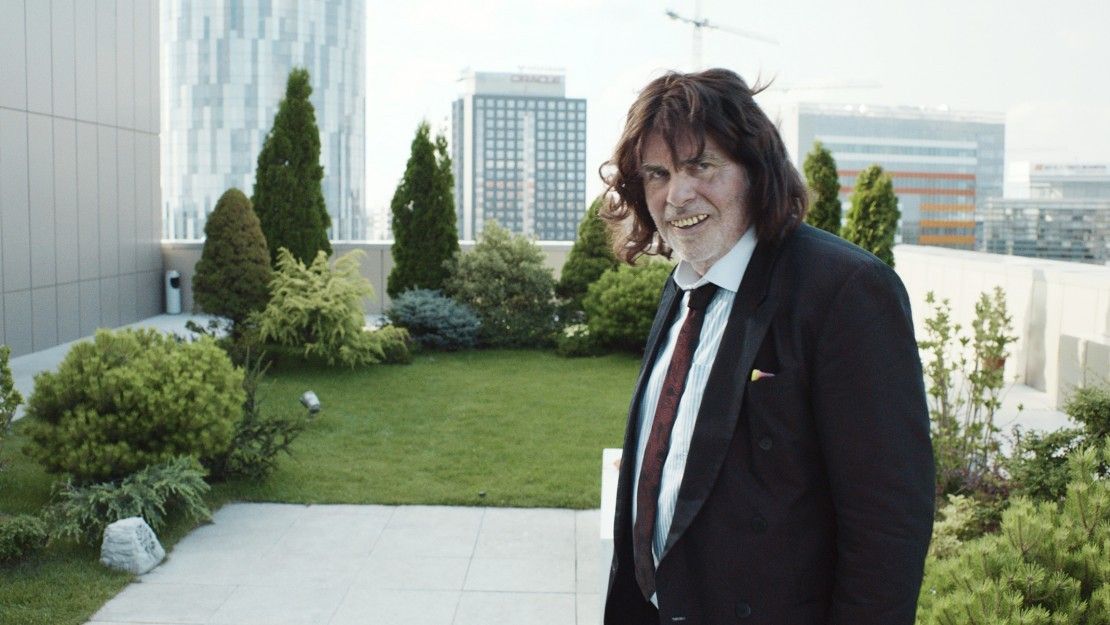
Today's Review: Toni Erdmann
De critici spreken schande van het feit dat Toni Erdmann in Cannes buiten de prijzen viel, maar als iemand zich daar weinig druk om zal maken, dan is het regisseuse Maren Ade zelf wel. Geïnspireerd door haar vader, een verwoed grappenmaker, is het project voor haar een persoonlijke zaak. Hij was degene die haar leerde dat je het leven niet te ernstig moet nemen en er vooral van genieten moet. Een boodschap die de regisseuse aanstekelijk uitdraagt in Toni Erdmann. In dat opzicht is ze niet te vergelijken met het vrouwelijke hoofdpersonage, wier drijfveren ambitie en carrière zijn. Ongeacht haar verlies in Cannes is het Ade gelukt juist met een tegenovergestelde levensovertuiging richting de top te klimmen, want Toni Erdmann is een allesbehalve serieus maar toch betekenisvol drama geworden.
Die titelfiguur Toni, gebaseerd op Ades eigen vader, is een uit noodzaak geboren persoon. Eigenlijk heet de oudere heer Winfried. Hij heeft niet bijster veel van het leven gemaakt, maar houdt er toch volop van, met zijn absurde gevoel voor humor als levensbepalende karaktereigenschap. Een schrijnend contrast met zijn dochter Ines, die tijdens het beklimmen van de ladder van het bedrijfsleven een tegenovergestelde figuur is geworden. Vader en dochter hebben weinig meer gemeen. Dat wordt Winfried pijnlijk duidelijk als hij haar bezoekt in Boekarest, waar zij vertoeft om een grote vis in de oliewereld voor haar baas aan de haak te slaan. Dochterlief heeft amper tijd voor haar vader en beschouwt hem als een sta-in-de-weg, ondanks zijn boerse charme waarmee hij zelfs haar doelwit bekoort. Tegelijkertijd maakt Winfried zich hoe langer hoe meer zorgen om zijn kind, dat tot een humorloze vrouw is uitgegroeid voor wie het ontslaan van mensen aan de orde van de dag lijkt te zijn. Hier moet ingegrepen worden, maar dat kan alleen Toni Erdmann.
Erdmann is gewoon Winfried met valse tanden en een sjofele pruik. Dat heeft Ines natuurlijk meteen door, maar toch staat ze toe hoe dit typetje zich in de high society van het bedrijfsleven naar binnen bluft en de hotemetoten inpalmt met zijn doldwaze charisma en bizarre anekdotes. Is het een onbewuste drang om uit haar verstikkende kleurloze bestaan bevrijd te worden of wil zij zien hoe weinig haar vader begrepen heeft van haar wereld? Ade laat het in het midden, maar Erdmann weet zich hoe dan ook goed te handhaven in de wereld van de 'één procent'. Dankzij het betoverende karakter van de meesterlijke Peter Simonischek sleept Erdmann ook ons volledig mee in zijn ondermijnende toneelstuk, waarmee het komische gedeelte van de film verzekerd is. Tegelijkertijd verliest Ade, geholpen door het sterke tegengas dat zijn tegenspeelster Hüller Simonischek geeft, het dramatische aspect van het mentale getouwtrek tussen Winfried en Ines geen moment uit het oog.
"Ben je eigenlijk wel een mens?", vraagt een vertwijfelde Winfried zijn dochter als hij geconfronteerd wordt met haar holle bestaan in de zakenwereld. Zijn dochter is een bikkelharde tante geworden, die alles inzet om de doelstellingen van haar bedrijf te behalen. Uitgaan, diners, zelfs haar verjaardagsfeestje, alles is slechts een middel in een strijd om de cijfers en alleen anonieme seks en af en toe een lijntje coke vormen enige ontspanning. Stilstaan bij de belangrijke dingen in het leven, zoals familie, is er niet bij. Van een eigen persoonlijkheid is weinig te bespeuren. Papa is niet trots op haar, maar bezorgd. Tegelijkertijd leidt ook Winfried niet het meest begerenswaardige leven. Hij is gescheiden, leeft alleen en pas als zijn hond sterft, zoekt hij toenadering tot zijn dochter. Daar mogen gerust vraagtekens bij gezet worden, maar hij is duidelijk gelukkiger dan zijn naar maatschappelijke maatstaven meer geslaagde dochter. Succes garandeert geen geluk. Toni Erdmann draait om twee totaal verschillende, maar even geknakte mensen wier verstandhouding opnieuw moet beginnen. De leugen Toni Erdmann moet die toenadering mogelijk maken.
Dat ingrijpen in andermans leven voor de eigen bestwil doet Erdmann met verve. Subtiliteit is daarbij niet het sleutelwoord. Wanneer hij Ines confronteert met het ontslag van arme arbeiders voor onbeduidende fouten neigt de film toch een beetje naar moralistisch sentiment. Er kan eveneens afgedongen worden op de eenzijdige wereld die Ade schetst van het bedrijfsleven. Dat is echter bijzaak, want het emotionele hart van Toni Erdmann wordt sterk gevormd door dit duet tussen twee persoonlijkheden, dat zowel aangrijpend als hilarisch is. Erdmann is een even merkwaardige als innemende verschijning die ons direct aan zijn kant weet te trekken, waardoor we volledig opgaan in de geleidelijke ontdooiing van de ijskoude Ines. Het duurt bijna drie uur, maar die tijd vliegt voorbij. De boodschap is niet bijster vernieuwend, maar dankzij heerlijke films als Toni Erdmann genieten we des te meer van het leven. Prestigieuze prijzen heeft Ade niet nodig, de breed gedragen erkenning dat Toni Erdmann een van de hoogtepunten van 2016 vormt, volstaat.
zaterdag 4 juni 2016
Today's Review: Elle
Picking up some speed at last.
Elle - recensie
It's an odd thing, but the press seems to almost unilaterally adore this latest film by Paul Verhoeven, with myself being an exclusion to that fact. Even though I love most of Paul Verhoeven's work - even going so far as to publicly consider the much maligned Showgirls a very fun film - I had a hard time appreciating this film. Even though I admit there's a number of things to appreciate about it.
First thing, it's a superb piece of acting by the lead, the fabulous French actress Isabelle Huppert. She delivers a grand performance as the protagonist, Michele, a powerful director of a videogame company who one day unexpectedly finds herself the victim of a brutal rape by an unknown assailant. She effortlessly navigates the part of rape victim and dominant, matriarchal presence at her job and as head of her family of miscreants. Better yet, the dormant demons of her shady past awake to stir things up even more, which soon makes for an intense psychological game between herself and those around her. Nobody is a match for her, both in terms of character and in terms of acting. Sadly, the rest of the cast is nowhere near as exciting to watch and mostly consists of sleazy personas out to make her life more miserable. It's a shame less effort was put into making Michele's surroundings a bit more interesting, but with such a powerful performance as her own, it's hard to keep up.
Second, Verhoeven basically does what he has always done: not give a damn about cinematic conventions and do as he like without taking what many people would consider 'good taste' into account. His continuation of exploring the underbelly of man proves devoid of adhering to the usual norms of narrative progression. Whoever thinks the rape dictates the rest of Michele's actions is wrong, as she doesn't end up a victim of the act, but rather her environment becomes a victim of herself. There's no tear jerking drama here wherein the violated female must come to terms with the traumatic event, nor is there your typical Hollywood style thriller plot which sees the aggressor hunted down by a revenge driven survivor. Yes, Michele does take matters into her own hands and aims to find her rapist, but this detective story thread suddenly comes to a dead stop as the identity of the culprit is revealed earlier than expected, to unforeseen and rather incredulous results. Wherever you think the story is going, Verhoeven doesn't care about your expectations.
Such stubbornness I generally approve of, since there's enough predictable studio drivel going around already. Nevertheless, despite Verhoeven clearly putting his own stamp on Elle which makes it a rather unique final result, I still found it far from a satisfying movie. It's simply too rebellious for the sake of being rebellious. It's a strange and uncomfortable mix of a thriller, family drama and dark comedy, filled with wholly unsympathetic characters. It echoes Verhoeven's scandalous Dutch film Spetters, which saw the auteur heavily criticized and proved one of the prime reasons for him to switch from Holland to Hollywood (and a good choice that was!). However, that film was torn to shreds by critics, while 35 years later Elle is unanimously embraced. The times apparently have changed, but Verhoeven has not changed with them and continues to be an eternal provocateur. In the current political milieu, such an attitude is apparently rewarded. Just not by me. I appreciate Verhoevens refusal to change his style and stick to his (lack of) principles, but I much lament his cynicism. And though it seems the press doesn't share that perspective, I have a feeling many a regular audience member will agree with me upon seeing the strange shock that is Elle.
zaterdag 23 april 2016
Today's Review: Bezness as Usual
Another review up at FilmTotaal, with one more to follow in the same week:
Bezness as Usual - recensie
This is the type of documentary you don't go to the movies for. The type you expect to see on public access late at night. The kind of topic that doesn't really attract you unless you already experience a personal stake in it. For its own type, it's not bad per se, it just lacks the necessary angle for which it would be a boon to theater audiences on other occasions than festival screenings. That's nothing to be held against it, it's just the way it is. The main actual argument against it is it introduces a despicable man whose shenanigans we have to watch for a good ninety minutes. A man who we can't judge as anything but unsympathetic from the get-go, but who the protagonist feels the need to discover if there's other sides to him that justify his behavior, past and present.
Big surprise: not really, he's just an old con man trying to use his son as a business angle rather than feeling true fatherly emotions for. A hard truth to swallow, but one we saw coming miles away, which makes for little emotional intensity. Considering this movie is basically self-therapy for the director, a child of different ethnicities torn between loyalties to people on two continents, it succeeds in making the protagonist reach a new understanding, but the same doesn't hold true for the audience. At the same time, we get a glimpse of far larger events unfolding in Tunisia, as the threat of terrorism grows ever stronger, but this subject is only slightly touched upon. Bezness as Usual is a small scale drama unfolding between two people, anything beyond that, however intriguing, is not the point. Too bad, since it might have made for a more dynamic and less predictable documentary. The type you would want to see on the big screen.
zaterdag 21 november 2015
Today's Review: A Family Affair
Reviewing for FilmTotaal continues:
A Family Affair - recensie
This was one boring watch. I had a tough time sitting this one out. I can't imagine why this would be the opening documentary for the IDFA (International Documentary Festival Amsterdam). It was just stale in every way. Stilistically it was a dud, mostly consisting of archive footage and talking heads. Worse thing, I couldn't care less about the topic. Grandmother is a cold hearted bitch and the whole family hates her. So of course the director, her grandson, would want to know why. But that is exactly what we just can't put our finger on. It's just the way it is. Bringing her back from South Africa to confront the rest of the family is a bad idea for everybody. It's not helping anyone discovering new perspectives, it just confirms that grandma doesn't care and nobody cares about grandma. Even the director is eventually antagonized by her ongoing manipulations. Which get particularly awkward when she declares she's in love with him. Yeah, right...
A Family Affair's biggest problem is its subject just proves wholly annoying. This is one mean old woman. Not someone you want to watch for the better part of two hours. I did, and I didn't enjoy it. As far as I'm concerned, this affair had better be left to the family itself. Why bother audiences with it? Especially in theaters, when it lacks the punch to be big screen material. This sort of documentary is usually seen late at night on public television. Or on documentary festivals for a one time screening. But not as an opening feature for the world's most prestigious documentary festival.
woensdag 21 oktober 2015
Today's Review: Ramon en het Paard van Sinterklaas
Here's my first review for FilmTotaal. Same business, different employee.
http://www.filmtotaal.nl/recensie.php?id=45825
The first Flemish Sinterklaas movie is definitely modeled after the Dutch formula. Which is not surprising, since until so far, the Flemish kids had to make do with the myriad of Dutch Sinterklaas titles. And those proved succesful enough to finally convince Belgian producers to develop a Sinterklaas product of their own. And since only one Dutch Sint movie is produced this year - usually it's two, sometimes even more - why not return the favour and release it in Holland? They need not have bothered. Not that Ramon en het Paard van Sinterklaas is particularly bad (though it's certainly not a good family film that wins the hearts of all family members, as it's really only fun for kids), but it doesn't add anything to the slate of Dutch movies covering the topic, other than certain long running characters in Sint's Flemish entourage that the Dutch kids aren't at all familiar with. And most of them aren't so much fun to watch they'll stick in kids' minds for very long.
Aside from that, the film feels very much like its Dutch counterparts. Sint and co. are preparing for their trip up north, something goes awry - in this case, Sint's horse and its attendant are kidnapped - but all ends well and the festivities can procede as they always do, full of mirth and merriment. Add to that a cast of supporting characters (but no children, interestingly enough) to spice things up a bit and you have a thirteen-a-dozen Sinterklaas flick. In Holland, it's good to keep the kids occupied for a good 90 minutes. However, there's so many side characters in this film, that it ends up nigh two hours in length. Too long for the parents, and as it turned out at the press screening where the target audience was represented as well, also quite a challenge for the kids to sit through without getting overly restless. So there at least is a difference with the Dutch method: the Flemish take their time. Other than that, if it wasn't for the accents and the presence of Antwerp, you'd hardly think you were watching a foreign Sinterklaas picture. I would have preferred something more distinct from the Dutch takes on the subject.
The big question on most parents' minds of course is: how are the Belgians portraying Zwarte Piet? It's a white guy in make-up, the blackness explicitly stated to be the result of crawling up and down chineys, just as he was always supposed to be. Good approach. However, thicker layers of soot might have been applied, since this particular Piet (and there's only one of him here) obviously hadn't seen a chimney for months. Which might as well be true, as I doubt he's doing much chimney diving at home in Spain. Nevertheless, when you call a well established character Zwarte Piet and the first reponse he gets from a child is 'is that Zwarte Piet?' because there's so little black on him, you know you're confusing kids needlessly. I'll say no more on the matter than that I applaud the Belgian intentions but their execution still leaves room for unnecessary debate.
zaterdag 12 september 2015
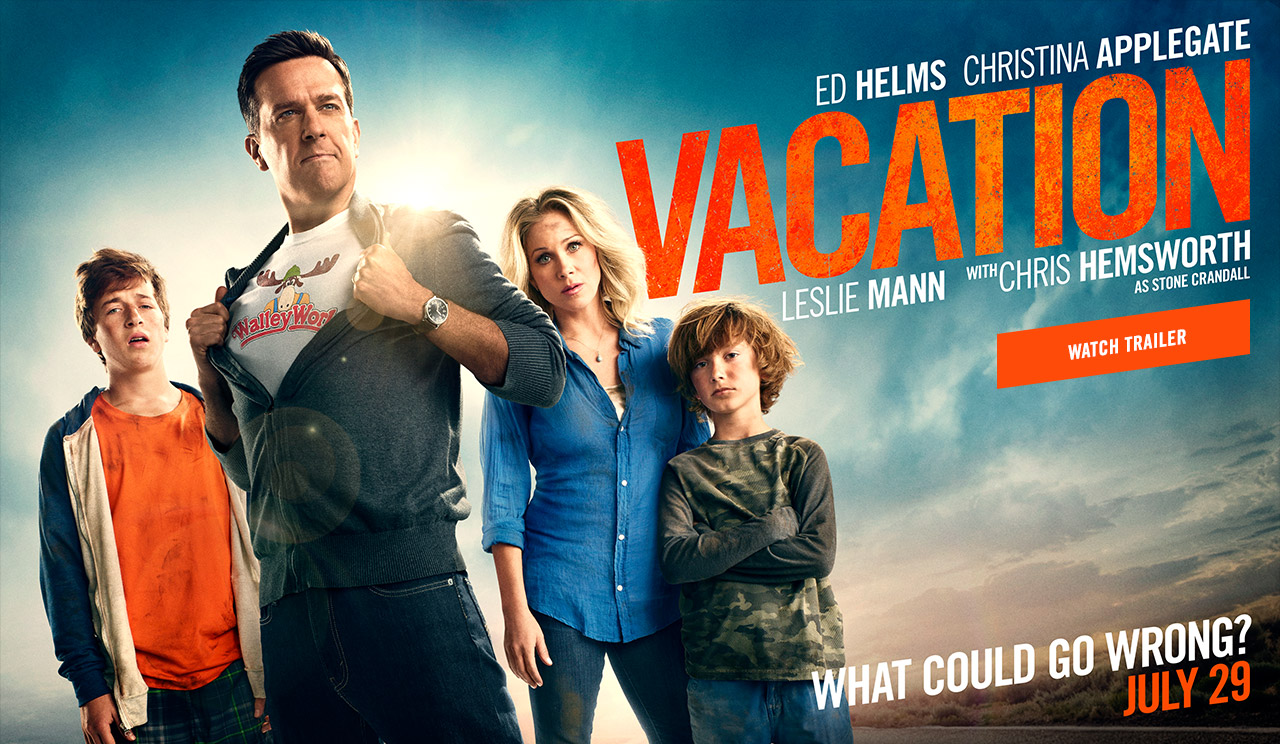
Today's Review: Vacation
Another review up!
Vacation - recensie
Well, that was positively awful. Of course, the current trend of making a comedy as raunchy as possible by cramming it full of dirty jokes involving excrements and unusual sexual positions has been going for quite a while now, so you can hardly blame this Vacation for that. It's not like the original movie refrained from such shenanigans. But the level of said gags is just abominably low here, making it painfully unfunny for the most part. Too bad, because I know the lead Ed Helms, of Hangover fame, is capable of funnier routines. But even he is hopelessly lost somewhere between the rim jobs and Chris Hemsworth's erection. You got a bad thing going when the holiday car is funnier that the characters driving it. But at least the car doesn't make poop jokes galore. This vehicle of Albanian make is just loaded with silly gadgets and awkward options. Not all of them a guarantee for success, but at least I chuckled over the navigation system's sultry female American voice accidentally being replaced by a seemingly outraged Korean counterpart. If translated however, it would no doubt be revealed to get in line with the rest of the ample obscenities the script contains.
As with most remakes these days, this one wouldn't have been missed if it wasn't produced at all. However, recycling the original film's plot and adding Horrible Bosses or We're the Millers type jokes to it likely saved the studio a few bucks. The story is mostly the same as its predecessor's, while some of the situations are even lifted verbatim from some of the other Vacation movies from the Eighties. It's not like this is that well known a franchise these days, so who would know, right? But if you acknowledge the status of this film as a remake by making jokes about that very fact in the actual film, you sure run the risk of people checking out the previous installments and finding out just how lazy the writing is this time around. Even such references to the original are hardly an inspired move. Remember 21 Jump Street addressing its status as a reboot by literally saying nobody at the top has any better ideas than just regurgitating old notions ad nauseam? It's a funny line, until you understand just how poignantly true it is. We don't need to hear the same argument here to hammer the point home. The movie is unhilarious enough without reminding us a better film with the same name and the same plot was produced thirty years ago. Or that we're likely to see another movie with said name and plot in a few more decades. The kids in this feature definitely appear stupid enough to make the same mistakes all over when they grow up.
Luckily, this Vacation will be swiftly forgotten. It'll prove a lot harder to get that obnoxiously catchy song Holiday Road out of our heads.
donderdag 26 maart 2015
Today's Review: Shaun the Sheep Movie
Another review up!:
Shaun het Schaap: de Film - recensie
A great stop motion film for the whole family this turned out to be. Would you have expected anything different from Aardman? I certainly didn't and I'm glad the finest stop motion studio in the world once again hit its mark. I'm ashamed to admit I've never seen any of the episodes from Shaun's own television show, so all I knew him from was his debut in the terrific original Wallace & Gromuit short A Close Shave (1995). It's amazing how little Shaun appears to have changed since we first met him 20 years ago. He looks largely the same, doesn't talk and is still the smartest sheep around. I like how Aardman sticks to its all too British roots and knows beter than to needlessly update their own characters to modern times. Both the studio's characters and its masterful level of craftsmanship and the quality that comes with it, remain a beacon of stability and tranquility in this troubled world of ours. And if that isn't enough to convince young and old alike to take the trip to theaters, the lack of dialogue which prohibits the usual exasperatingly obnoxious Dutch dubbing process is thrown in as a bonus. I just wish they could have dropped that annoying rap song that runs over the end credits. And yes, there's some bonus footage shown after those.
Now for Shaun's TV show. All 130 episodes... It's Aardman, so I don't mind at all!
donderdag 13 maart 2014
Today's Review: Suzanne
Yet again have I written a review for MovieScene:
http://www.moviescene.nl/p/154302/suzanne_-_recensie
Not a film that achieved what it set out to do. You just don't get to connect with a character enough if you seen 25 years of her life in the space of only 90 minutes. Suzanne therefore gets stuck in a web of consequences, not in creating understanding or exploring proper motivations of the protagonist, who we cannot help but judge harshly for her woeful willingness to behave both wholesomely irresponsible and socially inacceptible. Even though we supposedly get to see what we need to see, it's not enough to mentally associate as closely as we would like in order to place Suzanne's criminal activity in the proper context. Decent acting and fine cinematography not withstanding, for at least the movie succeeds on that account. Women that fall in love with all the wrong men still remain a mystery to the rest of the world. Suzanne doesn't change that.
maandag 24 februari 2014
Today's Review: Cloudy with a Chance of Meatballs 2
Cloudy
with a Chance of Meatballs 2: ****/*****, or 7/10
Cloudy
with a Chance of Meatballs remains an overlooked piece of
animation from recent years. Maybe because it's not a Pixar movie,
maybe because it doesn't have as distinct a style as the likes of
Aardman or Laika's stop motion features, maybe it's because it does
have a somewhat generic quality to it at first glimpse. That said,
it's a blast of a film, a great joy from beginning to end. And
apparently it did well enough at the boxoffice to spawn a successor,
as Cloudy with a Chance of Meatballs 2 has now thundered into
theaters.
Its
title is a work of deception, aimed to convince audiences this is
indeed a sequel. There's few meatballs to be found here, while the
meteorological aspect has been toned down significantly. What remains
is the characters from the first film, as well as the delightfully
whimsical humour and offbeat visual design that characterized the
previous movie. Though the directors of the original film decided to
do The LEGO Movie instead, they left the project in the
capable hands of people who understood and appreciated the quirky
subject matter.
After
his home island of Swallow Falls got covered in edible stuff during a
giant foodstorm he partially caused, young inventor Flint Lockwood
(Bill Hader) and his friends have relocated to the big city of San
Franhosé, where Flint is now working for Live Corp, a big company of
science enthusiasts created by his idol Chester V (Will Forte). While
that firm is also attempting to clean up the island to make it
livable for the human population again, strange things happen to the
mop-up crew and Chester calls on Flint for aid. Against his mentor's
advice, he recruits his friends, including his girlfriend Sam (Anna
Faris) and his stern father (James Caan), to help him in his mission.
To their astonishment, Swallow Falls has reverted to a wild,
primordial jungle, inhabited by all manner of strange animals and
plants, some friendly, others dangerous. And it's all made out of
food. Exploring this new wilderness he inadvertently created, Flint
finds that not all is as it seems and starts questioning his
allegiance. Flint soon must choose between the side of science and
cold reasoning or to stick to his irrational friends and family
instead, as the two sides of himself prove at odds over the future of
the island and its wildlife.
Cloudy
2 swaps food weather for food animals. That's not a bad thing, as
it avoids lazy repetition. No more zany weather patterns like
spaghetti tornadoes, now we have 'foodimals' like shrimpanzees and
hippotatomuses. It will come as no surprise that a lot of the jokes
are provided by such play-on-words, some ingenious, others less
clever. Nevertheless, the wonderful look of these beasties –
including the cutest strawberries ever! – clearly shows the fun the
animators must have had while designing this film. At the same time,
the characters we came to know and love from the previous film are
left intact. Sadly, not all of them are given their due, as the
emotional core of the movie is personified by Flint's idol on one
side and his father and girl on the other. The remaining supporting
characters are doing just that, without contributing to the whole
much. Though the energetic cop Earl and the multi-talented cameraman
Manny are still good for a laugh or two, they could have been left
out altogether, in favour of developing the new antagonist more
closely. No mistake is made from the beginning on that the expert
sillywalker Chester is the bad guy, though in the end, the
motivations of his diabolical schemes leave something to be desired,
considering his supposed intellect. Cloudy 2 can definitely be
accused of putting more focus on the look of the film than on the
development of its characters.
Such
slights are easily forgiven, as the film provides an excellent second
course in terms of visuals. The fabulous forests of foodstuff, the
clinically clean Live Corp headquarters, the quirky cityscapes, it
all looks delectable to behold. Whereas the beasts of the jungle are
obviously Jurassic Park inspired, their dwelling place takes a
note or two from Avatar's pages, adorned with bioluminescence
and all manner of bizarre features. This visual feast definitely sets
Cloudy 2 apart from its predecessor, which proved more simple
and primitive in this regard, giving it a look and feel all its own.
As the plot was inspired by JP, so too the eye candy is only
loosely based on Cloudy 1, instead of merely carbon copying
it.
The
elaborate visuals notwithstanding, there's a thing or two to be said
against the film's morality. Its message is one of ecological
respect, speaking out against the rape of nature for the sake of
making money. However, as cute as the foodimals may be, they remain
aberrations. An ecosystem has formed on this island, but what of the
original ecosystem that had to make place for it? Our heroes connect
to these creatures, seeing them as more than food, because they have
grown to be living, breathing entities. But what of the sardines they
happily consume, which were living, breathing entities to begin with?
Should they not also fall under the same category? Where do the
protagonists draw the line in deciding which creatures to stand up
for, and which to see as mere food? Uneasy questions like these are
formed when they do not eat animals made of food, but teach them how
to fish for normal lifeforms instead.
It
seems such questions never occurred to the writers, as the story of
Cloudy 2 is subject to the execution in terms of jokes and
visual flair. The latter works its magic throughout, awing us with
one spectacular sight after another and charming us with their
inhabitants, both human and food. The former is good for a smile all
through the piece: though the number of truly memorable jokes remains
somewhat limited compared to the previous installment, most gags
prove effective in the short bursts they seem designed for. If the
first movie was the main course, Cloudy 2 is a fine dessert, a
four-flavoured sorbet, comprised of your favourite taste, two others
you like fine, and one you never really cared for.
maandag 23 december 2013
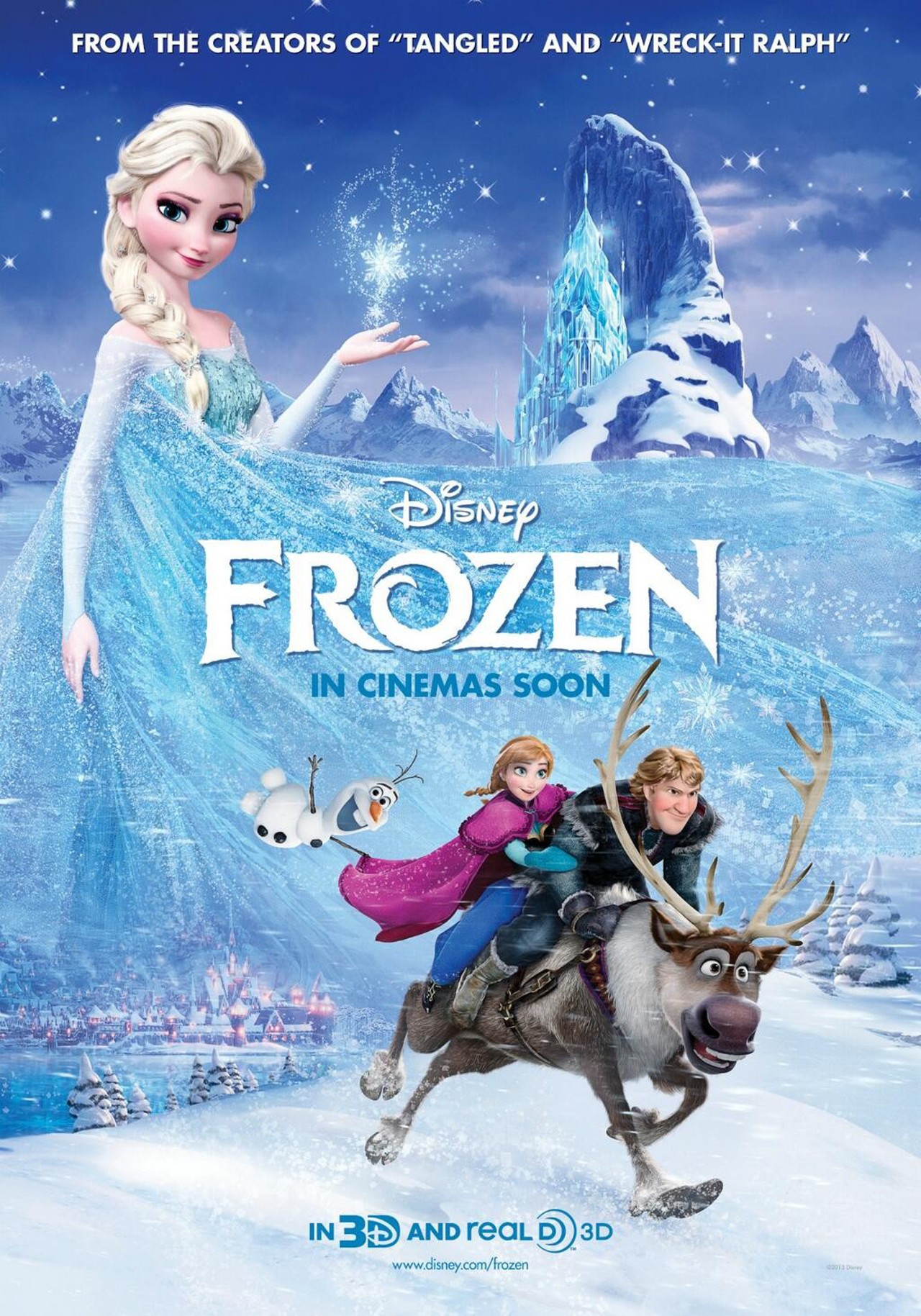
Today's Mini(?)-Review: Frozen
Frozen:
****/*****, or 8/10
Say
what you will about conservative Disney, there is some form of
modernization in progress in that studio. You might even label it a
feminist wave of sorts. Frozen marks Disney's first feature
length animated film (co-)directed by a woman and only the second
whose screenplay was written by such a creature. Not counting Pixar,
since then it would have to contend with Brave, a movie where
the girl power backfired, as did the quality of the piece as a whole.
And while Frozen largely stays within the trite-and-true
boundaries we've come to expect from Disney's fairy tale movies,
including princesses, charming princes, faraway lands, comedic
(animal) sidekicks and plenty of catchy songs, enough of such
regularly exploited material is directionally changed to make the
film feel as fresh and cool as the imagery the title inspires.
Jennifer Lee's directorial debut introduces not one, but two
beautiful young princesses, Elsa (voiced by Idina Menzel) and her
younger sister Anna (Kristen Bell), heirs to the kingdom of
Arendelle. Both are kind, independent and energetic spirits, but the
older girl carries a terrible secret: she's basically a mutant with
the power to control ice and snow, except she doesn't control it at
all, since her fear to wield it controls her instead. She has cause
to be afraid of her powers, as she nearly killed Anna at play as a
child. Her parents tried to keep her out of harm's way by largely
keeping her confined to her chambers, much to the dismay of her
sister, who had her injury and memory of the incident erased by a
nice wizard troll (this is a work of fantasy, need I say more?).
After the death of their parents and the coming-of-age of the elder
sister, a coronation takes place where Elsa is crowned queen and
where Anna – hilariously – meets her apparent groom-to-be, the
latter event uterly disrupting the former as Elsa unwittingly gets
pushed so far she sparks an endless winter that covers the entire
kingdom in frost. Fleeing the palace to built her own on a high
mountain precipice where she finally starts to accept her powers in
her moments of isolation, Anna is determined to bring back her sister
and get her to undo her unintentional damage to the realm, which
leaves her land vulnerable to the shady ambition of certain visiting
foreign dignitaries. Accompanied by a simple but reliable young
backwoods man named Kristoff, his carrot obsessed reindeer Sven and a
wacky living snowman named Olaf, Anna sets out on a tough voyage to
reunite with her wayward sister and bring summer back to Arendelle.
And, in typical Disney fashion, to discover True Love in the process.
But not in the usual sense of old.
Frozen
proves a worthy successor to the similarly themed, equally wonderful
Tangled (2010), which also re-established Disney's formidable
talent to craft charming, adventurous and romantic fantasy films for
all ages after over a decade of creative drought, as well as updating
its female characters to the 21st century, a time in which
the main focus of a woman is no longer a man to marry (but also not
excluding the possibility as not to upset the traditionalists in the
audience). Frozen introduces two solid female characters who
care first and foremost about eachother, though one of them does not
allow herself to show said fact. Both women are sizzling with
recognizable character flaws and strengths, familiar emotional family
conflict and the talent to burst into song, so despite their
ultimately antagonistic nature (though the traditional 'good versus
bad' set-up is carefully avoided in their strained relationship), you
root for them and their sibling affection both to survive against all
odds. Simultaneously, while the sterotypical good looking prince to
wed is not an image to be discarded, it develops into quite another
direction than is usual, and the expected notion of cheesy True Love
messages doesn't end up covering the usual sexual connection between
boy and girl. The voice cast delivers impeccable acting and shares an
audible chemistry, standout performances including a hilarious
Scandinavian tradesman (jå!) and Olaf, the token sidekick, who is
not nearly as irritating as he could have been and actually warms
everybody's heart with his simple but unattainable desire. Similarly
enjoyable are the clan of stone trolls, Kristoff's surrogate family,
a group of Smurfesque creatures with the ability to succesfully
camouflage themselves as rocks, and who unfortunately don't nearly
have as much screen time or background exploration as we would have
liked. And if you're afraid the reindeer talks (since animals with
the ability to speak are an oft dreaded Disney staple still), fear
not: his master does so for him to witty, almost self-reflective
results. The songs are a welcome return to tradition; though for a
moment at the start of the film they seem to comprise most of the
dialogue, better balance to the music is applied later on. Apart from
pleasing the aural senses, Frozen offers a delightful visual
feast as well with its wondrous winter landscapes and ever present
snow motifs, but considering the darkness of many scenes coupled with
the obligatory 3D effect, not all the imagery ends up looking as
amazing as it could have been. However, many of the 3D shots in the
lighter scenes hit their mark, especially those involving snow and
icicles, so seeing the 2D version instead isn't wholly recommended
either.
In
a time where Pixar is increasingly going down the drain creatively
because of its lack of inspiration and its current focus on prequels
and sequels, a thoroughly wonderful and ideologically original pure
Disney film like Frozen is a welcome sight. Even the coolest
minds and the coldest hearts will find it hard not to melt due to
this film's built-in warmth, and with the dominant motif of snow and
ice, Frozen proves to be a perfect Holiday movie for old and
young alike.
Labels:
animation,
computer animation,
Disney,
drama,
fairy tale,
family,
fantasy,
frozen,
princess,
sister,
snow,
snowman
donderdag 28 november 2013
Today's Mini-Review: What Maisie Knew
What
Maisie Knew: ***/*****, or 6/10
Some
children are blessed with loving parents, while others are stuck with
horribly egocentric folk that just can't get along, to the detriment
of their offspring. Poor Maisie (young newcomer Onata Aprile, only 7
years old at the time of shooting) unfortunately has to contend with
the latter, as her terrible excuses for parents, played by Julianne
Moore and Steve Coogan, simply cannot see eye to eye about anything
and only communicate by shouting at each other and arguing ad
nauseam. Maisie can't remember ever seeing them in another, happier
state of their relationship and has gotten used to their constant
petty bickering, but doesn't let it get her down as she tries to make
the best of it. Of course, the question always on our mind is: does
she understand that the emotionally unhealthy environment she's
growing up in is not the regular way for children to mature? Could
she ever choose between her mother or her father if it came down to
it as they are both lobbying for her unwavering love? Coogan and
Moore certainly excel in playing people you just can't help but hate
for how they're so obviously ruining Maisie's childhood, a fact they
ignore becayse they are more concerned for besting the other in
winning Maisie's love. While we are busy detesting these horrible
guardians for causing her to accept a living condition that is quite
simply unacceptable to behold for anybody with a slightest sense of
reponsibility, hope looms on the horizon as her parents both mix up
with just the right people to turn her life into a more positive
direction. Her father marries her foreign (Scottish) nanny, while her
mother hooks up with a seemingly not so bright, tall guy (Alexander
Skarsgård attempting to shed some of that sinister, scheming vampire
image of his, courtesy of True Blood, by playing a sweet,
easily likeable bartender). Unfortunately the story soon progresses
in the most predictable of directions as these two people, who
actually care more about Maisie as a person than as a means of
annoying the other by acquiring custody of the girl, come to
understand just how easy it is to love this charming child and agree
how much she deserves to be taken care of by decent folks. And
naturally they can't help themselves by also falling in love with
each other when they realize just what a manipulative, sleazy people
Moore and Coogan are, abusing both them and Maisie for their own
purposes as they keep up their disgusting little power play. In terms
of plot development, we soon come to know that What Maisie Knew
has little surprises to offer while delivering its fairly repetitive,
one-sided melodrama. The film makes up for this in the acting
department, where young Aprile stuns the audience with a most
exceptional, truly inspiring and convincing performance; a remarkably
rare occurrence for such a young child, but a solid promise for her
future career in acting should she decide to keep it up (we can only
hope). While the adult actors go through the motions in a more
regular fashion, which isn't devoid of merit but simply not nearly as
mesmerizing, Aprile carries the film as very few other actresses her
age could ever have done, proving just how much truth there is in
that old adage that good casting is doing half the work. What
Maisie Knew is just average in all other regards, but a fabulous
performance like this is well worth checking out, as it is so seldom
witnessed.
woensdag 11 september 2013
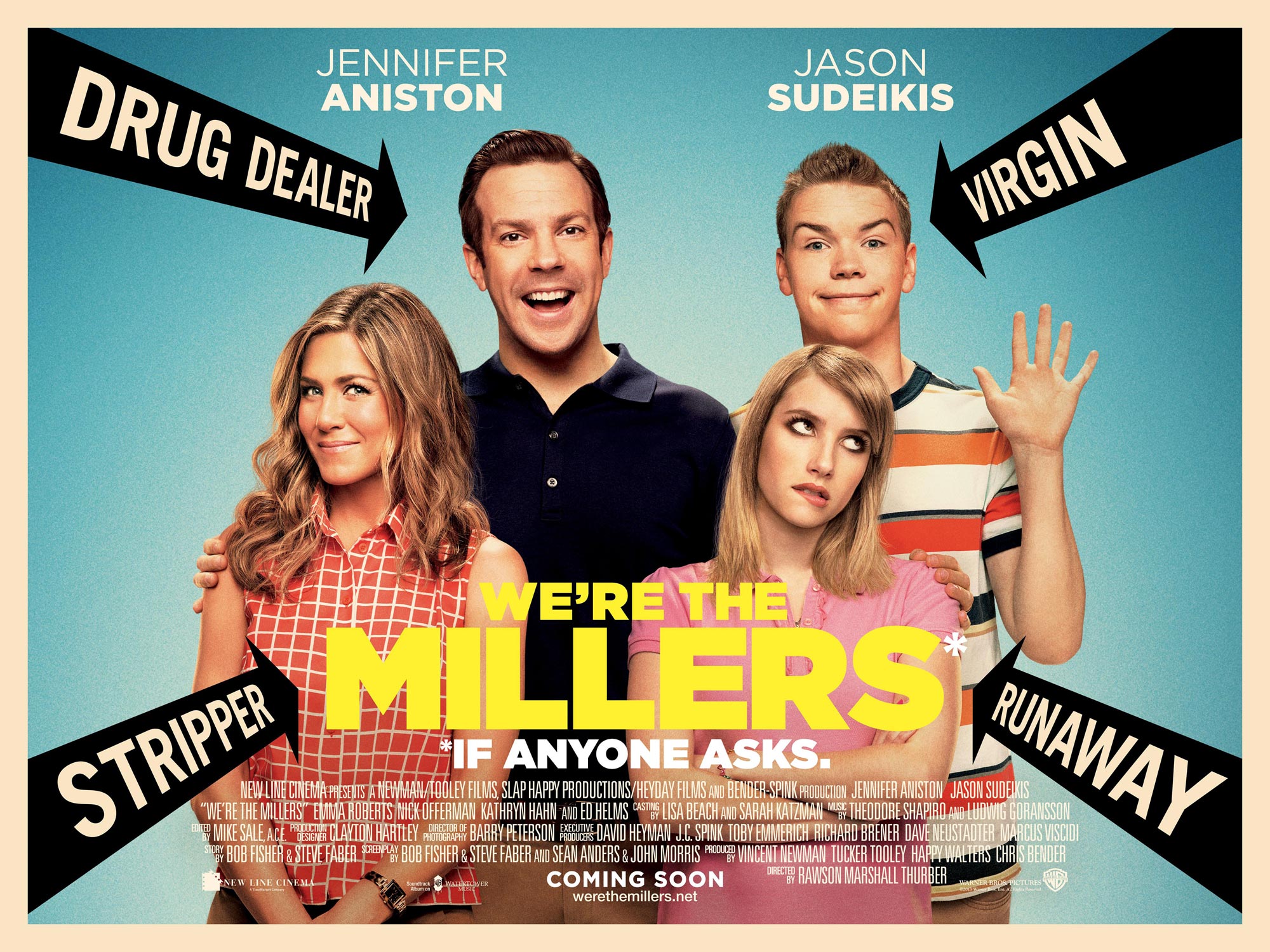
Today's Mini-Review: We're the Millers
We're
the Millers: ***/*****, or 6/10
Typical
formulaic Hollywood fare. You take a comedically intriguing premise,
you drown it in cheap sex jokes and excessive swearing for swearing's
sake, you add established funny actors for flavor to make sure
audiences will get what they expect (in this case Jennifer Aniston
and Jason Sudeikis: you didn't think they would be together in
something other than a comedy, did you?!), and you garner the whole
in moralistic messaging to ensure a predictably happy ending for
everyone concerned. The end result in this case is We're the
Millers, but you could have rightfully entered many comedy titles
of the last decades in its place with these ingredients. We're the
Millers isn't the worst of them though, since there's a number of
good dirty jokes too (and a killer whale eating a shark for extra
kicks). Small time drug dealer David (Sudeikis), a loner living a
life totally devoid of responsibilities whatsoever, ends up owning a
lot of money to his sleazy supplier (Ed Helms from the Hangover
series, largely identical narrative territory). He can make up
for it by smuggling a load of weed over the Mexican border though. To
avoid getting caught, David decides to masquerade as a family unit on
a holiday trip in an RV, together with a broke stripper (Aniston) who
hates his guts but needs his money, an obnoxious female teen runaway
and a socially awkward boy of eighteen that hasn't yet done the deed
(and thus ends up being both the victim of the majority of this
flick's crude jokes and getting a girlfriend). After having secured
the shipment, this so-called Miller family heads for home, but
unfortunately for them David's employer screwed over a Mexican drug
lord in the whole transaction, who soon is in hot pursuit together
with a grotesque, hulking one-eyed henchman. Plus, they also have to
deal with tarantulas, corrupt Mexican officials fishing for sexual
favors, agressive border patrols, an actual family on vacation
suffering from a dent in their sex life, and of course, each other.
However, to the surprise of all of them, they quickly discover the
benefits of and acquire a taste for family life, as Hollywood's
conformative, conservative propaganda machine is working overtime to
make sure all's well that ends well. At least we get a decent amount
of witty repartee and performances to match from a cast that is all
too familiar with this genre and knows how to make it work, which
could also translate as being on auto-pilot. And for those
interested, Aniston's sexy dance routines are adequate enough to
convince us she's playing a cheap stripper. But overall, We're the
Millers proves an all too standard comedy that you'll stick with
for 110 minutes and you'll forget about just as fast.
dinsdag 9 juli 2013
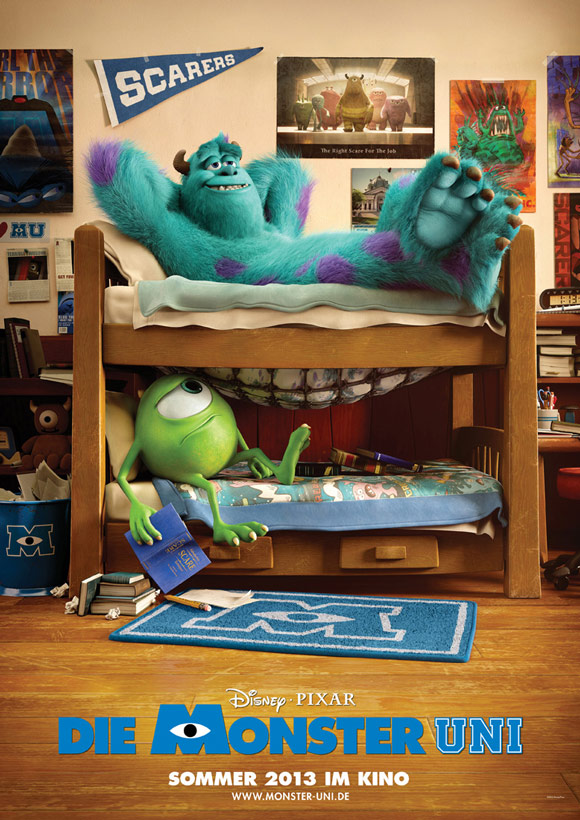
Today's Review: Monsters University
Here's my latest review for MovieScene, of a certain recent Pixar movie no less:
http://www.moviescene.nl/p/148393/monsters_university_-_recensie
The review basically says it all. If you're too lazy to go through 900 words, here's as good a summary as I can ever give you: Monsters University is a fun Pixar movie, but it's not a particularly good Pixar movie. Though the movie looks great and is filled with all kinds of likeable little details as well as good jokes for both adults and kids, the story leaves much to be desired, as it's filled with every kind of college cliché imaginable, simultaneously being all too predictable. It's not a sheer work of genius as Pixar used to deliver (the predecessor Monsters, Inc. among those), but it's just a damn entertaining piece of work regardless. I guess that's all we can hope for from Pixar from now on, now that Disney's dominion and its tight creative grip is choking the originality out of the animation studio, thus having ended its golden age. But hey, we'll always have Monsters, Inc.! And The Incredibles, and Finding Nemo. Plus Ratatouille. And let's not forget the Toy Story trilogy. Or Up, or Wall-E. There's a lasting legacy for ya. Too bad about all the upcoming sequels to those...
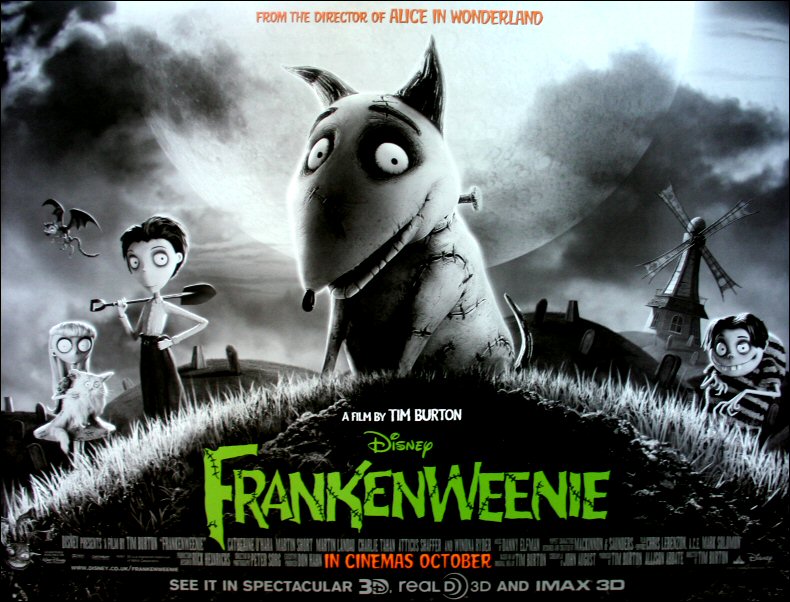
zaterdag 27 oktober 2012
Breathing new life into Tim Burton
Frankenweenie: ****/*****, or
8/10
Moviebuffs
familiar with Tim Burton's oeuvre will probably remember how one of
his earliest projects for Disney backfired on him, though it ended up
setting him in the right direction for a very fruitful career. In
1984 Burton directed a 29 minute family film named Frankenweenie,
an homage to the iconic original Frankenstein films from the
Thirties, involving a boy who loses his beloved dog but revives him
via electricity, to the shock of his neighbourhood. Though it was a
simple horror story for all ages, Disney was dismayed and deemed the
short film too disturbing and scary for its target audience, denying
it a theatrical run (but for some reason still giving it a home video
release). Burton was fired from the studio and looked for jobs
elsewhere, soon setting himself on the right track as he directed a
number of smash hits, including Batman (1990), Edward
Scissorhands (1990) and Batman Returns (1992), eventually
becoming a major player in Hollywood despite (or because) continuing
to utilize his own unorthodox visual style and displaying his love
for outcasts and their encounters with the bizarre. Leaving Disney
may have been the best thing that ever happened to Burton, but it
didn't stop him from revisiting the failure that basically started
his career, remaking his own short into a theatrical movie in an even
darker and more off-beat fashion 28 years later, but still for the
same Walt Disney Studios that didn't think much of him or his work
all those years ago. Apparently Burton's acclaimed career, plus an
earlier cooperation between the pair when doing the highly successful
Alice in Wonderland (2010), ensured Disney gave Burton the
benefit of the doubt and the chance to bring Frankenweenie back
to life in an even more spectacular way than the dog in the story is
reanimated.
For
despite the film now running 87 instead of only 29 minutes,
surprisingly little has changed in terms of story. Warning!
Spoilers! The protagonist is still a little boy named Victor
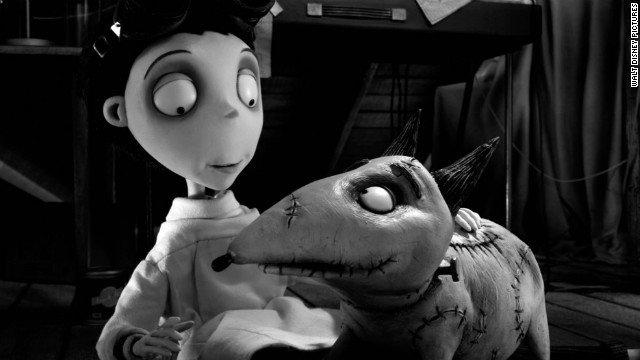
Frankenstein, a nerdy and imaginative kid whose best buddy in the
whole world is his dog, called Sparky (there's more than a little
'nomen est omen' in there somewhere I reckon). Together they
do anything from just playing around on the streets to making home
movies wherein the canine stars as a dinosaur slayer protecting
cardboard cities from plastic monsters. Of course with hobbies like
that, Victor isn't the most popular kid in school, but as long as he
has Sparky, he doesn't mind. But soon, tragedy strikes and Sparky is
fatally run over by a car and laid to rest, leaving an inconsolable
Victor all alone, despite his parents' assurances Sparky moved on to
a special place in his heart. However, when he learns of electricity
and its effects on dead tissue at school, the boy turns to the dark
art of science to bring his pet back to life by having its soulless
body struck by lightning. Against all odds, the experiment is a
success and his best friend is given a second chance at life, though
not in a perfect physical state as parts of him occasionally come
loose. Despite his efforts to keep Sparky's resurrection a secret,
the rest of the town soon finds out and is appalled by this
abominable obstruction of everyday life, turning into a typical angry
mob out to make sure the dead dog stays dead this time. Tracking the
pair to an old windmill, the construction catches fire and traps
Victor inside until Sparky gives his second life to save his young
master. Touched by his courage, the townspeople are convinced Sparky
deserved to live, after which they help Victor restoring him to life
once more in a total feel-good happy ending only Disney can deliver
(though it's maybe a bit too cheerful for a Tim Burton picture).
Though
the plot has hardly changed, there couldn't have been a bigger
difference in execution, as Burton turns to the much admired art of
traditional stop motion animation for his second incarnation of
Frankenweenie. Hardly a stranger to this type of filming,
having produced The Nightmare Before Christmas (1993) and
directed Corpse Bride (2005) before, Burton's use of stop
motion turns out fully justified as it gives the movie a stylistic
and visual edge over both the movie's predecessor as well as many a
“regularly” animated Disney movie. The film's look is simply
stunning, with some of the smoothest stop motion work to date, and it
also fits into Burton's oeuvre in a completely consistent manner: the
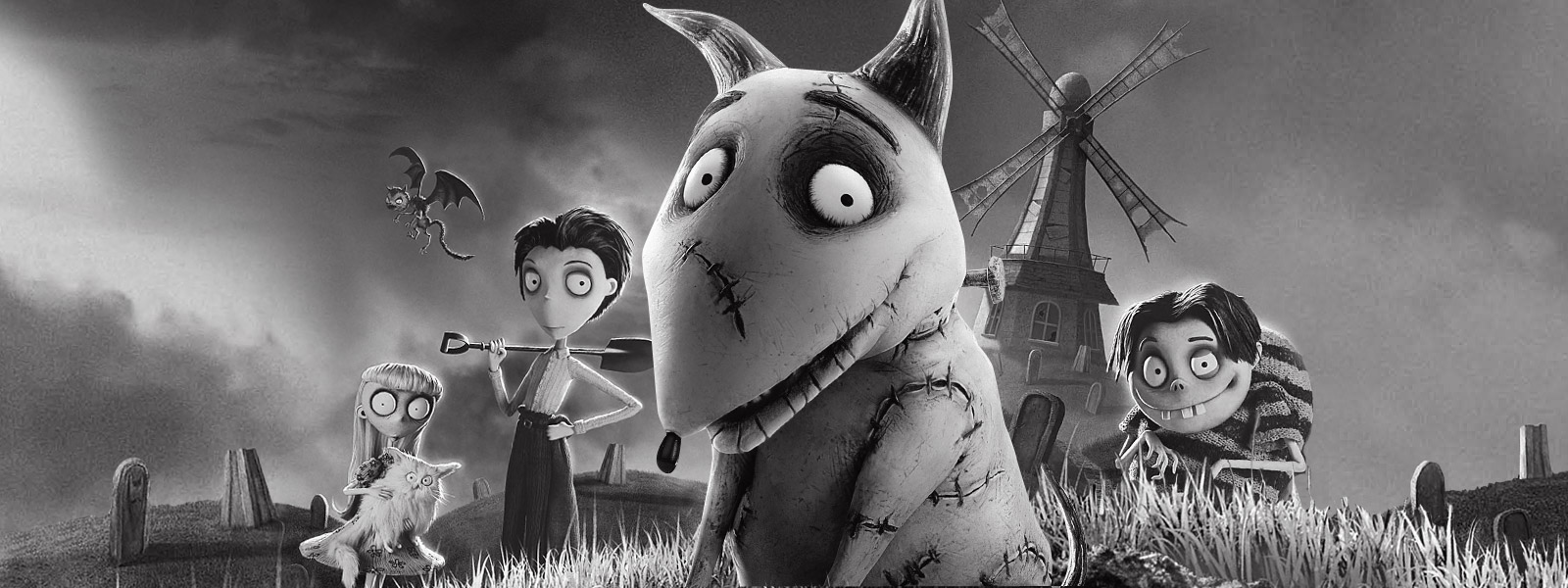
various characters, both human and animal, are all typically
Burtonesque with their big eyes, pale faces and generally
caricaturized physical features, while their brooding, often Gothic
surroundings make no mistake Tim Burton's signature stamp is all over
this film. Frankenweenie might as well be called Corpse
Bride's twin sister, were it not for the fact that, unlike that
film but like the original short, Frankenweenie is also shot
in black and white to make it appear even more distinct, as well as
perfectly in sync with the horror classics of old – particularly
James Whale's brilliant original Frankenstein (1931) and The
Bride of Frankenstein (1935), to which the movie knowingly owes
more than a little, on the narrative side – the movie keeps
referring to throughout the piece. While many a gag referring to such
narrative and stylistic forebears, albeit visual or in dialogue, is
undoubtedly missed by younger members of the audience, those even
slightly versed in the genre will recognize a multitude of little
nods and in-jokes softening the overall gloomy mood the style and
story prescribe. That doesn't mean there's no fun to be had for the
kids or the more uninformed spectators, as they too are treated to
many an outrageously zany moment triggering a few good laughs.
At the
same time, despite the many humourous occurrences, the movie isn't
afraid to downplay its moments of grief, and much to the credit of
the animation crew such instances are shot with the full range of
emotion they necessitate, making even the toughest viewers feel sad
as we witness Sparky's death – which fortunately remains largely
obscured from vision, instead of seen in more detail than is
necessary, underscoring the power of suggestion which Burton has also
mastered – and the sorrow it inflicts on those left behind, the
high point of tragedy remaining a simple shot of Sparky's neighbour
dog, a female poodle with whom he used to play ball through a hole in
the fence separating them: the poodle nods the ball through the hole,
then waits for a return nod that never comes. Maximum emotional
effect achieved through stylistic simplicity, and nobody ought to
keep a dry eye.
Despite
the overall story remaining largely identical to that of the original
short film, a longer running time does warrant the inclusion of a few
subplots to flesh things out just a bit more. The most noticeable
difference in narration is the science contest dominating events in
Victor's class as his school mates are all attempting to outthink
each other in making the most spectacular contribution to science,
encouraged by their new substitute teacher with his unpronouncable
but decidedly Eastern European sounding name (impeccable voicework
done by Burton veteran Martin Landau, who won an Academy Award for
his role in Burton's masterpiece Ed Wood (1994)). When the
word gets out on Victor's achievements, even though they were a
personal project to be kept hidden from the rest of the town, the all
too natural reaction of the other kids is imitation, as they
understandably decide to resurrect their own deceased pets as well.
However, their actions are motivated more by the desire for fame and
glory than they are by heart, while their teacher explained to Victor
the outcome of his experiment was fueled primarily by the love for
his subject instead of the lust for self-enrichment. Naturally, the
various rival experiments result in the creation of many monstrous
mutations soon terrorizing the town, including a cat/bat hybrid and a
giant dinosauresque turtle, enabling Burton and his partners in
animation to go all out with the stop motion process, continuing the
age old tradition of stop motion applied for breathing life into
monsters, as pioneered by special effects legends like Willis O'Brien
and Ray Harryhausen. It also results in a grander overall scale of
the film, clearly setting it apart against the simpler original short
movie, plus it adds some dynamic action for those audience members
who find it hard to sit through all the genuine emotion the movie
keeps evoking, if any. Ultimately though, Frankenweenie doesn't need such spectacle since its core plot about a boy and his dog is moving enough in itself and remains the picture's heart and soul, despite the additions made to make a short film longer.
Only a
few months ago, I critiqued Burton's Dark Shadows and feared
his signature style was overused by himself (and nowadays, by many others, too), which led to a
deterioration of quality in his recent films, culminating in Dark
Shadows ending up as one of Burton's biggest disappointments of
the last decade. I'm only too glad to find myself positively
surprised by Frankenweenie, one of his most delightful films
to date, which has proven this director is still fully capable of
delivering a satisfying viewing experience when his heart is truly in
it. Getting even at Disney while coming full circle from the start of
his career to the point where he is now clearly made sure Burton was
fully invested in this project, and he is proven right after a
quarter century: Frankenweenie was a thoroughly enjoyable
short movie then as it is a full theatrical film now, for audiences
both young and old. Apparently, in Burton's case revenge is a dish
best served dead, and revived.
Sidenote:
life is not without its cruel little ironies. For example, I got
to watch Frankenweenie the same week I had to let go of (yet another)
one of my cats. 2012 is not a good year for me, pet wise. Since I
happen to like animals more than people – if you know me and this
notion offends you, don't take it personally, it's just the way I am
– I'm having some trouble letting go, even though it wasn't my
favorite cat. In fact, the pet in question, poor little Akka, was
always drooling, generally unhygienic and somewhat obnoxious, but I
still loved her in her own right, and I will naturally miss her
presence (unlike the other cats, who don't seem to miss her at all).
Considering Frankenweenie revolves around the troubles of letting go
of your beloved pets, it got me thinking. If I were a creative little
boy and I lived in Tim Burton's imaginative world, I no doubt would
go for the solution offered in the film and resurrect the hell out of
my dead cat. However, I am not and I cannot, and even if it were
scientifically feasible, I would not. Especially not after the animal
in question had been rotting underground for a week (even if
protected by the cover provided by a wooden box, as Sparky was
given). After all, letting go when somebody or something dies is
just a part of life, the dark side of life of course, but still life.
What would be achieved by keeping dead animals alive? Sure, you can stick to their presence forever, but would it really be the pets you knew and loved? As Frankenweenie showed, Sparky's resurrection, instigated by love or not, was the result of a lucky shot, while the same experiment failed with all the other ex-pets. Monstrous mutations were the result, creepy crawlies and towering behemoths that looked nothing like their living predecessors. Moreover, if they had been healthy and happy like they used to be, death would lose its impact. You could just keep on recharging your dead pet to breathe a semblance of new life into it over and over again, which would keep you from letting go and forming new special bonds with other animals. But of course, new animals would still be born, and soon the number of zombified creatures would grow to excessive rates and leave less room for the living. Death may not be a nice thing, but there is a definite natural purpose to it. My cat had a decent life for over 16 years and she got to live to a fair old age. It's more than I can say for my previous cat, who succumbed to organ failure at age nine, which was far too young for my taste. Instead of focusing on resurrecting pets, it seems more reasonable to turn attention towards extending the natural lifespan of pets, which usually lasts for only one or two decades, while their masters' life outlasts them for many more years. For the same reasons as stated above I feel it shouldn't be attempted by artificial means though. Besides, natural human lives last far longer nowadays than they did centuries ago. I reckon the same is increasingly true for pets' lives, who receive better care and food than they did in days gone by. Who knows, with a little luck cats will eventually live for many more years than they do today. And if not, the memories of a good cat will last a lifetime in that special place in our heart. Even though we would have preferred them to stay here with us in the flesh...
And
watch the trailer here:
donderdag 19 juli 2012
This Ice Age has lost its cool
Ice Age: Continental Drift:
**/*****, or 4/10
Say what
you will about the writers of the Ice Age films, in hindsight
they're not afraid to admit the faults in their previous work. When
Sid the sloth is visited by his family in the latest addition to the
series, Ice Age: Continental Drift, he states 'we had an
adventure with dinosaurs, it made no sense but it sure was exciting!'
and he hits the nail on the head. That description fits the
predecessor Ice Age: Dawn of the Dinosaurs perfectly, since it
did feel rather nonsensical to have Ice Age mammals meet dinosaurs,
but it did result in a decent amount of fun (though as a dinosaur
fan, I could be biased in this opinion). Sadly, throwing yet another
random element in the mix in the fourth entry into the franchise,
pirates in this case, unfortunately backfires completely, leading to
a rather dull series of events loaded with dirty jokes and preachy
life lessons we would have preferred to do without.
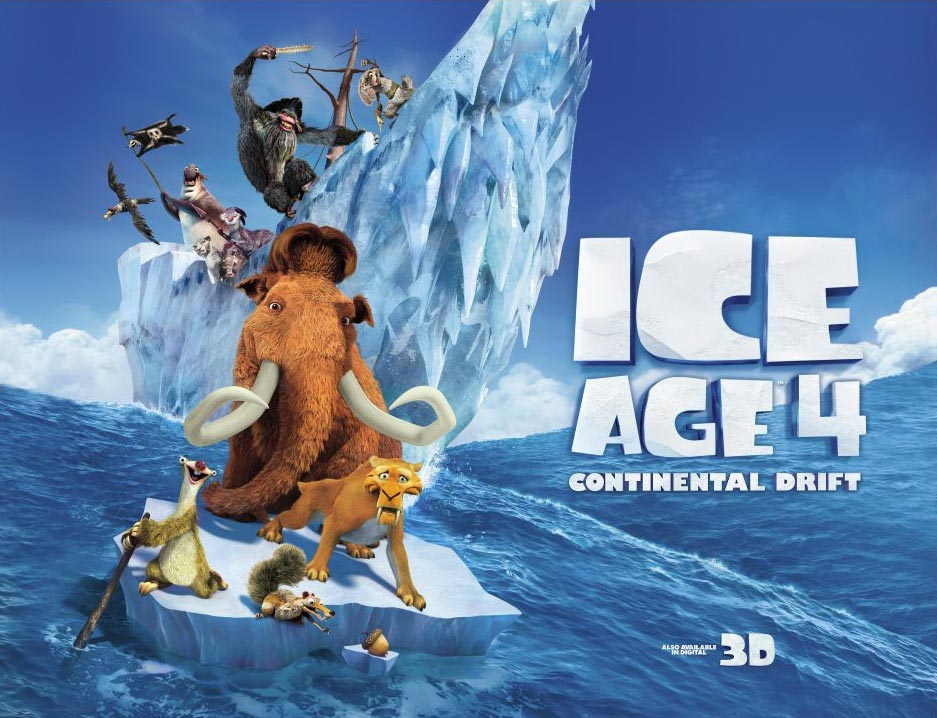
Ice
Age: Continental Drift picks up some time after the occurrences
in Dawn of the Dinosaurs.
Warning! Spoilers! Mammoth couple Manny
(still voiced by Ray Romano) and Ellie (still voiced by Queen
Latifah) are in the process of raising their daughter Peaches (Keke
Palmer), who's hit puberty and proves to be quite feisty and
headstrong. Like human teenage girls she's constantly irritated by
her father's overprotection, and just wants to have fun with kids her
own age, but needs to be accepted by them first. Her friendship with
the cowardly but cute mole hog Louis (Josh Gad) makes that kinda
hard, since everybody thinks little of him, but to nobody's surprise
she'll eventually find he was always her best and most loyal friend
to begin with, while the other teen mammoths are just a bunch of
intolerant jerks. All very recognizable for teenagers, who
undoubtedly will consider this film a Louis itself, since it's
clearly aimed at a younger audience that still enjoys gags revolving
around natural body wastes. Such an audience at least will not stop
to think about the grotesquerie of a mole hog falling in love with a
mammoth (interspecies romance? Eeewww!!).
Meanwhile,
Sid (still voiced by John Leguizamo) gets a surprise visit from his
family, a disgusting batch of smelly, unsympathetic characters that
fortunately exit the film as suddenly as they entered it, but sadly
leave Sid's grandmother (Wanda Sykes) behind, an extremely old and
weathered sloth which soon becomes the target of every conceivable
geriatric cliché, like Peaches provides the sterotypical teenager
routine for this herd of prehistoric animals that have banded
together over the last three movies to form an overly extended
family, which in itself has become a narrative problem: there's now
so many characters the movie can hardly accomodate them all into the
plot (it's only running 94 minutes), which leads to many returning
characters' involvement being reduced to bit parts, a few lines here
and there. Fortunately the writers realized which characters remain
the most important, namely the original trio of Manny, Sid and sabre
tooth tiger Diego (still voiced by Denis Leary). And so the plot of
the movie takes care of separating these three bosom friends from
their family, tasking them with finding a way back to their loved
ones to make sure the movie ends on a happy note. Unfortunately
Granny tags along with them to make sure the writers' stream of lame
smelly jokes flows uninterrupted.
The key
to getting the story in motion is, as always, Scrat. Still the most
beloved character of the franchise, his never ending quest for his
nut and the usual catastrophes this leads to kickstart the
continental drift of the title, splitting both the plot lines and the
herd in two (our heroes and Granny on the one hand and the rest of
the herd on the other) and once again keeping Scrat from attaining
his seemingly simple goal, which continues the tradition of funny
intermezzos this franchise has firmly established from day one, in
which the squirrel continues his hunt for his nut, all the while
enlarging everybody's problems because of his natural tendency
towards causing major calamities in the process. His other talent,
getting the best jokes, is also reaffirmed, as Scrat's appearances
interrupting the main plot make for a sporadic hilarious moment in a
movie otherwise filled with cringe worthy situations resembling
attempts at humour, plus dreary moral lessons. The moment of calm the
movie delivers when the protagonists are cut off from their family
proves all too brief, as we witness one overload of characters being
substituted by another in the shape of the pirate crew that forms the
movie's main antagonist (not counting that darn nut). The notion of
adding pirates to the franchise seems an attempt to capitalize on
Disney's major successes with Pirates of the Caribbean, just a
few years too late to successfully jump on that particular bandwagon.
The
merry band of pirates are just as diverse a bunch of characters as
the ones Manny, Sid and Diego just left behind, they're just a little
less friendly. The ship shaped iceberg they set sail on the seven
seas with is run by a giant gorilla named Captain Gutt (pleasantly
voiced by Tyrion Lannister Peter Dinklage, who balances well between
insincere politeness and ruthless villainy) running a tight ship over
his scruffy looking band of buccaneers, which includes an obnoxious
killer rabbit, a thick headed elephant seal (Nick Frost) and a
sultry, seductive female saber called Shira (voiced by Jennifer
Lopez), who is introduced to (romantically) spice up Diego's
character a bit: not a bad idea considering the poor pussycat has had
no interaction with his own kind since the first film of the series,
and has since felt more and more like a redundancy character wise,
with little development or purpose other than saving his friends from
imminent danger every once in a while. Shira herself is a typical
tough girl with a rough past, who would like a change in her life
style but is afraid of being hurt again. Of course it will surprise
nobody when she switches sides and turns against her captain, much to
his chagrin. Captain Gutt is a fairly straightforward bad guy,
uncompromisingly dominating his underlings, ruling by fear instead of
respect: in this regard he's the polar opposite of Manny, the gentle
giant running his herd with love and integrity instead. Of course
both characters soon find themselves physically at odds, with Manny
winning the first round, making Gutt swear vengeance against him and
– oh woe! – his family. Unfortunately Gutt's reason for being a
short tempered vicious villain remains unexplored, making him a
largely one-dimensional character, except in his few interactions
with Shira, sort of his surrogate daughter (more by abduction than
adoption).
Escaping
the clutches of Gutt the first time, our heroes (and Granny) continue
their journey home, which leads to the occasional nod to Homer's
Oddyssey, including a confrontation with Sirens, monstrous
creatures with hypnotic powers out to lure animals to their death.
Though adding references to classic literature (Coleridge's Rime
of the Ancient Mariner is also hailed at least once) to the
already chaotic mix at least results in a suspenseful scene like
this, it's not enough to keep the movie from becoming tiresome and
continuing to feel like a string of random events, except for the
scenes centering on Scrat. Unfortunately some of his scenes have
already been used in the movie's trailer campaigns, so these will
feel overly familiar. In fact, it might be a better idea altogether
from here on out to ditch the rest of the Ice Age gang
entirely and keep producing theatrical shorts of Scrat chasing his
nutty dream attached to other family movies, as used to be the
tradition with the classic Looney Tunes sketches this squirrel's
shenanigans were obviously inspired by. Scrat's adventures as a
castaway on a tiny island, his own Siren encounter and him causing
the downfall of Scratlantis (featuring a delightful little voice role
for Patrick Stewart as 'Ariscratle') prove insufficient to carry the
whole film, but could easily carry themselves on separate occasions.
No doubt, this would clash with the studio's financial interests,
even though it would waste much less of everybody's time.
Though
the quality of both the story and the gags has deteriorated
progressively since the first Ice Age film, the same cannot be
said for the animation. Whereas it could be called more than
primitive in 2002, in this day and age it looks absolutely marvelous,
courtesy of a vast army of nameless pixel pushing desk slaves no
doubt. It almost feels cruel to realize such an amount of work
amounted to such a disappointing final product, as if the animation
talents had better put their efforts to use elsewhere. However,
Continental Drift does not beat Dawn of the Dinosaurs
on the visual front, since it's largely a return to the well known
territory of the first two films as far as character and landscape
style is concerned. While Dawn of the Dinosaurs opened up a
whole new array of possibilities provided by the lush underground
jungle realm populated by reptilian/avian creatures, Continental
Drift returns to the icy vistas inhabited by furry mammals, its
only addition numerous wide seascapes of water, water everywhere.
Though adding dinosaurs to the franchise seemed silly from a
narrative perspective (it was, really), it succeeded wonderfully in
adding grandiose new environments and creatures to the whole, making
it the most original movie of the bunch from a visual point of view.
In every regard, be it in terms of story, humour or characters, the
top of the franchise has clearly been reached before, and Continental
Drift as such only goes over it, speeding downhill, snowballing
its plot and gags to lower depths as it nears the end of 94 minutes
of excrement jokes, pirate lunacy and worn out, tiresome family
values involving sticking by your faithful friends and trusting in
fatherly love.
Even
though it's clear by now the writers are out of original ideas, the
current box office results for Ice Age: Continental Drift will
undoubtedly pave the way for a fifth addition to the franchise. This
time, with aliens. Why? No reason. It makes no sense, but it might
sure prove to be exciting! Or maybe the writers will admit to
themselves there's little more to add to this Ice Age and finally
melt it down for good. Ice Age: Extinction... sounds good,
after this letdown of mammoth proportions!
And
watch the trailer here:
maandag 30 april 2012
Cloudy with a Chance of Meatballs
Rating:
****/*****, or 8/10
Delightful,
often overlooked and underrated animated family film about young
inventor Flint Lockwood (voiced by Bill Hader) who lives on a
depressing island where everything revolves around sardines, until he
invents a machine that when shot up in the sky can make it rain food.
Soon the town lightens up and a food theme park is created, but due
to the mayor's humongous greedy appetite, dark clouds of junk food
soon loom over the horizon as a food hurricane forms and threatens to
destroy the island, if not the world. Together with an intrepid
female reporter (performed by Anna Faris), who he has a serious crush
on, Flint must find a way to turn off his machine before the whole
planet succumbs to severe food poisoning. Features a host of fun
supporting characters, including a local spoiled ex-child celebrity,
Flints stern and less than enthusiastic father (James Caan) who can't
stop talking in fishing metaphors, an overprotective cop/father (Mr.
T. with a reverse tomahawk hairdo) who constantly bugs Flint for
disturbing the peace with his cracking contraptions, and a talking
monkey (of sorts). Though the typical thematic values the movie deals
with, mostly about not being afraid to be different (i.e., a nerd)
and believing in yourself, the film's strength lies in its abundance
of quick visual gags and witty jokes, making it a fun fest for kids
and adults alike. The 3-D version also holds up pretty well compared
to many other animated films released in the same format. The Dutch
dubbed version is notable for its ingenious use of Flemish and
regular Dutch dialects: the island inhabitants all speak Flemish, the
rest of the world speaks plain Dutch.
Starring:
Bill Hader, Anna Faris, James Caan
Directed
by Phil Lord, Chris Miller
USA:
Columbia Pictures, 2009
Labels:
animation,
Anna Faris,
bill hader,
cloudy with a chance of meatballs,
comedy,
computer animation,
family,
flint lockwood,
food,
james caan,
meatballs,
monkey,
science fiction,
storm
woensdag 1 februari 2012
American Beauty
Rating
****/*****, or 8/10
Poetic
and slow paced but ingenious and witty comedy about the Burnham
family, stuck in the typical conventions of the dreary middle-class
suburban life style. The father (Kevin Spacey in an unforgettable
role that rightly won him an Academy Award) one day decides to rebel
against society's suffocating rules when he falls in love with his
teenage daughter's girl friend and starts living his life exactly
like he wants to, much to the dismay of his wife (Annette Bening). Of
course, such a selfish way of living comes with a price. A great cast
of other respectable actors in wonderfully off-beat roles –
including Wes Bentley as a teenager who videotapes every little
aspect of everyday life, Chris Cooper as his ultra-conservative army
dad and Thora Birch posing as a sexually aggressive girl who turns out
to be a virgin – completes this very funny but also at times quite
tragic film, courtesy of Sam Mendes in his directorial breakthrough
(which got him an Oscar too).
Starring:
Kevin Spacey, Annette Bening, Thora Birch
Directed
by Sam Mendes
USA:
Dreamworks SKG, 1999
Abonneren op:
Posts (Atom)