Frankenweenie: ****/*****, or
8/10
Moviebuffs
familiar with Tim Burton's oeuvre will probably remember how one of
his earliest projects for Disney backfired on him, though it ended up
setting him in the right direction for a very fruitful career. In
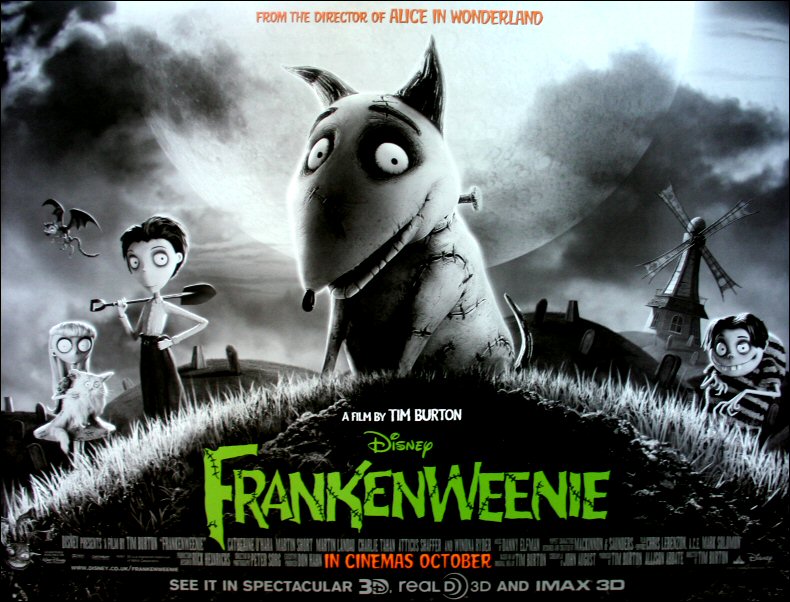
1984 Burton directed a 29 minute family film named Frankenweenie,
an homage to the iconic original Frankenstein films from the
Thirties, involving a boy who loses his beloved dog but revives him
via electricity, to the shock of his neighbourhood. Though it was a
simple horror story for all ages, Disney was dismayed and deemed the
short film too disturbing and scary for its target audience, denying
it a theatrical run (but for some reason still giving it a home video
release). Burton was fired from the studio and looked for jobs
elsewhere, soon setting himself on the right track as he directed a
number of smash hits, including Batman (1990), Edward
Scissorhands (1990) and Batman Returns (1992), eventually
becoming a major player in Hollywood despite (or because) continuing
to utilize his own unorthodox visual style and displaying his love
for outcasts and their encounters with the bizarre. Leaving Disney
may have been the best thing that ever happened to Burton, but it
didn't stop him from revisiting the failure that basically started
his career, remaking his own short into a theatrical movie in an even
darker and more off-beat fashion 28 years later, but still for the
same Walt Disney Studios that didn't think much of him or his work
all those years ago. Apparently Burton's acclaimed career, plus an
earlier cooperation between the pair when doing the highly successful
Alice in Wonderland (2010), ensured Disney gave Burton the
benefit of the doubt and the chance to bring Frankenweenie back
to life in an even more spectacular way than the dog in the story is
reanimated.
For
despite the film now running 87 instead of only 29 minutes,
surprisingly little has changed in terms of story. Warning!
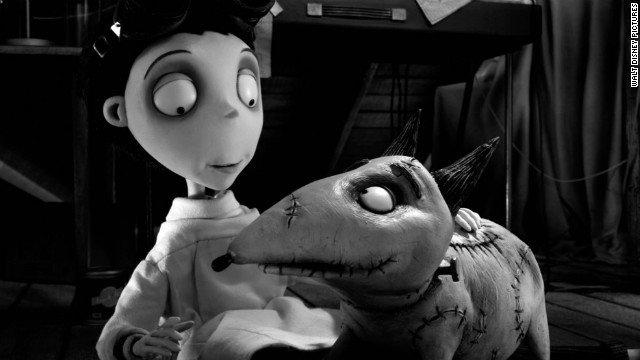
Spoilers! The protagonist is still a little boy named Victor
Frankenstein, a nerdy and imaginative kid whose best buddy in the
whole world is his dog, called Sparky (there's more than a little
'nomen est omen' in there somewhere I reckon). Together they
do anything from just playing around on the streets to making home
movies wherein the canine stars as a dinosaur slayer protecting
cardboard cities from plastic monsters. Of course with hobbies like
that, Victor isn't the most popular kid in school, but as long as he
has Sparky, he doesn't mind. But soon, tragedy strikes and Sparky is
fatally run over by a car and laid to rest, leaving an inconsolable
Victor all alone, despite his parents' assurances Sparky moved on to
a special place in his heart. However, when he learns of electricity
and its effects on dead tissue at school, the boy turns to the dark
art of science to bring his pet back to life by having its soulless
body struck by lightning. Against all odds, the experiment is a
success and his best friend is given a second chance at life, though
not in a perfect physical state as parts of him occasionally come
loose. Despite his efforts to keep Sparky's resurrection a secret,
the rest of the town soon finds out and is appalled by this
abominable obstruction of everyday life, turning into a typical angry
mob out to make sure the dead dog stays dead this time. Tracking the
pair to an old windmill, the construction catches fire and traps
Victor inside until Sparky gives his second life to save his young
master. Touched by his courage, the townspeople are convinced Sparky
deserved to live, after which they help Victor restoring him to life
once more in a total feel-good happy ending only Disney can deliver
(though it's maybe a bit too cheerful for a Tim Burton picture).
Though
the plot has hardly changed, there couldn't have been a bigger
difference in execution, as Burton turns to the much admired art of
traditional stop motion animation for his second incarnation of
Frankenweenie. Hardly a stranger to this type of filming,
having produced The Nightmare Before Christmas (1993) and
directed Corpse Bride (2005) before, Burton's use of stop
motion turns out fully justified as it gives the movie a stylistic
and visual edge over both the movie's predecessor as well as many a
“regularly” animated Disney movie. The film's look is simply
stunning, with some of the smoothest stop motion work to date, and it
also fits into Burton's oeuvre in a completely consistent manner: the
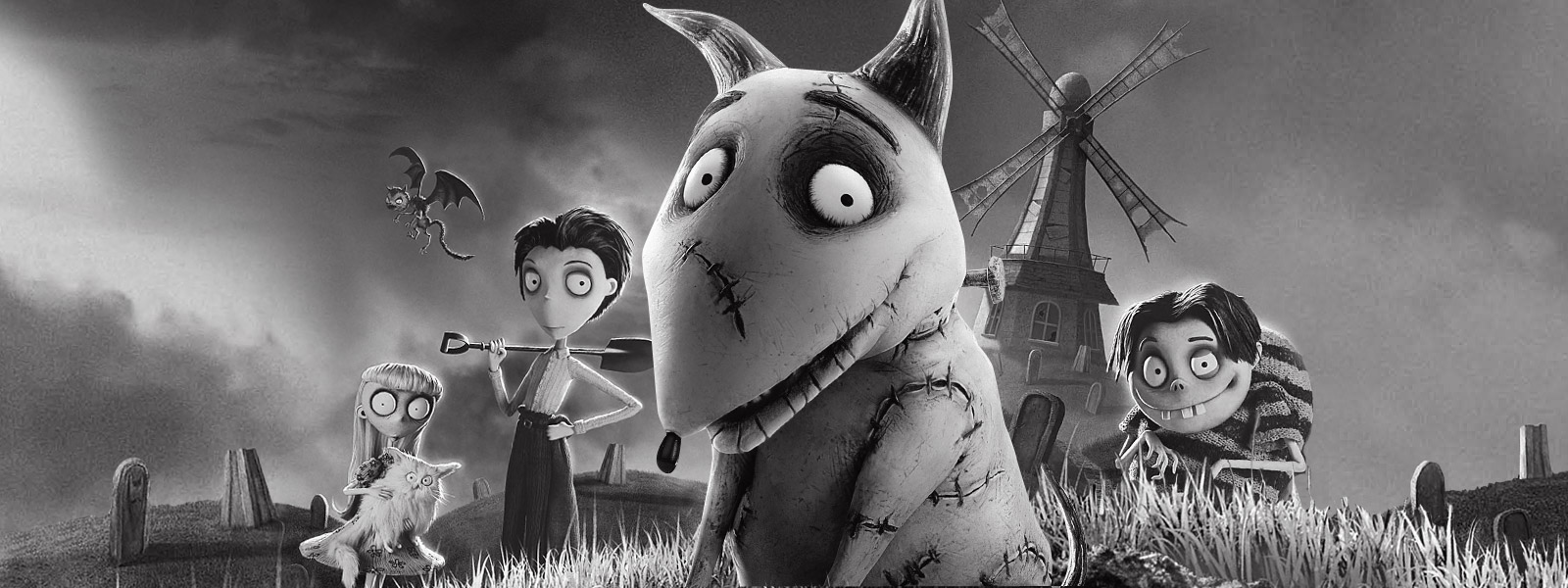
various characters, both human and animal, are all typically
Burtonesque with their big eyes, pale faces and generally
caricaturized physical features, while their brooding, often Gothic
surroundings make no mistake Tim Burton's signature stamp is all over
this film. Frankenweenie might as well be called Corpse
Bride's twin sister, were it not for the fact that, unlike that
film but like the original short, Frankenweenie is also shot
in black and white to make it appear even more distinct, as well as
perfectly in sync with the horror classics of old – particularly
James Whale's brilliant original Frankenstein (1931) and The
Bride of Frankenstein (1935), to which the movie knowingly owes
more than a little, on the narrative side – the movie keeps
referring to throughout the piece. While many a gag referring to such
narrative and stylistic forebears, albeit visual or in dialogue, is
undoubtedly missed by younger members of the audience, those even
slightly versed in the genre will recognize a multitude of little
nods and in-jokes softening the overall gloomy mood the style and
story prescribe. That doesn't mean there's no fun to be had for the
kids or the more uninformed spectators, as they too are treated to
many an outrageously zany moment triggering a few good laughs.
At the
same time, despite the many humourous occurrences, the movie isn't
afraid to downplay its moments of grief, and much to the credit of
the animation crew such instances are shot with the full range of
emotion they necessitate, making even the toughest viewers feel sad
as we witness Sparky's death – which fortunately remains largely
obscured from vision, instead of seen in more detail than is
necessary, underscoring the power of suggestion which Burton has also
mastered – and the sorrow it inflicts on those left behind, the
high point of tragedy remaining a simple shot of Sparky's neighbour
dog, a female poodle with whom he used to play ball through a hole in
the fence separating them: the poodle nods the ball through the hole,
then waits for a return nod that never comes. Maximum emotional
effect achieved through stylistic simplicity, and nobody ought to
keep a dry eye.

Despite
the overall story remaining largely identical to that of the original
short film, a longer running time does warrant the inclusion of a few
subplots to flesh things out just a bit more. The most noticeable
difference in narration is the science contest dominating events in
Victor's class as his school mates are all attempting to outthink
each other in making the most spectacular contribution to science,
encouraged by their new substitute teacher with his unpronouncable
but decidedly Eastern European sounding name (impeccable voicework
done by Burton veteran Martin Landau, who won an Academy Award for
his role in Burton's masterpiece Ed Wood (1994)). When the
word gets out on Victor's achievements, even though they were a
personal project to be kept hidden from the rest of the town, the all
too natural reaction of the other kids is imitation, as they
understandably decide to resurrect their own deceased pets as well.
However, their actions are motivated more by the desire for fame and
glory than they are by heart, while their teacher explained to Victor
the outcome of his experiment was fueled primarily by the love for
his subject instead of the lust for self-enrichment. Naturally, the
various rival experiments result in the creation of many monstrous
mutations soon terrorizing the town, including a cat/bat hybrid and a
giant dinosauresque turtle, enabling Burton and his partners in
animation to go all out with the stop motion process, continuing the
age old tradition of stop motion applied for breathing life into
monsters, as pioneered by special effects legends like Willis O'Brien
and Ray Harryhausen. It also results in a grander overall scale of
the film, clearly setting it apart against the simpler original short
movie, plus it adds some dynamic action for those audience members
who find it hard to sit through all the genuine emotion the movie
keeps evoking, if any. Ultimately though, Frankenweenie doesn't need such spectacle since its core plot about a boy and his dog is moving enough in itself and remains the picture's heart and soul, despite the additions made to make a short film longer.
Only a
few months ago, I critiqued Burton's Dark Shadows and feared
his signature style was overused by himself (and nowadays, by many others, too), which led to a
deterioration of quality in his recent films, culminating in Dark
Shadows ending up as one of Burton's biggest disappointments of
the last decade. I'm only too glad to find myself positively
surprised by Frankenweenie, one of his most delightful films
to date, which has proven this director is still fully capable of
delivering a satisfying viewing experience when his heart is truly in
it. Getting even at Disney while coming full circle from the start of
his career to the point where he is now clearly made sure Burton was
fully invested in this project, and he is proven right after a
quarter century: Frankenweenie was a thoroughly enjoyable
short movie then as it is a full theatrical film now, for audiences
both young and old. Apparently, in Burton's case revenge is a dish
best served dead, and revived.
Sidenote:
life is not without its cruel little ironies. For example, I got
to watch Frankenweenie the same week I had to let go of (yet another)
one of my cats. 2012 is not a good year for me, pet wise. Since I
happen to like animals more than people – if you know me and this
notion offends you, don't take it personally, it's just the way I am
– I'm having some trouble letting go, even though it wasn't my
favorite cat. In fact, the pet in question, poor little Akka, was
always drooling, generally unhygienic and somewhat obnoxious, but I
still loved her in her own right, and I will naturally miss her
presence (unlike the other cats, who don't seem to miss her at all).
Considering Frankenweenie revolves around the troubles of letting go
of your beloved pets, it got me thinking. If I were a creative little
boy and I lived in Tim Burton's imaginative world, I no doubt would
go for the solution offered in the film and resurrect the hell out of
my dead cat. However, I am not and I cannot, and even if it were
scientifically feasible, I would not. Especially not after the animal
in question had been rotting underground for a week (even if
protected by the cover provided by a wooden box, as Sparky was
given). After all, letting go when somebody or something dies is
just a part of life, the dark side of life of course, but still life.

What
would be achieved by keeping dead animals alive? Sure, you can stick
to their presence forever, but would it really be the pets you knew
and loved? As Frankenweenie showed, Sparky's resurrection, instigated
by love or not, was the result of a lucky shot, while the same
experiment failed with all the other ex-pets. Monstrous mutations
were the result, creepy crawlies and towering behemoths that looked
nothing like their living predecessors. Moreover, if they had been
healthy and happy like they used to be, death would lose its impact.
You could just keep on recharging your dead pet to breathe a
semblance of new life into it over and over again, which would keep
you from letting go and forming new special bonds with other animals.
But of course, new animals would still be born, and soon the number
of zombified creatures would grow to excessive rates and leave less
room for the living. Death may not be a nice thing, but there is a
definite natural purpose to it. My cat had a decent life for over 16
years and she got to live to a fair old age. It's more than I can say
for my previous cat, who succumbed to organ failure at age nine,
which was far too young for my taste. Instead of focusing on
resurrecting pets, it seems more reasonable to turn attention towards
extending the natural lifespan of pets, which usually lasts for only
one or two decades, while their masters' life outlasts them for many
more years. For the same reasons as stated above I feel it shouldn't
be attempted by artificial means though. Besides, natural human lives
last far longer nowadays than they did centuries ago. I reckon the
same is increasingly true for pets' lives, who receive better care
and food than they did in days gone by. Who knows, with a little luck
cats will eventually live for many more years than they do today. And
if not, the memories of a good cat will last a lifetime in that
special place in our heart. Even though we would have preferred them
to stay here with us in the flesh...
And
watch the trailer here:


