Posts tonen met het label arthouse. Alle posts tonen
vrijdag 19 mei 2017
Today's Review: Ascent
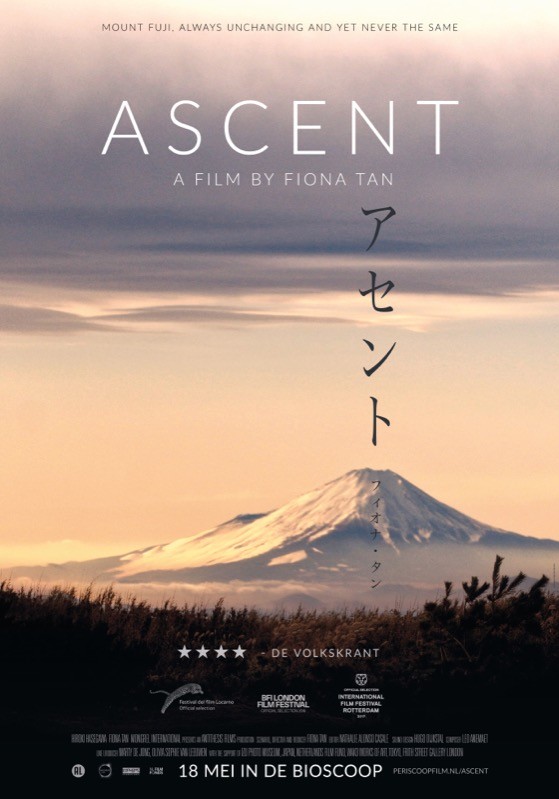
Met vierduizend foto's een semidocumentair verhaal vertellen over een berg, je moet het maar durven. Fiona Tan doet precies dat in Ascent, een experimentele film waarin bewegend beeld geschuwd wordt, maar toch een verhaal verteld moet worden aan de hand van louter fotografie. En het hoofdonderwerp is niet eens een mens, maar een berg. Maar dan wel één van de beroemdste en meest gefotografeerde bergtoppen op aarde, de Japanse Fuji. Aan deze piek kleeft zoveel symboliek en geschiedenis dat Tan haar tachtig minuten makkelijk gevuld krijgt. Want Fuji is onlosmakelijk verbonden met het verleden, het heden en de toekomst van Japan en haar inwoners en dus goed voor een onuitputtelijke bron van verhalen. Tan brengt er een handjevol ter herinnering in Ascent, maar het feit blijft dat de film ondanks de dappere vorm toch een verzameling fraaie plaatjes voorzien van boeiende maar statische voice-overs blijft.
Wie verwacht dat een film die slechts bestaat uit fotografisch materiaal per definitie een documentaire moet zijn, komt bedrogen uit. Tan gebruikt de verzamelde shots tegen de verwachting in ook met een narratief doeleinde. In dat verhaal wordt een Engelse vrouw geconfronteerd met de door haar overleden Japanse geliefde bijeen vergaarde foto's van de berg Fuji. Ze probeert via deze foto's hernieuwd inzicht te krijgen in de Japanse geest, die ze weliswaar van dichtbij meemaakte, maar als buitenstaander nooit volledig kon begrijpen. Fuji is essentieel in die Japanse mindset. Zelfs voor niet-Japanners roept het iconische beeld van de berg direct associaties op met de haast ongrijpbare mystiek van het land van de rijzende zon, die wonderlijke natie waar eeuwenoude traditie en ongebreidelde moderne technologie zo eenvoudig hand in hand lijken te gaan. Fotografie is echter niet de meest moderne technologie, maar door haar langere geschiedenis voor Tan wel de ideale methode om Fuji te bezien, op een manier waarvoor film, fictie of documentaire tekort zou schieten.
Fotografie is immers de kunst van het stilstaande beeld en die onwrikbaarheid is nou net wat Fuji schijnbaar typeert. Het uiterlijk van Fuji is in wezen niet veranderd, van die alleroudste foto's uit het midden van de negentiende eeuw tot op de dag van vandaag. Fuji is simpelweg een onbeweeglijke natuurkracht die voor Tan alleen via fotografie begrijpelijk gemaakt kan worden. En daarin verschilt de berg niet veel van de mensen om haar heen. Want ondanks de technologische vooruitgang verandert de Japanse geest haast niet. Zij wordt misschien getemperd door de tijden, zoals in haar turbulente oorlogsverleden, maar blijft anderszins eveneens onwrikbaar. Tan illustreert dat door het voortdurende ontzag dat de Japanners koesteren voor hun berg te tonen in de veelzijdigheid van het fotografisch materiaal. Eeuwenoude, met de hand ingekleurde studiofoto's van bont gekostumeerde geisha's met een getekende Fuji op de achtergrond gaan hand in hand met hedendaagse kiekjes van toeristen genomen vanuit stedelijke vergezichten en het weidse platteland. Het is die diversiteit die Ascent boeiend houdt.

Voor Tan en haar hoofdpersoon wordt echter de beklimming uit de titel door de (op Fuji?) gestorven Hiroshi als leidraad genomen. Dichter bij Fuji dan op haar wonderschoon besneeuwde top kan men niet komen. Die beklimming is meer een ritueel dan een toeristische uitstapje, dat door duizenden tegelijk voltrokken wordt, als een soort bedevaart. Zoals de poëtische voice-over van Hiroshi - verleden tijd voor zijn vrouw, maar zeer in leven in zijn eigen vertelling van zijn 'close encounter' met de berg - vertelt zit Fuji in het Japanse bloed. Dat onderstrepen de verhalen die beide vertellers ons meegeven. Mythologie wordt moeiteloos afgewisseld met historische anekdotes. Zelfs het optreden van Fuji in de film King Kong versus Godzilla wordt aangehaald, waarbij de berg het decor vormt voor het titanengevecht uit de titel. Gelijk ook een strijd tussen Japanse en westerse iconografie, eveneens van toepassing op Fuji's historie. Als symbool voor Japan trachtten de Amerikanen tijdens hun bezetting na de Tweede Wereldoorlog die symboliek te breken door de berg zoveel mogelijk uit film en foto's te censureren. Een zinloze taak natuurlijk, want die berg staat er immers nog steeds in al zijn onbeweeglijke glorie, zo onderstreept Tans relaas treffend.
Die immobiliteit moet echter toch relatief beschouwd worden, want Fuji is en blijft een vulkaan en vulkanen zijn wispelturige natuurkrachten. Hoewel de laatste uitbarsting alweer meer dan driehonderd jaar geleden plaatsvond - ruim voordat de fotografie ten tonele verscheen, dus van het gevaar van Fuji geen beeldmateriaal - zal de berg uiteindelijk opnieuw haar vurige woede over haar omgeving uitstorten. "Foto's zijn ijs, film is vuur", meent Tan in Ascent, maar als vulkaan is Fuji beide. De fotografische benadering is gewaagd, maar toch te beperkt om de geest van Fuji waarachtig te vangen. Hoewel Tans opzet respect oogst door ondanks de beperkingen van het door haar gebruikte medium onze aandacht vast te kunnen houden, is een berg van Fuji's kaliber een dynamischer eerbetoon waard.
Labels:
art,
arthouse,
ascent,
documentary,
fiona tan,
fuji,
godzilla,
japan,
mountain,
narrator,
photography
zaterdag 11 februari 2017
Today's Review: Paterson
"Ik maak liever een film over een man die zijn hond uitlaat dan over de keizer van China", sprak indie-regisseur Jim Jarmusch ooit. Met Paterson heeft hij nu woord gehouden. De nieuwste film van de minimalistische regisseur moet het inderdaad niet van markante, kleurrijke personen hebben, maar juist van de alledaagse realiteit die de meesten van ons ondergaan. De herkenbare werkelijkheid van normale mensen die een dagelijkse routine leven en daar voldoening in vinden. Jarmusch zou Jarmusch niet zijn als hij daar geen poëzie in zag. Paterson is het eerbetoon aan de doorsneemens, een welkome afwisseling van al die films over bijzondere individuen die we gewend zijn.
Die man die in Paterson elke avond de hond uitlaat, draagt dezelfde naam als de film en woont bovendien in de gelijknamige stad in New Jersey. Jarmusch volgt hem gedurende één week van zijn leven. De week begint op maandag, als hij 's ochtends opstaat, ontbijt en naar zijn werk gaat. Als buschauffeur vervoert hij normale mensen die over ordinaire dingen praten. Tussendoor wijdt hij zich aan zijn hobby, de dichtkunst. 's Avonds keert Paterson huiswaarts richting zijn ondernemende vriendin, die in tegenstelling tot hem diverse toekomstplannen koestert. Na het avondmaal gaat hij op stap met de hond en bezoekt hij de plaatselijke bar waar hij zich laaft aan één biertje, alvorens weer vroeg naar bed te gaan. Zie daar een dag uit Patersons leven, die Jarmusch aan aantal keer herhaalt, met slechts minieme variaties op de sleur van alledag. Saai? Feitelijk wel, maar om die saaiheid terug te zien op het witte doek is verfrissend, zeker als het ook nog weet te boeien.
Die fascinatie is hoofdzakelijk de verdienste van de hoofdrolspelers. Adam Driver mag dan recentelijk nog de rol van een grote schurk in de laatste Star Wars hebben vertolkt, hier is hij een doodgewoon mens met alledaagse beslommeringen, net als zijn publiek. Driver weet ons prima mee te sleuren in Patersons doen en laten door hem van een puike balans tussen burgerfatsoen, brave speelsheid en sympathie te voorzien. Er gebeurt weinig in zijn leven, maar daar zit hij ook helemaal niet op te wachten. Hij is gelukkig met zijn simpele bestaan. Daar tegenover plaatst Jarmusch zijn energieke vriendin Laura, die elke dag wel een nieuw plan bedenkt om haar stempel op de wereld te drukken. De ene dag wil ze een beroemde gitariste worden, de andere een gevierd kunstenares. Tegelijkertijd tracht ze Paterson, tegen diens zin in, te stimuleren zijn gedichten te publiceren, ook al schrijft hij ze puur voor zijn eigen vermaak. De Iraanse Golshifteh Farahani geeft Driver effectief tegengas in de rol van zijn kwieke wederhelft en de chemie tussen beiden zindert van de herkenbaarheid.
Van veel vaart of spanning moet Paterson het dus niet hebben. En daar is het Jarmusch nou precies om te doen. Er zijn immers al talloze films waarin zoveel gebeurt dat het mensen nodeloos opjaagt. Met Paterson bewerkstelligt hij juist het tegenovergestelde: fascinatie voor de dagelijks terugkerende nietszeggendheid die het leven van de meeste mensen typeert. En daardoor erkennen we dat de routine die Paterson zo dierbaar is (alsmede die van onszelf) eigenlijk voortdurend onder vuur ligt. Als Laura zijn sleur poogt te doorbreken door een experimenteel gerecht op te dienen, is hij zichtbaar onthutst. Een herkenbare situatie, maar vergelijkbaar met een plottwist in een thriller. En zo gaat het door. Dinsdag wordt Paterson op straat aangesproken door ongure sujetten. Woensdag wordt hij in de bar geconfronteerd door een verward persoon met een neppistool. Op vrijdag begeeft zijn bus het. En het dieptepunt van de week vormt uiteraard de emotionele climax van de film. Al heeft het hier geen grootscheepse consequenties, het dagelijkse leven is allerminst saai, maar doorspekt van kleine afwijkingen en toevalligheden die in de handen van Jarmusch tot een beklijvend geheel worden gedicht.
Want dichten, dat is wat Jarmusch voor ogen heeft met Paterson. Zoals de hoofdpersoon poëzie schrijft over alledaagse dingen als lucifers of regen, zo rijmt Jarmusch die dagelijkse gang van zaken aaneen tot een cinematische lofzang op de banaliteit van het bestaan. Daarbij bedient hij zich van de voor hem gebruikelijke minimalistische toon, met een rustige camera, zonder aandachttrekkerige of opzwepende stijlmiddelen. Samen met de gevatte dialogen, de dromerige montage en de schilderachtige weergave van de stad uit de titel - oud en vervallen, maar toch bruisend en vol karakter - levert dat een gedicht in beeldvorm op, een hommage aan al die mensen die simpelweg hun leven leven, maar zo zelden in films worden geportretteerd omdat er niets over ze te vertellen zou zijn. Met Paterson bewijst Jarmusch dat ook normale levens interessante films kunnen opleveren. Die Chinese keizers en vergelijkbare grootse figuren krijgen immers al genoeg aandacht op het witte doek.
Labels:
adam driver,
america,
art,
arthouse,
boring,
dog,
drama,
everyday life,
golshifteh farahani,
jim jarmusch,
paterson,
poem,
poetry
zondag 29 januari 2017
Today's Review: The Student
Het is fijn om te weten dat in de Russische cinema nog kritische geluiden klinken. Ook al duiken die hoofdzakelijk op in 's lands arthousefilms die het nationale publiek niet op grote schaal zullen bereiken, buiten de grenzen kunnen ze doorgaans rekenen op een warm onthaal. Leviathan, Andrei Zvyagintsevs aanklacht tegen de corruptie in de bestuurlijke macht, ging er twee jaar geleden bijna met een Oscar vandoor. Het valt te bezien of Kirill Serebrennikovs The Student, gebaseerd op een door hemzelf geproduceerd theaterstuk, het even ver zal schoppen, maar hij vormt een eveneens energiek pleidooi tegen die andere grote pijler van de Russische samenleving: het geloof. Want onder het presidentschap van Poetin zijn de politiek en de Russisch-Orthodoxe Kerk nader tot elkaar gegroeid, tot weinig jubel van de ruimdenkende Rus.
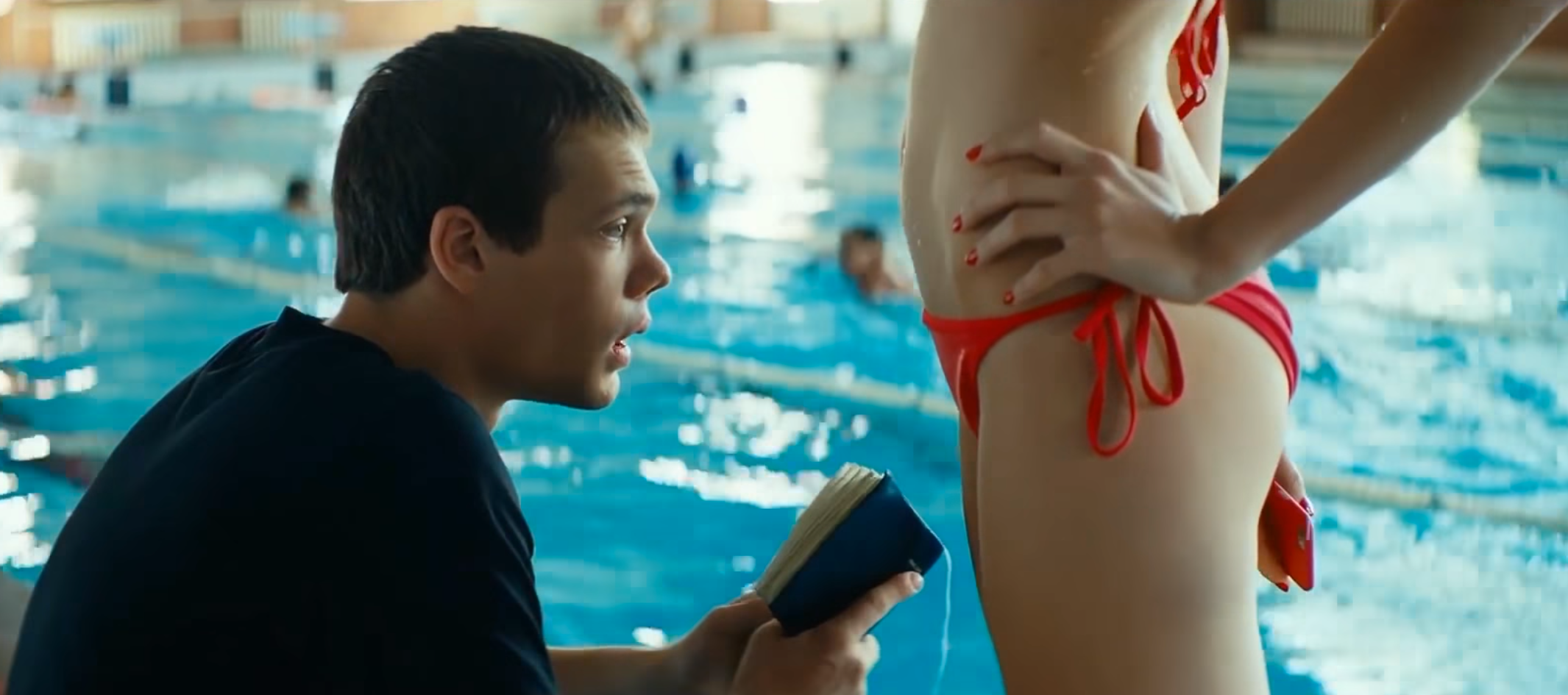
De student uit de titel is Venya, voorheen een onopvallende, alledaagse middelbare scholier, een buitenbeentje onder zijn klasgenoten. Nu heeft hij het christelijk geloof omarmd, waarop hij zich direct van zijn meest fanatieke kant laat zien als religieus adept. Venya slaat iedereen met het ene na het andere Bijbelcitaat om de oren, als kritiek op alles wat in strijd is met zijn invulling van de wereld. Wie het met hem oneens is, wordt geconfronteerd met rechtstreeks uit de Bijbel overgenomen verwensingen die in klare taal omschrijven wat er met andersdenkenden dient te gebeuren. Niemand doet het goed volgens Venya, van zijn bloedeigen moeder tot de docent godsdienst, nota bene zelf een aanhanger van de orthodoxe kerk. Om de gemoederen te sussen geeft het schoolbestuur - portret van Poetin aan haar muur - stukje bij beetje toe aan Venya's eisen. Bikini's bij de zwemles moeten plaatsmaken voor kuisere badpakken, Darwins evolutieleer wordt voortaan onderwezen samen met de christelijke scheppingsleer, enzovoort. Dit tot onvrede van de biologiedocente Elena, die lijdzaam moet toezien hoe vrijheden worden ingeperkt door de agressieve mening van een charismatische eenling.
Want dat het Venya niet ontbeert aan charme, moet gezegd worden. Van de status als outsider die hij ooit had, is niets meer over. Venya's kruistocht tegen onzedelijkheid en tolerantie wordt door zijn klasgenoten met gejuich onthaald, niet omdat ze het inhoudelijk met hem eens zijn, maar omdat hij de docenten met zijn extravagante optreden op hun nummer zet. Dat zijn medestudenten op den duur vrijheden moeten inleveren door zijn fanatische beschuldiging tegen de leiding, maakt hem schrikbarend genoeg niet minder populair. Petr Skvortsov speelt Venya inderdaad met een betoverende flair, een meeslepende prestatie voor een dergelijk jonge acteur. Ook al zullen weinigen zijn kant kiezen, zijn wervelende uitvaringen tegen het establishment zijn een genot om naar te kijken. Hij krijgt daarbij uitstekend tegengas van Victoria Isakova als Elena, die hem - als spreekbuis van regisseur Serebrennikov - van rake repliek dient en hem confronteert met zijn waanzin door het blootleggen van de talloze tegenstrijdigheden in het Heilige Schrift. Waarvoor de fanaat uiteraard doof blijkt.
In dat fanatisme van de hoofdpersoon, wat de film zijn luister meegeeft, schuilt tegelijk ook de grootste zwakte van The Student. Nergens in de film leren we waarom Venya zich zo met hart en ziel op het geloof gestort heeft. De film gaat voorbij aan diens omschakeling van loser van de klas naar religieuze rockster. Is hij werkelijk van de ene op de andere dag zo diepgelovig geworden, of is het slechts een wijze om stoom af te blazen als tiener tegen zijn opvoeders? Naar Venya's motieven voor het opzoeken van het christendom blijft het gissen. Dat het hem menens is, wordt echter hoe langer hoe meer duidelijk. Populariteit bij het andere geslacht ligt binnen handbereik, maar slaat hij af. Daarentegen concentreert hij zich op het streven zijn voornaamste tegenstander, Elena, het zwijgen op te leggen, waarbij hij moord niet uitsluit. Dit is niet langer een methode van een dwarse puber om aandacht te krijgen, maar een verwerpelijke tactiek van een onwrikbare extremist om andersdenkenden uit de weg te ruimen. Hoe Venya zo wanstaltig fanatisch kon uitgroeien in zo'n korte tijd blijft een frustrerend raadsel in The Student.
Uiteraard is zijn hoofdpersoon voor Serebrennikov slechts een metafoor voor de huidige situatie in Rusland, waarin de macht van de orthodoxe minderheid groeit ten koste van de vrijheid van het individu. Venya is niet bedoeld als serieus uitgediept personage, maar als een satirische verschijning. Dat is jammer, want Svortsovs overtuigende spel is een genuanceerder uitgewerkt personage waardig. De charismatische prediker in de eerste helft van de film ontpopt zich slechts tot een bijzonder onsympathieke moordzuchtige fanaat. Die bovendien ook nog bijgestaan wordt door een overbodige volgeling, een verschoppeling in zijn klas die zegt zijn Woord te volgen, maar voorspelbaar slechts uit is op een homoseksuele relatie. Het reduceert Venya uiteindelijk tot een typetje in een toch al erg theatrale film, die de verontrustende dagelijkse werkelijkheid in Rusland wat al te opzichtig parodieert.
dinsdag 5 juli 2016
Today's Review: A Long and Happy Life
Another review up:
A Long and Happy Life - recensie
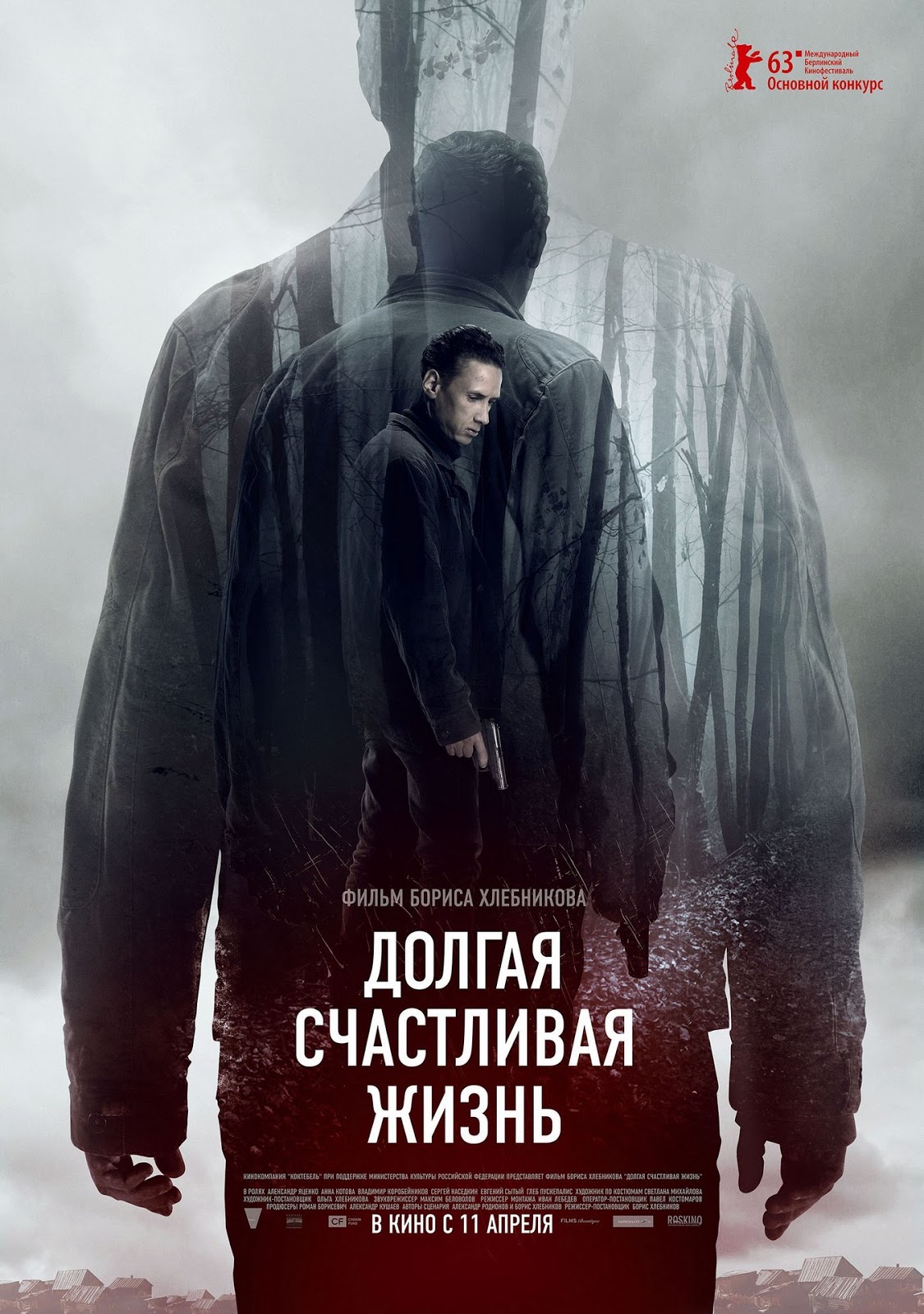
Director Boris Khlebnikov conceived of this film as a modern day Western set in Russia, inspired by the classic High Noon. With that knowledge in mind, you can easily recognize it as such, though for those with less prescience in regards to A Long and Happy Life, most of the ingredients are there for all to see. There's the lone hero, the rough but beautiful landscape, the love affair, the oppressed mob and of course the climactic shootout. All in just 77 minutes.
But the aspirations of an American Western aside, this is first and foremost a contemporary Russian social drama. So naturally, things don't proceed as they usually would. Unless you're versed in Russian arthouse, where the plethora of problems plaguing the nation, despite Putin's claims to the contrary, are placed front and center. Then you know full well what's in store. Corruption and the inevitability of its winning the day are the central themes of A Long and Happy Life, as they are in many similar films from Khlebnikovs peers. Sascha, who manages a small collective farm in the cold north of Russia, is all too eager to be bought by his superiors to split up the farm so the land can be used for something more productive. The dough gives him the opportunity to abandon this God forsaken place and move to the big city with his girlfriend. However, when the farmers under his command refuse to be moved as the state leaves them with next to nothing if it happens, Sascha's conscience gets in the way of the life from the title he envisioned for himself. Moved by their plight and their trust in him, he resists the officials, refuses the money and fights to keep his farm open. A hopeless battle, he knows, but as an honest man he must fight it anyway.
Now, honest men, those are hard to find, so says Khlebnikov in this fatalistic little film. The farmers sure don't turn out to be such men, as they quickly search for ways to get out, each man for himself, with as much money as he can make of it. And so Sascha soon finds himself fighting the good fight all by himself, betrayed by everybody. Tension mounts and it's obvious things cannot end on a happy note, but rather in a violent showdown only. Such is life is Russia these days, according to Khlebnikov. The point is well taken, but would have been better served by a different lead actor. Alexandr Yatsenko is well suited to play a corrupt underling, but makes a feeble impression as a lone hero. He simply lacks the necessary charisma for the part and so we're not sold on his switch from bored city boy wanting to leave the country to rebellious protector of the common folk. Which is also hindered by the small amount of time Khlebnikov puts into things, in obvious pun intended contrast to the title, since this film is naturally far from long and happy. But if you expected it to be, you are likely not familiar with Russian arthouse. Or Westerns for that matter.
zaterdag 22 november 2014
Today's Review: White Bird in a Blizzard
Wrote another review for MovieScene this week. After all, I had some catching up to do in that department:
http://www.moviescene.nl/p/157936/white_bird_in_a_blizzard_-_recensie
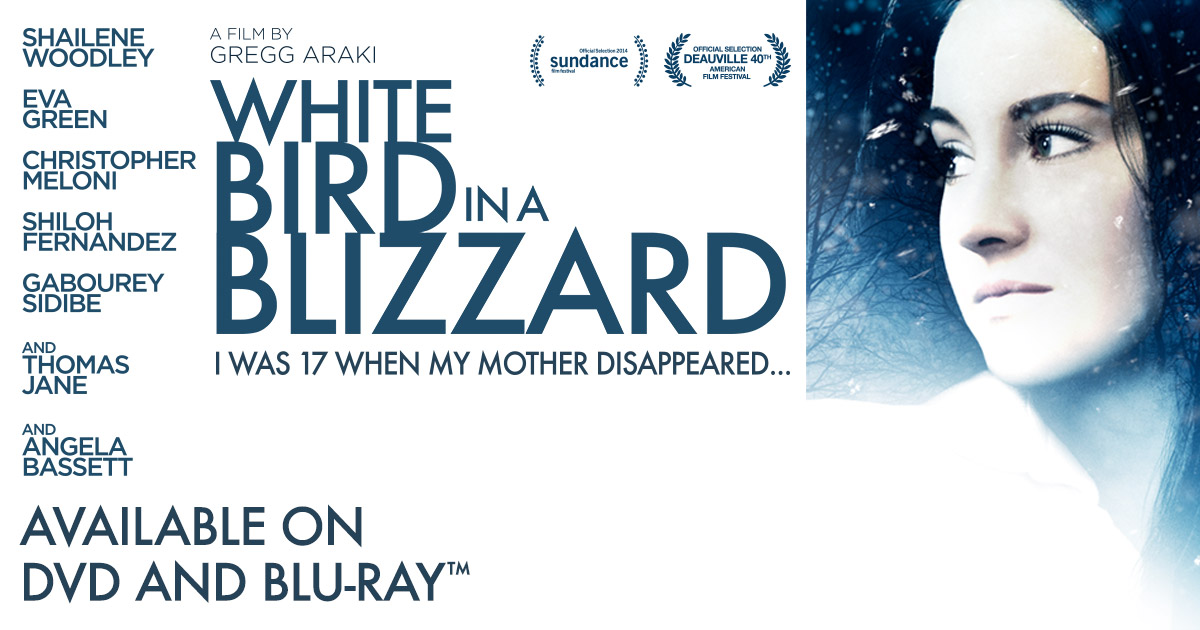
From director Gregg Araki, we both got what we expected and we didn't, in this film's case. White Bird in a Blizzard contained all his usual themes - surrealism, teenage social issues, sexuality, death - but it lacked his usual energetic visual style. It never got recognizably 'Arakiesque'. Usually it's a not a bad thing per se when you can't tell who the director is from looking at the picture, but in this case, it's no flattery at all. White Bird is a visually unimpressive, bland picture that in many ways feels like a missed oppurtunity on this director's part. You might say he preferred to stick to the source material, this being an adaptation of somebody else's novel, but considering he did change a fair amount of things already, it would also have suited him to get the film more in line with his signature style to feel less detached and make us care more about the characters.
At least performances are good throughout the piece. Shailene Woodley makes a better impression than usual. However, it's Eva Green who steals the show while playing her mother. That too, doesn't help the movie much, as it's not her show (hence the proverbial 'stealing'). In fact, it's much more about her absence than it is about her presence, but when she graces the screen, the movie lightens up considerably. Green does an excellent job portraying a seemingly perfect house wife, sizzling with the frustrations of a wasted life and unfulfilled desires just underneath the facade. Her unhealthy relationship with her daughter makes for the most emotional scenes, thoroughly uncomfortable yet mesmerizing to behold. However, the moment she's out of the picture, literally and figuratively,and the story fully centers around Woodley's character just hanging out with her friends, having sex and going to college, our attention wanes. And then it uneasily evolves from a typical coming-of-age drama into a thirteen-a-dozen thriller in the second half and all the predictable dirty secrets come out. But we care too little, too late at that point.
White Bird in a Blizzard will always be compared unfavorably to that other adaptation of a literary work Araki directed, Mysterious Skin. That movie too featured all his themes (including a visually sober look), but fared a lot better combining teen angst, creepy sexual relations and a thriller component, as the movie unraveled in a way that did make us interested in the questions of what happened to whom. White Bird in a Blizzard sadly feels repetitive and redundant on Araki's resumé. But at least Green is not at fault.
donderdag 5 juni 2014
Today's Review: In the Name Of
I did this review of a Polish movie (original title: W Imie...) for MovieScene last week:
http://www.moviescene.nl/p/155980/in_the_name_of_-_recensie
I found it a fairly decent arthouse flick, which revealed more novel information about the relation between religion and (homo)sexuality in Poland specifically than in general, as this theme has been explored (not to mention parodied) before. The main component in its favour was the strong and thoroughly compelling performance of its main actor, Andrzej Chyra, who delivered a veritable tour-de-force in his role as a talented country priest torn by his devout Roman-Catholic beliefs and his natural, human yearning for love. It wasn't even about him being gay, that was rather secondary to be honest. Of course, if he was interested in female companionship it would have been even less innovative, as that topic has been addressed in cinema hundreds of times before. The homosexual aspect was important mostly for showing just how ordinary gay people are to the general Polish audience, as yet not so convinced of that fact I hear. For a Dutch audience, that element of the film was hardly an eye opening notion. However, the premise of a homosexually frustrated priest working with underage boys in the countryside without deteriorating into sensational stories of sexual abuse in church circles is a refreshing one. Not every homosexual priest is a child molester, ya know. Thanks for informing and comforting us on that front, Malgorzata Szumowska.
donderdag 13 maart 2014
Today's Review: Suzanne
Yet again have I written a review for MovieScene:
http://www.moviescene.nl/p/154302/suzanne_-_recensie
Not a film that achieved what it set out to do. You just don't get to connect with a character enough if you seen 25 years of her life in the space of only 90 minutes. Suzanne therefore gets stuck in a web of consequences, not in creating understanding or exploring proper motivations of the protagonist, who we cannot help but judge harshly for her woeful willingness to behave both wholesomely irresponsible and socially inacceptible. Even though we supposedly get to see what we need to see, it's not enough to mentally associate as closely as we would like in order to place Suzanne's criminal activity in the proper context. Decent acting and fine cinematography not withstanding, for at least the movie succeeds on that account. Women that fall in love with all the wrong men still remain a mystery to the rest of the world. Suzanne doesn't change that.
zaterdag 8 maart 2014
Today's Column: behind the scenes of arthouse programming
Wrote another column for MovieScene:
http://www.moviescene.nl/p/154147/column_-_hoe_programmeer_ik_een_filmhuis
Inspiration was tough this time because I was quite busy with both my regular job and my new hobby supporting the programming department of the new Filmhuis Alkmaar arthouse theater. I eventually decided to just write a piece about that, as it seemed appropriate to do this follow-up to my emotionally charged column about Provadja's demise a few months back. Nevertheless, because of my lack of available time I consider this latest column to be a bit on the superficial side, even though I daresay you get the gist of it. So far it's fun work, though because of the poor quality of internal communications between the various departments that comprise the staff (voluntary that is) of the theater it can at times prove stressful. Also something to take into account, and not mentioned here, is the fact distributors love to mess around with their movies' release dates, making a keen eye for spotting such moves and accordingly flexible programming to accomodate these happenstances rather imperative. The most striking example was the German film Das Wochenende, which was originally slated for release in January, then moved to March and is now currently expected to hit theaters in October... Am I glad we didn't plan that one for our opening weekend, that would have been awkward to say the least! As for Wes Anderson not being popular in Alkmaar, as far as I'm concerned we'll make him popular. The decision to order his upcoming magnum opus The Grand Budapest Hotel for only a single week has seemingly been reversed in favour of a two week appearance, something I opted for from the beginning. There weren't that many other attendance magnets available, so Anderson got out on top. Suits me fine.
Here's to a bright future for Filmhuis Alkmaar!
dinsdag 10 december 2013
Today's Column: the end of Provadja as we know it
Another column of mind own had got published on MS, this time dealing with a tragic topic (for me at least):
http://www.moviescene.nl/p/151898/column_het_einde_van_provadja_in_alkmaar
I'm certainly gonna miss Provadja. The relaxed, cinephile atmosphere, the lack of pressure from managers I experience at my real job, the proximity to home, the historic building and most of all the good movies and kind audience. Even when Filmhuis Alkmaar works out in everybody's favor and will open this February, and even if I do resume my previous duties in this new direction, it just won't be the same. I imagine it's much harder for those that lived with and loved Provadja for decades than for me, since I only worked there (as a volunteer too) for nigh 18 months. I'm glad I did though, those were good times. Here's to hoping Filmhuis Alkmaar will prove to be similarly enjoyable, blessed with the same longevity of 43 years (or more). Farewell Provadja!
Labels:
arthouse,
column,
drama,
moviescene,
provadja
zaterdag 11 mei 2013
Today's News: S.H.I.E.L.D. show is a go / La Cinquieme Saison mini-review

This news has been on MovieScene mere minutes and it's already available here:
http://www.moviescene.nl/p/147013/marvels_s.h.i.e.l.d._officieel_een_serie
Personally I can only say: bring it! Yes, the overall story synopsis sounds like a bland retreat of shows like The X-Files or The 4400, but hey, I liked those shows and I like Marvel so I still have no reason not to be thoroughly excited. Plus, I've been a great admirer of the way Marvel is constructing its larger cinematic universe in theaters and I'm quite intrigued by the question of how they will continue keeping this up on the small screen. After all, it's one thing to have a series of movies that are referring to one another culminating in one big giant super movie (The Avengers, remember?), but it's quite another to incorporate a TV series into this whole. TV shows just work via different logistics, different methods of production, different ways to keep their principal actors in check, etc. It's laudable ABC dares to take the risk, but also rather understandable considering the box office results from both The Avengers last year and currently Iron Man 3 (though the latter didn't deserve it as much as the former unfortunately). Be it in the TV business or in Hollywood, you can't keep a good exec away from the promise of being showered in precious dough, eh? And what's up with that likeable Agent Coulson playing the lead of this show, despite having died in The Avengers? Seems there's already one big mystery to solve to begin with.
With Marvel, Joss Whedon and TV (the last two categories alone would pique my interest already, really) all mixed together, I can safely say that however Agents of S.H.I.E.L.D. will turn out, it will be interesting on multiple levels, regardless of its eventual quality or lack thereof. I for one think it might actually happen to be a good show, and I'll definitely seek it out to shield me from boredom!
By the way, it's been quite a while since I posted a review (mini or otherwise) on this blog of mine. Guess I should go and remedy this critical drought, and why not start now? So here's a little review to let you know I have not forgotten about posting other things than my pieces for MovieScene. I saw this fascinating little film at Provadja recently:
La Cinquième
Saison
Rating: ****/*****, or 7/10
A poetic European look at Apocalyptic
cinema, this film deals with a small rural community which is
confronted with the sudden emergence of a new season. Nihilistic in
nature, it falls between winter and spring and is basically a season
of nothingness: there's no snow or rain, but nature stays dead as
nothing grows, except for the desperation of the townspeople as their
resources dwindle. Soon people go to ever increasing lengths just to
stay alive or to explain this unusual break in seasonal patterns, to
shocking results. Young girls prostitute themselves simply for food,
while the town's outsider is branded a cause to all the town's
dismays, targeted as a human sacrifice and burned alive. Though much
more esoteric in tone than regular end-of-the-world dramas, the film
proves all as haunting and unsettling as it successfully registers
the dark side of man and his unwavering ability for cruelty when
faced with inexplicable catastrophe and basic survival. Also explored
is mankind's role in this world under the uncompromising rule of the
environment (though it is never addressed whether mankind itself is
at fault for the creation of this fifth season), which can still play
hell with our sense of civilization and kindness when it comes down
to creating unsustainable living conditions that make society
crumble. The visual imagery the film resorts to is both gritty and
raw as the material demands, but at times surprisingly off-beat and
confusing. The Apocalypse has truly gone arthouse, as La Cinquième
Saison proves.
donderdag 14 maart 2013
Today's Review: Trois Mondes
Finally got a decently lenghty review up again, at MovieScene as usual:
http://www.moviescene.nl/p/145052/trois_mondes_-_recensie
I'll willingly admit it's not my best review, but this was a fairly tough nut to crack. As is normal for my MS reviews it has been edited to some extent (about 200 words have been omitted, some justly, others not so much), but I understand why and I do agree it may have been for the best. I'm just glad I finally got back to serious reviewing at all!
http://www.moviescene.nl/p/145052/trois_mondes_-_recensie
I'll willingly admit it's not my best review, but this was a fairly tough nut to crack. As is normal for my MS reviews it has been edited to some extent (about 200 words have been omitted, some justly, others not so much), but I understand why and I do agree it may have been for the best. I'm just glad I finally got back to serious reviewing at all!
zondag 24 februari 2013
Movies Gone By: the Continuation
As
stated yesterday (two posts in as many days, waddayaknow?! Off to a
good start I'd say!), I'll continue posting all too short reviews of
movies I saw in the last few months but failed to comment on in more
detail due to computer troubles at home. I might write more extensive
reviews on a few of these somewhere in the future if time permits me
(fat chance!), while I do plan to give these more coverage in the
Movie Archives in the long run; which will be very long, since it's
practically a work in progress forever (until the day I die most
likely, or the day I turn blind and can't watch films no more). But
so far there is cause for optimism, so let's focus on that, and on
another batch of recently seen movies. Today's group, like
yesterday's, consists entirely of films I had the pleasure of
screening at Provadja.
Lawless:
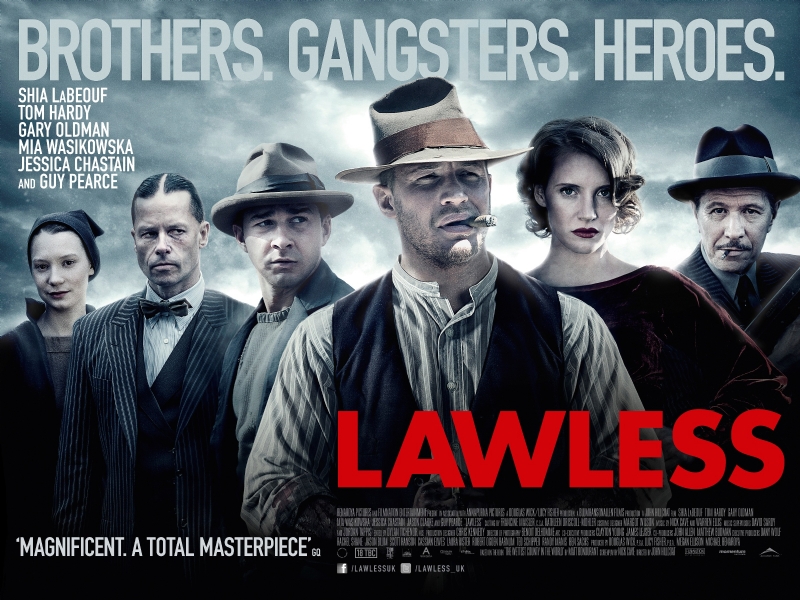
****/*****. Hard-edged, gritty and extremely violent Prohibition era
set drama, sort of a substitute for people who don't have the time to
watch Boardwalk Empire (which is superior in terms of story
development, but showcases acts of violence not nearly as disturbing
as this film does). Three brothers operate an illegal liquor business
in a small town, but big city mobsters are closing in on their turf
and give them the choice to cooperate or see their venture
terminated. Not taking crap from nobody, also because of an urban
legend regarding their supposed immortality, they respectfully
decline and quickly find themselves the target of both the mob and a
ruthless deputy trying to force the matter. Obviously, they retaliate
against both the lawbreakers and the law itself, with deadly
consequences. A more intelligent film then you might be inclined to
believe judging from this brief synopsis, with strong performances by
amongst others Guy Pearce and Tom Hardy. Director John Hillcoat (The
Road) delivers an impessive look, also in regard to the period
look of the Twenties, at the rough life of independent booze runners
harassed by bigger fish and unscrupulous law enforcers on their
payroll.
Amour:
****/*****. Excellent but still severely overrated social drama
depicting the autumn days of a elder couple still absolutely in love.
When the wife suffers a devatasting stroke leaving her helpless, her
husband takes care of her despite being in a process of mental
deterioration himself. Soon he comes to the realization there's only
one solution to their problems and it's not a pretty one, shocking
many a spectator (but not so much me since I found it only a logical
and ultimately predictable step), as is usual for uncompromising
director Michael Haneke who has a history of not making it easy on
his audience. Though this is still a gripping and tragic film, in my
mind it's marred by its slow pace and lazy cinematography. And
someone explain to me why this foreign film is nominated not only for
the correct 'Best Foreign Film' category at the Academy Awards, but
also for four other categories despite not having a single word of
English in it (as has always been the norm at the Oscars). Good film,
but not so mindboggingly good as some would have us believe.
Cloud
Atlas: ****/*****. Fascinating mosaic of connected lives
throughout the ages. Quite reminiscent of Aronofsky's The
Fountain, but not as compact (since it spans three more time
frames). Telling six vastly different tales set from the 1700s to the
distant future, it delves into the matter of acts, both good and bad,
and their consequences leaving an impact lasting for hundreds of
years. The point is made clear by an impressive international
ensemble cast (including Tom Hanks, Jim Broadbent, Hugo Weaving and
Halle Berry) turning up in completely different roles – bridging
issues like gender and race – from tale to tale, sometimes with
daring but also occasionally awkward results (most notably Hugo
Weaving playing a woman and an Asian guy). The spectacular visual
look and the different attitudes and styles of the various stories,
incorporating social drama, comedy, horror and science fiction leave
something to enjoy (and no doubt to detest as well) for everybody,
while none of the stories suffer from an overly fragmented or
complicated narrative. Courtesy of a fruitious cooperation between
the Wachowskis (The Matrix trilogy) and Tom Tykwer (Lola
Rennt).
Le
Magasin des Suicides: ***/*****. Offbeat and quirky animated
French film about a city so bleak and miserable that most people
can't wait to end their life, aided by the many possibilities of
dying offered by the local suicide shop. Run by a grim couple and
their not so cheerful kids, eagerly exploiting the despair of their
fellow man, the shop is a booming business, but matters are
complicated when their third child turns out nothing but happy and
obnoxiously optimistic, soon disrupting their livelihood as he means
to bring a smile to everybody's face. Though wonderfully animated and
stylistically inspired, making for a pleasant change from its
American counterparts, the story cannot help but feeling overly
random in the solutions offered to ending the omnipresent desire for
death plaguing the town (and what's with that awkward nude dance?).
Plus, some of the songs (this is, in fact, a musical too) just aren't
very enjoyable to endure, though that might be a case of Francophobia
on my part.
Seven
Psychopaths: ***/*****. Oddball comedy from the director of the
brilliant In Bruges. An aspiring screenwriter (Colin Farrell)
is set to produce a screenplay about seven psychopaths but suffers
from writer's block. However, he soon gets all the inspiration he
needs from his flamboyant and basically lunatic pal (Sam Rockwell)
who gets into trouble when his dognapping associate (Christopher
Walken) kidnaps the wrong Shih Tzu, the best friend of a maniacal
gangster (Woody Harrelson). Soon events lead to a colourful array of
bizarre and quirky situations as the dim witted protagonists try to
stay out of ever more explosive circumstances alive, resulting in the
all too soon audience drawn conclusion that none of these people are
in any way normal and the screenwriter is surrounded by all the
psychopaths he could want. Though starting off promisingly, the
narrative gets ever more convoluted and harder to follow while the
number of jokes keeps feeling lacking, especially compared to the far
superior predecessor (which also starred Farrell). The very
definition of a mixed bag.
Anna
Karenina: ***/*****. Unusual but still lavish (in some regards at
least) adaptation of the classic Tolstoy novel. Keira Knightley stars
as the Russian lady of noble blood torn between her romantic desires
and the restrictions and traditional expectations placed on her by
upper class Imperial society of the late 1900s. Will she compliantly
stay with her boring husband Jude Law or be swept off her feet by the
dashing young officer Aaron Taylor-Johnson instead? Whatever choice
she makes, she will predictably suffer from it. In the meantime,
young nobleman Domnhall Gleeson (son of Brendan) explores other
possibilities offered by the rising revolutionary tides offering a
vastly different but ultimately more simple and satisfactory life
from high society. To underscore the feeling of being trapped in an
upperclass setting in danger of being overtaken by the reality of the
common people, most of this movie is set in a rundown theatre, which
is an original choice (and undoubtedly budgetary inspired as well)
but as the movie progresses not exactly a stylistically pleasing one.
Contrary, Gleeson's character is the only one to explore the outside
world, along with the traditonally snowy Russian plains. As is usual
by now for a Keira Knightley film, excellent costume work. And some
lovely acting to go with it.
Labels:
amour,
anna karenina,
arthouse,
cloud atlas,
Colin Farrell,
john hillcoat,
keira knightley,
lawless,
magasin des suicides,
michael haneke,
provadja,
seven psychopaths,
tom tykwer,
wachowskis
zaterdag 23 februari 2013
Mr. Hammond, I think we're back in business!
It seems I've finally landed back on my digital feet again. My PC has been returned to me, Windows Vista freshly installed (and hopefully a legit version this time), but it took me the purchase of a new monitor to finally get rid of my start-up problems once and for all (or so it appears). Fingers crossed! So I can finally get serious again where my blog is concerned, though of course my work as a news editor on MovieScene keeps preventing me from posting on this blog as regularly as I would like (certainly not daily as I once intended a little bit too optimistically). However, I will continue to post everything I post on MovieScene here as well, and I will keep posting other movie news and reviews (though certainly not as lengthy as I used to write them). Let's hope my good intentions won't come to naught in the long run.
In the three months I was (mostly) computerless I did - naturally - keep watching movies, both new and old. Sadly I didn't really get around to discuss any of them, but today and the next few days I'll post a list of all the new movies I saw in the meantime (both in regular theatres and at my local arthouse cinema Provadja, where I still screen movies every Wednesday night). There's some great stuff here, and a few duds too.
-Meek's Cutoff: **/*****. Unusual and unorthodox neo-western about a goup of settlers lost on the great plains, looking for water. Their leader proves increasingly untrustworthy, while a captive Indian might be their only hope. Could have been a great film, but the age old 1,33:1 aspect ratio takes the fun out of all the potential western landscapes, while the abrupt ending leaves a lot to be desired and can even be accused of cheating the audience, even though it leads to the promise of hope for the protagonists.
-A Perdre la Raison: ****/*****. The deconstruction of a family drama. A French man of Moroccan descent marries a western woman, but their happy union over time leads her to an ever more restricted and mentally unbalanced life as she finds herself trapped between her own upbringing and the desires placed on her by her new family, which includes a very intrusive old would-be uncle and financial benefactor who soon seems to run both their lives. Eventually, the completely unhinged woman can find only one shocking way out for her and her three children. A movie filled with increasing moments of unease, complete with a shocking climax which, despite being quite predictable, sticks with you for a while. Not an easy watch. At all.
-All You Need Is Love: **/*****. Seriously toned, Scandinavian counterpart to Mamma Mia. A cancer stricken woman travels to overly sunny Italy for her daughter's wedding, where family troubles are stirred due to her being cheated on by her lousy husband. Fortunately, the Mediterranean vistas come with Pierce Brosnan as an angry widower who might just cheer her up, and vice versa. Not very inspired and rather bland, despite good acting.
-Jagten: ****/*****. Harrowing drama about a kindergarten teacher (fabulous performance by Mads Mikkelsen) who is wrongfullly accused of child abuse by one of his pupils and despite formerly being a beloved and popular guy quickly finds himself without friends in his small community. Things continue to get out of hand as he must persuade his fellow man of his innocence, though he's the subject of a witch hunt that appears not to blow over until it has claimed his now ever more sorry life. The lenghts people will go to to get back on what they consider to be bad people - without for a moment considering they might actually be innocent - while acting against the law themselves in the process, is made frightfully clear in this excellent but disturbing social drama, which unfortunately got snubbed all too easily at the 2012 Oscars in favour of Amour. Don't expect to go home in a cheerful mood.
-Sister: ***/*****. Social drama about an apparent pair of siblings (older sister and younger brother) who live a hard and sad life in the French mountains without parents. The boy scrapes together a meager living by stealing ski equipment off of rich tourists and selling it on, while his sister (French femme fatale Lea Seydoux) hangs out with all the wrong guys and spends what little money he makes for them both. Their situation gets ever more desperate, leading to a surprising confrontation about their actual relationship they both try to deny is real. Depressing and gritty drama showcasing society's forgotten kids and the reasons they exist at all. So, another gloomy movie. Also guest starring Gillian Anderson.
-Killing Them Softly: ***/*****. Slow paced and at times alarmingly violent thriller about a hitman (Brad Pitt) who is hired by mobsters to clean up after a card game robbery orchestrated by three not-so-intelligent petty thieves. He decides to make his job more low profile, and easier for himself, by first setting them up against each other, having them rat each other out, before moving in for the decisive kill. Andrew Dominik directs, and as is usual throws in ample amounts of social commentary, mostly directed at the current economic crisis. It shows a little too obvious at times, detracting from the story proper, but does make for a memorable closing argument by Pitt's character.
More mini-reviews to come soon.
In the three months I was (mostly) computerless I did - naturally - keep watching movies, both new and old. Sadly I didn't really get around to discuss any of them, but today and the next few days I'll post a list of all the new movies I saw in the meantime (both in regular theatres and at my local arthouse cinema Provadja, where I still screen movies every Wednesday night). There's some great stuff here, and a few duds too.
-Meek's Cutoff: **/*****. Unusual and unorthodox neo-western about a goup of settlers lost on the great plains, looking for water. Their leader proves increasingly untrustworthy, while a captive Indian might be their only hope. Could have been a great film, but the age old 1,33:1 aspect ratio takes the fun out of all the potential western landscapes, while the abrupt ending leaves a lot to be desired and can even be accused of cheating the audience, even though it leads to the promise of hope for the protagonists.
-A Perdre la Raison: ****/*****. The deconstruction of a family drama. A French man of Moroccan descent marries a western woman, but their happy union over time leads her to an ever more restricted and mentally unbalanced life as she finds herself trapped between her own upbringing and the desires placed on her by her new family, which includes a very intrusive old would-be uncle and financial benefactor who soon seems to run both their lives. Eventually, the completely unhinged woman can find only one shocking way out for her and her three children. A movie filled with increasing moments of unease, complete with a shocking climax which, despite being quite predictable, sticks with you for a while. Not an easy watch. At all.
-All You Need Is Love: **/*****. Seriously toned, Scandinavian counterpart to Mamma Mia. A cancer stricken woman travels to overly sunny Italy for her daughter's wedding, where family troubles are stirred due to her being cheated on by her lousy husband. Fortunately, the Mediterranean vistas come with Pierce Brosnan as an angry widower who might just cheer her up, and vice versa. Not very inspired and rather bland, despite good acting.
-Jagten: ****/*****. Harrowing drama about a kindergarten teacher (fabulous performance by Mads Mikkelsen) who is wrongfullly accused of child abuse by one of his pupils and despite formerly being a beloved and popular guy quickly finds himself without friends in his small community. Things continue to get out of hand as he must persuade his fellow man of his innocence, though he's the subject of a witch hunt that appears not to blow over until it has claimed his now ever more sorry life. The lenghts people will go to to get back on what they consider to be bad people - without for a moment considering they might actually be innocent - while acting against the law themselves in the process, is made frightfully clear in this excellent but disturbing social drama, which unfortunately got snubbed all too easily at the 2012 Oscars in favour of Amour. Don't expect to go home in a cheerful mood.
-Sister: ***/*****. Social drama about an apparent pair of siblings (older sister and younger brother) who live a hard and sad life in the French mountains without parents. The boy scrapes together a meager living by stealing ski equipment off of rich tourists and selling it on, while his sister (French femme fatale Lea Seydoux) hangs out with all the wrong guys and spends what little money he makes for them both. Their situation gets ever more desperate, leading to a surprising confrontation about their actual relationship they both try to deny is real. Depressing and gritty drama showcasing society's forgotten kids and the reasons they exist at all. So, another gloomy movie. Also guest starring Gillian Anderson.
-Killing Them Softly: ***/*****. Slow paced and at times alarmingly violent thriller about a hitman (Brad Pitt) who is hired by mobsters to clean up after a card game robbery orchestrated by three not-so-intelligent petty thieves. He decides to make his job more low profile, and easier for himself, by first setting them up against each other, having them rat each other out, before moving in for the decisive kill. Andrew Dominik directs, and as is usual throws in ample amounts of social commentary, mostly directed at the current economic crisis. It shows a little too obvious at times, detracting from the story proper, but does make for a memorable closing argument by Pitt's character.
More mini-reviews to come soon.
donderdag 13 december 2012
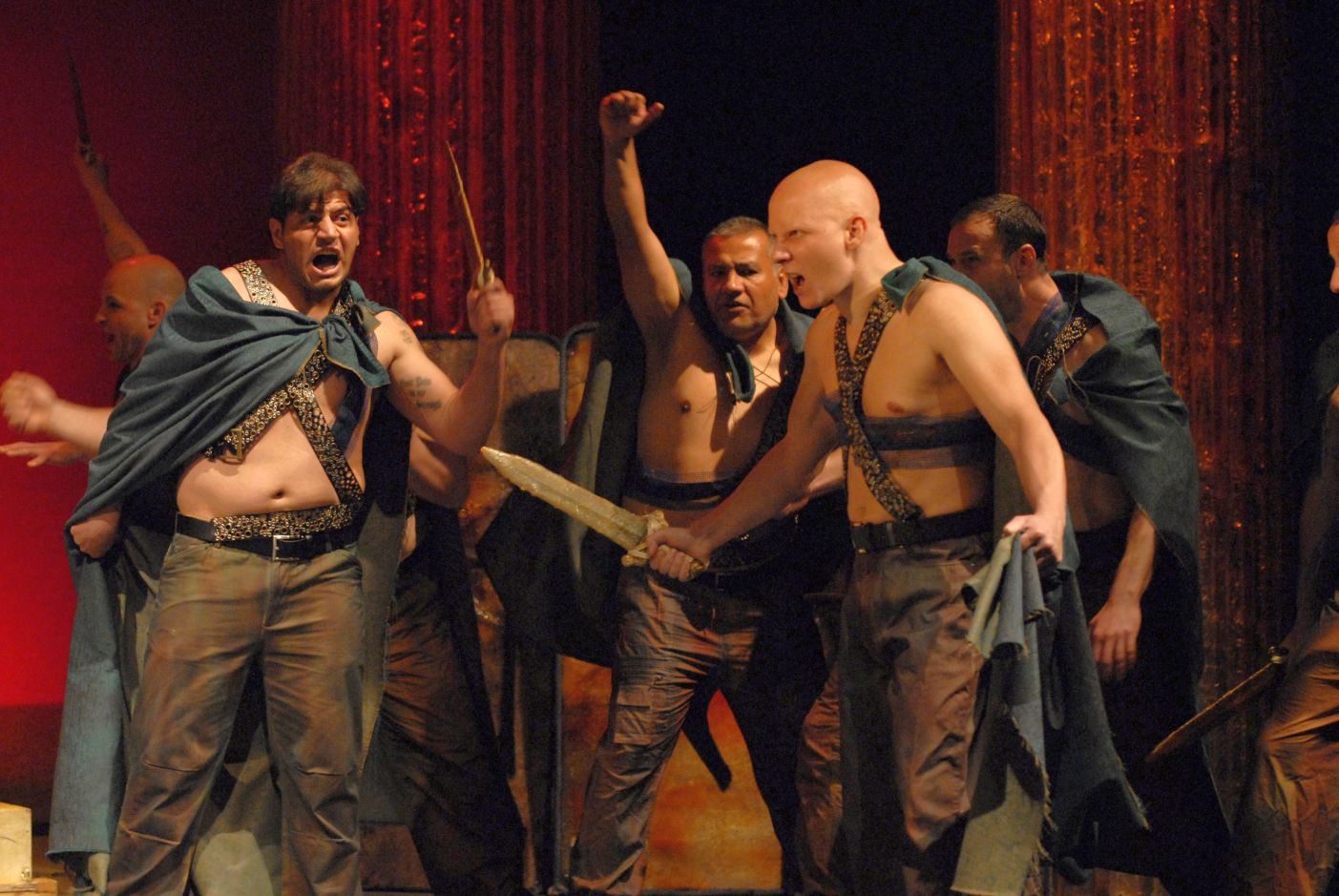
Review: Caesar Must Die
And so my computer once again returns to the store from whence it came to undergo yet another attempt to install Windows Vista - properly this time I hope. This means that once more I'll have very limited opportunities for about one or two weeks to update this blog. Do not despair though! Always, hope prevails. Today for example I had my second movie review, of an arthouse pseudo-docu drama called Caesar Must Die, posted on MovieScene, and the result (once again changed in terms of length from its original, this time at least by my own hand), can be found here:
http://www.moviescene.nl/p/142408/caesar_must_die_-_recensie
Up next in my MS schedule is a press screening for Silent Hill: Revelation 3D next week. It'll be a nice reprieve from reviewing arthouse flicks (which is not to say I don't enjoy that). I sincerely hope my computer has returned to me by that time, otherwise I'll find writing a piece about said movie quite the challenge. Fortuitously, in darkness there is always a little light left, since the large amounts of spare time I now have at my disposal make it easier for me to watch the predecessor (simply named Silent Hill) to prepare me for the upcoming chore.
Oh, and supposedly The Hobbit arrived at theaters this week, which means I'll be tasked with the quest to see it despite overwhelming odds in the shape of the humongous masses on the same quest. If you thought Frodo had it bad, think again... Nobody ever said going to the movies for free is easy...
http://www.moviescene.nl/p/142408/caesar_must_die_-_recensie
Up next in my MS schedule is a press screening for Silent Hill: Revelation 3D next week. It'll be a nice reprieve from reviewing arthouse flicks (which is not to say I don't enjoy that). I sincerely hope my computer has returned to me by that time, otherwise I'll find writing a piece about said movie quite the challenge. Fortuitously, in darkness there is always a little light left, since the large amounts of spare time I now have at my disposal make it easier for me to watch the predecessor (simply named Silent Hill) to prepare me for the upcoming chore.
Oh, and supposedly The Hobbit arrived at theaters this week, which means I'll be tasked with the quest to see it despite overwhelming odds in the shape of the humongous masses on the same quest. If you thought Frodo had it bad, think again... Nobody ever said going to the movies for free is easy...
zondag 14 oktober 2012
Provadja's Past Presentations
Autumn
continues to deliver a rather sad stream of unremarkable movies
wedged in-between a great summer and a hotly anticipated winter that
will conclude the otherwise excellent year of 2012 with a much
anticipated bang. The lack of appealing movies has kept me from going
to cinemas for a few weeks now, something I hope to remedy soon.
However, it's also caused me from revisiting this blog much too often
of late, and that's not what I intended. Thank heaven for Wednesday
nights though, since they offered me a solution! Running the show
every week at the local arthouse theater Provadja
provides for something to occupy my thoughts with so I can use my
experiences there in times of cinematic drought like these. The
downside is I'm watching these films from the projector's booth where
the movies' sound is being drowned by the noisy humming of the
machines, plus I occasionally leave the room to check on other
things, at which point I am likely to miss scenes of interest if not
importance to the overall picture. Therefore, I can't consciously
write an in-depth review of such films since I just didn't get to
fully appreciate the film as it was seen by the regular audiences and
I might have missed vital clues that upon closer inspection harbored
the filmmakers' intentions, which I would be likely to misinterpret.
However, I do get to see enough of these films to form a decent
opinion on the overall narrative (if any (eh, Holy
Motors!)), the general
direction and the actors' performances. That gives me at least
something to work with here. So which films did I get to project for
Provadja's clientele lately? Here's a few from the last month.
Et si
on vivait tous ensemble?
Rating:
***/*****, or 7/10
Stéphane
Robelin wrote and directed this socially engaged movie, released in
France a year earlier than it arrived in the Netherlands. This
thoughtful dramedy (drama with a comedic note to keep it from
becoming too much to bear) provides an intriguing solution to the
question what should be done with old people. Rather than stick them
all together in a retirement home, the seniors in this movie (played
compellingly by such notable actors as Jane Fonda, Geraldine Chaplin
and Pierre Richard) decide they might do better spending their last
days and defeating the isolation commonly associated with old age by
living in a small commune where they can just keep an eye on each
other instead of having to hire total strangers to do it for them. Of
course having five headstrong and short tempered elderly people
sharing the same house also isn't the best of ideas, as they soon
discover a level of intrigue and discord between them they had not
anticipated, which ultimately ends up in a revelation of some sordid
secrets from the past that might shatter their friendship.
Fortunately
they had the good sense to hire the young German ethnology student
Dirk (Daniel Brühl, Inglourious Basterds, Good Bye Lenin!)
to do the housekeeping in exchange for the opportunity to study the
elderly up close for his research. Dirk manages to keep the old folks
from falling out with each other entirely, indicating the younger
generation should still take good care of their predecessors, without
placing restrictions on their lives as is done in retirement homes.
The difference between the protagonists' life style and the situation
of their peers behind lock and key for their “own good” is
effectively made clear when one of their number falls ill and his
friends rescue him from the clutches of ruthlessly institutionalized
elderly care as they break him out of a shamefully prison like
facility. Of course growing old it's not all as depressing as this,
as Dirk finds out when one of the old ladies supplies him with ample
details on her sexual activities for his research, much to his
embarrassment (and ours!). Robelin's call for mutual understanding
between the old and the young is laudable, but the movie fails to
fully answer the question whether old people becoming each other's
room mates would truly be a workable solution. Age detrimentally
catches up with everybody after all, and as the movie perfectly
illustrates with the character of Dirk, the intervention and guidance
of the young remains vital, even though many seniors wouldn't want to
admit it. However, Robelin's suggestion we can and should do better
in our attempts to care for the elderly is decently underscored:
nobody would want to whither away in retirement homes, certainly not
without their dearest friends closeby.
This
movie was distributed in Holland under the shorter and simpler title
Tous Ensemble, while it was released accordingly as All
Together in most English speaking territories.
To
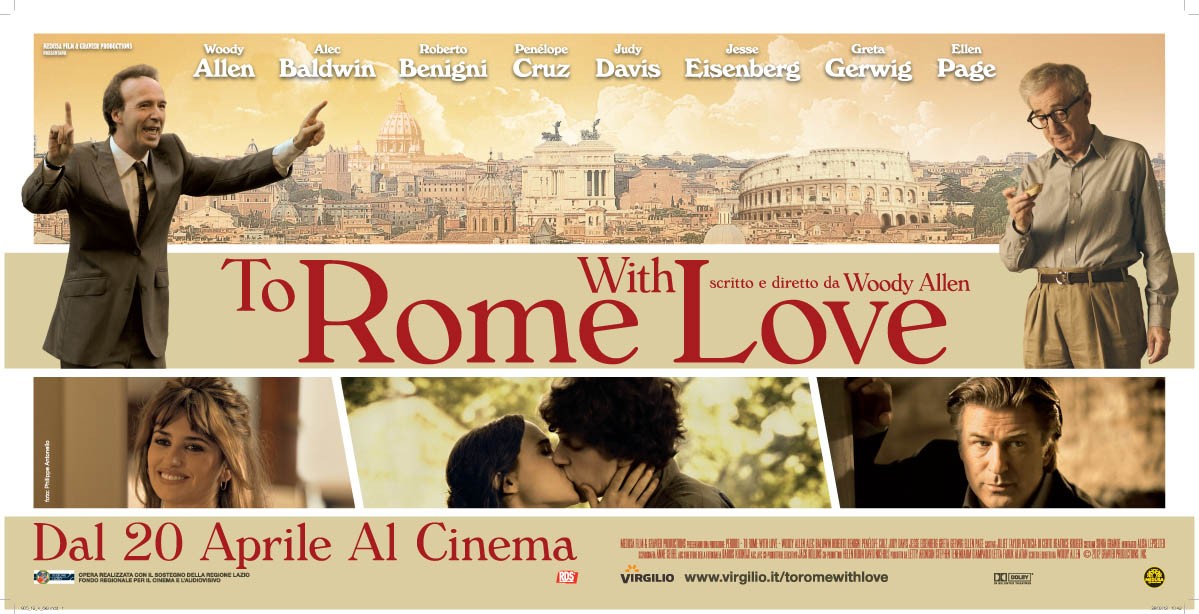
Rome with Love
Rating:
***/*****, or 6/10
Woody
Allen continues to pay homage to the great cities of the world and
this time directs his attention to Rome, where he has an ensemble
cast of noted actors play in four different stories set in the
Eternal City, though never overlapping one another.
First,
famed architect John (Alec Baldwin) revisits Rome where he supposedly
meets a young student of architecture Jack (Jesse Eisenberg) and
guides him in his ever complicated dealings with his girlfriend and
her friend Monica (Ellen Page, always a joy) who he quickly falls in
love with, despite his intentions not to. Question is, is John simply
reliving his Roman experiences of thirty years past and criticizing
what he should have thought about Monica then?
Second,
the young American Hayley (Alison Pill) and Italian Michelangelo
(Flavio Parenti) decide to get married, after which her parents
Phyllis and Jerry (Judy Davis and of course Woody Allen himself) fly
to Rome and meet his family, including his father Giancarlo, an
undertaker. Bored to death in retirement, Jerry overhears Giancarlo
singing operas in the shower and quickly plans to make a star out of
him, but since his talents only work in the shower, Jerry is forced
to make unorthodox decisions to allow his plans for fame and glory to
come to fruition.
Third,
newlyweds Milly (Alessandra Mastronardi) and Antonio (Alessandro
Tiberi) visit Rome on their honeymoon, but events swiftly separate
them, setting both of them on their own adventures as Antonio is
mistaken for somebody else by a prostitute (Penélope Cruz) after
which he applies her talents to ensure a good business deal goes
through as planned, while his new wife finds herself ensnared by a
famous Italian actor and is lured into a passionate affair, only to
be interrupted – and saved – by a robbery.
Fourth,
average Roman citizen Leopoldo (Roberto Benigni, love him or hate
him, as usual) lives a mundane life but all of a sudden finds himself
the centerpiece of attention for the media as he rises to full-fledged
but short-lived stardom for no reason whatsoever.
Utilizing
Rome's many fabulous settings to great effect, Allen's various
stories prove to be less compelling, driven by simple and predictable
plot twists. In the hands of a lesser director this would only spell
doom for the film, but in Allen's capable hands it at least results
in a cheerful viewing experience as the cast fully embraces and
enjoys their roles (and their pleasant stay in Rome no doubt). Still,
the quality of the four stories differs considerably, with the tale
of Milly and Antonio the film's high point as both characters are
swept off their feet by Rome's turbulent life offering them ample
opportunities for inappropriate passion, with the both of them
struggling to escape fate's ironic turn of events to return to their
true love. Aided by Penélope Cruz' joyful and memorable performance
as a hooker this story stands out the most, while at the other end of
the spectrum the tale of Jerry's attempt to bring Giancarlo's voice
to full on-stage recognition results in the predictable answer of
having him perform operas while showering, a resolution only
appreciable for those not familiar with Donald Duck comics. And while
the story of Leopoldo offers plenty of opportunities to critique the
Italian paparazzi media Allen forgoes this chance in favor of a
simple story of a normal man living his fifteen minutes of fame which
blows over as suddenly as it started, resulting in Benigni jumping
through the Roman streets with his pants pulled down in hopes of
recapturing his glory that so unexpectedly has come and gone. To
Rome with Love makes it clear Allen, who was offered to direct a
film in Rome with full financial support of local distributors, never
intended for this film to be more than the sum of its rather bland
parts, but it's a credit to his capabilities as a director and the
quality of his assembled cast the film at least succeeds in giving us
two hours of simple fun in the Roman sun. Accept it as Allen's way of
sending the world a postcard, from Rome, with love.
And
watch the trailers here:
Et si on vivait tous ensemble?:
To Rome with Love:
Labels:
alec baldwin,
arthouse,
comedy,
drama,
geraldine chaplin,
jane fonda,
Jesse Eisenberg,
old people,
Rome,
sex,
stephane robelin,
to rome with love,
tous ensemble,
Woody Allen
zaterdag 6 oktober 2012
The life of an actor, or something like it
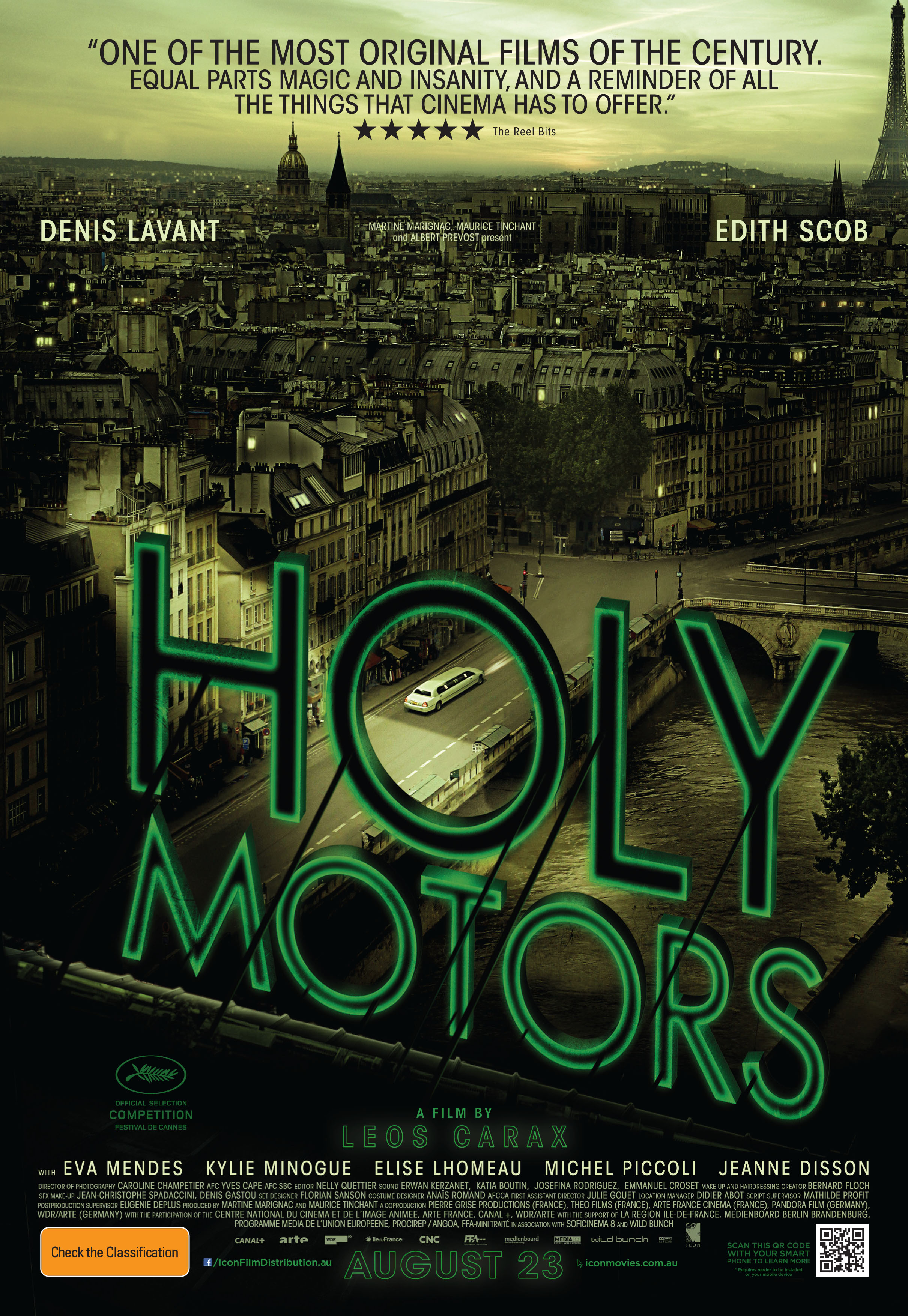
Holy Motors: ****/*****, or 8/10
For
those of you who were wondering whatever happened to Leos Carax after
his last film Pola X (1999) sadly flopped, wonder no more, for
Carax has returned from obscurity with a vengeance. Of course, you
must have heard of him before having been able to miss him, and
considering the general inaccessibility of his often experimental
work in cinema, his mere existence will have gone unnoticed to many.
His latest project, the hallucinatory Holy Motors, deserves to
change such neglect, considering it's nothing short of a mesmerizing
night drive through Paris. By limousine, no less.
The
protagonist, if there is one specific protagonist to speak of, is a
man referred to only as Mr. Oscar (excellent performance on multiple
levels by Carax regular Denis Lavant). When night falls, this
shadowy, enigmatic character is picked up by his personal limo driver
Céline (Edith Scob), who takes him from one strange job to another,
with little or no apparent connection between them. Successively, we
see Mr. Oscar as Motion-Capture performer, madman, assassin, musician and
deathbed mourner, among other things. For each outing, Mr. Oscar is
supplied with the necessary make-up, costumes and accessories to
finish his task, without the audience knowing who orders him around
and why exactly he does what he does.
In his
“exile” from the film industry, Carax on several occasions
started to develop new projects and wrote material accordingly, but
it always failed to materialize in a finished film, his ideas being
turned down every time. Though his persistence at least produced a
number of short features, the final product that is Holy Motors
clearly reveals the diversity of ideas that haunted the director for
over a decade, resulting in a kaleidoscopic two-hour piece that is
open to as many interpretations as it offers story threads. This
leaves the spectator ever unable to fully account for them all when
suggesting a consistent story line that explains the lot of them, but
such a loss to come up with a final solution for this film's
narrative whole – something which clearly was never intended to be
found – only makes the film a greater joy to behold. That is, for
those members in the audience who want to be surprised and can
swallow a lack of coherent diegesis. It must be said, this film
surely is not for everybody: when viewing this picture, as many
people left the room as remained in their seats, the latter no doubt
utterly captivated by Carax's bizarre joy ride through their
minds,while the former undoubtedly found themselves repulsed by this
attack on their sanity, or proved just generally unable to cope with
what they experienced. For those that stayed, it also helped to be
treated to many a superb image of Paris by night, the director
utilizing light and shadow to maximum effect to achieve a sense of
constant ill-at-ease paired with total fascination, both
'Verfremdung' during and unquestionable acceptance of the full 115
minute trip we take as we escort Mr. Oscar from one sketch to the
next.
What do
I think is going on here plot wise? I must firmly state that I
believe Holy Motors does never intend to deliver us a
full-fledged narrative which allows itself to be entirely rationally
explicable. That said, I believe the film revolves around the act of
seeing and being seen as an actor, the question remaining who but
ourselves is watching Mr. Oscar, assuming he's actually supposed to
perform for anybody's pleasure at all. As Mr. Oscar, Lavant is being
maneuvered from one play to another, having to rely on all his skills
as an actor while often enduring excessive make-up and clothing,
without ever being watched by an audience explicitly. Mr. Oscar is
clearly acting, but he's not being filmed, as if he's simply running
around practicing, trying to 'stay in shape' as any athlete would
without there being an actual contest involved. At the same time,
Carax seems to expose the lies of being an actor, as Mr. Oscar is
moved from one project to another without time in-between to be
himself, taking on so many roles but never living a life of his own.
His roles are as variable as are his multiple personae, and
considering he should have died twice in his line of duty, as he is
both violently shot and stabbed, it's certain this can't be anything
but acting. Certain actions Mr. Oscar plays out serve no true purpose
for anybody: in the role of the horrifying madman, Oscar eats
flowers, bites off fingers and subsequently abducts and sexually
assaults a beautiful model (Eva Mendes' most oddball role ever), but
such actions are devoid of reason other than playing the madman. The
only spectators enjoying them, or being completely freaked out by
them, are we, Carax's viewers.
Anything
conclusive about Carax's supposedly serious comments on the busy life
of a professional actor we might think we can distillate from this
film is inexorably shot down in the closing scene when Oscar's limo,
along with many others limousines from other people sharing his
incoherent occupation, is collected back by the Holy Motors company
and stored in their huge warehouse until further notice: using their
lights, the cars communicate about their day and the various roles
their occupants played, some of them at the same time urging their
peers to be quiet because they want to sleep. Whatever philosophical
or metaphysical message you thought you could discern in Holy
Motors, this ending makes it perfectly obvious there's no point
to take this film overly serious. As this final scene clearly
illustrates, the last laugh is for Leos Carax, who with this
grotesque but terrific film proves there's still room left for
inexplicable, near-experimental cinema.
Directed
by Leos Carax
Starring:
Denis Lavant, Edith Scob, Eva Mendes
France/Germany:
Pierre Grise Productions, 2012
And
watch the trailer here:
donderdag 8 maart 2012
Babel
Rating:
****/*****, or 7/10
Iňárritu's
call for tolerance and mutual understanding between everyone, no
matter what their ethnic, linguistic or religious background, is an
ingeniously woven mosaic following four families around the globe in
the aftermath of a boyish prank gone terribly wrong. An American
couple (compellingly portrayed by Brad Pitt and and always phenomenal
Cate Blanchett) on vacation in Morocco sees a good time turning into
a nightmare when the wife accidentally gets shot by two Moroccan boys
playing with their father's gun, their family afterwards immediately
suspected of terrorist activities by the local authorities.
Meanwhile, the couple's Mexican babysitter gets into trouble at the
American border with their two children in tow, and a widower in
Japan, the former owner of the gun, deals with his deaf teenage
daughter's blossoming sexuality. Iňárritu's
message is clear: if people tried harder to listen to each other, a
lot of trouble could be avoided. Overall, Iňárritu
gets a little too preachy near the end of the picture, despite
thoughtful writing and solid acting.
Starring:
Brad Pitt, Cate Blanchett, Rinko Kikuchi
Directed
by Alejandro González Iňárritu
USA/Mexico:
Paramount Vantage, 2006
Abonneren op:
Posts (Atom)