Posts tonen met het label old people. Alle posts tonen

zaterdag 29 juni 2013

Today's bunch of minireviews: young people, old people and sex


Spring Breakers: ****/*****, or 7/10

Harmony Korine's provocative take on the death of the American Dream – or the exact opposite, its ultimate realization – follows a quartet of young college girls (including Harmony's wife Rachel) who will stop at nothing to celebrate Spring Break in Florida just to engage in endless mindless, decadent sex and drug use. Being penniless proves a bit of an obstacle at first, but their solution is as shocking as it is effective: just rob a restaurant, get in a car and don't look back. It's only the beginning of a nightmarish thrill ride into the mind of America's hedonistic youngsters who, despite beind educated and full of opportunity, prefer to opt for the easy way out in order to live a careless/carefree life, even if only for a short while. Just when they're living their fantasy to the fullest, the police intervene and haul their asses to jail for abuse of illicit substances. Fortunately, a rapper/gangster/parasite called Alien (James Franco being quite the chameleon, to say the least!) bails them out and introduces them to his world of everything. Thanks to his wild and violent life style leeching off the American way of life, he has loads of guns, loads of dope and loads of sex to offer, which the girls accept all too eagerly. Except for the devout Christian of course, who decides to return home: quite the hypocrit, considering her religious values ought to have kept her from coming along for this ride in the first place, knowing full well what she got herself into but opting to look the other way for her own pleasure. The other girls have the time of their life for a while, until the situation turns dark when a rival mobster threatens Alien's turf. Soon however, it appears Alien got more than he bargained for when the remaining teens prove quite resilient in helping him deal with the aggressor in a surprisingly violent manner. 

Casting several former Disney Channel stars like Selena Gomez (Wizards of Waverly Place) and Vanessa Hudgens (High School Musical) was a brave and perfect choice, both underscoring the point Korine tries to make and allowing these girls to break completely with their 'sweet & innocent' stigma. People who expect lots of booze and boobs in an overly simplistic story get exactly what they expected, just handed in a different way than they would probably have liked, since Spring Breakers is not a simple exploitation flick, but a mesmerizing descent into madness rife with wildly divergent visual gimmicks and hallucinatory effects, making the audience less of a viewer and more of a participant. Korine's rebellious denial to uphold to cinematic conventions made distributors rather uneasy, since the expectations of mainstream teen drama mixed with evocative artsy display caused them, in their limited money driven line of thinking, to be unable to successfully classify this film. As a result, Spring Breakers witnessed a release in both multiplexes and arthouse theaters, but failed to fully win over both audiences due to its rough, offbeat style and confronting thematic contents. Mission accomplished, Korine!


Thérèse Desqueyroux: **/*****, or 5/10

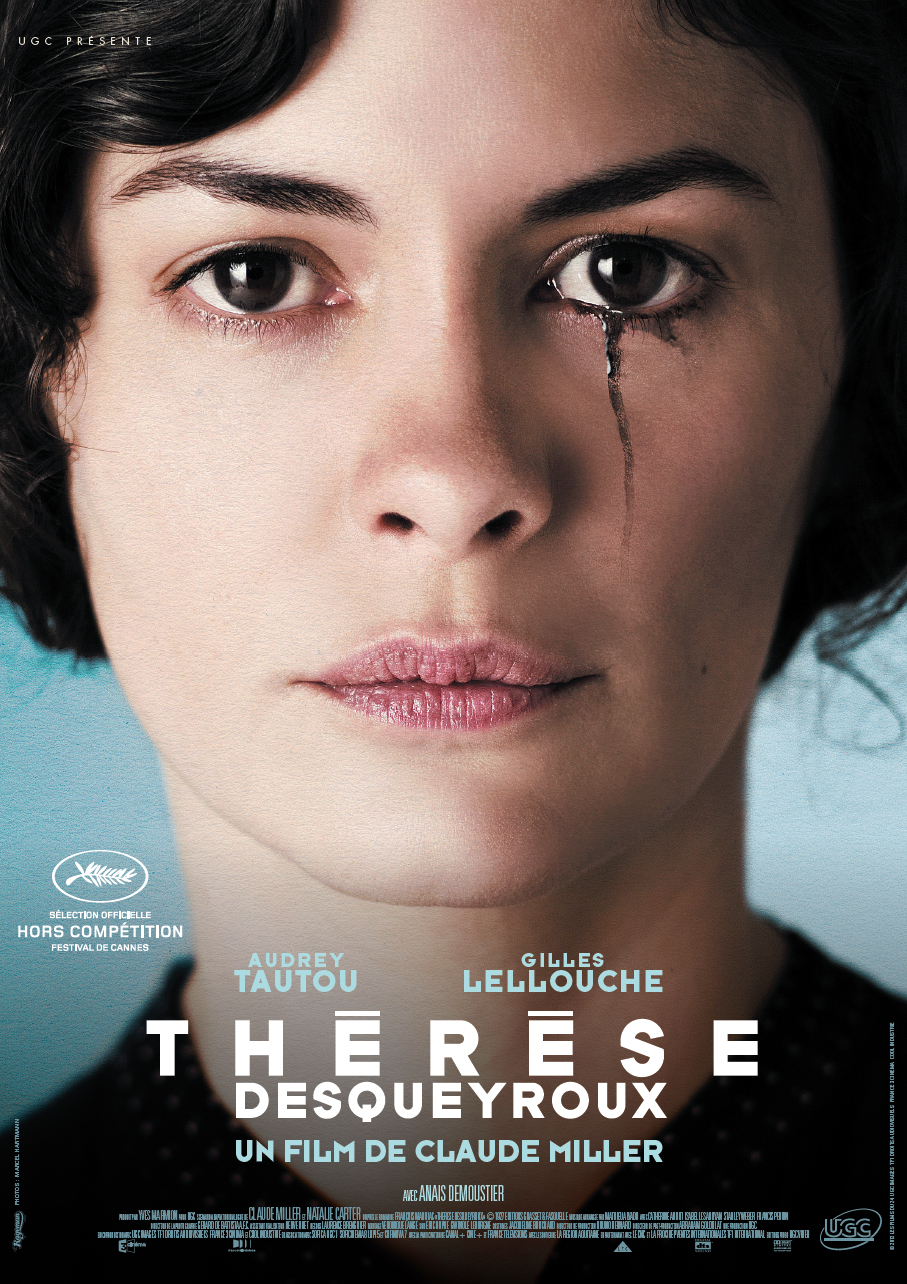
Dull French period drama, set in the 1920s, about the daughter of a wealthy land owner who is forced to marry an older man just so her family can improve its social status by getting its hands on his lands as well and thus becoming a major player in the pinery business. Thérèse (played by Audrey Tautou) soon finds that her loveless marriage revolves all around her child her husband sired with her, while she herself matters little anymore. She's as much a commodity as the pine trees her family trades in, and she receives as little affection. Yet she is expected to help convince a female relative, who's deeply in love with a boy of low status, to also marry for money. The continuing lack of care and interest in what she wants soon drive Thérèse to take outrageous, increasingly dark measures to get noticed again, including setting fires in the plantation and poisoning her husband. When her disturbing deeds come to light, her family threatens to take her child from her and gives her house arrest to avoid the scandal from becoming public knowledge. Though Tautou gives a convincing performance of a cold and calculating woman who sees her freedom and personal space deteriorate more and more, it's hard to feel much for her, since she and those around here are all despicable people who base their lives on increasing the family fortune and their social status instead of aiming to live a happy family life. Interesting parallels can be drawn between this French film and the TV-show Game of Thrones, which have much in common from a plot perspective. However, the latter does succeed much more in squeezing compelling drama out of nasty people out to strengthen their family and riches by marriage and procreation. Thérèse Desqueyroux has to make do with annoying people dancing around each other for two hours. At least the period setting of provincial France in the Twenties offers some diversion from the otherwise tedious story progression of this film.


Song for Marion: ***/*****, or 6/10

Cheerful feel-good movie that is bound to make anyone smile. Grumpy old Arthur (Terence Stamp) is married to the ever optimistic Marion (Vanessa Redgrave), whose favorite passtime is singing in a local choir with other old folks under the tutelage of the beautiful younger woman Elizabeth (Gemma Arterton, a joy to behold as always). Arthur thinks little of her hobby, thinking she'll make a fool of herself, but when she passes away from cancer he feels he must honour her passion and join up with the choir which has entered a singing contest. Arthur does so despite suffering from stage fright and general lack of interest in basically everything, including his estranged son (Who? Christopher Eccleston!) and his granddaughter. The utterly sympathetic and optimistic old performers in Elizabeth's choir, quite a colorful band of singers with their various funny idiosyncrasies, prove to be the most charming and uplifting element of the film (especially when they cheekily start singing about sex), but the emotional core revolves around Arthur and Marion. Though it is rather puzzling to find a spirited woman like her marrying a cynical old fart like him, their devotion towards one another is pulled off convincingly enough to make you believe Arthur would bother with putting up with her hobby, going so far as to save the day in the choir competition where Elizabeth's merry band of singing enthusiasts is as out of place between all the professional top choirs as Arthur is in Marion's choir itself. Of course father and son also become closer to one another due to all the merriment the songs deliver. This movie is utterly devoid of narrative surprises but proves just as pleasing all the same for all ages. An overly simplistic and predictable story does not stand in the way of strong, touching performances throughout and an overall 'don't worry be happy' attitude that nobody can resist. The song may be for Marion, but the movie is for everybody who expects nothing but 90 minutes of cheerful delight.

zondag 14 oktober 2012

Provadja's Past Presentations

Autumn continues to deliver a rather sad stream of unremarkable movies wedged in-between a great summer and a hotly anticipated winter that will conclude the otherwise excellent year of 2012 with a much anticipated bang. The lack of appealing movies has kept me from going to cinemas for a few weeks now, something I hope to remedy soon. However, it's also caused me from revisiting this blog much too often of late, and that's not what I intended. Thank heaven for Wednesday nights though, since they offered me a solution! Running the show every week at the local arthouse theater Provadja provides for something to occupy my thoughts with so I can use my experiences there in times of cinematic drought like these. The downside is I'm watching these films from the projector's booth where the movies' sound is being drowned by the noisy humming of the machines, plus I occasionally leave the room to check on other things, at which point I am likely to miss scenes of interest if not importance to the overall picture. Therefore, I can't consciously write an in-depth review of such films since I just didn't get to fully appreciate the film as it was seen by the regular audiences and I might have missed vital clues that upon closer inspection harbored the filmmakers' intentions, which I would be likely to misinterpret. However, I do get to see enough of these films to form a decent opinion on the overall narrative (if any (eh, Holy Motors!)), the general direction and the actors' performances. That gives me at least something to work with here. So which films did I get to project for Provadja's clientele lately? Here's a few from the last month.


Et si on vivait tous ensemble?

Rating: ***/*****, or 7/10

Stéphane Robelin wrote and directed this socially engaged movie, released in France a year earlier than it arrived in the Netherlands. This thoughtful dramedy (drama with a comedic note to keep it from becoming too much to bear) provides an intriguing solution to the question what should be done with old people. Rather than stick them all together in a retirement home, the seniors in this movie (played compellingly by such notable actors as Jane Fonda, Geraldine Chaplin and Pierre Richard) decide they might do better spending their last days and defeating the isolation commonly associated with old age by living in a small commune where they can just keep an eye on each other instead of having to hire total strangers to do it for them. Of course having five headstrong and short tempered elderly people sharing the same house also isn't the best of ideas, as they soon discover a level of intrigue and discord between them they had not anticipated, which ultimately ends up in a revelation of some sordid secrets from the past that might shatter their friendship.

Fortunately they had the good sense to hire the young German ethnology student Dirk (Daniel Brühl, Inglourious Basterds, Good Bye Lenin!) to do the housekeeping in exchange for the opportunity to study the elderly up close for his research. Dirk manages to keep the old folks from falling out with each other entirely, indicating the younger generation should still take good care of their predecessors, without placing restrictions on their lives as is done in retirement homes. The difference between the protagonists' life style and the situation of their peers behind lock and key for their “own good” is effectively made clear when one of their number falls ill and his friends rescue him from the clutches of ruthlessly institutionalized elderly care as they break him out of a shamefully prison like facility. Of course growing old it's not all as depressing as this, as Dirk finds out when one of the old ladies supplies him with ample details on her sexual activities for his research, much to his embarrassment (and ours!). Robelin's call for mutual understanding between the old and the young is laudable, but the movie fails to fully answer the question whether old people becoming each other's room mates would truly be a workable solution. Age detrimentally catches up with everybody after all, and as the movie perfectly illustrates with the character of Dirk, the intervention and guidance of the young remains vital, even though many seniors wouldn't want to admit it. However, Robelin's suggestion we can and should do better in our attempts to care for the elderly is decently underscored: nobody would want to whither away in retirement homes, certainly not without their dearest friends closeby.

This movie was distributed in Holland under the shorter and simpler title Tous Ensemble, while it was released accordingly as All Together in most English speaking territories.


To Rome with Love

Rating: ***/*****, or 6/10

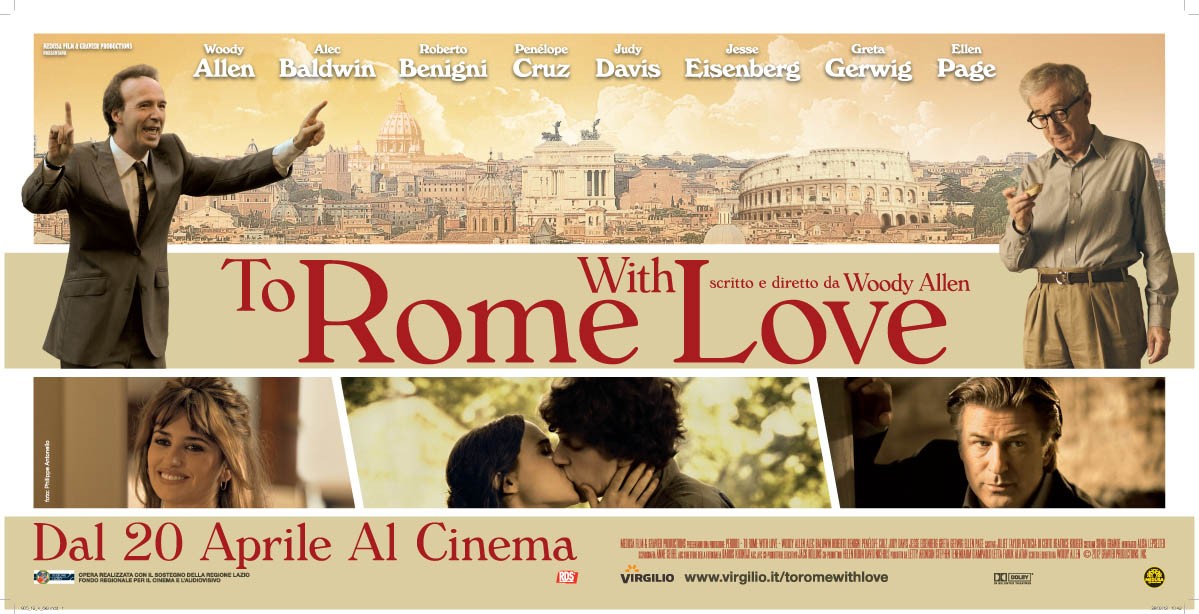
Woody Allen continues to pay homage to the great cities of the world and this time directs his attention to Rome, where he has an ensemble cast of noted actors play in four different stories set in the Eternal City, though never overlapping one another.

First, famed architect John (Alec Baldwin) revisits Rome where he supposedly meets a young student of architecture Jack (Jesse Eisenberg) and guides him in his ever complicated dealings with his girlfriend and her friend Monica (Ellen Page, always a joy) who he quickly falls in love with, despite his intentions not to. Question is, is John simply reliving his Roman experiences of thirty years past and criticizing what he should have thought about Monica then?
Second, the young American Hayley (Alison Pill) and Italian Michelangelo (Flavio Parenti) decide to get married, after which her parents Phyllis and Jerry (Judy Davis and of course Woody Allen himself) fly to Rome and meet his family, including his father Giancarlo, an undertaker. Bored to death in retirement, Jerry overhears Giancarlo singing operas in the shower and quickly plans to make a star out of him, but since his talents only work in the shower, Jerry is forced to make unorthodox decisions to allow his plans for fame and glory to come to fruition.
Third, newlyweds Milly (Alessandra Mastronardi) and Antonio (Alessandro Tiberi) visit Rome on their honeymoon, but events swiftly separate them, setting both of them on their own adventures as Antonio is mistaken for somebody else by a prostitute (Penélope Cruz) after which he applies her talents to ensure a good business deal goes through as planned, while his new wife finds herself ensnared by a famous Italian actor and is lured into a passionate affair, only to be interrupted – and saved – by a robbery.
Fourth, average Roman citizen Leopoldo (Roberto Benigni, love him or hate him, as usual) lives a mundane life but all of a sudden finds himself the centerpiece of attention for the media as he rises to full-fledged but short-lived stardom for no reason whatsoever.

Utilizing Rome's many fabulous settings to great effect, Allen's various stories prove to be less compelling, driven by simple and predictable plot twists. In the hands of a lesser director this would only spell doom for the film, but in Allen's capable hands it at least results in a cheerful viewing experience as the cast fully embraces and enjoys their roles (and their pleasant stay in Rome no doubt). Still, the quality of the four stories differs considerably, with the tale of Milly and Antonio the film's high point as both characters are swept off their feet by Rome's turbulent life offering them ample opportunities for inappropriate passion, with the both of them struggling to escape fate's ironic turn of events to return to their true love. Aided by Penélope Cruz' joyful and memorable performance as a hooker this story stands out the most, while at the other end of the spectrum the tale of Jerry's attempt to bring Giancarlo's voice to full on-stage recognition results in the predictable answer of having him perform operas while showering, a resolution only appreciable for those not familiar with Donald Duck comics. And while the story of Leopoldo offers plenty of opportunities to critique the Italian paparazzi media Allen forgoes this chance in favor of a simple story of a normal man living his fifteen minutes of fame which blows over as suddenly as it started, resulting in Benigni jumping through the Roman streets with his pants pulled down in hopes of recapturing his glory that so unexpectedly has come and gone. To Rome with Love makes it clear Allen, who was offered to direct a film in Rome with full financial support of local distributors, never intended for this film to be more than the sum of its rather bland parts, but it's a credit to his capabilities as a director and the quality of his assembled cast the film at least succeeds in giving us two hours of simple fun in the Roman sun. Accept it as Allen's way of sending the world a postcard, from Rome, with love.


And watch the trailers here:

Et si on vivait tous ensemble?:


To Rome with Love: