Posts tonen met het label teenagers. Alle posts tonen
zondag 29 januari 2017
Today's Review: The Student
Het is fijn om te weten dat in de Russische cinema nog kritische geluiden klinken. Ook al duiken die hoofdzakelijk op in 's lands arthousefilms die het nationale publiek niet op grote schaal zullen bereiken, buiten de grenzen kunnen ze doorgaans rekenen op een warm onthaal. Leviathan, Andrei Zvyagintsevs aanklacht tegen de corruptie in de bestuurlijke macht, ging er twee jaar geleden bijna met een Oscar vandoor. Het valt te bezien of Kirill Serebrennikovs The Student, gebaseerd op een door hemzelf geproduceerd theaterstuk, het even ver zal schoppen, maar hij vormt een eveneens energiek pleidooi tegen die andere grote pijler van de Russische samenleving: het geloof. Want onder het presidentschap van Poetin zijn de politiek en de Russisch-Orthodoxe Kerk nader tot elkaar gegroeid, tot weinig jubel van de ruimdenkende Rus.
De student uit de titel is Venya, voorheen een onopvallende, alledaagse middelbare scholier, een buitenbeentje onder zijn klasgenoten. Nu heeft hij het christelijk geloof omarmd, waarop hij zich direct van zijn meest fanatieke kant laat zien als religieus adept. Venya slaat iedereen met het ene na het andere Bijbelcitaat om de oren, als kritiek op alles wat in strijd is met zijn invulling van de wereld. Wie het met hem oneens is, wordt geconfronteerd met rechtstreeks uit de Bijbel overgenomen verwensingen die in klare taal omschrijven wat er met andersdenkenden dient te gebeuren. Niemand doet het goed volgens Venya, van zijn bloedeigen moeder tot de docent godsdienst, nota bene zelf een aanhanger van de orthodoxe kerk. Om de gemoederen te sussen geeft het schoolbestuur - portret van Poetin aan haar muur - stukje bij beetje toe aan Venya's eisen. Bikini's bij de zwemles moeten plaatsmaken voor kuisere badpakken, Darwins evolutieleer wordt voortaan onderwezen samen met de christelijke scheppingsleer, enzovoort. Dit tot onvrede van de biologiedocente Elena, die lijdzaam moet toezien hoe vrijheden worden ingeperkt door de agressieve mening van een charismatische eenling.
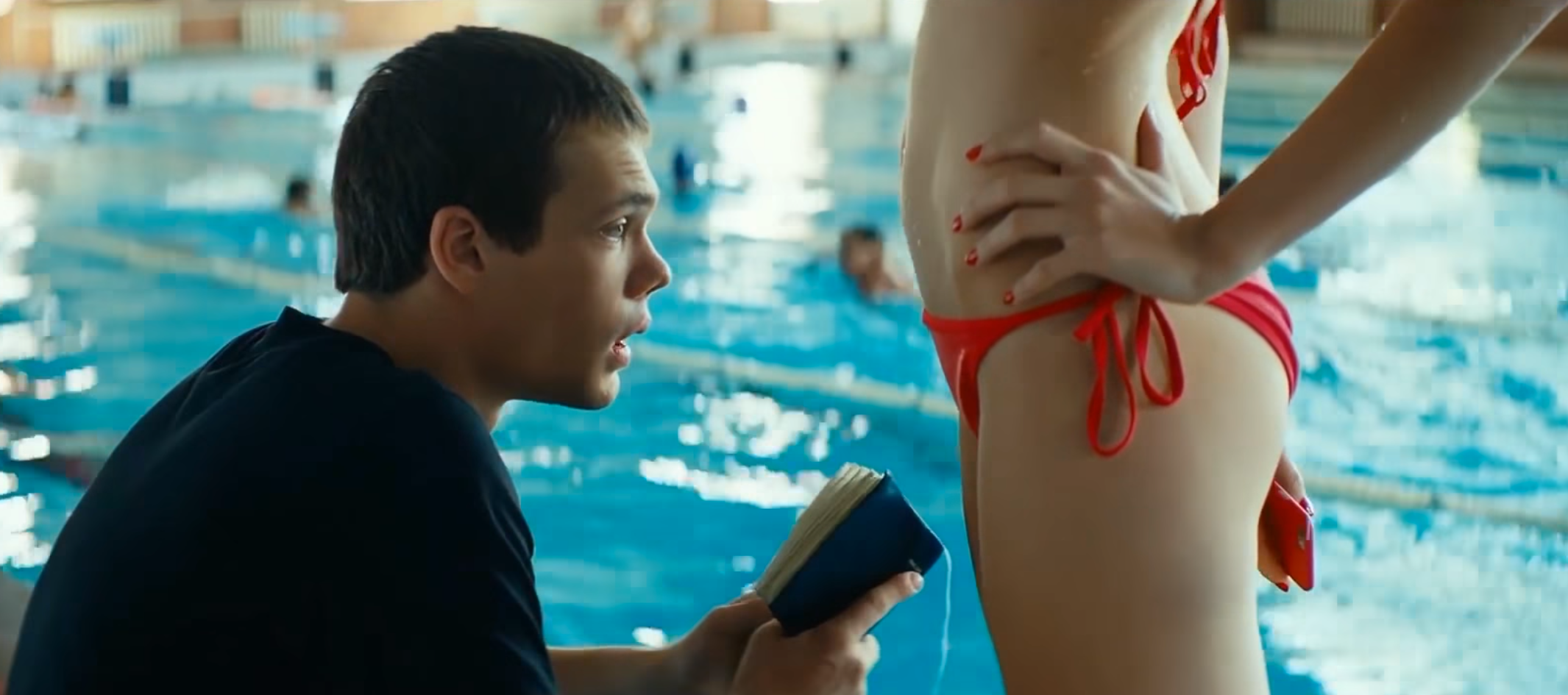
Want dat het Venya niet ontbeert aan charme, moet gezegd worden. Van de status als outsider die hij ooit had, is niets meer over. Venya's kruistocht tegen onzedelijkheid en tolerantie wordt door zijn klasgenoten met gejuich onthaald, niet omdat ze het inhoudelijk met hem eens zijn, maar omdat hij de docenten met zijn extravagante optreden op hun nummer zet. Dat zijn medestudenten op den duur vrijheden moeten inleveren door zijn fanatische beschuldiging tegen de leiding, maakt hem schrikbarend genoeg niet minder populair. Petr Skvortsov speelt Venya inderdaad met een betoverende flair, een meeslepende prestatie voor een dergelijk jonge acteur. Ook al zullen weinigen zijn kant kiezen, zijn wervelende uitvaringen tegen het establishment zijn een genot om naar te kijken. Hij krijgt daarbij uitstekend tegengas van Victoria Isakova als Elena, die hem - als spreekbuis van regisseur Serebrennikov - van rake repliek dient en hem confronteert met zijn waanzin door het blootleggen van de talloze tegenstrijdigheden in het Heilige Schrift. Waarvoor de fanaat uiteraard doof blijkt.
In dat fanatisme van de hoofdpersoon, wat de film zijn luister meegeeft, schuilt tegelijk ook de grootste zwakte van The Student. Nergens in de film leren we waarom Venya zich zo met hart en ziel op het geloof gestort heeft. De film gaat voorbij aan diens omschakeling van loser van de klas naar religieuze rockster. Is hij werkelijk van de ene op de andere dag zo diepgelovig geworden, of is het slechts een wijze om stoom af te blazen als tiener tegen zijn opvoeders? Naar Venya's motieven voor het opzoeken van het christendom blijft het gissen. Dat het hem menens is, wordt echter hoe langer hoe meer duidelijk. Populariteit bij het andere geslacht ligt binnen handbereik, maar slaat hij af. Daarentegen concentreert hij zich op het streven zijn voornaamste tegenstander, Elena, het zwijgen op te leggen, waarbij hij moord niet uitsluit. Dit is niet langer een methode van een dwarse puber om aandacht te krijgen, maar een verwerpelijke tactiek van een onwrikbare extremist om andersdenkenden uit de weg te ruimen. Hoe Venya zo wanstaltig fanatisch kon uitgroeien in zo'n korte tijd blijft een frustrerend raadsel in The Student.
Uiteraard is zijn hoofdpersoon voor Serebrennikov slechts een metafoor voor de huidige situatie in Rusland, waarin de macht van de orthodoxe minderheid groeit ten koste van de vrijheid van het individu. Venya is niet bedoeld als serieus uitgediept personage, maar als een satirische verschijning. Dat is jammer, want Svortsovs overtuigende spel is een genuanceerder uitgewerkt personage waardig. De charismatische prediker in de eerste helft van de film ontpopt zich slechts tot een bijzonder onsympathieke moordzuchtige fanaat. Die bovendien ook nog bijgestaan wordt door een overbodige volgeling, een verschoppeling in zijn klas die zegt zijn Woord te volgen, maar voorspelbaar slechts uit is op een homoseksuele relatie. Het reduceert Venya uiteindelijk tot een typetje in een toch al erg theatrale film, die de verontrustende dagelijkse werkelijkheid in Rusland wat al te opzichtig parodieert.
woensdag 26 oktober 2016
Today's Review: Hart Beat
Wie de doelgroep is van Hart Beat is vanaf de eerste seconde duidelijk. Met een opening die wordt ondersteund door uitzinnig schreeuwende tienermeisjes, zwijmelend bij een zingende hunk, is de toon gezet voor de rest van de film. De hunk in kwestie is Rein van Duivenboden, voorheen een lid van de boyband MainStreet. Deze Nederlandse Justin Bieber heeft met Hart Beat zijn eigen speelfilm gekregen waarin uit de doeken wordt gedaan hoe zwaar tienersterren het hebben als ze zowel een persoonlijk leven als een glansrijke carrière in de muziek ambiëren. Want net als gewone mensen willen ze het liefst Echte Liefde. Die harde strijd om de Ware te behouden wanneer ze gevonden is, vormt het 'hart' uit de titel, uiteraard ondersteund door een flinke dosis muziek, in een nogal voorspelbaar romantisch puberdrama dat alleen die doelgroep zal behagen.
Van Duivenboden gaat in Hart Beat als Mik door het leven. Met zijn zoetgevooisde keel en zijn weergaloze uiterlijk is hij het idool van een hele generatie meisjes, maar nou net niet van Zoë. Die moet niets hebben van zijn kazige muziek en diens aan waanzin grenzende aanhang. Zij prefereert een natuurlijker, gevoeliger soort muziek. En dus draait Hart Beat om de ironie dat nou net dit tweetal verliefd wordt. Hij rijdt haar aan met zijn tourbus, zij scheldt hem uit en eist een nieuwe fiets en ergens daartussen slaan vonken over. Vervolgens gooit het wrede leven alles in de strijd om het duo ervan te weerhouden elkaar te krijgen, maar niemand die gelooft dat ze zich laten tegenhouden in hun wederzijdse smachten. Prima, dit soort films moet het nou eenmaal niet hebben van een geraffineerd verhaal, maar van een aanstekelijke feelgood uitwerking die de beoogde jongere doelgroep aanspreekt. Die tienermeisjes zal het wel bekoren, maar het lijkt onwaarschijnlijk dat andere demografieën zich tot deze fletse jeugdige romantiek aangetrokken zullen voelen.
Een verhaal als Hart Beat valt of staat hoofdzakelijk met de chemie tussen beide partijen, en die laat in dit geval te wensen over. Aan de jonge actrice Vajèn van den Bosch ligt het niet. Zij heeft al de nodige theater- en televisieproducties op haar conto staan en houdt zich opvallend goed staande naast de ervaren acteurs. Helaas heeft het scenario van de film haar in de eerste helft voorzien van een nogal onsympathieke houding, waardoor ze dikwijls nors en bits uit de hoek moet komen. Dat Zoë gebukt gaat onder de relatieproblemen van haar ouders moet het verhaal een extra dimensie geven, maar het maakt haar karakter er aanvankelijk dusdanig onaantrekkelijk op dat we niet geloven dat Mik voor haar valt. Mik zelf is echter een groter probleem, want dat Van Duivenboden voor het eerst acteert, is iets te klaarblijkelijk. Hoe sexy hij er ook uitziet en hoe leuk hij ook kan zingen, feit blijft dat hij maar één gelaatsuitdrukking hanteert en daardoor raakt onze emotionele betrokkenheid al snel in het geding. Ook de sidekicks maken de situatie er niet beter op. Zoë's compagnon is een overdadig bijdehand wicht met een tenenkrommende lijst hartsvriendinnenregeltjes. Mik moet het doen met een door rap geobsedeerde vriend - om gelijk maar een zo breed mogelijk jongerenpubliek voor de film warm te maken - die door iedereen met de neus wordt aangekeken naast de ster om wie alles draait. De ingrediënten voor jaloezie en wraak die de affaire tussen de twee jonge harten moeten verstoren liggen zo al binnen vijf minuten open en bloot op tafel.
Naast de jonge castleden komen de oudgedienden helaas niet veel beter uit de verf. Ondanks de vele accolades in hun resumé worden de volwassen acteurs hier hoofdzakelijk gereduceerd tot eenzijdige typetjes, te vaak ingezet voor gemakzuchtig komische noten. Zelfs het tragische subplot omtrent Zoë's ouders wordt hier op den duur de dupe van, want Hart Beat moet vooral niet te serieus worden, zo lijkt de gedachtegang. De doelgroep wordt immers al te vaak gebombardeerd met zware thema's in Carry Slee-verfilmingen, dus luchtigheid is het devies. De impact van alle intrige en verstoorde verhoudingen rond de romantiek brokkelt zo snel af als de film naar een bruisend happy end holt. De potentiële zelfreflexieve diepgang omtrent de jonge ster, gespeeld door zichzelf, die achter de schermen als melkkoe voor managers en producenten wordt ingezet die niets om zijn persoonlijke leven geven, wordt verspild aan een magere puberromance. De slappe dialogen - "Oh mam, doe nou 'ns even relaxed!" en dergelijke taal - doen niet vermoeden dat de schrijvers het hedendaagse jongerenjargon doorgronden. Hart Beat is simpelweg net zo 'cheesy' als Zoë Miks muziek verwijt te zijn. De fans van de zanger zal het worst wezen, die komen wel opdagen. Het is echter onwaarschijnlijk dat veel anderen hart voor Hart Beat zullen tonen.
woensdag 19 oktober 2016
Today's Review: Nerve
Hoewel het weergeven van socialmediafenomenen in films doorgaans met een paar jaar vertraging plaatsvindt vanwege het productieproces, kon Nerve in Nederland niet op een toepasselijker moment uitkomen. Terwijl de maatschappelijke ophef over Zaanse treitervloggers het kookpunt nadert, presenteert deze thriller een vergelijkbaar scenario waarin losbandige jongeren via social media de regels aan hun laars lappen. Hoe verder over de schreef, hoe beter, alles voor die felbegeerde 'likes'. Dat dergelijk gedrag al snel omslaat in terreur voor de lijdende voorwerpen komt nimmer als een verrassing, want Nerve is er uiteraard niet op uit om zulk anarchistisch gedrag goed te praten. Maar dat de producenten de huidige jongerencultuur begrijpen, is voor de doelgroep al een hele verademing.
'Nerve' is anno 2019 een schimmig online spel, waarin betalende kijkers deelnemers volgen als die uitdagende opdrachten trachten op te lossen, uiteraard tegen betaling maar met vooral 'instant fame' als beloning. Voor menig jongere lonkt roem en avontuur, maar de keerzijde is niet mis. Wie faalt, maakt zich publiekelijk belachelijk. Wie te verbeten is op het winnen, riskeert lijf en ledematen. En wie het waagt uit de school te klappen over het spel, wacht een nog gruwelijker lot. Ondanks de negatieve gevolgen waagt Vee Delmonico toch de gok, want het meisje heeft niet alleen geld nodig maar wil ook onder de schaduw van haar door het spel geobsedeerde boezemvriendin uitkomen. De eerste opdracht oogt onschuldig, als ze in een bar een onbekende moet kussen en zo in aanraking komt met de charmante Ian. Niets is echter wat het lijkt, en al snel raakt Vee steeds steviger verstrikt in het snode spel, waarvoor ook Ian een duister geheim herbergt.
Nerve maakt er vanaf de opening geen geheim van gericht te zijn op de jeugd van tegenwoordig, de stereotiepe tieners die niet los te koppelen zijn van hun mobieltjes en voor wie een 'like' van groter belang is dan een goed rapportcijfer. Misschien niet het meest genuanceerde beeld, maar dat een groot deel van de doelgroep in dit straatje past, is een feit. Inhoudelijk verschillen de tieners van nu echter weinig van hun voorgangers, want ook in Nerve spelen gebruikelijke ingrediënten als groepsdruk en identiteitsvorming een hoofdrol. De muizige Vee ziet in Nerve een financieel redmiddel en een manier om haar vrienden te laten zien wat ze in haar mars heeft. Met haar ontwapenende naïviteit gaan de kijkers snel overstag, zeker als ze chemie vertoont met hunk Ian. Die chemie is gelukkig ook voelbaar tussen hoofdrolspelers Roberts en Franco, die allebei geknipt zijn voor hun rollen, hoewel zeker de laatste eigenlijk niet meer tot de generatie behoort die Nerve groot heeft gemaakt. De standaard tienerromance en puberintriges die hun relatie kenmerken zijn herkenbaar voor het beoogde publiek, maar het is de goed getimede maatschappijkritiek die Nerve interessant maakt voor de oudere toeschouwers.
Want met Nerve blijken regisseurs Joost en Schulman, hoewel zij het plot baseren op het gelijknamige boek uit 2012, een sterk begrip te hebben voor de aantrekkingskracht van social media op jongeren, maar ook op hun keerzijde die haast elke dag in de krant belicht wordt. Wat ben je bereid op te offeren voor digitale roem? Is die hevige maar kortstondige glorie het conflict met vrienden en familie waard? Hoewel het opgeheven vingertje op den duur om de hoek komt kijken, maken de regisseurs wel duidelijk dat zij de sociale dilemma's van hun publiek doorhebben. Hun onvermijdelijk negatieve oordeel richt zich hoofdzakelijk op digitale openheid. Alle gegevens van de deelnemers liggen op straat, hun accounts op social media zijn voor niemand veilig. De kijkers gebruiken elk stukje persoonlijke informatie tegen hun pionnen, in volslagen anonimiteit. Daarmee wordt de schuldvraag ontweken als het fout gaat wat natuurlijk gebeurt want niemand dwingt de deelnemers fysiek en noch de kijker, noch het spel zelf zijn te traceren door het gezag. Mentaal vormen Vee en Ian echter een vlieg in een spinnenweb in het steeds dodelijker spel.
Het maakt Nerve tot een vaardig gemaakte thriller, die weliswaar niet verstoken blijft van een voorspelbare voortgang die culmineert in een climax à la The Hunger Games, maar onmiskenbaar stof tot nadenken oplevert. We nemen het voor lief dat het plot soms wat gemakzuchtig in elkaar steekt, zoals wanneer Vees beste vriend tot een hackerscollectief behoort dat haar uit de penarie kan helpen. Visueel is de film designtechnisch dik in orde met haar aanstekelijke neonlichtgebruik, maar de hectische montage wekt, ondersteund door een soundtrack vol herrienummers, toch irritatie op. Nerve heeft iets te veel weg van een lange videoclip. Ongetwijfeld gericht op de jeugd, die hier minder bezwaar tegen zal maken. Nerve kan, ondanks zijn tekortkomingen, een generatiebepalend cinematisch pamflet worden. Maar dan moeten diens potentiële volgers wel eerst losgeweekt zien te worden van hun social media, voor Hollywood helaas al jaren een te moeilijke opdracht.
woensdag 3 augustus 2016
Today's Review: Madeliefjes (Sedmikrasky)
Another one up, this one an oldie:
Madeliefjes - recensie
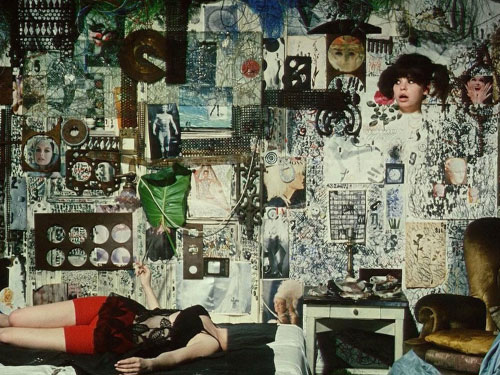
Ideologically, Sedmikrasky still makes sense. More so than ever, in fact. Designed as a feminist act of rebellion against patriarchal political systems, there's a lot to say for it when such systems are on the rise again. Now that so-called strong willed men are elected to office (or otherwise just grabbing such positions for themselves) around the globe, it's no surprise women's rights, hard fought and well earned, are slowly but surely diminished, even in democratic territories. So why not re-release a movie that fought for female independence fifty years back? Maybe because it is dated as heck in all other regards, for one thing.
Sedmikrasky deals with two young women tired of being told what to do by old men and turning the tables on them by questioning everything taken for granted and stopping to adhering to social rules. That sounds pretty hardcore, but the eventual acts of rebellion ultimately prove rather tame. They start by luring cuckolds into dates and humiliating them in public by acting like spoiled brats and messing with their food (a lot!). Soon, things get a bit more serious when they add burglary to their nefarious behavior. Still, that's about it. And all of it is executed in a subversively childish manner, which makes it hard to take seriously fifty years down the road, as we've seen much worse in cinema since. Though we can sympathize with rebels attacking an oppressive system, these two women are mostly just absurdly annoying, making for a good 73 minutes that prove hard to sit through.
What's worse, at least for general audiences, avant-gardist director Very Chytilova applies some mindbogglingly experimental cutting and photography, which makes for a wholly inaccessible movie. Everything is overly stylized, as if filming a dream. What's a modern audience to make of all this weirdness? Movie buffs and art lovers at least will appreciate the constant switching between colour palettes, the abrupt editing and the odd camera angles, not to mention the historical context which makes this film a classic in its own right, a prime example of its tempestuous zeitgeist. But without bearing all that in mind, little remains to provoke thoughts or aspire the latest generation of feminists, aside from good intentions.
zaterdag 21 mei 2016
Today's Review: Quand on a 17 Ans
I've fallen a little bit behind on updating my blog with my latest reviews. Let's see whether I can undo some of the damage.
Quand on a 17 ans - recensie
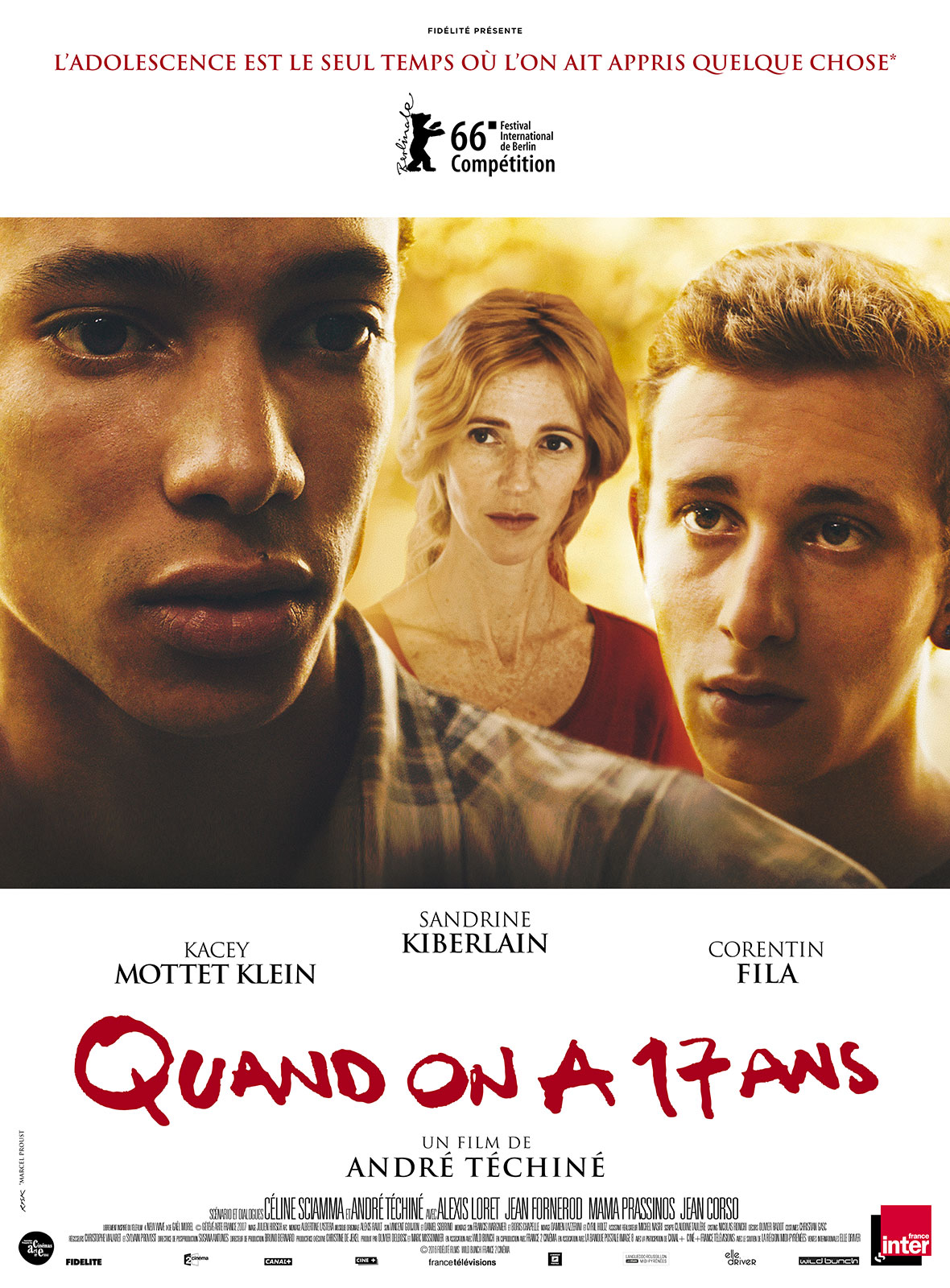
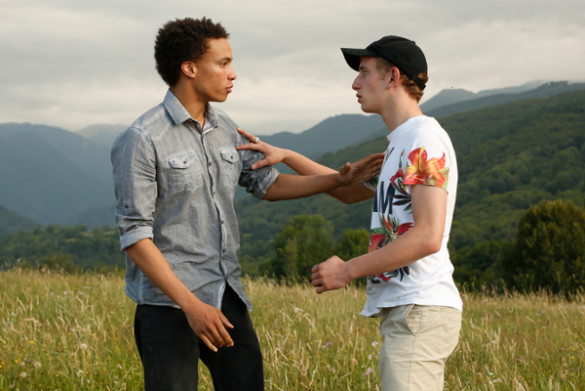
This film, which in English speaking territories is released under the title Being 17, at first has all the hallmarks of your typical teenage drama. There's two seventeen year old boys and a fair bit of animosity between them. However, where usually there's girls or social status involved in explaining said strife, that is not the case here. In fact, there's no particular cause for their mutual dislike at all, it's just there. So we can imagine the horror on the one boy's face when his mother invites the other to come live with them. It's a generous but odd decision, considering their rivalry is there for everybody to see. It's not the oddest choice Quand on a 17 ans makes, since the intention of this film is showing the start of a homosexual relationship. You'll have a tough time believing this film, which takes place over a period of about 18 months, will see the relation between the boys change from mutual hatred and the occasional bit of violence to underscore that feeling, to genuine, physical affection between the pair.
Director André Téchiné - himself a gay man - is no stranger to both gay drama and teen angst. However, he felt the subject material needed the aid of writer Céline Sciamma to flesh the characters out to their best extent. Sciamma recently came off the teen drama Girlhood, which also showed rough relationships between youngsters (though all of them girls in that particular case), but despite the 37 year difference in age between herself and her director, she proves a right addition to make the teen dialogue that much more snappy and convincing. Aided by strong, not to mention daring, performances from both the young actors and their more experienced counterparts, the script goes a long way to make the unlikely transformation from one state of affairs to the other feel that much more real. Cinematography and editing do their bit as the movie moves from a snowy, cold opening to a warm and colourful close in summer, as a perfect (but rather obvious) metaphor for the change in teen moods.
Nevertheless, for the audience it's still a far cry from hate to love (especially a type of love this deeply felt) in just under two hours time. All the ingredients are there to make us convince this is transpiring, but it just moves too fast to make us feel it with the two main characters. It has the pretention, conscious or unconscious, of an emotional epic the likes of La Vie D'Adele (better known as Blue is the Warmest Colour in many regions), but unlike that wonderful film, it just cuts the time necessary to make it equally emotionally compelling for us by a third. We cannot help but feel things are rushed, even though the movie cannot be accused of being fast paced. A change in teen nature of this magnitude simply begs more illustration for full emotional immersion, it seems.
zondag 19 juli 2015
Today's Review: Inside Out
Look at little me turning Pixar's Inside Out inside out! Or as much as you can in a general review of under a thousands words in length.
Inside Out - recensie
This may be a turning point for Pixar. The naysayers who wrote off the studio ever since Disney took over often seemed right in their sweeping generalizations that Pixar's truly creative days of imaginary wonder where done. Sequels, that's what was in store for the audience ad nauseam. It worked well on Toy Story 3, few will deny. Not so much on Cars 2 though, or even Monsters University. So a new original project was definitely desperately needed to show Pixar has lost none of its dreaming potency, and this is it. Inside Out is as emotional and beautiful, not to mention innovative and soulful an animated movie as they come, and especially as they used to come in this company's own case.
It's not as perfect as the likes of Wall-E or Toy Story 3, I'll have you know, since it has some little flaws. Like Monsters, Inc. and Up, that makes it a classic Peter Docter movie. Those films, too, featured the occasional emotional highs that went coupled with some whimsical additions that had a bit of a trouble fitting in the whole. It was especially vexing in the case of Up, where the movie just never got as powerful as it proved to be in its first act. Inside Out equally knows a few moments where the magic diminishes, most notably when it concerns the elaborate logistics of the brain (though personally I found the forgotten imaginary friend rather an obnoxious sort as well, though I appreciated the notion). Docter has learned something from Up's experience though, saving the emotional climax for the end of the film. And it packs quite a punch, as Docter delivers his message that it's okay to be sad. Quite a rebellious act, since the movie still flies the banner of the Mouse House which usually tells us the exact opposite. While still an undeniably happy end, it's unlikely anybody will restrain their tears. As Docter says they shouldn't.
So is this a definite comeback for Pixar? The list of upcoming projects still consists mostly of sequels, with the only original tale for the foreseeable future presented by The Good Dinosaur. I'm more than a bit skeptical about that one, judging from the first teaser and its overly retro dinosaurs parading through near photo-real landscapes. I doubt an Inside Out 2 is out of the question, considering the film is doing fine at the boxoffice. Still, I like to think the naysayers remain in the wrong, and there's still a few tears of joy to be spilled over Pixar's films in the next few years.
And otherwise we'll still have the shorts preceding the main events. Hopefully they'll be as delightful as Inside Out's Lava, which also gets those eyes wet and thus perfectly warms us up for the main course to follow.
zaterdag 22 november 2014
Today's Review: White Bird in a Blizzard
Wrote another review for MovieScene this week. After all, I had some catching up to do in that department:
http://www.moviescene.nl/p/157936/white_bird_in_a_blizzard_-_recensie
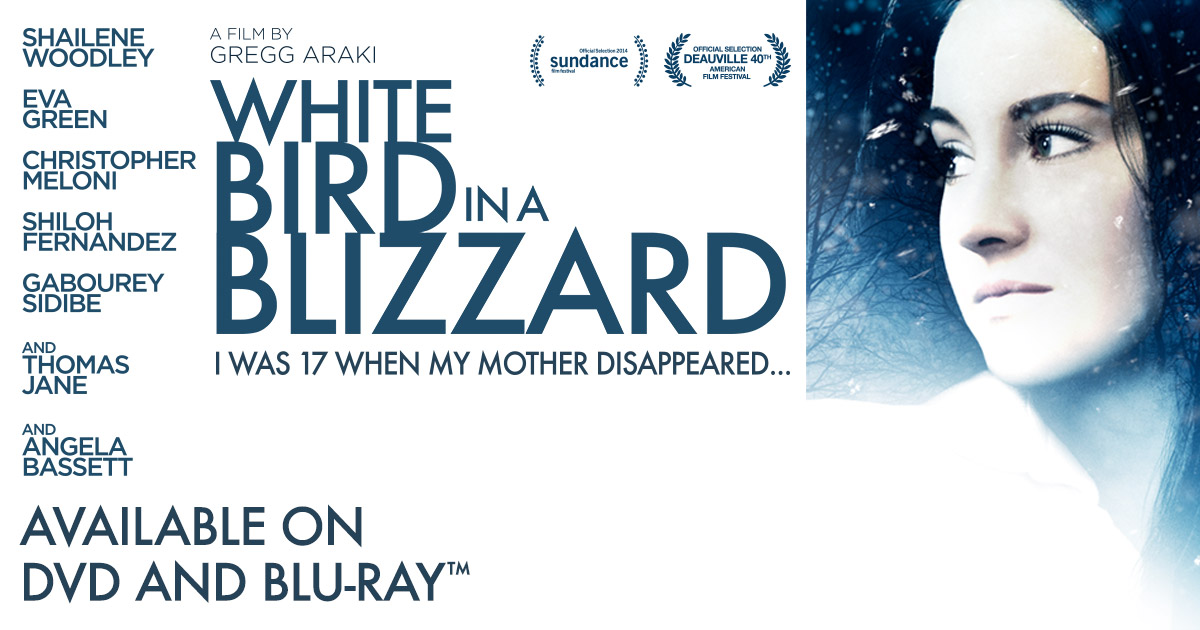
From director Gregg Araki, we both got what we expected and we didn't, in this film's case. White Bird in a Blizzard contained all his usual themes - surrealism, teenage social issues, sexuality, death - but it lacked his usual energetic visual style. It never got recognizably 'Arakiesque'. Usually it's a not a bad thing per se when you can't tell who the director is from looking at the picture, but in this case, it's no flattery at all. White Bird is a visually unimpressive, bland picture that in many ways feels like a missed oppurtunity on this director's part. You might say he preferred to stick to the source material, this being an adaptation of somebody else's novel, but considering he did change a fair amount of things already, it would also have suited him to get the film more in line with his signature style to feel less detached and make us care more about the characters.
At least performances are good throughout the piece. Shailene Woodley makes a better impression than usual. However, it's Eva Green who steals the show while playing her mother. That too, doesn't help the movie much, as it's not her show (hence the proverbial 'stealing'). In fact, it's much more about her absence than it is about her presence, but when she graces the screen, the movie lightens up considerably. Green does an excellent job portraying a seemingly perfect house wife, sizzling with the frustrations of a wasted life and unfulfilled desires just underneath the facade. Her unhealthy relationship with her daughter makes for the most emotional scenes, thoroughly uncomfortable yet mesmerizing to behold. However, the moment she's out of the picture, literally and figuratively,and the story fully centers around Woodley's character just hanging out with her friends, having sex and going to college, our attention wanes. And then it uneasily evolves from a typical coming-of-age drama into a thirteen-a-dozen thriller in the second half and all the predictable dirty secrets come out. But we care too little, too late at that point.
White Bird in a Blizzard will always be compared unfavorably to that other adaptation of a literary work Araki directed, Mysterious Skin. That movie too featured all his themes (including a visually sober look), but fared a lot better combining teen angst, creepy sexual relations and a thriller component, as the movie unraveled in a way that did make us interested in the questions of what happened to whom. White Bird in a Blizzard sadly feels repetitive and redundant on Araki's resumé. But at least Green is not at fault.
zondag 4 mei 2014
Today's review: Divergent
Divergent:
**/*****, or 5/10
There
is nothing 'divergent' about Divergent. It's a formulaic piece
catering to the prime Hollywood target audience of young adults in
every conceivable way (save for the absence of the near obligatory
love triangle perhaps). Accusations that it was only produced to cash
in on the success of the superior The Hunger Games franchise
among that most lucrative demographic cannot be denied a certain
degree of validity. Divergent is a predictable teen flick with
overt aspirations to grow into a full fledged franchise too, and it
continuously feels as such upon viewing.
The
greatest pleasure to be had from the film is the set-up of its
admittedly ludicrous dystopian society, a singular form of repressive
civilization that feels completely untenable from the get-go and
unsurprisingly proves just that over the course of the plot. Sometime
in the future the world order has collapsed. The city of Chicago –
or what's left of it, as it still appears rather disheveled – has
cut itself off from the rest of the world by an enormous fence,
protecting the supposedly harmonious society within from the ruined
world outside. Life is determined by belonging to one of five
factions: Abnegation (selfdenial and government), Dauntless
(police/army), Erudite (science), Candor (law/order) and Amity
(farming/food production). Children grow up with their parents in one
of these groups, but get to pick their own faction at the age of
sixteen after a harrowing personality test, potential family pressure
to stay in their current niche notwithstanding. There is also a
number of factionless people, those that failed to cut it in the
factions they chose, who are tolerated despite seemingly not
contributing anything to society. Of course, rivalry and shady
alliances have formed between the various factions, and nobody
appears to like Abnegation as they seem a redundant part of the
whole. There's your overall plot right there.
Enter
Beatrice Prior (Shailene Woodley, aged 23), a 16-year old girl who
never felt truly at home growing up as a child of Abnegation parents
but kept her personal convictions all bottled up. When the test
reveals her personality not to fit in into any one specific group but
rather to carry qualities of all, her sympathetic test agent labels
her a 'Divergent' and swiftly falsifies her results, as these rare
outcasts are considered a danger to society because of their mental
versatility and are eliminated accordingly. You'd think the people
who came up with this social pattern would have opted for the city to
be run by Divergents to coordinate the other factions and guide them
to get along better for the good of the whole, but that would put an
abrupt ending to the following two hours of Beatrice's
self-exploration. When the choice is put before her, she goes with
Dauntless, because that's where all the cool kids are. This future
dystopia is actually little more than a caste system reflecting an
ordinary contemporary schoolyard, where the usual stereotypical
classifications of punks, nerds and the like are strictly adhered to
by people of all ages. Really scary, not to be able to break away
from the high school pecking order for the rest of your life.
After
abandoning her parents and changing her name to the much slicker
'Tris', our protagonist is confronted by a rigorous mental and
physical training, to get rid of her former abnegating life and
determine whether she's tough enough to join the warrior caste.
Fortunately for her, her enigmatic tutor Four (Theo James) proves a
likeable guy with a killer body and charms to match. You know where
this is going the moment they first meet. If you're hoping to see
more of the logistics of this particularly unlikely dystopia, you're
out of luck, as most of what follows revolves around Tris and Four
(too) slowly but (too) surely getting romantically entangled and
making that most shocking of discoveries imaginable; they're both
Divergents. As much as Woodley is no Jennifer Lawrence, the chemistry
between her and James is passable at best, but never thoroughly
engaging. The same is true for the interaction between both
characters and their peers, while the more experienced actors among
the cast hardly get a good chance to shine. Even Kate Winslet, an
otherwise impeccable actress who has ever proven a joy to behold,
delivers a less than stellar performance in her role as the movie's
baddie, an Erudite official out to wipe out the Abnegation caste,
including Tris' parents, so her scientist order can take control of
the system. It's a diabolical ploy nobody is surprised to encounter
after the first five minutes of exposition of Divergent, which
already convinced the spectator this form of government was doomed
from its infancy. Our heroic duo of Divergents swiftly prove their
worth as they figure out a way to halt Winslet's evil plot of
assuming mind control of Dauntless to annihilate Abnegation. However,
since there's two more books and three more films to follow, don't
expect them to get thanked for their decisive actions just yet.
Ideologically
speaking, Divergent's plea against mindless conformation and
its case for individual freedom is handled just a little too
obviously. The movie proves a teenage angstfest, laced with the
pubescent search for personal identity and the development of the
sense of true belonging to such an excessive degree that the plot's
metaphorical value is utterly wasted. Tris gets to question her role
in society through all the tests and challenges to such a lengthy
extent her process of selfdiscovery simply starts to bore us. Whereas
the fear of growing up to the status of adulthood and the anxiety
regarding the need to fit into society's often repressive standards
were addressed to much better results in the Hunger Games
franchise, such thoughts prove all too overt and in-your-face in
Divergent. Nevertheless, there is room for improvement as much
for this film as there was for the first installment of that rival
series. Now that the set-up is over and done with, the viewer does
wonder where the plot (not the romance that is) goes from here. The
brief glimpses – limited both in terms of scope and frequency,
mostly due to budget restrictions no doubt – we witnessed of this
odd dystopian future do leave room for curiosity as to how exactly
this world functions, as it has done for an alleged century.
Considering the target audience has flocked en masse to theaters to
get lost from their own woes and indentify with these relatable
issues (for them at least), those sequels have been guaranteed.
Hopefully a final similarity to The Hunger Games can be made
in the future, as Divergent's sequel proved to be much more
intricately crafted than its otherwise bland and forgetful
predecessor.
zaterdag 12 april 2014
Today's Double News: Divergent fanbase can go ape
Today's batch of fairly fresh movie news:
http://www.moviescene.nl/p/155049/derde_deel_divergent_opgedeeld_in_twee_films
http://www.moviescene.nl/p/155032/nieuwe_afbeeldingen_dawn_of_the_planet_of_the_apes
This is getting old. But the trick keeps working in studios' favour, so why not repeat it ad nauseam since the target audience doesn't seem to mind being milked? When it was first announced that the last Harry Potter book would get a double finale, I rejoiced, since I felt there was way too much material for a single movie. I felt that way about books 5 and 6 too though. After that, every successful franchise aimed predominantly at a young adult audience took a hint from this strategy. The trick was repeated with The Twilight Saga, which I - and many others - don't care as much for as for the adventures of said young wizard (basically, not at all) and that time, I experienced it as a nuisance, since all those bloody teenage girls made a mess of my movie theater twice in a row, obnoxiously screaming like such female groupies tend to do. Now The Hunger Games: Mockingjay will undergo the same treatment. I haven't read that book in its entirety, but when I picked it up in a book store and browsed through the last few pages to spoil myself on who died and who didn't, the volume wasn't any thicker than its predecessors, making me wonder whether splitting the movie in two would result in a decent pair of movie. Divergent (or better yet, Allegiant, as is the title of the third book in Veronica Roth's trilogy), same story really. As nobody will deny, it's simply a way for the studio to make more money out of a lucrative franchise, postponing the end as long as they can. Makes you wonder why they don't bother splitting the second novel either. It's barely begun pre-production, so there's still time to do so. I wouldn't have mind if the fifth and sixth Potter installments were comparably chopped up, considering how much material from the books was brisquely swept aside. Why not go that extra mile and give the second Divergent film (Insurgent) a similar treatment? Go fully episodic! Oh wait, that kind of storytelling is what television exists for... Considering TV these days has proven a vastly superior medium in terms of storytelling, it's no surprise Hollywood studios take a hint from its narrative make-up. It starts with splitting up movies in half, who knows, maybe it will end with the return of the Thirties' serials. That's what you get if you chop up stories that might not benefit from being overdone this way.
Then again, Peter Jackson has succeeded in making a threesome of three-hour movies out of a book that is even less imposing in size than the Divergent novels...
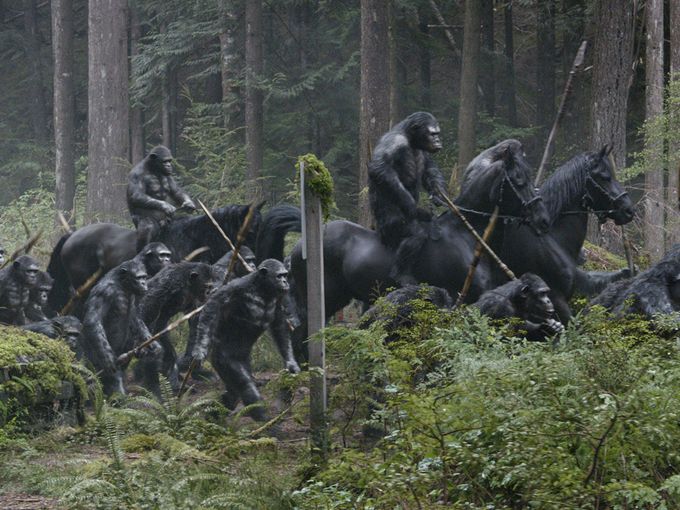
At least the Planet of the Apes franchise doesn't have to worry about similar issues, as its origin can be traced back to a book so small in size you're finished reading within an hour. Didn't stop Hollywood from basing five (!) movies off it, though most of it they made up for themselves. And now that the reboot series is in full swing, Pierre Boulle's little novel is ignored altogether, as the new movies base their story off the later entries in the original movie saga, which had little to do with the original story by the French author. Doesn't matter in terms of quality though, as the first movie in the reboot franchise proved quite a solid film, making us forget the dreadful Tim Burton remake of ten years earlier. So far, word on the sequel is equally positive. These freshly released stills indicate that the second movie too incorporates its fair share of story elements from the original movie series for its own purposes. And thanks to the wonders of CGI (and the mo-cap performances of Andy Serkis and others, lest we forget), the apes look more photorealistic than ever. Even when they're riding horses or wielding guns. Now that Dawn of the Planet of the Apes is deep in the post-production phase and FX shots are finished on a daily basis, we can expect a deluge of similar pictures in the next few months, showing off just how much animators can convincingly do with their apes nowadays. And if it's true director Matt Reeves has succeeded in balancing story and effects as much as his predecessor on Rise of the POTA, this series too might make it to five films. Or more. There's no restrictions based on the literary source here, after all.
donderdag 3 april 2014
Today's Review: La Jaula de Oro
Here's another review I wrote for MS this week:
http://www.moviescene.nl/p/154754/la_jaula_de_oro_-_recensie
Quite a harrowing movie. And it began in a rather optimistic fashion, with positive teenagers hoping for a better life in the USA and following their dreams, leaving behind their extreme poverty and hopping on a train off into the great unknown through the beautiful jungle. An unknown that keeps being unraveled by revealing nothing but misery which keeps spiralling into ever more degenerative depths of despicable human behavior the closer the protagonists get to the border. What began as a roadmovie ends in a social horror picture. Director Diego Quemada-Díez has made a chilling drama movie that needs to be seen to fully understand the plight of Latin-American illegal immigrants. But he doesn't make it easy on his audience, nor should he if he is to respect his source material, the suffering immigrants themselves.
dinsdag 19 november 2013
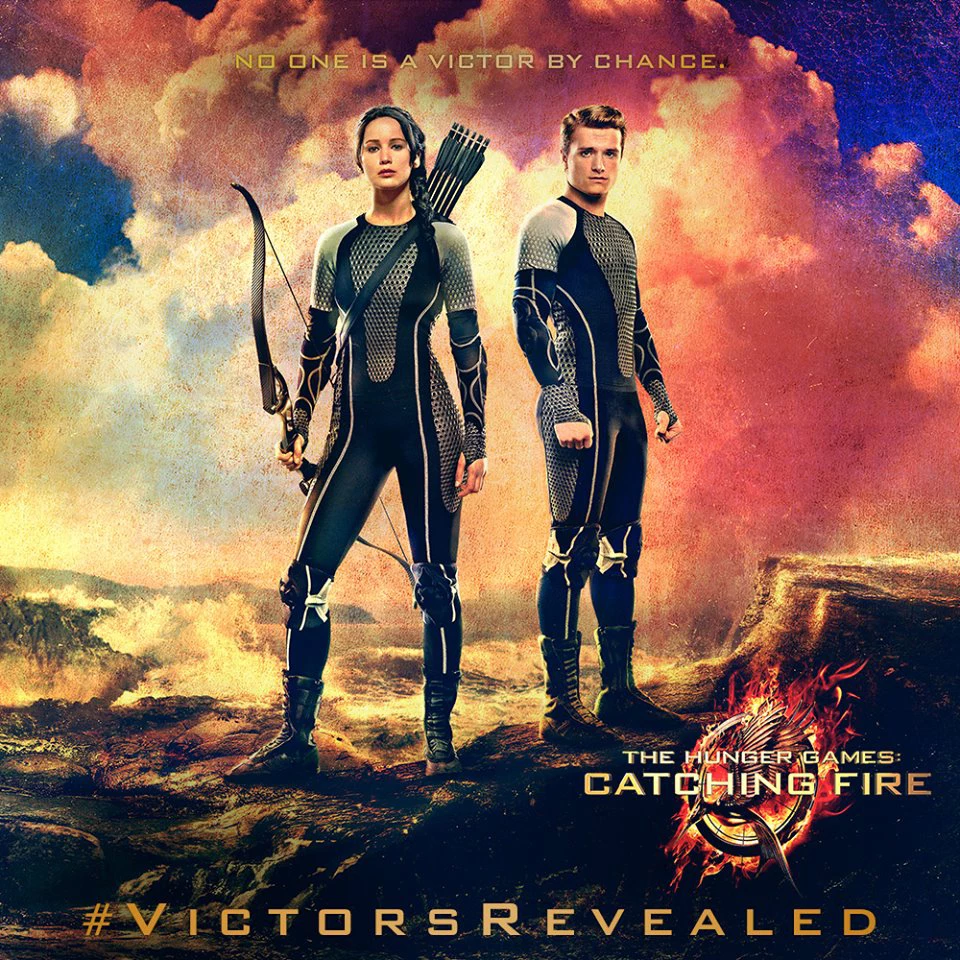
Today's Review: The Hunger Games: Catching Fire
I had the privilege of reviewing the next installment for The Hunger Games last week, and here's the result as posted on MovieScene today:
http://www.moviescene.nl/p/151677/the_hunger_games_catching_fire_-_recensie
It got edited down a bit due to length, as is usual for my MS reviews. Some of the sentences don't run as smoothly as my original intention was, but you get the gist: I was quite positive about the film. It was a worthy successor to the first film and in many ways surpassed it. Nor was the much dreaded love triangle, though still present, as much as an obstacle for the flow of the film and the attention of the audience as I initially feared. Though still not perfect, Catching Fire did about everything The Hunger Games did, except bigger and to more gripping results.
This was also my first major press viewing. Whereas most of the ones I attended so far drew crowds of no more than 20 people, this particular screening witnessed at least 80 attendees from all over the country. It was a more formal showing too, complete with security taking the audience's cell phones in custody to prevent potential illegal copying. They didn't find one on me, much to their surprise and my entertainment. Furthermore, the distributor tried to bribe us with copies of the book and a neat little mockingjay brooch. Considering my 8/10 rating, they might as well have succeeded. I'm currently reading that book, which is odd, since I haven't read the first novel and I usually refrain from reading Dutch translations from books originally written in the English language. Maybe it's simply a good read, even though I preferred the movie (which follows the original text fairly closely I must add). To top it all, the screening was held at my actual job location, so I surprised and frustrated my colleagues, hard at work at that time, by appearing on the job only to disappear into the theatre to watch a film they all desperately wanted to see for themselves. And of course I bragged about it the rest of the week, for such is my nature. All in all, I much enjoyed this first big shot press screening of mine and I sure hope more will follow (though sadly I just lost out on the second Hobbit film).
It seems the odds where in my favor on this one.
maandag 4 november 2013
Today's Mini-Review: Jeune & Jolie
Jeune
& Jolie: ***/*****, or 6/10
François
Ozon paints a titillating but rather illogical coming-of-age portrait
of the seventeen year old Isabelle (Marine Vacth) who explores her
sexuality over the course of a year, told in four episodes over the
four seasons. In summer we witness the nubile French girl's
defloration by a German boy whilst on vacation with her parents. It's
not a very fulfilling first time to say the least, as the young man
humps her in a rather unflattering way (though alcohol is partially
to blame). In the next season Isabelle chooses a secret life of
prostitution, the suggested notion being to seek out other sexual
options with men of various ages and preferences to really find out
what she likes and desires herself. The exact reason for opting for
such a drastic measure to discover her own sexual nature Ozon
regrettably leaves in the dark, a rather cowardly move on his part as
a writer, since it requires quite a leap of faith to take this
decision for granted, one most spectators will have difficulty with.
Vacth (actual age 23) nevertheless exhibits a brave performance in
her role as hooker, as she is seen nude throughout the film on a
regular basis throughout many a steaming sex scene, some exerting a
genuine sense of tenderness and even playfulness, but others falling
into a category of either unpleasant to watch to the point of
debasing, or just awkward redundancy as we fully understood she was a
prostitute at that point in the story. Despite all the intercourse
she partakes in, the only real connection Isabelle experiences is
with an old man who actually seems to care about her as a person too,
instead of simply as a body for hire. Unfortunately she proves too
much for his weak heart which expires as they have sex one time too
many, after which Isabelle's hidden profession comes to light to the
police, and ultimately her parents. Over the next two seasons, the
girl must cope with her double life, her mother even more so, and
come to terms with the reason why she chose such a dangerous and
desperate path for her self-exploration. A clear answer is sadly
never provided, so we are led to believe that any girl whose first
time isn't pretty could easily go down the same route. Isabelle,
however, must also deal with the death of a man, especially when she
meets his widow (Charlotte Rampling) in spring, who seeks answers of
her own regarding his demise. An overly mutually understanding
confrontation follows, which further adds to the plot's credibility
being stretched further than it ought to be. With Jeune &
Jolie Ozon doesn't penetrate the realm of female sexuality for
the first time (e.g. Swimming Pool for example), but he does
so in his least convincing film to date. Nevertheless, thanks to
strong performances by the cast overall and Vacth in particular, as
well as genuinely compelling emotions being stirred in the various
revelations (not answers, mind you) of the details of Isabelle's
life, Jeune & Jolie is still a far cry from the mindless
sensational soft-erotic drivel it would otherwise have become.
maandag 23 september 2013
Today's Mini-Review: The Bling Ring
The
Bling Ring: ***/*****, or 6/10
Sofia
Coppola examines the darker side of fame and celebrity worship in
this tale based on true events. A gang of teenagers repeatedly break
into the lavish homes of various celebs (victims include Paris
Hilton, Orlando Bloom and Lindsay Lohan) and steal thousands of
dollars worth of clothing, jewelry and other assorted personal
belongings (but at least they don't take Hilton's dog). This simple
plot line is based around two notions that trigger both surprise and
disgust in the viewer. Firstly, the ease with which these young
robbers manage to sneak into their targets' villas: in many cases all
that was needed was scaling a fence and climbing through an unlocked
window, or locating the front key under the door mat. And in some
cases the gang succeeded to pay return visits over five times, as if
the celebrities they stole from either didn't notice their stuff was
missing – which is likely the case, as they tend to be out a lot
and own so much stuff they hardly seem able to keep track of it all –
or they simply didn't care. You'd almost be inclined to think the
stars literally invite the perpetrators to enter their homes and
become part of their exorbitant life style, which, as the movie
reveals, is all the teens really aspire to in their lives. Secondly,
and even more mindboggling, is the fact the illegal actions of this
'Bling Ring' as it was called were met with praise and adulation from
their peers all over the country and the teens became minor
celebrities themselves. Yes, they got fined heavily and sentenced to
serve jail time by the authorities, but many people, equally obsessed
with living a similarly shallow life of fame and riches, applauded
their actions and their nerve. Coppola is not so much interested in
exploring the causes of this rampant fascination with banal celebrity
culture that invites emulation amongst young people who seem to care
about nothing else than expensive fashion, all-night partying with
excessive drug and alcohol abuse and endless posting on various
social media about their decadent way of life. She merely records and
observes young adult obsession with lowbrow popculture spiralling out
of control, as these youngsters find they want a piece of their idols
and discover it's all too easy to get it, without really caring about
the consequences. For this purpose Coppola assembled a convincing
cast of young actors with limited motion picture experience, with the
exception of Emma Watson (of Harry Potter fame, obviously),
who in many ways could be viewed as the type of celeb that might have
fallen prey to this band of kleptomaniacs (luckily she lives in
England). Watson delivers the most compelling performance of the
group as a girl so devoid of social scruples, hints of intelligence
and sense of consequence it's both hilarious and frightfully
disturbing. Equally offputting is Paris Hilton's mansion, once a
crime scene in regard to the movie's topic, now ironically serving
as a location for much of the film. We are treated to a glimpse into
Hilton's outrageous life style as we walk through her home as the
protagonists are cleaning it out. A personal night club lounge with
dance pole, huge closets filled with all kinds of expensive dresses,
hundreds of pairs of shoes; you name it, Paris has got it. We can
only hope those alleged saucy “private” photographs of hers the
gang embezzles are meant as a joke. Coppola's neglect to delve deeper
into the decadent teen copycat culture that allowed for these
burglaries to happen – which she may have done intentionally so as
to make the 'Bling Ring' equally as bland and emotionally boring as
it was in real life – makes for a rather dull movie consisting of
an intriguing topic but a rather poor execution, as we are basically
treated to a bunch of despicable, flat characters going on an endless
“shopping spree”, all the while talking about fashion, sex and
drugs, but without having anything to say that makes them remotely
interesting. Pretty soon you hope for the police to arrest their
butts and drag them off to jail to lock these horrid teenagers up for
good. The fact that this doesn't happen for over an hour of this 90
minute film, while the young criminals get moderately famous when it
finally is time to pay for their actions, does deliver some sort of
twisted punch to the piece, but it doesn't make the film easier to
sit through.
zondag 25 augustus 2013
Today's Review: The Mortal Instruments: City of Bones
Here's another one of them review thingies I did for the folks at MovieScene:
http://www.moviescene.nl/p/149313/the_mortal_instruments_city_of_bones_-_recensie
Suffice to say, City of Bones gave me no boner. It's simply too much of a formulaic movie doing whatever you expect from a formulaic movie, especially where it concerns the lack of being at all interesting. It's a real shame, considering the abundance of good, capable actors, even of the teen variety. I doubt this film will do what Twilight did - drawing excessive numbers of teenage girls to the cinema - and I don't lament it, but I mostly see a waste of talent here, both in terms of acting and in terms of the art department which also did a solid job. Oh well, it's not the first disappointing movie of the year. Not that I had particularly high hopes for this one.
woensdag 3 juli 2013
Today's Mini-reviews: Hannah and the Call Girl
Hannah
Arendt: ***/*****, or 7/10
Biopic
about the noted 20th century Jewish-German philosopher
Hannah Arendt (1906-1975), played impeccably by Barbara Sukowa.
Directed by Margarethe von Trotta, the movie mainly examines Arendt's
reports on the trial of Nazi war criminal Adolf Eichmann in Israel
for the American magazine The New Yorker, as well as the
overwhelming critique, following their publication, on her
controversial findings regarding the mentality of the architects of
the Holocaust. Arendt's conclusion is that they were not evil inhuman
monsters, nor even purely driven by antisemitist motivations, but
instead that they were everyday bureaucratic nobodies who viewed
their atrocities simply as a job that needed to be carried out as
effectively as possible. This new concept of the 'banality of evil'
caused widespread criticism of Arendt's philosophical thinking, and
caused her to be much maligned by fellow Jews, including people close
to her. The movie covers all of this turbulence in Arendt's life, but
does so in an overly stiff manner, rendering both Hannah and her
intellectual antagonists rather emotionlessm thus sadly underscoring
the popular opinion that philosophy is dull. It also makes it uneasy
for the audience to really care about Hannah's tribulations as she
undergoes them with minimal visible emoting. Nevertheless, from a
historical perspective the topics covered remain intriguing, aided by
good performances throughout as well as the terrific use of actual
footage of the real Eichmann at his trial, indeed showing him to be a
single-minded man devoid of critical thinking or even remotely
interested in the moral issues while carrying out his former
onslaught. The movie does do a botched job of portraying the romantic
relationship between Arendt and her mentor – and eventual Nazi
philosopher – Heidegger, which is touched upon in a series of short
flashbacks which hint at its importance, but eventually fails in
being fleshed out in a satisfactory manner that helps us beter
understand Arendt. It's a missed opportunity, but ultimately not
completely harmful to the overall plot. Warning! Due to heavy smoking
by Arendt throughout the whole of this picture, this movie may cause
irreversible damage to your lungs.
Call
Girl: **/*****, or 5/10
Swedish
thriller regarding prostitutes and politicians in the Seventies,
which caused quite a stir in its own country due to its suggestion
that a popular prime mininster of that era engaged in secret sexual
hook-ups with underage girls who were forced into this sleazy
business. Though in truth the movie only briefly touches upon that
particular subject, it's no surprise many Swedes would take offense
at the rather bleak and harsh view Call Girl offers of the
political arena of the day and its subversive fascination with young
female flesh, as seen through the eyes of a troubled teenage girl,
locked away in a juvenile rehabilitation center. As she escapes her
confinement she and her friend soon meet up with all the wrong people
and are ushered into a world of glitter and power where they can have
whatever they want, but for a price. Under the “care” of an
unscrupulous older woman, a terrifying role by Pernilla August (once
Anakin's warm and caring mum), she finds herself landing the job of
underage hooker, being shipped from one dirty old powerful man to the
other, seemingly with no hope of escape. Meanwhile, a political news
reporter gets wind of the whole affair and means to expose it, but
finds himself intimidated by the agents of the powers-that-be at
every turn, until there is no way out but death or victory. Call
Girl cannot be denied to be a gutsy movie, handling a sensitive
topic with nerve and bravery, but there's various elements against
either enjoying it as a thriller or taking its contents too
seriously. For one thing, there is the excessive running time of 140
minutes, which surely could have been shorter to make for a more
compelling film, since several scenes of political corruption and
debauchery, heroic investigative journalism and plenty of bare boobs
feel redundant. For another, the main girl the movie revolves around
is a rather stupid, obnoxious and spoiled young cow, making one
stupid decision after the other to predictable effects, making it
hard to really care about her fate since she so obviously did
everything to deserve it. Though the ice cold, wholesomely disturbing
role by August and the shocking, uncompromising climax make up for it
quite a bit, it's not enough to make the movie feel like its
overstaying its welcome, while appearing to warn teenagers to behave
and stay away from strangers a little too overtly.
zaterdag 29 juni 2013
Today's bunch of minireviews: young people, old people and sex
Spring
Breakers: ****/*****, or 7/10
Harmony
Korine's provocative take on the death of the American Dream – or
the exact opposite, its ultimate realization – follows a quartet of
young college girls (including Harmony's wife Rachel) who will stop
at nothing to celebrate Spring Break in Florida just to engage in
endless mindless, decadent sex and drug use. Being penniless proves a
bit of an obstacle at first, but their solution is as shocking as it
is effective: just rob a restaurant, get in a car and don't look
back. It's only the beginning of a nightmarish thrill ride into the
mind of America's hedonistic youngsters who, despite beind educated
and full of opportunity, prefer to opt for the easy way out in order
to live a careless/carefree life, even if only for a short while.
Just when they're living their fantasy to the fullest, the police
intervene and haul their asses to jail for abuse of illicit
substances. Fortunately, a rapper/gangster/parasite called Alien
(James Franco being quite the chameleon, to say the least!) bails
them out and introduces them to his world of everything. Thanks to
his wild and violent life style leeching off the American way of
life, he has loads of guns, loads of dope and loads of sex to offer,
which the girls accept all too eagerly. Except for the devout
Christian of course, who decides to return home: quite the hypocrit,
considering her religious values ought to have kept her from coming
along for this ride in the first place, knowing full well what she
got herself into but opting to look the other way for her own
pleasure. The other girls have the time of their life for a while,
until the situation turns dark when a rival mobster threatens Alien's
turf. Soon however, it appears Alien got more than he bargained for
when the remaining teens prove quite resilient in helping him deal
with the aggressor in a surprisingly violent manner.
Casting several
former Disney Channel stars like Selena Gomez (Wizards of Waverly
Place) and Vanessa Hudgens (High School Musical) was a
brave and perfect choice, both underscoring the point Korine tries to
make and allowing these girls to break completely with their 'sweet &
innocent' stigma. People who expect lots of booze and boobs in an
overly simplistic story get exactly what they expected, just handed
in a different way than they would probably have liked, since Spring
Breakers is not a simple exploitation flick, but a mesmerizing
descent into madness rife with wildly divergent visual gimmicks and
hallucinatory effects, making the audience less of a viewer and more
of a participant. Korine's rebellious denial to uphold to cinematic
conventions made distributors rather uneasy, since the expectations
of mainstream teen drama mixed with evocative artsy display caused
them, in their limited money driven line of thinking, to be unable to
successfully classify this film. As a result, Spring Breakers
witnessed a release in both multiplexes and arthouse theaters, but
failed to fully win over both audiences due to its rough, offbeat
style and confronting thematic contents. Mission accomplished,
Korine!
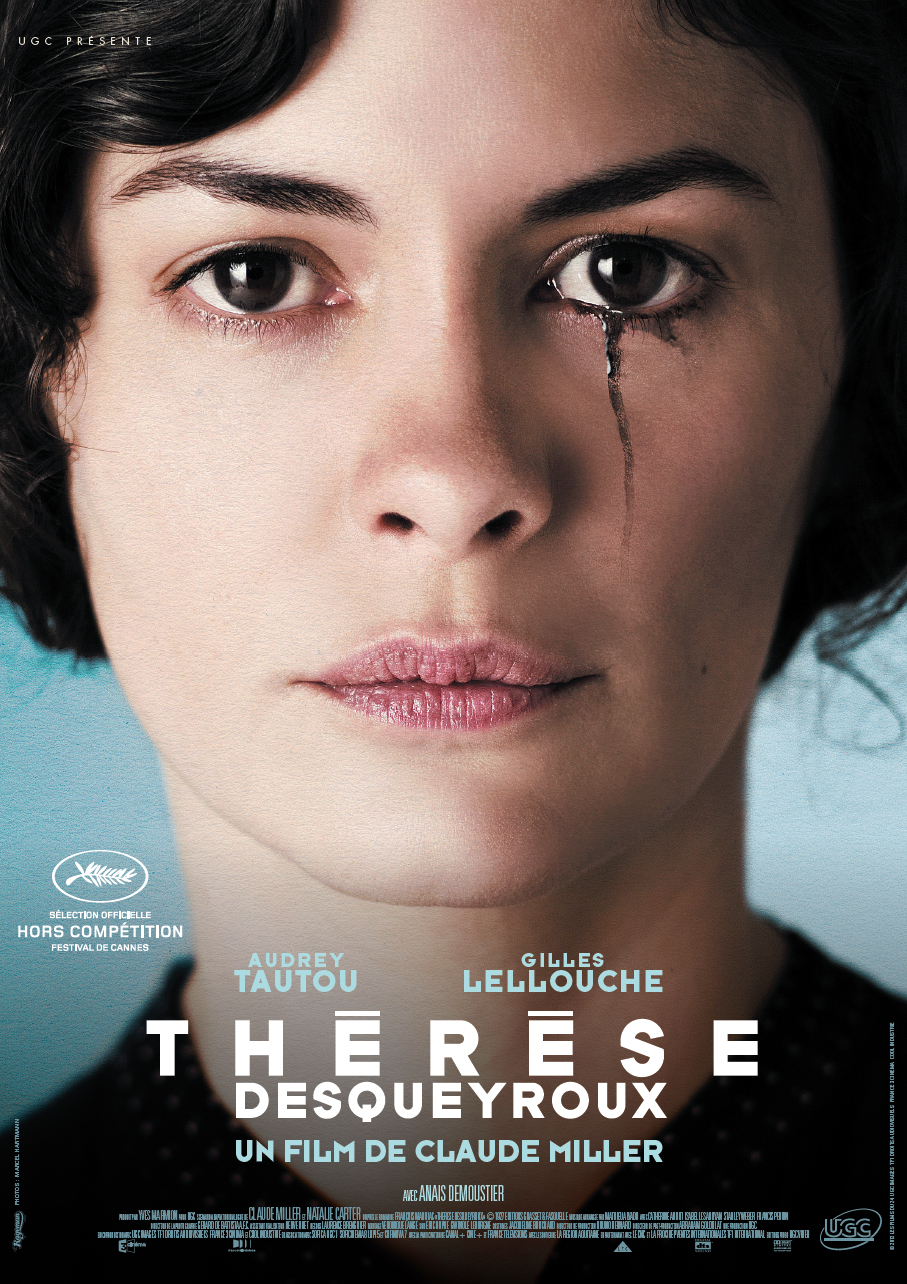
Thérèse
Desqueyroux: **/*****, or 5/10
Dull
French period drama, set in the 1920s, about the daughter of a
wealthy land owner who is forced to marry an older man just so her
family can improve its social status by getting its hands on his
lands as well and thus becoming a major player in the pinery
business. Thérèse (played by Audrey Tautou) soon finds that her
loveless marriage revolves all around her child her husband sired
with her, while she herself matters little anymore. She's as much a
commodity as the pine trees her family trades in, and she receives as
little affection. Yet she is expected to help convince a female
relative, who's deeply in love with a boy of low status, to also
marry for money. The continuing lack of care and interest in what she
wants soon drive Thérèse to take outrageous, increasingly dark
measures to get noticed again, including setting fires in the
plantation and poisoning her husband. When her disturbing deeds come
to light, her family threatens to take her child from her and gives
her house arrest to avoid the scandal from becoming public knowledge.
Though Tautou gives a convincing performance of a cold and
calculating woman who sees her freedom and personal space deteriorate
more and more, it's hard to feel much for her, since she and those
around here are all despicable people who base their lives on
increasing the family fortune and their social status instead of
aiming to live a happy family life. Interesting parallels can be
drawn between this French film and the TV-show Game of Thrones,
which have much in common from a plot perspective. However, the
latter does succeed much more in squeezing compelling drama out of
nasty people out to strengthen their family and riches by marriage
and procreation. Thérèse Desqueyroux has to make do with
annoying people dancing around each other for two hours. At least the
period setting of provincial France in the Twenties offers some
diversion from the otherwise tedious story progression of this film.
Song
for Marion: ***/*****, or 6/10
Cheerful
feel-good movie that is bound to make anyone smile. Grumpy old Arthur
(Terence Stamp) is married to the ever optimistic Marion (Vanessa
Redgrave), whose favorite passtime is singing in a local choir with
other old folks under the tutelage of the beautiful younger woman
Elizabeth (Gemma Arterton, a joy to behold as always). Arthur thinks
little of her hobby, thinking she'll make a fool of herself, but when
she passes away from cancer he feels he must honour her passion and
join up with the choir which has entered a singing contest. Arthur
does so despite suffering from stage fright and general lack of
interest in basically everything, including his estranged son (Who?
Christopher Eccleston!) and his granddaughter. The utterly
sympathetic and optimistic old performers in Elizabeth's choir, quite
a colorful band of singers with their various funny idiosyncrasies,
prove to be the most charming and uplifting element of the film (especially when they cheekily start singing about sex), but
the emotional core revolves around Arthur and Marion. Though it is
rather puzzling to find a spirited woman like her marrying a cynical
old fart like him, their devotion towards one another is pulled off
convincingly enough to make you believe Arthur would bother with
putting up with her hobby, going so far as to save the day in the
choir competition where Elizabeth's merry band of singing enthusiasts
is as out of place between all the professional top choirs as Arthur
is in Marion's choir itself. Of course father and son also become
closer to one another due to all the merriment the songs deliver.
This movie is utterly devoid of narrative surprises but proves just
as pleasing all the same for all ages. An overly simplistic and
predictable story does not stand in the way of strong, touching
performances throughout and an overall 'don't worry be happy'
attitude that nobody can resist. The song may be for Marion, but the
movie is for everybody who expects nothing but 90 minutes of cheerful
delight.
Labels:
audrey tautou,
drugs,
french film,
gemma arterton,
harmony korine,
old people,
sex,
song for marion,
songs,
spring breakers,
teenagers,
terence stamp,
therese desqueyroux,
Vanessa Hudgens
maandag 26 maart 2012
Blood of Dracula
Rating:
**/*****, or 4/10
Beware!
Misleading title here! This movie has nothing to do with the Dracula
character in whatever incarnation, despite some semi-vampiric
presence in the plot. A better title would have been 'I was a Teenage
Dracula', considering this was produced by the same company behind I
was a Teenage Werewolf, also released in 1957, to which it bears
more than just a coincidental resemblance story wise as it tells of a
troubled teenage girl (Sandra Harrison) dumped at a boarding school
by her father, who finds herself subjected to hypnotic experiments by
the evil headmistress (Louise Lewis), that turn her into a vampire at
her behest. This results in a few suspenseless murders here and there
and a dull subplot about police investigators trying to find out
what's going on. This movie was released as a double bill for
drive-ins with I was a Teenage Frankenstein. Production
company American International Pictures (AIP) was responsible for
many a lousy B-movie in the latter half of the fifties (many of them
with overly grandiose, incorrect and thus irresponsible titles):
though this flick is far from good, it's by no means the worst of
this extensive bunch.
Starring:
Sandra Harrison, Louise Lewis, Gail Ganley
Directed
by Herbert L. Strock
USA: AIP,
1957
Abonneren op:
Posts (Atom)