The Hunger
Games
Rating ****/*****, or 7/10
With the Hollywood studio executives
frantically scouring the book stores in search of new potential
easy-to-sell franchises to fill the huge financial gaps left by the
now finished Harry Potter and soon to be completed Twilight
sagas, it came as no surprise when news reached the ears of the media
regarding the upcoming motion picture adaptation of the best-selling
Hunger Games novels by Suzanne Collins. After all, the first
novel suited the Hollywood prime audience of youths between the ages
of twelve and 25 perfectly, for one thing because it was about such
youths (as were the franchises mentioned above), and for another,
because it turned out an excellent balance between action and drama,
with enough romance and humour mixed in to appeal to most
demographics, plus it had the benefit of an already existing 'big
name' because of the book's popularity. Hollywood apparently did the
right thing for itself by turning The Hunger Games into a
movie, given the various ticket sale records already broken in the
first few weeks of its theatrical run. The question is: did it do the
right thing for the general audience? Judging on this first entry
into what will undoubtedly become a trilogy faster than you can learn
to realistically mimic a Mocking Jay's whistle (people who have
already seen the film will know Jennifer Lawrence couldn't), the
answer is a hesitant 'yes'. The Hunger Games, though not
without flaws in both execution and overall plot, is at least an
exciting thrill ride that will appease many a viewer on any dreary
day, and will probably satisfy the majority of the novel's legion of
fans.
Set in a dystopian society in a
temporally unspecified future (a few centuries away most likely) and
a geographically unestablished part of North America, The Hunger
Games deals with the adventures of 16 year old Katniss Everdeen
(played by rising star actress Jennifer Lawrence who's fortunately up
to the task of carrying the majority of this film but still looks
better covered in blue paint), an intelligent and athletic girl from
District 12 of the nation of Panem. (Panem=Pan Am=all of (North)
America? Or is it the Panem from 'panem et circenses' (bread
and games in Latin), meaning the Capitol running this state supplies
the “bread” (means of living) and the subjected Districts supply
the “games” (i.e. the tributes in the form of 24 kids a year)?
Witty name? Pretentious perhaps? You decide for yourself, but I think
'Panem' sounds like a silly name for any country.) The movie gives us
an intriguing but all too brief history lesson into the foundation of
this country's present status quo, which goes a little bit
like this: in a post-apocalyptic world, the twelve poor Districts
started an uprising against their rich Capitol overlord, a conflict
in which the latter triumphed. As punishment for their disobedience,
each District must offer annual 'tributes', namely two of its
children between the ages of 12 and 18, which are pitted against the
other Districts' tributes in the 'Hunger Games', a battle to the
death, broadcast nation wide, with only one survivor out of the total
of 24 competitors allowed.
Katniss is living the good rural life
with her little sister, her mother (Deadwood's favourite whore
Paula Malcomson) and her hunky loverboy Gale (Liam Hemsworth, Thor's
brother). Of course, all good things must come to an end, especially
this early in the film, so Katniss finds herself as tribute,
selflessly offering herself voluntarily so her little sister, who was
the actual choice of cruel fate, is spared a violent certain death in
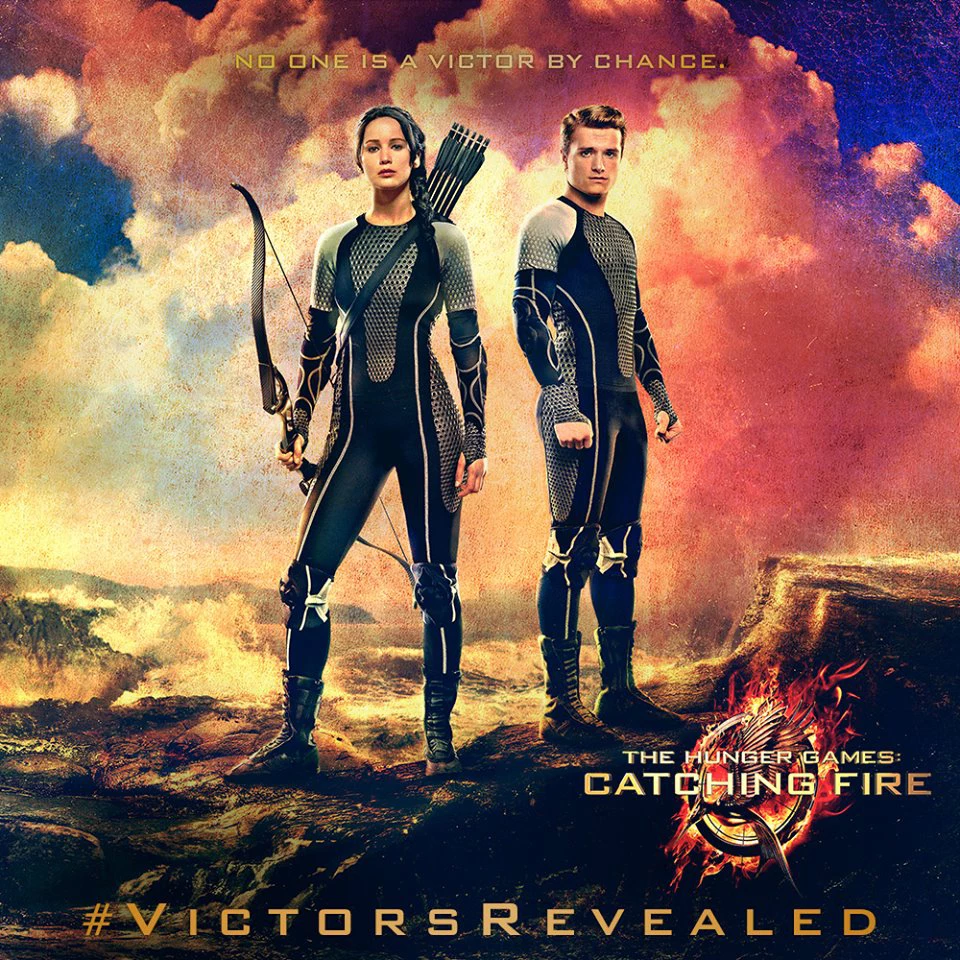
the arena. The other District 12 tribute is Peeta Mellark (Josh
Hutcherson of Journey 1 and 2 fame, apparently also a rising
star in Hollywood but nowhere near as talented as Jennifer), a boy
with a secret. Together with their mentor Haymitch (Woody Harrelson
doing what he does best, playing someone out of his bloody mind), a
former Hunger Games survivor who since has made a successful
transition from celebrated champion to opportunist alcoholist, the
pair travels to the Capitol.
And here the fun really begins. One of
The Hunger Games' strongest assets is the set design and the
simple but effective way it communicates the vast differences, both
culturally and ideologically, between the Capitol and the Districts
(or at least the 12th District, since we sadly get to see
next to nothing of the other Districts). While Katniss' world is lush
and green, with lots of forests and actual wildlife, simple cottages
for housing and populated by hardened, gritty coal miners, the
Capitol is the exact opposite, a totally urban environment filled
with big, ugly concrete buildings in the Italian Fascist style,
technologically advanced with no remnants of nature of any kind,
populated by people in the most excessively flamboyant attire and
make-up imaginable. Especially this last piece of cultural
establishment of the ruling part of the world raises some
uncomfortable laughs from the audience, given the fact that the
grotesque outfits of the Capitol citizens makes them look both
pleasantly innocent and dangerously disturbing, amiable and sinister
at the same time (Elizabeth Banks excels in showcasing this duality
in the role of Effie Trinket, the Capitol liaison to the District 12
kids). The only one who doesn't seem to join in on the current
Capitol fashion is the dictator Snow (a fittingly regal but somewhat
maniacal Donald Sutherland), who rules both Panem and the Hunger
Games event with an iron fist.

Katniss and Peeta, understandably
overwhelmed by the grandeur and splendour of the Capitol, are
welcomed by its population as would-be heroes or true star athletes,
though everyone knows they'll soon be most likely quite deceased.
What follows upon the tributes' arrival is a lenghty series of
sequences around the tributes that are designed to let the audience,
both the Capitol spectators and the viewers watching the film, get to
know this latest batch of cannon fodder, all the while working up to
the actual tournament and slowly but surely making the tension levels
mount accordingly. So in a successfully satirical mockery of media
power we watch Katniss and her rival competitors being dragged
through a parade, interviews with television host Caesar Flickerman
(performed with visible enthusiasm by Stanley Tucci) and training
sessions in which we also learn some of the differences between the
tributes' mentality. The kids from Districts 1 and 2 (which turn out
to be the Districts most loyal to the Capitol, sucking up to it
vigorously) all volunteered for the event and are really out for
blood instead of mere survival. This is of course a simple plot ploy
to establish a 'good kids' versus 'bad kids' routine, the virtuous
Katniss and Peeta belonging to the former, and the likes of the
psychopath Cato (bulked out Alexander Ludwig) and his entourage to
the latter. Both in the interviews and the training, Katniss appears
to be a most promising competitor, with her popularity in the Games
only growing when Peeta publicly reveals to be in love with her.
Question is: is he really, or is it an attempt to make his level of
interest among the Hunger Games' audience rise for his own benefit?
And then the Games begin. Now the movie
gets to make good on its promise of suspenseful life-or-death
fighting. To hurry things up a little, a whole bunch of tributes is
killed in the first few minutes of the show when all but Katniss run
to acquire weapons made available to them. Katniss makes for cover
first, using her knowledge of the forest – the shape the arena has
conveniently taken – to survive and only kill when necessary.
Alliances are soon formed, and much to Katniss' chagrin Peeta appears
to have been forced to join Cato's merciless gang of cutthroats, who
hunt down and pick off lone warriors one by one. Katniss herself
teams up with the little District 11 girl Rue (charming young Amandla
Stenberg), who of course gets murdered all too soon, after which she
believably mourns her loss and disposes of her body with respect, the
televized images of which start a rebellion in Rue's home District.
A District 12 tribute causing an
uprising in District 11 raises some uncomfortable plot questions
here: what is the point of giving the 12 Districts a common cause
against the Capitol again, in the shape of this tournament? President
Snow describes the Games as a symbol of hope for the Districts, but
the only hope there seems to be is the rise of a martyr/savious who
will rid the Districts of the Capitol, and I daresay that is not the
message the dictator means to send to his subjects... The Hunger
Games seem to be just simple amusement for the ruling city at the
expense of their subjected territories, encouraging dissent among the
latter which will ultimately overthrow the former. Also, why 24
subjects out of 12 Districts, thus making sure every District faces
at least one loss, while the Capitol can set the Districts against
each other by using one 12 victims, with one District triumphing over
the other eleven. Given the status of District 1 and 2 as suck-ups to
the Capitol, supplying the Hunger Games annually with trained killer
kids that are said to almost always win the day, provides for a
genuine opportunity to strengthen the differences between the
Districts, so as to keep them hating each other instead of focusing
to bring down the repressive regime together. 'Divide and conquer'
tactics are apparently lost on this particular dystopian government,
but not on the observant spectator trying to make sense out of the
Hunger Games' purpose.

That said, as poorly conceived as the
political situation around the Hunger Games may be, the film itself
certainly succeeds in making the event worthwhile, by delivering some
rather tense moments of suspense as the kids are after one another in
full force. Katniss has to use her every skill to stay alive from her
persecutors, and witnesses a decent amount of unfair slaughter in the
process. Of course, the movie is rated PG-13, so the level of
bloodshed is restrained to an appropriate minimum, courtesy of quick
cutting away from the gorier moments or shaking the camera around
vehemently to make sure we don't get to see in too much detail what
we obviously know we would see otherwise. Eventually, Katniss
regroups with Peeta, who's escaped from Cato's vile clutches, and the
two share some intimate moments in a hidden cave, proving Peeta's
love is true. Katniss more or less returns the favour, which makes
the existence of a love triangle the likes of Twilight in this
film official! Who will she choose, her actual boyfriend Gale waiting
for her back home, or her buddy-in-arms helping her to stay alive?
Fortunately, this movie has little to say about it otherwise (though
the unavoidable sequel undoubtedly will), considering Katniss needs
to survive first in order for her to be able to make an actual
choice, and of course, so does Peeta, since Katniss isn't the
necrophile type.
And this provides another plot point of
contention, considering Katniss never has to actually make
a choice. Warning, here be spoilers!
Katniss and Peeta are the sole survivors after having fed Cato to a
bunch of digital (both for real and in the Hunger Games' arena)
mutant dog monsters. Now of course we come to the long awaited matter
of: 'what will Katniss choose?' There can be only one survivor after
all, but apparently the rule is: 'there must be one survivor'.
And so Katniss comes up with a cop-out solution of her and Peeta
eating poison berries, thus committing suicide together instead for
one being forced to kill the other. This the Games do now permit, so
both kids are allowed to live and return home alive, much to the
dismay of President Snow who has his Gamemaster (Wes Bentley) commit
suicide himself over this fiasco. So all's well that ends well, but
the audience is robbed of seeing Katniss' choice between life and
death, which feels like something the movie was working up to.
Instead, we are treated to the prospect of an annoying love triangle
for the next film. Yay...

So there you have it. The Hunger
Games, overhyped as any such big event film designed first and
foremost to the teenage market is, is not a bad film per se, but not
wholly good either. Though it delivers solid action, up to par acting
and offers a fairly delicious dystopian society, reminiscent to those
good old post-apocalyptic flicks in the same style from the
Seventies, it could have been better if the world of Panem had been
flushed out a bit more, the Hunger Games themselves finetuned
somewhat stronger, and if the plot hadn't stolen a satisfying
emotional climax from us. The set-ups for a sequel or two are overtly
present, and though there's a certain appeal to seeing more of Panem,
there's also the strong dread it will only go downhill from here,
turning into a teen dramafest. Whether that will be the case remains
to be seen. I'm not exactly hungry for more, but if you offer me some
tasty little portions more of this, I'm game.
And watch the trailer here: