Posts tonen met het label future. Alle posts tonen

zondag 12 juli 2015

Today's Review: Terminator Genisys


Told you I'd be back with another review?

Terminator Genisys - recensie

And Arnold's back, too. Again. Wish he wouldn't be, considering the disappointing result. Once again a franchise is mucked up by messing with its time line. The producers obviously tok a hint from the financial success (brief as it was) from the recent Star Trek reboot. I hated it, because it created a new time line that hardly acknowledges the old which was running for nigh 45 years, basically saying 'anything goes' from here on out. I would have preferred it if they had shown more loyalty to the existing time line and its fanbase. Surprisingly, that is the route taken for Terminator Genisys, with equally lackluster results. In this movie's case, the new time line does nothing but acknowledge the old, resulting in a total nostalgia fest that rehashes characters, events and particularly oneliners from the previous installments. It offers nothing new, and only shows you the limits of the Terminator franchise if there is a mandate in place to incorporate the ingredients of its past successes, which was put in place because the previous installment, Terminator Salvation, offered too much novelty for many. I appreciated that movie for it. There's no innovation or novelty in Genisys, whereas in Trek's case by comparison, there was a little too much for my taste, so much so that it just didn't feel like Trek anymore. This movie undeniably feels like a Terminator movie, but still leaves a lot to be desired.

Maybe it's a sign that starting new time lines to retcon existing franchises just is a bad idea in general. How about creating new franchises instead, rather than desperately clinging to nostalgia? That's probably too revolutionary an idea for Hollywood's taste...

zondag 4 mei 2014

Today's review: Divergent


Divergent: **/*****, or 5/10

There is nothing 'divergent' about Divergent. It's a formulaic piece catering to the prime Hollywood target audience of young adults in every conceivable way (save for the absence of the near obligatory love triangle perhaps). Accusations that it was only produced to cash in on the success of the superior The Hunger Games franchise among that most lucrative demographic cannot be denied a certain degree of validity. Divergent is a predictable teen flick with overt aspirations to grow into a full fledged franchise too, and it continuously feels as such upon viewing.

The greatest pleasure to be had from the film is the set-up of its admittedly ludicrous dystopian society, a singular form of repressive civilization that feels completely untenable from the get-go and unsurprisingly proves just that over the course of the plot. Sometime in the future the world order has collapsed. The city of Chicago – or what's left of it, as it still appears rather disheveled – has cut itself off from the rest of the world by an enormous fence, protecting the supposedly harmonious society within from the ruined world outside. Life is determined by belonging to one of five factions: Abnegation (selfdenial and government), Dauntless (police/army), Erudite (science), Candor (law/order) and Amity (farming/food production). Children grow up with their parents in one of these groups, but get to pick their own faction at the age of sixteen after a harrowing personality test, potential family pressure to stay in their current niche notwithstanding. There is also a number of factionless people, those that failed to cut it in the factions they chose, who are tolerated despite seemingly not contributing anything to society. Of course, rivalry and shady alliances have formed between the various factions, and nobody appears to like Abnegation as they seem a redundant part of the whole. There's your overall plot right there.


Enter Beatrice Prior (Shailene Woodley, aged 23), a 16-year old girl who never felt truly at home growing up as a child of Abnegation parents but kept her personal convictions all bottled up. When the test reveals her personality not to fit in into any one specific group but rather to carry qualities of all, her sympathetic test agent labels her a 'Divergent' and swiftly falsifies her results, as these rare outcasts are considered a danger to society because of their mental versatility and are eliminated accordingly. You'd think the people who came up with this social pattern would have opted for the city to be run by Divergents to coordinate the other factions and guide them to get along better for the good of the whole, but that would put an abrupt ending to the following two hours of Beatrice's self-exploration. When the choice is put before her, she goes with Dauntless, because that's where all the cool kids are. This future dystopia is actually little more than a caste system reflecting an ordinary contemporary schoolyard, where the usual stereotypical classifications of punks, nerds and the like are strictly adhered to by people of all ages. Really scary, not to be able to break away from the high school pecking order for the rest of your life.

After abandoning her parents and changing her name to the much slicker 'Tris', our protagonist is confronted by a rigorous mental and physical training, to get rid of her former abnegating life and determine whether she's tough enough to join the warrior caste. Fortunately for her, her enigmatic tutor Four (Theo James) proves a likeable guy with a killer body and charms to match. You know where this is going the moment they first meet. If you're hoping to see more of the logistics of this particularly unlikely dystopia, you're out of luck, as most of what follows revolves around Tris and Four (too) slowly but (too) surely getting romantically entangled and making that most shocking of discoveries imaginable; they're both Divergents. As much as Woodley is no Jennifer Lawrence, the chemistry between her and James is passable at best, but never thoroughly engaging. The same is true for the interaction between both characters and their peers, while the more experienced actors among the cast hardly get a good chance to shine. Even Kate Winslet, an otherwise impeccable actress who has ever proven a joy to behold, delivers a less than stellar performance in her role as the movie's baddie, an Erudite official out to wipe out the Abnegation caste, including Tris' parents, so her scientist order can take control of the system. It's a diabolical ploy nobody is surprised to encounter after the first five minutes of exposition of Divergent, which already convinced the spectator this form of government was doomed from its infancy. Our heroic duo of Divergents swiftly prove their worth as they figure out a way to halt Winslet's evil plot of assuming mind control of Dauntless to annihilate Abnegation. However, since there's two more books and three more films to follow, don't expect them to get thanked for their decisive actions just yet.


Ideologically speaking, Divergent's plea against mindless conformation and its case for individual freedom is handled just a little too obviously. The movie proves a teenage angstfest, laced with the pubescent search for personal identity and the development of the sense of true belonging to such an excessive degree that the plot's metaphorical value is utterly wasted. Tris gets to question her role in society through all the tests and challenges to such a lengthy extent her process of selfdiscovery simply starts to bore us. Whereas the fear of growing up to the status of adulthood and the anxiety regarding the need to fit into society's often repressive standards were addressed to much better results in the Hunger Games franchise, such thoughts prove all too overt and in-your-face in Divergent. Nevertheless, there is room for improvement as much for this film as there was for the first installment of that rival series. Now that the set-up is over and done with, the viewer does wonder where the plot (not the romance that is) goes from here. The brief glimpses – limited both in terms of scope and frequency, mostly due to budget restrictions no doubt – we witnessed of this odd dystopian future do leave room for curiosity as to how exactly this world functions, as it has done for an alleged century. Considering the target audience has flocked en masse to theaters to get lost from their own woes and indentify with these relatable issues (for them at least), those sequels have been guaranteed. Hopefully a final similarity to The Hunger Games can be made in the future, as Divergent's sequel proved to be much more intricately crafted than its otherwise bland and forgetful predecessor.

zondag 29 december 2013

Today's Mini-Review: Daybreakers


Rating: ****/*****, or 8/10

Starring: Ethan Hawke, Willem Dafoe, Sam Neill
Directed by Michael & Peter Spierig
USA: Lionsgate, 2009

You'd think that after 80 years of vampire movies there's little 'fresh blood' to be added to the genre, but Daybreakers proved such pessimist thinking wrong. Containing one of the most intriguing premises I've ever come across, this film puts a wholly different spin on the notion of the undead thriving on the blood of their human victims. In the not too distant future, a viral outbreak has turned most of the world population into vampires, while regular human beings have become quite the endangered species. Since the vamps need human blood to survive while they are as immortal as usual, blood shortages are increasingly threatening the societal status quo (which remains remarkably human in appearance). A hematologist (Ethan Hawke) works tirelessly on a synthetic blood substitute, experiments which continue to fail, partially because the CEO of the company that controls the 'real deal' (a deliciously sinister Sam Neill) is rather keen to keep making the big bucks off rich vampires that can afford genuine blood. Vampires or not, money is still the driving factor behind it all, to the detriment of civilization. The situation is getting ever more untenable as poorer vampires are so desperate they start feeding on each other or even on themselves, causing them to mutate into crazed bat people (a funny take on the ever present relationship between vampires and bats, which otherwise plays no significant part in this film); freaks that are brutally exterminated by the authorities. Hawke's sympathetic scientist, made vampire by his brother against his will, proves a guilt ridden person determined to change this upside down world for the better and sympathizes with what few humans remain free, continuously hunted by the vampire military as they are. After aiding a group of humans evade capture, he is contacted by an underground resistance movement, led by ex-vampire Willem Dafoe, that aims to develop a cure for vampirism, the only viable way for both humans and vampires to survive their impending doom. Hawke accepts their invitation and joins their cause, which soon pits him and the rebels against Neill's profit driven tyranny.


Daybreakers' strongest moments are found in its first half, as we explore a world where vampirism is the normal state of being and society has evolved to accomodate it. Since the vampires of Daybreakers adhere to many of the archetypal characteristics of the genre, they also cannot abide ultraviolet light, and therefore “life” takes place at night, so commonplace items like houses and cars are designed to protect against sunlight. In other regards, this world differs little from our own, as the vamps work in order to pay their bills, buy their blood and live their immortal life. The disturbing imagery of humans forcefully strapped to transfusion tubes and slowly drained of their life essence in huge factory like environments successfully evokes comparisons to how we ourselves as a species treat animals in the bio-industry for our own basic needs without allowing them any shred of dignity and natural behavior. The vampire world is living in its 11th hour, close to self-annihilation caused by plain and simple greed of those in power who prove unwilling to change for the common good, in some regards echoing our own inability to alter our ways for the better in fear of loosing what we gained. In the second half of the movie, Daybreakers sheds such symbolism and largely replaces the exposition of its fascinating dystopia in favor of more trite and true action scenes and an overabundance of traditional gore (it's still a horror film, you know!), including some almost orgiastic blood baths of famished vampires feeding. Whether society is ultimately changed for the better is left somewhat ambiguous, as the movie underscores the notion that vampires, for all their superior physical strength, are still always all too human in their limited line of thinking. Though it's a pity the movie doesn't end as strongly as it started, it doesn't undermine Daybreakers' position as one of the more ingenious vampire films to date, a far cry from the currently popular image of these undead as sexy hunks to appeal to teenage audiences.


zondag 21 oktober 2012

Doing the Judge justice


Dredd 3D: ****/*****, or 7/10

In the annals of cinema, you'll find few instances of remakes surpassing their predecessors in quality. The lack of creative originality and the general feeling of déja vù all too often prohibit a remake from living up to the name of its forebear, usually rendering them highly derivative products produced simply for making more money by cashing in on an established franchise's name. However, one of the latest additions to the ever growing but already overly long list of remakes, reboots, re-imaginings and the like, Dredd 3D proves a pleasant deviation from the norm in this regard. However, it will surprise few people familiar with the former Judge Dredd movie from 1995 (which starred Sylvester Stallone as Dredd) that its successor improves upon that film on just about every level, considering it ranks considerably high on nigh on every list of 'worst comic book adapations' in existence. Judge Dredd is just an easy movie to top, and Dredd 3D does so with a vengeance appropriate for its titular character.


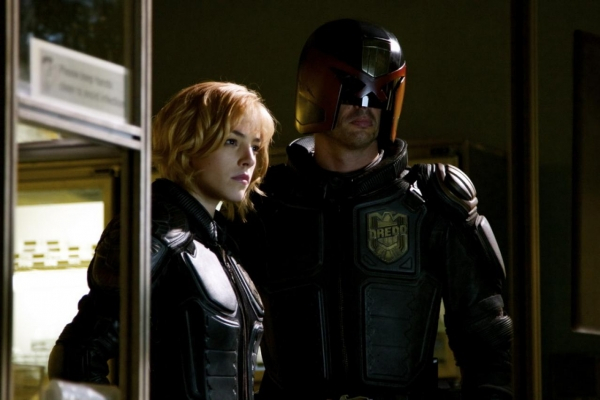
Transporting us to a typical post-apocalyptic future world where humanity has made a big mess of things via nuclear war and global pollution, we are introduced to the setting of the film, a vast metropolis named Mega-City One, where the remaining 800 million people live in a state of near anarchy on the remains of the world-that-was, huddled together in slums and giant skyscrapers. Of course so many people in a single spot is a recipe for crime running rampant, but fortunately for the decent citizens of the city (if any) the Hall of Justice has a small army of Judges patrolling the town, acting as judge, jury and if needs be, executioner in any conflict.. Sporting intimidating outfits with eerie helmets to match, a wide range of explosive weaponry and an overall 'don't fuck with us' mentality and attitude, this future police force roams the street delivering swift justice to any offenders unlucky enough to cross their path; which is still only a small percentage of total crime levels, aptly indicating the need for such a seemingly excessive justice system. Among the hardened veteran Judges is a character simply named Dredd, a paragon of virtue even amongst his fellow law enforcers, highly skilled in making sure criminals get their just due if he happens upon their shady activities. Playing Dredd is Karl Urban, who, given his fairly impressive resumé of similar Sci-Fi action flicks (examples include Priest (2011), Doom (2005) and The Chronicles of Riddick (2004), though he's undoubtedly best known for his performance as Eomer of Rohan in the two final installments of The Lord of the Rings trilogy), seems the perfect choice for the role, which fits in neatly with the rest of his oeuvre. His Dredd carries the neccessary gravitas for the character of an uncompromising badass cop, meeting out punishment with a total lack of prejudice, simply adhering to the laws in a dystopian world where very few seem to care about said law, so he refuses to shy away from intimidation and violence if warranted.

Of course such a character proves difficult to feel much empathy for, so we – and Dredd himself – are introduced to rookie Judge-in-training Anderson (Olivia Thirlby, The Darkest Hour (2011)) to help guide us into this gritty, bleak future world, working alongside Dredd on her first day as he assesses her qualities as a potential Judge. Though she failed for her first exams in training, Dredd's superiors are eager to keep her on the force since she is a mutant, possessing psychic abilities to read minds and such, which would make her a great asset to the force. That is, if she survives her first day: unfortunately she and Dredd stumble upon quite a tricky situation as they are faced with a vicious gang murder in a skyscraper which proves to be just the tip of the iceberg in a huge narcotics operation under control of the highly dangerous psychopathic Ma-Ma (another terrific, and horrific, bad lady for Lena Headey, who once played the protector of mankind's future in her own series Terminator: The Sarah Connor Chronicles, but since her performance as the devious, scheming Cersei Lannister in the superb HBO series Game of Thrones ironically excels at playing convincingly evil dames). When she learns these Judges are onto her, she immediately seals off the enormous building from the outside and, in order to get rid of the evidence most effectively, orders her legions of creepy minions to kill them both in whatever nasty way they see fit. All too soon, Dredd and Anderson find themselves cornered and have to mow their way through scores of bad guys, while attempting to break the perimeter and call for back-up. If this story sounds somewhat familiar, it's not because this movie is a remake, but because much of the plot is overly reminiscent of the recent Indonesian action hit The Raid: Redemption, which featured a police squad under siege in an apartment building on the orders of a ruthless crime lord who orders the local tenants to exterminate the law enforcers. Were it not for the fact both movies were produced more or less simultaneously, the plethora of similarities would seem just a little too suspicious. Luckily, Dredd 3D at least differs in its execution by its future setting and the fact the plot is less used as a showcase for impressive martial arts and more as a standard Hollywood type action flick (though the film was produced independently from the studio system) applying “ordinary” gun fights and stunts as its main visual draws.


Speaking of visuals, it's ironic drugs offer the most successful FX shots of the movie, despite the protagonist's insistence on shutting this drug operation down, thereby aiming to end the fabulous visual flair applied to the effects the drugs in this film have on its characters for the audience to enjoy. The drugs in question are nicknamed 'Slo-Mo' and their effects revolve around the apparent slowing down of time to a fraction of its actual speed. This results in the movie's most stunning 3D shots (it's called Dredd 3D after all), where we see the image slowing down accompanied by a glittering haze that adds some much desired colour to this otherwise dreary and bleak future. Whenever Slo-Mo is used, dazzling, almost lyrical visuals brighten the gloomy mood, allowing for wonderful dimensions of visual depth to be revealed, which are however also applied for further enhancing the levels of gore, already disturbing at times. When we see characters fall to their death from the great heights of Ma-Ma's complex, we're both fascinated and revulsed by the image of seeing them hit the ground and splattering across the screen in the graphic depth and detail such slow-motion effects allow for. It takes a strong stomach for sure, but such shots form the visual highlight of the film, and their ingenuity in 3D justifies the '3D' in the film's title, considering for most of the film two dimensions appear to suffice.


Ultimately, such visuals plus the basic action and violence are Dredd 3D's main assets, since both the story and the character development leave something to be desired. As for character development, Dredd basically has none. One might say the title is grossly misleading, considering it's really not Dredd's story at all, it's Anderson's. Though we see the film from both their perspectives, it's mostly about her. It's her first day on duty, being trained in the ways of the Judges by her mentor. For Dredd, it's all in a day's work, while for Anderson, it's a life defining experience that sees both her physical and her mental faculties tested to their limits as she must confront one creepy criminal after another, almost getting (mind) raped in the process, while Dredd, who simply shoots and maims his way through the baddies, experiences no such ordeals. Credit must be given to Thirlby for playing such a demanding role (especially considering she has never done this type of film before, unlike Urban who we already know revels in it) and pulling it off compellingly, thus adding some heart, cause and emotion to the film (though we would like to have seen a bit more explanation on the role of mutants like her in Mega-City One, something the movie alludes to on more than one occasion but never fleshes out sufficiently), whereas Dredd stays a rather bland character throughout. However, in Dredd's case, revealing more about his persona isn't at all necessary. Staying true to the comics on which the movie is based, nowhere in this film is he seen removing his helmet or showing his face, other than his mouth – which houses a well suited grumbly, raspy low voice (think Christian Bale as the similar themed Batman character in the recent Dark Knight trilogy) – since as the truest servant of the law, he must feel like something beyond simply human, more like an ideal than an actual man of flesh and blood. Dredd is made out to be just that by staying underdeveloped, unexplored, a walking talking enigma, a man without a past and without clearly defined motivations, who only lives to uphold the law, the one thing holding this screwed up society together. Undoubtedly such a character has a colourful past to explain his one sided rationale, but explaining that all away would defeat Dredd's effectiveness in this film: it would remove his helmet metaphorically, so it's as much a no-go as is removing his actual helmet, something Stallone back in 1995 had less issues with in his take on the character, which is one of the reasons his Judge Dredd failed to properly adhere to the character.

In short, Dredd 3D is a decent new shot at adapting the original comic book, superior to its feeble predecessor. It offers little new material to the genre though, since both the story and the dystopian future setting have been done before (and better) in the past, but that doesn't stop the film from being a wholesomely entertaining Sci-Fi action flick, sporting some thoroughly thrilling scenes of violence and gore and impressive visuals at times, aiding the otherwise hardly noticeable 3D effects. The unfathomable Dredd as played by Urban proves a memorable re-imagining of the iconic comic character, a sentry of the law making a lawless city just a little bit safer. Considering its various plot similarities to The Raid: Redemption, Dredd 3D fortunately also renders the much dreaded American remake of that particular film redundant. Sadly Dredd 3D underperformed at the domestic box office, so it may be quite a while before we see Dredd in action again, but until that time, this is without the doubt the best rendition of the character, effecting some much needed justice upon the franchise name by making us completely forget the lackluster 1995 film.


Sidenote: despite its shortcomings, consciously or not, Dredd 3D ultimately proved to be inspiring. Taking the metro on the way home at night, I noticed a woman harassed by some vagabonds. I stood at some ten metres distance, but nobody appeared to come to her aid (though there was quite a number of people around), despite her obvious distress. I simply walked down the tram towards the incident and demanded to know what was going on. The assailants told me in a rude and agressive tone to fuck off, but I stood my ground and told them to end their intimidation and public disturbance, at which point they directed their attention toward me. Though I got increasingly nervous, I didn't let them notice and simply looked at them very sternly uninterruptedly. The forbidding relentless eye contact clearly made them unhinged and though they continued slinging (racist) insults and threats my way, they didn't go so far as to resort to more physical measures to underscore their intentions. My tactic proved effective as several other people joined me in pointing out the hoodlums' faults in the matter and when reaching the next station, the agressors made a swift though noisy departure, clearly intimidated by the now greater numbers opposing them, exposing them for the cowards they were. Looking back, I seemed to have quickly judged the situation and acted upon it, likely extinguishing an explosive situation publicly, and I didn't need a cool helmet (quite the opposite in fact), a gun or other weaponry to do so.

Or did I? When the loudmouths had left, I realized I unknowingly had zipped open my coat's left pocket and had clutched a pen I always keep in there. Though one wasn't necessary in the end (thankfully!), I apparently unconsciously had looked for a weapon to defend myself with if it had come down to a brawl. Maybe my antagonists had noticed and feared I harbored something more formidable in there, thus hastening their decision for a quick exit. I cannot help but wonder what would have happened if it had come to a fight. A pen may normally not constitute a lethal weapon, but people have been severely hurt with less. I'm just grateful I never had to find out how such alternate situations would have developed. Unlike is usual for Dredd, this particular incident only warranted his typical quick assessment and unrelenting domineering posture to bring it to a happy end (as the woman thanked me and I received credit from numerous people on the tram for my action). But then, Amsterdam is hardly Mega-City One. Still, if I had seen a different motion picture in the hours before, would I have been in the right mood to defuse a potentially violent situation like this...?

And watch the trailer here:

maandag 30 april 2012

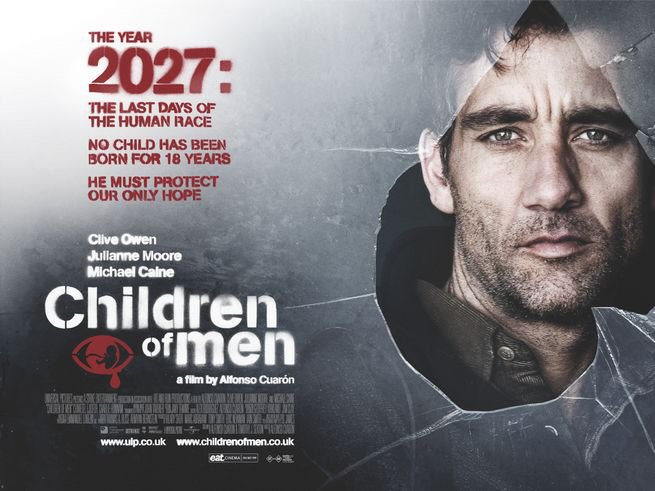
Children of Men


Rating: ****/*****, or 8/10


Depressing and gritty picture regarding a dystopian world in the not too distant future where women have lost the ability to get pregnant and have babies, after which humanity has abandoned all hope to avoid its own demise and society has degenerated to the verge of total collapse. Clive Owen lends himself perfectly in the role of grim and cynical would-be hero Theo, who is asked by his activist ex-wife (Julianne Moore) to transport a young woman, miraculously pregnant, to a safe haven where she might help scientists to figure out a way to save mankind from its looming extinction. However, other factions, more nefarious in nature, mean to appropriate the girl for their own revolutionary purposes, so Theo has a hell of a job getting her out of England alive, guiding her across the leftovers of the once quaint English country side and through a nightmarish ghetto where human lives mean next to nothing. Taking elements from classic dystopian texts, including Orwell's 1984, as well as referencing to recent actuality (including Abu-Ghraib and Guantanamo Bay), Cuarón portrays a very depraved England in a society close to committing suicide, where the absence of children has seemingly made humanity lose the ability to care about anything, after which it really let itself go and totally messed up the world in a short space of time. Exact explanations as to why women can't get babies anymore and just how the girl got pregnant are notably left out altogether, since Cuarón is only interested in showing the results of such happenstances. However, the shock of seeing a dying mankind that has deteriorated into utter lawlessness and violence hits the viewer hard, underscored by interesting stylistic choices in editing and photography, including several extremely ambitious long takes, single shots (at least, they appear to be) that last for minutes and are filled with dozens of people and all-round chaos. A very intriguing but distressing film, the subject matter clearly not suitable for everybody.


Starring: Clive Owen, Julianne Moore, Michael Caine


Directed by Alfonso Cuarón


USA/UK: Universal Pictures, 2006

woensdag 1 februari 2012

A.I.: Artificial Intelligence


Rating ***/*****, or 7/10

Overly bombastic and grandiose science fiction drama with an increasingly sentimental plot like only Spielberg can deliver, but still quite intriguing nonetheless, and wonderfully designed. A couple in fear of loosing their son has a child robot custom made, but rejects him when their son's condition improves, forcing the android to survive in a world that proves at times to be hostile to artificial life. In a retelling of the Pinocchio story, the little robot wants to become real so his human “mother” will love him again. With Jude Law in his ultimate role as a robot gigolo. Originally planned as Stanley Kubrick's last project, but when he died, Spielberg took over.


Starring: Haley Joel Osment, Jude Law, Frances O'Connor

Directed by Steven Spielberg

USA: Warner Bros Pictures, 2001

Æon Flux


Rating ***/*****, or 6/10

Not particularly convincing and convoluted dystopian science fiction flick involving a post-apocalyptic future society ruled by tyrant scientists who resort to genetic engineering to keep the population perfectly balanced, but a secret rebellion plots to overthrow these despots. Super agent Æon Flux is sent to kill the head scientist, but has a change of heart when she learns they were involved romantically in a past life. Not a great film, but mildly entertaining due to the intriguing futuristic look, some great action scenes and Charlize Theron dressed in an excessively tight suit. Based on the cult TV series.


Starring: Charlize Theron, Marton Csokas, Frances McDormand

Directed by Karyn Kusama

USA: Paramount Pictures, 2005