Posts tonen met het label post-apocalyptic. Alle posts tonen

zondag 13 april 2014

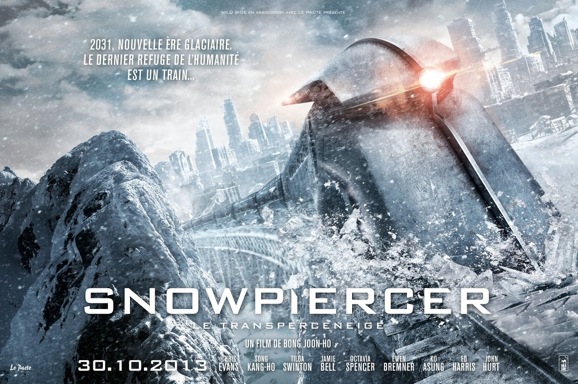
Today's Review: Snowpiercer


Snowpiercer: ****/*****, or 8/10

Blame it on the economic crisis or some such, but it continues to be a good time for post-apocalyptic cinema. Hollywood jumps on the-end-of-the-world bandwagon multiple times a year it appears, and there's no excuse for other countries not to also try their hand at exploring dystopian societies where human rights are nonexistant. A striking example from last year includes the big budget Elysium, wherein the majority of mankind is left to suffer on an overpopulated and heavily polluted Earth while the rich live a life of luscious luxury up in space. Directed by native South-African Neill Blomkamp, he utilized his home land settings and talent to great effect, though ultimately the Hollywood approach in terms of story and marketing prevailed (though it didn't much harm the film overall). Not so with Snowpiercer, which dabbles in very similar themes, but proves to be enriched as a viewing experience by a rather un-American sensibility, courtesy of South-Korean director Joon-ho Bong.

It cannot be denied that Snowpiercer's premise – based off the French comic Le Transperceneige – has to be taken with a grain of salt, at the risk of sounding utterly ludicrous. Set in the year 2031, seventeen years after a worldwide attempt to halt global warming by dispersing cooling gasses into the atmosphere went mercilessly awry, our planet suffers under an extreme ice age that covers the globe in snow and ice. Humanity's last few survivors live aboard a huge train, where a rigid class system has developed. The poor masses are relegated to the back compartments of the train, while the wealthy live in the front in relative comfort. Powered by a perpetuum mobile, the train rages over the frozen planet's surface, seemingly ad infinitum. While the haves play and party to their leisure, the have-nots suffer endlessly, huddled together in uninterrupted squalor and near-starvation. The rich are only interested in their kids, which they take away at random for undisclosed but doubtlessly sinister purposes. But biding their time under the command of the calculating Curtis (Chris Evans), the dispossessed plot their revolution, hellbent on overthrowing the repressive system and taking over the train for themselves. Such a plot line seems thirteen-a-dozen stuff when it comes to dystopian cinema, but the unusual element of the train makes all the difference, if you're willing to accept this rather bizarre concept.


'Bizarre' is exactly right to describe Bong's approach to Snowpiercer, if not to his whole oeuvre. With The Host, the Korean director delivered a monster-on-a-rampage movie unlike any other, while his celebrated but twisted thriller Memories of Murder firmly rooted him as a student of and a commentator on the human capacity for violence. Snowpiercer fits right into his resumé and stylistically reveals him to have auteur tendencies. The cruel and the weird go hand in hand in his clash of classes. Bong takes his time to explore the train and its hierarchy, where the mysterious designer and machinist of the vehicle,Wilford, is given divine status by those he keeps alive. As the desperate rebels who want to put an end to this dictatorship slowly but surely work their way to the front of the train, Bong keeps surprising us as much as his protagonists with each new compartment they enter. But, applying a certain video game logic to the narrative, each discovery also comes with new dangers, both physically and in terms of resolve of standing united against a common foe, as Curtis moves ever closer to the 'end boss' Wilford, and upon meeting him finds out the true machinations of the powers-that-be.

Bong tells his strange tale of revolution through an international ensemble of actors, which underscores the thought that humanity has collectively 'taken the same train' in the destruction of their habitat and must deal with it accordingly or perish as a whole. You'd be inclined to think of Evans as a typical all-American hero leading the quest for freedom, but you'd be much mistaken, as the character carries a particularly sordid past that would definitely write him off as such. The same is true for Jamie Bell, apparently his hotheaded sidekick, whose relationship with his older brother-in-arms is much more disturbing than you would at first glance suspect. Bong surprises you as much with the twisted interrelations between his protagonists as with the various situations they encounter. John Hurt seemingly plays an archetypal wise old man as he has done on many prior occasions, but what we come to know about him in the course of the film again subverts expectations, as do the motives of the apparently unstable demolitions expert/drug addict Kang-ho Song (a Bong regular) and his clairvoyant daughter. The audience is being toyed with in their mental perception of “the good guys” on a similar note as it is in regards to the physical appearance of the leading baddie, minister Mason, played by an unrecognizable Tilda Swinton in an outrageous costume and false teeth. Nevertheless, the cast succeeds in relaying the fact this class conflict isn't as black and white as you would initially believe, although with such morally colourful characters, it makes you wonder with whom Bong wants you to identify (if anyone): the line between good and bad characters is indeed as thin as the rails that keep their train going.


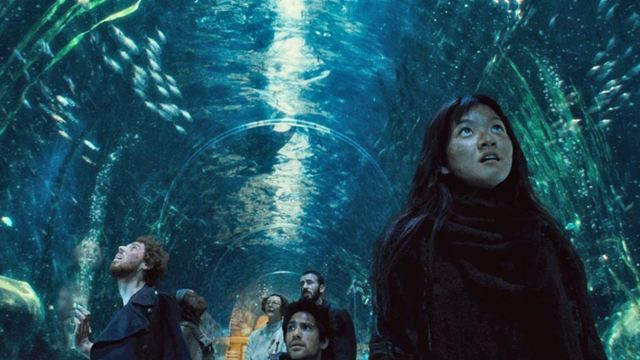
Even more colourful is Bong's sense of style. Clearly a confined space, Bong makes good use of that fact to show off his train in delightfully flexible cinematography and a colour scheme to match. Starting off with the plight of the tormented oppressed, he sticks with an abundance of brown tones – supplying a nearly monochromatic touch – and cramped, crowded spaces for the first hour, before he lets in the light and dazzles both the revolutionaries and the audience with the rich and vibrant world of the oppressors, filled with all kinds of unexpected wonders. A huge vegetable garden, a giant aquarium walkthrough (complete with manta rays), a classroom car; we're confronted with whatever we expect the least, and Bong has it all make appropriate sense. Which is not to say that he doesn't throw us off-guard at times, also in terms of the flow of the narrative. Bong makes use of the occasional off-beat, even absurdist moment that only adds to his wonderfully weird train, but continues to suggest the director's dark predilections. A brutal showdown between the tyranny's minions and the insurgents is postponed by a New Year celebration before the carnage ensues, while an overly cheerful classroom scene explodes in a bloody shootout, the presence of children notwithstanding. Not the type of thing you'd find in the more generic American dystopian flicks, nor is the movie's big revelation near the end (think The Matrix Reloaded, but without sequel aspirations). The climax however does leave some room for hope, which feels out of place and hints at studio interference, most likely from the American investors (as the film is a Korean/American/French/Czech co-production). As for the action scenes, Snowpiercer contains many and they are all sufficiently choreographed to make you bite into their mayhem, despite the oddities Bong throws at you along the way. Unfortunately many visual effects shots of the white world outside prove less than stellar and more than a little bit digital, making you wish Bong would stick more to the train, which is where nearly all of the excitement happens anyway.


Snowpiercer's premise and the logistics of its world might be hard to accept at first, but Bong makes it work. Plus, he keeps surprising you, confronting you with your own expectations, fed by having seen mostly American takes on the conflict between good and evil in dystopian societies. If you accept Bong's craziness and unwillingness to adhere to orthodox storytelling, Snowpiercer proves quite an intriguing ride, though admittedly not everyone will be able to stay on board for this one, violent, disturbing and thoroughly messed up as it deservedly can be called.


vrijdag 21 februari 2014

Today's News: Hounsou en Reedus getting some air, blowing off steam


Here's another newsflash, two days old by now:

http://www.moviescene.nl/p/153886/reedus_en_hounsou_in_hoofdrollen_air

Sources informed me this is a low budget production, and the script sure seems to suggest it, considering this doesn't exactly sound like an original idea. People go into suspended animation because of some catastrophic event, and those few unlucky souls left behind to keep their cryogenic tubes up and running start to unravel mentally, becoming a danger to themselves and their mission, and thus to everybody else. As is the case with many a Sci-Fi plot, I've already seen this concept on Star Trek. Twice, in fact. Remember that episode of Voyager where the ship passes through a lethal nebula and the whole crew is put in stasis except for Seven and the Doctor, and ultimately she is all alone and goes bonkers big time? Or remember that episode of Enterprise where the ship passes through a lethal nebula and the whole crew is put in stasis except for Phlox, and ultimately he is all alone and goes bonkers big time? Well, there you basically have the same plot as in this movie called Air. Circumstances are different, a post-apocalyptic event - in this case, a lack of breathable atmosphere - is added to up the ante a bit, as befits a movie as opposed to a TV show, where everything is bigger, including the stakes involved. As is the case with most post-apocalyptic films, it mostly revolves around the few survivors interacting with each other and ending up unable to cooperate for mutual benefit, so everybody gets screwed over by that unfortunate human tendency.


Dramatically, the most interesting aspect in this regard is the increasingly tense situation between the parties involved, slowly but surely getting ever more hostile until the shit hits the fan. Man simply cannot coexist with his fellow man, even if his life depends on it, is what this type of films usually informs us. But we sure keep enjoying to watch decent actors go at it and reach that intense crescendo. Norman Reedus definitely is no stranger to this subject matter, as he's experienced his fair bit of post-apocalyptic survival troubles playing Daryl on The Walking Dead. However, Reedus' experience as a film actor is so far limited, which is where Djimon Hounsou (Gladiator, Amistad, Blood Diamond) fits right in. The latter's involvement in a low budget picture like this is somewhat surprising, considering his resumé of big budget Hollywood bluckbusters (he's currently got Fast and Furious 7 and Guardians of the Galaxy on his slate), but maybe he just needed a break from all that in favor of something smaller, and probably more challenging. I have faith in both actors's capability to play characters who at their core are good, but will go to any length when survival is at issue. Both have a habit of playing tough, strong characters who take crap from nobody, so they're rather evenly matched. Since both gentlemen are also terrific actors I'll enjoy seeing what they make in this Trek plot rehash, but otherwise this movie doesn't sound particularly noteworthy.

maandag 6 januari 2014

Today's Mini-Review: Day the World Ended


Rating: ***/*****, or 7/10

Starring: Richard Denning, Lori Nelson, Mike Connors
Directed by Roger Corman
USA: Golden State Productions, 1955

Truth is, few of the films from Roger Corman's early days of directing schlock movies for a dime are 'good' in the usual sense of the word. In fact, most (if not all) of them are cheap exploitation quickies shot for next to nothing so they could do nothing but make a profit in drive-in theaters screaming for content to cater to teenage love birds more interested in each other in the dark than in the goings-on present on the big screen in front of them. Flicks like The Beast with a Million Eyes (1955), Swamp Women (1956) and It Conquered the World (1956) nowadays are interesting only to geeks revelling in bad taste or film students exploring the fringes of acceptable study material. Still, the occasional sort-of decent film can be found among Corman's early work for those with enough patience and the stomach for digesting campy creature features from the Fifties. Day the World Ended I count among these very few.


Stories about man's inability to coexist in peace with his fellows, even when such cooperation would be to both parties' mutual advantage in the struggle for basic survival, have often resulted in fascinating pieces of audiovisual excitement studying the human condition and continue to do so to this day even when you thought little more could be added to the subject, except for different, usually interchangeable threats. You think people watch popular shows like The Walking Dead only for the excessive gore and neat-o zombie make-up? Think again: they watch it for the gripping human drama involved in living together under extreme circumstances. Corman applied the same formula to this post-apocalyptic tale of tragedy almost sixty years ago, as he tells the story of a small band of survivors who seek refuge in the same remote mountain location when the bombs finally fall, a typical fear of the Fifties where such an occurrence never seemed so unlikely. Among those that would live are a survivalist, his pretty daughter, a geologist, a loudmouth crook, his slutty girlfriend and a man with a terrible secret. Of course tension quickly mounts between these disparate people over the usual things, like who's in charge, who rations the food and who ends up dating the daughter. Most of the film consists of people arguing, but fortunately the movie only lasts 79 minutes and the man with a secret mutates into a horrifying monster (read: guy in a silly suit) to spice things up a bit. Corman proves quite adept in suspensefully paving the way for the creature's first appearance between all the petty bickering. And even though you know the actual monster isn't gonna succeed in living up to this buildup to his rampage, if you know and accept what type of movie you're watching before you start, you might be able to get a kick out of this film regardless of the total lack of production values, even if only for laughs (who ever said Corman made serious movies anyway?). Aficionados of Fifties' Sci-Fi films will also be grateful to see Richard Denning star as the handsome scientist and noble man of action, as the actor is almost a staple of the science fiction films of this era, starring in genre pieces like the classic Creature from the Black Lagoon (1954) and less well remembered pictures like The Black Scorpion (1957) and Target Earth (1954).


The dystopian themes of Day the World Ended, effectively underscoring that man is his own worst enemy (hardly a novel notion in 1955 to begin with), have since been addressed in other films and television ad infinitum (compare various episodes of the different Twilight Zone series, as well as recent films like The Divide and The Mist for example) yet continue to fascinate and appeal to people, who cannot help but wonder if this was really what it came down to when the world went to hell. Corman crafts a fairly entertaining film out of the subject matter, which remains one of his best, though that is hardly saying something. Though I wouldn't exactly recommend this type of film to anyone, I can honestly say that if you ever fell the need to go sit and watch an obvious cashgrab B-movie from a master in creating such fare the likes of Corman, it might as well be this one. You could do far worse and really, really waste your time.


donderdag 14 november 2013

Today's Review: The Colony (Blu-Ray release)


Here's my second home cinema release review for MovieScene:

http://www.moviescene.nl/p/151545/the_colony_-_blu-ray_recensie

Another lousy flick. Though not nearly as bad and bizarre as the Nazisploitation cult curiosity called Salon Kitty, which I had the distinct displeasure of reviewing at home earlier this year. In fact, the failure in The Colony's case in many ways lies in the exact opposite method of sticking to a trite and true format instead of exploring its own merits, of which there are definitely some. Though it starts off pretty good, it soon slides into a worn out narrative that has been done to death, and almost always to better results. Nevertheless, on a rainy Sunday afternoon there's worse movies to sit through for those who happen to love dystopian and/or post-apocalytic action vehicles, with or without vicious cannibals.

woensdag 18 september 2013

Today's Article: Destination God, Part 5

Hoofdstuk 5: Apocalyptiek: atoombommen en het Einde der Tijden

Zoals opgemerkt in Hoofdstuk 1 was angst een bepalend kenmerk van de Amerikaanse samenleving in de vijftiger jaren. Angst voor het communisme was alom tegenwoordig, vooral toen de situatie in Korea tot een werkelijke oorlog escaleerde. Maar sterker nog was de angst voor de bom. Dit was een geheel nieuw soort angst, een collectieve vrees voor een plotseling einde aan alles dat men kende. De bom kon zonder waarschuwing inslaan, waar dan ook in Amerika, en in korte tijd een groot gebied verwoesten. Sterker nog, in een atoomoorlog zouden kernwapens in een ommezien de menselijke beschaving van de aardbodem kunnen vegen, of zelfs al het leven op Aarde uit kunnen roeien. Hoe grootschalig een dergelijke vernietiging zou kunnen zijn wist de gemiddelde Amerikaan niet, maar dat het een reëel gevaar betrof was zeker. Ellwood verwoordt de angsten in dit tijdperk als volgt:

Many now living still remember that in those days, as children or young people, they did not expect to live to full adulthood. They would die in a nuclear holocaust, or be sent to some far-off battlefield where the cold war had become hot, like Korea, and die there.1


Vergelijkbaar stelt Brosnan:

Prior to Hiroshima and Nagasaki talk of splitting the atom was, to the man in the street, just another esoteric subject for egghead scientists to indulge in, but after the war the general public quickly realized that atomic power could destroy not only cities but the whole world. Almost overnight the assumed permanency of life on earth had vanished, and people were forced to live with the traumatic awareness that total, worldwide obliteration was a strong possibility in the near future.2

Uiteraard haakte Hollywood in op dit thema van het Einde der Tijden, of in ieder geval het einde van de beschaving zoals Amerika dat kende. Hoewel het in sciencefictionkringen niet een geheel nieuw thema betrof3, was het grotendeels onontgonnen terrein in de filmindustrie. Desondanks, binnen enkele jaren ontstond er een diversiteit aan representaties van dergelijke Apocalyptiek, divers zowel in haar representatie per subgenre als binnen de subgenres zelf. In bijna alle gevallen van apocalyptische sciencefictionfilms speelde religie een rol, variërend van slechts sporadisch aanwezig tot nadrukkelijk in beeld. Eens te meer wordt bovendien de nadruk gelegd op de definitie van “vooruitgang”, technologische ontwikkeling die de mensheid veel goeds beloofd maar ook grote nadelen met zich meebrengt. 
 
Het sciencefictiongenre in de jaren vijftig toont verschillende maten van verwoesting, van ‘grootschalig’ tot ‘totaal’. In de meeste gevallen is wetenschap, direct of indirect, de boosdoener. Het geval van grootschalige verwoesting is terug te vinden in bijna het gehele ‘terrestrial creature’ subgenre en in de meer agressieve variatie op het ‘alien invasion’ subgenre dat de aliens als veroveraars toont. Vooral in het ‘terrestrial creature’ subgenre is de connectie met de atoombom expliciet: in het merendeel van de films uit dit subgenre worden de wezens ofwel gecreëerd door de straling veroorzaakt door atoomproeven (It Came from Beneath the Sea, Them!), ofwel gewekt door atoomproeven (The Beast from 20,000 Fathoms, The Giant Behemoth, The Deadly Mantis). Dit subgenre is het duidelijkst in haar opvattingen met betrekking tot de atoombom: de bom brengt grootschalige verwoesting met zich mee die hele steden in de as legt. Minder concreet is zij in haar oordeel over de wetenschap die de bom heeft geschapen; wetenschap wordt in dit subgenre dan ook zelden eenzijdig gerepresenteerd. De films uit het subgenre maken doorgaans het statement dat wetenschap weliswaar zulke problemen voortbrengt, maar ze ook oplost, waardoor een tweezijdig beeld van wetenschap ontstaat. De wetenschap neemt verantwoordelijkheid voor het door haar aangerichte kwaad, en presenteert een plan of uitvinding om het kwaad weer uit te roeien. Het gaat niet om de wetenschap zelf, maar om diegenen die haar gebruiken, lijkt dit subgenre te beweren. 
 
Deze boodschap wordt verder benadrukt in het ‘alien invasion’ subgenre, waarin we voorbeelden zien van zowel het positieve gebruik als het misbruik van wetenschap. Aan de ene kant zijn er enkele wezens die aantonen dat wetenschap ten goede gebruikt kan worden en zelfs een Utopia kan voortbrengen (The Day the Earth Stood Still, Red Planet Mars). Aan de andere kant zijn er de buitenaardsen die hun wetenschap ten kwade gebruiken en de mensheid met geweld willen onderwerpen, wat opnieuw gepaard gaat met grootschalige verwoesting (The War of the Worlds, Earth vs the Flying Saucers). Ook dit subgenre levert een tweezijdig beeld van wetenschap, waarin zowel een beeld getoond wordt van de voordelen als de nadelen van verregaande technologische ontwikkeling (ofwel een vreedzaam Utopia, of een versmelting van biologie met technologie dat leidt tot ontmenselijking).

Naast de ‘grootschalige verwoesting’ is er de ‘totale verwoesting’ in het genre, die slechts in een paar films aangetroffen wordt. De films die hier als voorbeeld kunnen dienen zijn Day the World Ended (USA: Roger Corman, 1956), Five (USA: Arch Oboler, 1951), Target Earth, en On the Beach (USA: Stanley Kramer, 1959). In deze films wordt de mogelijke wereld na de ramp – de ‘Atomic Holocaust’, de ‘collective incineration and extinction which could come at any time, virtually without warning’4 waar men voor vreesde in de vijftiger jaren – behandeld. Een allesverwoestende nucleaire oorlog of soortgelijke ramp heeft een handjevol overlevenden achtergelaten, die met elkaar moeten leren leven. (Er zou hier sprake van een potentieel vijfde subgenre in het sciencefictiongenre kunnen zijn, ware het niet dat de twee films die zich niet onder één van de andere subgenres laten plaatsen, On the Beach en Five, een zeer laag gehalte sciencefiction omvatten, en zich beperken tot het afschilderen van de diverse gedaantes van het menselijk wezen en de psychologie van het omgaan met het einde. Hoewel zij een duidelijke afspiegeling van de angst voor de bom vormen, worden zij hier niet behandeld, door hun twijfelachtige status als sciencefiction.5)


Hoe verhoudt religie zich tot de verschillende visies op wetenschap in films die Apocalyptische vormen aannemen? Zoals eerder vermeldt in paragraaf 4.2 (p. 44) kan gesproken worden van de thema’s ‘wetenschap als religie’ en ‘wetenschap versus religie’. Opmerkelijk is de prominentie van ‘wetenschap als religie’ in deze Apocalyptische sciencefictionfilms. Hoewel wetenschap doorgaans de verwoesting heeft gecreëerd (via de atoombom), werpt zij zich in veel gevallen op als redder van de mensheid. In Day the World Ended heeft een wetenschapper, die de bui al zag hangen, zich verschanst in een fall-out vrije bunker waarin hij een paar overlevenden opvangt. In Target Earth, zoals in meer ‘alien invasion’ films, rekent de menselijke wetenschap uiteindelijk af met haar boosaardige buitenaardse tegenhanger. In zulke films redt “gewone” religie de mensheid niet (in tegenstelling tot in een film als The War of the Worlds), maar profileert de wetenschap zich als datgene wat de mensheid de Apocalyps zal doen overleven, waarbij zij zich elementen van religie eigen maakt. Zij beschermt de wereld (Amerika) tegen kwaadaardige buitenaardse “religies” (de verwoestende buitenaardse wetenschap als on-Amerikaanse ideologieën). De wetenschappers worden priesters, met eigen “rituelen” en een eigen taal die voor niet ingewijden onbegrijpelijk is. Wetenschap lijkt de functie van de kerk over te nemen en biedt een betere, comfortabele wereld voor iedereen die haar als autoriteit accepteert. Door middel van technologische vooruitgang levert zij het betere leven dat zij de mensheid belooft. Ook Vieth maakt deze vergelijking tussen wetenschap en religie:

The power of science lies in its ability to both provide answers and to control the fundamental (that is, atomic) forces of nature. Its practitioners are privy to that understanding and have power over those forces. The metaphor is similar to certain religious constructions, with science as revealed truth and scientists as priests. 6

De connectie tussen wetenschap en religie, hoewel thematisch frequent aanwezig, wordt slechts een enkele keer expliciet aangekaart in de films zelf. Zo beweert een wetenschapper in Invaders from Mars dat ‘Doctors are sort of like ministers, you can tell them anything’, wanneer een jongetje aan komt lopen met het verhaal dat zijn ouders door aliens zijn overgenomen. Evenals religie presenteert wetenschap een wereldbeeld dat een waarheid voor ogen staat en met deze waarheid de mens van dienst wil zijn. Echter, wetenschap baseert zich op de directe realiteit, niet op de vermeende gebeurtenissen van duizenden jaren eerder. Wetenschap concentreert zich op het hier en nu, net zoals haar resultaten (de verregaande technologische ontwikkeling in de jaren vijftig) afgeleverd worden in het hier en nu. De wetenschap is daardoor niet zozeer spiritueel, maar substantieel. Desondanks tracht zij eenzelfde geestelijke troost en vrede te bewerkstelligen als “echte” religies, door zich in te zetten voor een betere wereld voor de gehele mensheid. Ook critici in de jaren vijftig zagen een parallel tussen wetenschap en religie; vooral schrijvers in Godsdienststudies vonden een dergelijke vergelijking beangstigend. Ellwood haalt als voorbeeld Robert Fitch aan, die waarschuwt voor

[…] a “new priesthood of science”, with scientists as “a new sort of religious order”, set apart from the rabble by “a discipline, a language”, and an attitude” of contemptus mundi – disdain for the world of ordinary people – though their language was not Latin but the arcane hieroglyphics of mathematics. Their temptations, like that of any priestly class, were spiritual pride, and the desire to assume temporal authority, being ethical purists and devoutly believing that such power would be for the good of all.7

Zulke kritiek op wetenschap was niet geheel ongegrond. Evenals religie kan ook zij vervormd of misbruikt worden en ingezet worden voor doeleinden die haaks staan op haar bedoelingen. De impact van haar misbruik is echter groter dan religieus misbruik, zeker in het tijdperk van de atoombom. Bovendien, als wetenschap de mensheid al redt, dan nog is de wereld onherroepelijk veranderd, zo ingrijpend is haar invloed.8 In het sciencefictiongenre wordt dit laatste punt zowel bevestigd als ontkracht: verandering door de invloed van wetenschap kan catastrofaal zijn, maar ook positief of zelfs noodzakelijk. Het is hier gepast de blik opnieuw op het ‘man into space’ subgenre te richten.


De grootschalige verandering die wetenschappelijke vooruitgang teweeg kan brengen wordt zowel op positieve als negatieve wijze geïllustreerd in het ‘man into space’ subgenre. De positieve manieren, de mogelijkheden van ontdekking en verovering van de ruimte en de welvaart die dit de mensheid kan opleveren, zagen we al in Hoofdstuk 2. De negatieve kanten, naast het mogelijke conflict met religie waar het gaat om het domein van God, nemen ook in dit subgenre Apocalyptische vormen aan. In plaats van een Aardse Apocalyps maakt men hier echter gebruik van, zoals ik het noem, de ‘Alien Apocalyps’: de weergave van stervende of verwoeste buitenaardse beschavingen veroorzaakt door wat wetenschappelijke vooruitgang had moeten zijn. Zo tonen de films de wonderen van de wetenschap, het reizen in de ruimte, maar waarschuwen zij tegelijk ook voor het achterliggende gevaar dat misbruik van wetenschap kan vormen. Voorbeelden van de ‘Alien Apocalyps’ zijn te vinden in Forbidden Planet, waarin een technologisch geavanceerde beschaving een staat van Utopia had bereikt, om vervolgens ten onder te gaan aan haar eigen sluimerende primitieve driften: wetenschap kan een perfecte wereld opleveren, maar dit is zinloos zolang deze wereld bevolkt wordt door wezens die zelf imperfect zijn. This Island Earth toont een beschaving die in een staat van oorlog is met een naburige planeet, waardoor wetenschap slechts wordt aangewend voor het vervaardigen van wapens en de planeet zijn ondergang tegemoet gaat. Andere films houden het dichter bij de realiteit van de jaren vijftig en plaatsen de atoombom in deze context. Zowel Flight to Mars als Rocketship X-M tonen een post-apocalyptische wereld geschapen door een atoomoorlog. In het eerste geval heeft de beschaving zich gedeeltelijk gehandhaafd maar wordt zij nu geconfronteerd met tekort aan grondstoffen die zij vervolgens op de Aarde willen buitmaken (het exacte tegendeel van de situatie in Conquest of Space, waarin de mensheid zelf de ruimte intrekt op zoek naar grondstoffen). In het tweede geval zijn de overlevenden gedegenereerd tot blinde mutanten die in een staat van primitieve barbarij leven. De boodschap is in alle gevallen duidelijk: kijk wat de wetenschap deze beschavingen heeft gebracht en houd in het achterhoofd dat zij zowel voordelen als nadelen kan brengen. Het is aan de mens zelf ervoor te waken dat wetenschap niet misbruikt wordt.

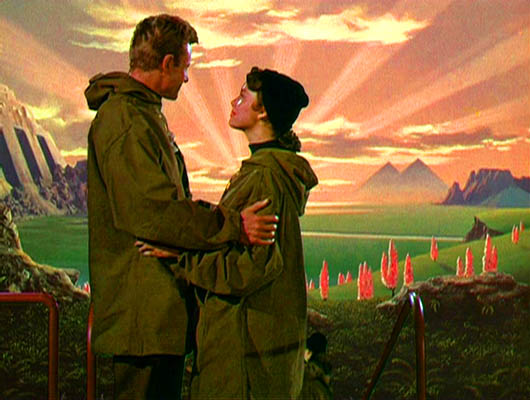
Naast de ‘Alien Apocalyps’ toont het ‘man into space’ subgenre in enkele gevallen ook een menselijke Apocalyps. Daarbij is wetenschap de grote redder van de mensheid in plaats van de boosdoener: wetenschap helpt de mensheid overleven, zowel in minder gehaaste omstandigheden (het opraken van aardse grondstoffen in Conquest of Space) als in situaties van direct gevaar. Ter illustratie, het meest concrete voorbeeld van de wetenschap die de mensheid van de Apocalyps redt en naar een betere wereld leidt treffen we aan in When Worlds Collide, waarin wetenschap sterk de vorm van een religie aanneemt. Deze film vormt een geval apart in het kader van ‘totale verwoesting’, aangezien zij ‘totaal’ zeer letterlijk neemt en zich niet beperkt tot de verwoesting van de menselijke beschaving, maar van de planeet zelf. Daarmee vormt zij het ultieme voorbeeld van de noodzaak voor de mens om de ruimte in te trekken, zoals besproken in paragraaf 2.1. In When Worlds Collide wordt de hele Aarde vernietigd in een botsing met de ster Bellus. Haar satelliet, de planeet Zyra, scheerde enkele dagen eerder daarvoor rakelings langs de Aarde, en een klein aantal mensen weet in een raket naar Zyra te vluchten om daar een nieuwe menselijke beschaving op te bouwen. De (Amerikaanse) wetenschap had de Apocalyps voorspeld: zij zag de planeet als eerste naderen en waarschuwde de mensheid, maar werd niet geloofd door wetenschappers uit andere landen. Dankzij het kapitalistische Amerikaanse systeem – het persoonlijke kapitaal van een rijke grootindustrieel die de boodschap wel serieus neemt – kon zij een reddingsplan in werking stellen: de constructie van een ruimteschip dat, als de Ark van Noach (de film zelf legt deze link ook expliciet), een handjevol mensen kan redden. Uiteindelijk slaagt het schip erin gelanceerd te worden vlak voor de Aarde ten onder gaat, en komt het aan op Zyra. Eenmaal geland op haar oppervlak blijkt deze planeet een paradijselijk oord, een hemels landschap met groene velden, bloeiende bomen, zonnestralen en witte wolkjes. Zo redt de wetenschap haar getrouwen (immers, alleen mensen die bijgedragen hebben aan de bouw van het schip mogen mee) van de totale ondergang. 


Geproduceerd door George Pal blijft de film uiteraard niet gespaard voor religieuze connotaties (in grotere hoeveelheden dan andere Apocalyptische films), evenals de jaren hierop zou gebeuren met The War of the Worlds en Conquest of Space. De film opent met een shot van de Bijbel, waarin te lezen is (terwijl hymnische muziek klinkt op de achtergrond):

And God looked upon the earth, and behold, it was corrupt; for all flesh had corrupted his way upon the earth. And God said unto Noah, the end of all flesh is come before me; for the earth is filled with violence through them: and, behold, I will destroy them with the earth…

Dit citaat impliceert dat deze Apocalyps een straf van God is. De verwoester, de planeet Bellus (wat een connotatie oplevert met het Latijnse woord voor 'oorlog' en als zodanig al een beeld van verwoesting suggereert) komt ook uit de “hemelen”, maar wordt in de film zelf verder niet aan God toegeschreven. In tegenstelling tot de andere variaties op het Einde der Tijden in het sciencefictiongenre uit deze periode is hier sprake van een natuurlijke verwoester, niet van een technologische verwoester die door de wetenschap is voortgebracht. Als God de mensheid inderdaad straft in deze film, doet Hij dat niet voor haar wetenschappelijke transgressies. Hij stelt de “sekte van de wetenschap” immers toe om het “paradijs” te bereiken en daar een nieuwe menselijke samenleving op te bouwen. ‘[…] we are hoping that with God’s help and guidance, a few may do exactly that’, stelt de wetenschapper die de Verenigde Naties toespreekt, en hij krijgt gelijk. Als het Einde der Tijden later in de film daadwerkelijk nadert en Zyra dichterbij komt, wat gepaard gaat met natuurrampen en grootschalige verwoesting, komt ook de rest van de mensheid tot inkeer.
Never before in the history of the world has humanity felt so close to God. As Zyra inexorably rushes toward us, perhaps to destroy the Earth, men and women of all races and creeds pause to think, to pray and to atone’, wordt over de radio vermeldt. Maar het is te laat voor de rest van de mensheid. De wetenschap heeft de noodzaak om maatregelen te treffen verkondigd, maar dat gebeurde niet. Alleen dat deel van de mensheid dat geloof had in de wetenschap (en dan alleen de ware wetenschap, want ook de wetenschappers waren verdeeld) zal gered worden.

Wetenschap en religie gaan hier hand in hand: niet voor niets zien we halverwege de film een close-up van een boekenkast waarin de Bijbel naast wetenschappelijke boeken (onder andere Anatomy of the Human Body, Practical Mathematics en Standard Agriculture) staat, maar wel twee keer zo dik is als de andere boeken. Ook de Bijbelse opening van de film wekt de indruk dat religie de overhand heeft: hoewel het niet als zodanig gesteld wordt in de film, gunt God het de wetenschappers (Noach) een Ark te bouwen, de ondergang te overleven en het Paradijs te betreden.9 God staat welwillend tegenover de wetenschap, maar Zijn macht overheerst nog steeds de macht van de wetenschap.


1 Ellwood 1997: p. 171
2 Brosnan 1978: p. 72
3 In geschreven sciencefiction werd het thema van grootschalige verwoesting dor technologische ontwikkeling al decennia eerder aangekaart, onder andere in het werk van H.G. Wells (Brosnan 1978: p. 72). In sciencefictionfilms was het tot dan toe slechts een enkele keer behandeld, onder andere in Things to Come (USA: William Cameron Menzies, 1936), een film die gebaseerd is op een boek van diezelfde Wells.
4 Citaat van Susan Sontag in: Sobchack 1980: p. 47
5Tegenover beide films valt Day the World Ended onder het ‘altered human’ subgenre, en is Target Earth een ‘alien invasion’ film. Het verhaal van beide films komt overeen met het uitgangspunt van deze Apocalyptische films zoals hier omschreven: een groep mensen met uiteenlopende achtergronden wordt door een allesomvattende ramp bij elkaar gebracht en moet leren met elkaar te leven, terwijl ze respectievelijk mutanten/buitenaardse robots van het lijf moeten zien te houden.
6 Vieth 2001: p. 180
7 Ellwood 1997: p. 188
8 Jancovich 1996: p. 27
9 Anton Kozlovich bespreekt When Worlds Collide kort in zijn tekst over Christusfiguren in film. Hij beschrijft een beschouwing van Glenn Erickson over Zyra als een ‘subtextual Jesus’. Persoonlijk vind ik dit te ver gaan, des te meer omdat Erickson’s argument niet onderbouwd wordt en Kozlovich het laat bij deze aanduiding die hijzelf ook afschildert als pretentieus. Daarom heb ik Zyra, de planeet als Christusfiguur, niet behandeld in paragraaf 4.1. Kozlovich, Anton Karl. The Structural Characteristics of the Cinematic Christ-figure.The Journal of Religion and Film, vol. 8 (september 2004): p. 9

donderdag 18 juli 2013

Today's Mini-reviews: feel-good and feel-bad


Quartet: ***/*****, or 7/10

Dustin Hoffman's directorial debut brings together a top-notch cast of grand British actors, all of old age but none of them showing any signs of deterioration in terms of acting abilities. At Beecham House, a home for retired musicians, the success of the annual concert in celebration of Verdi's birthday is endangered by a new arrival. Jean (Maggie Smith), a diva with a history, has no interest in returning to the stage, but her former co-singers (Billy Connolly, Pauline Collins) and her estranged ex-husband (Tom Courtenay) have to convince her otherwise in order to save their home financially. Trouble is, they too are hindered by the ups and downs of geriatrics, making for many an endearing moment. A fine cast lifts this otherwise mediocre feel-good film to greater heights, though the typical string of 'old folks' jokes and the fairly predictable outcome of past romantic entanglements never make for remarkably emotionally compelling angles. Apart from the use of real (ex)musicians in the supporting cast and their appropriation of the works of the grand classic composers, it's the main quartet of actors that carries the movie and provides most of the fun; Billy Connolly especially as a rather eccentric and cheeky old man, filled with naughty charisma and ever ready for witty, sexually charged repartee, who never stops to hit on every female he encounters, no matter her age. Michael Gambon also delivers some laughs in his role as an insufferable concert planner plagued by short term memory loss and a general obnoxious and insensible loudmouth attitude. Ironically, the final quartet the title hints at, and the movie in fact builds up to, is left out, so we never get to hear just how good of a singers the main characters are, which is a bit of a downer considering the plot keeps boasting their vocal prowess and their acting talent alone is considerate enough to make you wonder just how talented they are in other departments. However, it's clear this movie is not about the quartet itself, but the long and difficult road towards it. And with a good cast, all actors so clearly enjoying themselves to the fullest, plus the plethora of vocal performances already present in the picture, such closure isn't actually warranted.


After Earth: **/*****, or 3/10

M. Night Shyamalan's worst movie to date, but you can blame its failure on the Smith family, since this is another attempt of Will Smith's to launch his son into stardom. If the gods are just, it ought to backfire seriously. Set in a distant future 1,000 years after humanity has abandoned Earth for making it uninhabitable (as humanity is currently doing), it centers on a father, a battle hardened military officer called Cypher Raige, and his teenage son Kitai, desperately attempting to follow into his father's footsteps (as Jaden Smith is doing himself here, to no avail). Mankind has settled on a different planet where it got into a conflict with an alien race (briefly mentioned but otherwise not shown) who unleashed monsters called Ursa, blind predatory creatures that hunt via the detection of human fear. Cypher led the vanguard in defeating the creatures when he found a way to shut out all sense of fear and became the ultimate Ursa slayer. Unfortunately for his family, and the audience, he seems to have destroyed all other human emotions too, as this is without a doubt Smith's least compelling performance ever: all trace of the charismatic Smith of old has gone, leaving him a sour, dull character. Call him a poor man's Vulcan (he makes Zachary Quinto look like Kolinahr material!). You would feel sorry for Kitai, were it not that Jaden's acting is still humongously subpar as well, not likely to get better any time soon. En route for some good father/son bonding, the Raiges crashland on Earth, which is populated by strange creatures and plagued by harsh geological and climatological phenomena. As Cypher says, 'everything on this planet has evolved to kill humans'. It seems the people that made this movie don't understand just how evolution works and how long it takes. For one thing, if there have been no more humans around for a milennium, how come everything has evolved to kill them? It's just the first in a long line of plot holes that riddle this movie like Swiss cheese. The wounded Cypher – Will Smith spending the rest of the movie sitting down and looking gloomy – sends his frightened son out to retrieve a distress beacon from the ship's tail section, which crashed a 100 miles away. Fortunately for Kitai his father is able to watch and comment on his progress the entire time, so he can endlessly point out what he's doing wrong and what an idiot he is. If only Smith had told his son he can't act for shit before making this movie, it would have saved him a lot of money and spared us 100 minutes of audiovisual agony. Might be Smith had an ulterior motive in making this film though, since it seems laced with Scientology propaganda. Smith's rumoured interest in that cult seems confirmed throughout the movie when he gives long speeches on banning fear and keeping your emotions in check for your own mental and physical health, meant to inspire his whiny son but delivered while he's directly looking into the camera as if he's indoctrinating the spectator. It doesn't work though, since the viewer is too smart to take this bad film seriously, while his son has no time to take in all his lessons anyway as he's continously running for his life from digital giant baboons, digital giant eagles, digital giant cats and other terrors of poorly rendered digital environments until he reaches the tail section – which looks like a few pieces of plastic covered in toilet paper – where he comes to the conclusion there's an Ursa stalking him. Will Kitai defeat the monster, save himself and his father and become a true space ranger? Will his father actually care? Will we? To save you time and money you might otherwise have wasted on this so-called movie, here's the answers: yes, no, no. A predictably happy end cannot be avoided as father and son are reunited, but Cypher still doesn't look like a proud father, and the viewer is simply too concerned with locating the nearest exit to care. Despite the absence of the dreaded plot twist, poor Shyamalan's career seems ever less likely to recover. We can only hope our own future will look nothing like this. That said, I know what the future will hold for this movie: endless hating and being made fun of. But hey, Smith's Afterbirth makes it so easy...

donderdag 13 juni 2013

Today's minireview: Oblivion


Oblivion: **/*****, or 5/10

Disappointing sci-fi actioner by Tron: Legacy director Joseph Kosinksi, yet another one of those flicks that seems to think that having Tom Cruise in every single scene makes for a good film in itself. This time Cruise plays a military veteran stationed at a small base up in the sky, from where he and his female co-worker (Andrea Riseborough) oversee and conduct repairs on a vast network of drones, which is used to safeguard giant machines scouring the planet of its last remaining natural resources. After all, we are talking about a post-apocalyptic Earth here, ravaged by war between humanity and some alien species, that witnessed most of the planet becoming uninhabitable to human life. Therefore, mankind left the planet and settled elsewhere, leaving Cruise and his drones as a sort of worldwide mop-up crew (think Wall-E). Or so Cruise thinks. His world is turned upside down soon enough when he encounters an underground force of human rebels who fight to preserve what's left of their planet under the command of Morgan Freeman (who unfortunately has much too small a role; he deserves better and so do we). The ugly truth is revealed when it turns out Cruise is the true alien evil and there's hundreds of duplicates of himself, an army of clones engineered by extraterrestrial intelligence to stripmine the planet while being unaware of the real facts, just hoping to soon complete their job and go home (think Moon). Of course the real bad guy – a giant super computer with its own nefarious agenda (think I, Robot) – won't allow Cruise to switch sides so easily and thus a rather boring fight ensues between the rebels and the drones. Despite the sometimes intriguing premise of the main character finding out his whole life is a lie so he needs to reinvent himself, existential questions about the nature of the self are briskly ignored in favour of monotonous action scenes involving guns, bikes and funky aircraft, all of them seemingly designed by the Apple Corporation, considering the film's overreliance on slick, white, minimalistic looking technology. After a while, shots of Cruise flying around in his little helicopter get exceedingly tedious. At least the spectacular Iceland vistas do not, nor do the grand sights of famous (digital) architecture left to rot in desolate landscapes. And it is gratifying to see Hollywood jumping on the 'creepy drone technology' bandwagon so quickly (though it will probably brand the movie as 'soooo 2013' in years to come). But despite a few points in Oblivion's favour, it can't be helped this film is simply dull and derivative.

donderdag 22 november 2012

Today's Film: Dawn of the Dead (2004)


Dawn of the Dead


Rating: ****/*****, or 8/10


Few remakes ever surpass their predecessors, but this one gets remarkably close, if it's not a definite improvement over the already great original George A. Romero zombie classic from 1978. Zack Snyder, who would go on to direct 300, Watchmen and unfortunately Sucker Punch, first proved his talent for adapting – in this case re-adapting – other people's work with this gripping, gory and hugely entertaining horror flick. A zombie plague engulfs America after which a band of survivors barricades itself in a shopping mall for safety. Tensions run high in the group as its members continue to find themselves attacked by the living dead and eventually a choice must be made: do these people decide to stay in their safe haven where they got everything they need except their freedom, or do they take their chances storming out in an attempt to find out whether there's other people still alive out there in some remote and secure location, with the hopes of joining them. 

The story remains largely the same (except for the absence of a violent, marauding biker gang invading the mall), but the hungry undead are more lethal than ever, this time also adding speed to help satiate their lust for devouring human flesh, making them much easier to take seriously than Romero's slow, lumbering walking dead, thus only enhancing the suspense (and the body count). Fantastic make-up efects galore in this picture, providing a wide array of eerie zombies and disturbing scenes of dismemberment and bloodshed. Still, Snyder doesn't let the gore rule the film, but prefers to locate the horror in the story itself. Of particularly great shock effect is the film's fabulous opening, which starts off very restrained and seemingly normal with a nurse just going home after a hard day's work, going to bed at night and waking up the next morning finding her neighbourhood burning in utter chaos and despair as it has suddenly fallen prey to a zombie apocalypse. Though the movie treats us to many a memorable moment of naked, merciless terror later on, this gruesome opening stands out as its most horrifying scene. The TV show The Walking Dead – though itself based on a graphic novel – would later feature a very similar world of undead post-apocalyptics, clearly inspired by this remake and building on its premise of a ragtag group of survivors trapped in a hellish world ruled by hungry corpses.


Starring: Sarah Polley, Ving Rhames, Jake Weber


Directed by Zack Snyder


USA: Strike Entertainment, 2004


zondag 16 september 2012

Hollywood didn't remember this one wholesale


Total Recall (2012): ***/*****, or 6/10

Total Recall (1990) is still a high point in Paul Verhoeven's oeuvre. At the time the most expensive movie ever made, it featured Arnold Schwarzenegger at the height of his career, running for his life from government conspirators in a provocative, nightmarish future setting both on Earth and on Mars, all the while messing with the spectator's mind in determining whether his tribulations were for real or just a sign of his brain being screwed up just moments before a lobotomy, in the typical sardonic and satirical Verhoeven style. Of course, nowadays nothing is sacred in Hollywood, and since more than two decades have passed the executive powers that be decided it was time for a fresh adaptation of Philip K. Dick's short story We Can Remember It for You Wholesale (1966). Adaptation, however, is too strong a term: inspiration would be more precise, something underscored by the end credits which state the new movie was only inspired by Dick's original work. In fact, it takes even more poetic license with his story than Verhoeven's version did. Unfortunately, various elements that made the previous film such a joy to watch are wholesomely neglected this time around, while the overall story remained the same. As a result, the new Total Recall is neither more sophisticated nor more fun to watch than its predecessor.


The narrative core of Verhoeven's Total Recall is carried over largely intact into the new movie. Douglas Quaid (Colin Farrell, who portrays a bored laborer more convincingly but less enjoyably than the hulking Schwarzengger did) is an everyday underpaid factory worker tired of his dull dead-end job, living in a lousy apartment with his beautiful wife Lori (Kate Beckinsale). Longing for an escape from the boring routine of his life, he visits Rekall, a company that implants fake memories the customer never experienced but that seem totally real as if the subject lived through them himself. In need of a dramatic change of pace, Quaid orders a set of secret agent memories injected in his mind, after which all hell breaks loose when apparently dormant but true experiences of a life as a spy manifest themselves, after which he finds himself on the run from the authorities, including his wife who proved to be an undercover operative, in their attempt to stop Quaid from exposing an elaborate government conspiracy involving corrupt officials out for personal gain at the expense of the lives of thousands of oppressed workers. Trouble is, are we sure all of Quaid's newfound experiences are real, or are they just what he ordered, with the problem being he can't separate truth from fiction as his mind has trouble processing it all?

Warning! Spoilers ahead! With the overall story of the remake identical to the original motion picture, the differences of the new script mostly involve setting and background history. Still set in the not too distant future, the plot now takes place on a post-apocalyptic Earth where chemical warfare has ravaged most of the planet, leaving only Western Europe and Australia habitable. Dubbed the United Federation of Britain and the Colony respectively, the former is the seat of power ruling what's left of the globe with an iron fist, while the latter houses the huge work force keeping things running, as well as home to the many dispossessed masses whose sole task in life is day-to-day survival. Travel between the UFB and the Colony is only possible via the Fall, a sort of giant subway system through the planet's core, allowing the laborers – Quaid among them – to journey to their work every day, deporting them back to the ass-end of the planet when the day is over just as easily. Of course there is resistance to this near-enslavement, most notably in the shape of a terrorist group run by the enigmatic Matthias (an all too small part for the great Bill Nighy), out to destroy the Fall and wreaking havoc in the process. Naturally, the terrorists are the ones we should feel sympathy for considering the hard exploitative regime that controls the workforce's life under the rule of the sinister Chancellor Cohaagen (Breaking Bad's Bryan Cranston), who is secretly hatching a diabolical scheme to get rid of all the miscreants and malcontents in the slums: his motivations for doing so differ from Total Recall's previous incarnation, where he sought to control alien technology. His venture in the current film involves replacing the human workers with robots, a scheme rather derivative of other science fiction works including the likes of I, Robot (2004): there's a reason Total Recall's mechanical men are so reminiscent to that movie's droids.


Unlike both the short story and Verhoeven's take on that, all the action is Earth bound and Mars is nowhere to be seen, other than being only briefly mentioned – in a post-John Carter Hollywood Mars is not a welcome location – so the script switches locations between the UFB and the Colony. Location wise, this turns out to be a mistake. Whereas the trip to Mars only worked to the predecessor's visual advantage, setting it apart from the action that had gone before and underscoring the eerie, dreamy quality of the piece, the visual look of the UFB and the Colony in this version is totally interchangeable. Both areas are defined by excessive urbanization, as overpopulation has led to ever upward building, with an elaborate maze of mile high towering constructions the result. Though the abundance of CGI thrown at these sets makes it look stunning at first, amazement soon turns to acceptance, and acceptance even faster turns to visual disinterest as the movie spends almost two hours following the protagonist being driven from one skyscraper to the next in a string of dynamic chase scenes that eventually make it hard to tell just where on the planet we are exactly. An all too brief excursion to the terrorists' secret layer in the desolate wastelands outside the habitable zone offers little reprieve from this monotonous setting, which in itself is very obviously inspired by undying science fiction classics like Blade Runner (1982) and Metropolis (1927), but used to much less dramatic effect because of its overexposure.

Equally overused is action. Of course, a big Hollywood blockbuster like Total Recall needs action scenes to draw crowds, but not in numbers this high. From the moment Quaid's unconscious cover is exposed in the Rekall salon, he spends most of the film running for cover as he's hunted by Cohaagen's minions, both robotic and flesh and blood, Lori chief among them. If Quaid's not running, he's fighting his way through scores of bad guys. The plot only allows short intermissions for the audience to catch its breath, at which time a great deal of exposition is delivered in as little time as is deemed necessary to warrant the next thirty minutes of relentless action, until the end credits start rolling. Just as the surroundings where such action takes place, the action scenes themselves are similarly interchangeable. Not even a flying car chase (a little too reminiscent of The Fifth Element (1997)) and a pursuit in a labyrinth of elevators offer enough diversion to keep the action from mentally becoming one big blur when the theater lights go back on. Director Wiseman knows action like few others, as he amply showed with movies like Underworld (2003) and Die Hard 4.0. (2007), but the script just kept him from balancing action and exposition to appropriate levels, while the ever singular looking environments didn't allow him to come up with interesting new ideas to shoot such action other than a bunch of general shoot-them-ups. At least his skill in directing fight scenes makes it easy for Total Recall's to look convincingly brutal, entertaining the viewers for a while before such scenes become too commonplace to really care less about them.


 With the focus a little too much on action, it comes as no surprise that other areas of the film's whole remain underexposed. Chief casualty is the emotional climax provided in Verhoeven's version, which made you guess until the very end just as to what's real and what isn't. The script largely follows the same pattern as the original did, but makes it clear all too soon and all too obvious whether its allegiance lies to fiction or reality, thus disabling the audience's pleasure to debate the exact chain of events since there's no room left for speculation. At times the film appears to turn the table on the audience's expectations, just as eager to switch it back mere moments later so the audience doesn't get to be confused, even though it would undoubtedly expect and like to be confused at least a little considering the picture deals with messing with man's mind. This lack of guts to smarten up the movie where it easily can be done makes it all the harder to accept a short lecture at the Rekall facility about the brain and its inner workings: in light of the lack of plot twists and the loads of dull action scenes to come, the movie at this point pretentiously seems to say 'here's how the brain works, now you can go and shot down yours for a few hours since there's really nothing more to our plot'. Worse even is the absolutely serious tone Total Recall adopts for the next ninety minutes, as it leaves little room for humour to put things in perspective considering the absence of intelligence. Among the car chases, the gun fights and the hand to hand combat there's no place for a laugh or two to remind the audience this isn't all as serious as it appears to be, unlike Paul Verhoeven's tone of witty sarcasm that only enhanced his Total Recall's sense of wonder and adventure. You'll find no Johnny-Cab in this film, though as time goes on you desperately want there to be...

Total Recall (2012) is a perfect example of a Hollywood exercise in futility as far as remakes go. It does not improve on the earlier version, nor does it address elements from the plot of the original short story the 1990 film might have ignored. It regurgitates a well crafted story and spits it out in a slicker and stylistically more modern variation that sadly fails to captivate the audience, taking itself way too seriously while simultaneously explicitly weeding out the plot hints that might have made for a more thought provoking, inconclusive ending. What remains is a generic high voltage chase flick filled with standard fisticuffs and gun fights in a visually impressive but monotonous and uninspired environment, which moderately entertain the viewer for two hours, but ultimately prove to be wholly forgetful. The only thing the producers apparently picked up from Paul Verhoeven's classic is the unforgettable image of a triple breasted prostitute, an all too brief pointless insert that only serves as a nostalgic nod to a superior take on this same story. Clearly it doesn't suffice to take a Verhoeven flick and throw out everything that makes it recognizable as such, since that's what makes it memorable. With remakes of Verhoeven's other excellent Sci-Fi/action films RoboCop (1987) and Starship Troopers (1997) in production, Hollywood executives best recall the many shortcomings of Total Recall (2012), unless they truly aim to make movies the audience will soon forget, so they can simply remake them again in another twenty years time.

And watch the trailer here:

maandag 30 april 2012

City of Ember


Rating: ****/*****, or 7/10


Underrated, enjoyable post-apocalyptic fantasy family flick. After a devastating world war, mankind retreated underground with the hopes of once returning to the surface. Hundreds of feet below ground, the City of Ember was constructed as a safe house to the last remnants of humanity, its lights kept running by huge machinery. However, after several generations had passed, the descendants of the original survivors forgot about their origin and the world above, while the technology keeping them alive slowly degraded, threatening to leave them in everlasting darkness. Superb child actress Saoirse Ronan (nominated for an Oscar for Atonement) stars as young Linda Mayfleet, a girl driven by curiosity and intelligence who wants to fight off the imminent undoing of her home town and the corruption of Ember's greedy Mayor (Bill Murray once more excels at playing a scumbag) and his sinister henchmen, but is confronted on the one hand by narrow minded doctrine stating Ember is all there is, and on the other by giant men-eating mole creatures (making this movie a tad too scary for younger kids). The film sports a tremendously exciting look, almost making Ember itself a living, breathing entity, but we get to explore this ingeniously crafted world less than we would want in exchange for a fairly typical coming-of-age story about kids fighting the older generation's strict rules that seek to keep them mentally chained, breaking loose in the worn out 'follow your heart' style. Still, the delightful fantasy tones of this oft neglected film make for a pleasant surprise to those who bother to check it out.


Starring: Saoirse Ronan, Bill Murray, Toby Jones


Directed by Gil Kenan


USA: Walden Media, 2008

maandag 2 april 2012

Boy and His Dog, A


Rating: ***/*****, or 7/10


Screwed up post-apocalyptic thriller like only the seventies can provide, based on the novella by Harlan Ellison. After a devastating nuclear war, the planet scape has been reduced to a desolate wasteland where scavenging marauders roam the plains living off the scraps on the past. The young Vic searches the dusty wastes for anything that can help him survive another day (particularly food and sex), accompanied only by his loyal telepathic (!) dog Blood. One day Vic meets Quilla June, a young girl sent to the surface by a secret underground community of survivors. She hooks up with Vic and lures him down to her home so he can provide seed to father a new generation of underground dwellers. This is not done via regular good old-fashioned sex as Vic had hoped, but through electroejaculation which will cause him an agonizing death. Warning! Spoilers! With Blood's help, Vic manages to escape this nightmare with Quilla, who he has developed romantic interests for, but Blood is injured in the process and will need a few weeks rest and food, something Vic can only provide by “sacrificing his love” for Quilla in the most disturbing meaning of the term possible, since 'a boy just loves his dog'. Often accused of blatant misogyny for portraying women as sex objects (and food...) at the mercy of cruel horny men, but I'd say the portrayal of men in this film is far from laudable and so over the top it's hard to take seriously. Shot on a very low budget, the look of this film, with its display of deserted stretches of land filled with rusty cars and random junk inhabited by primitive brigands fighting over what little food and shelter is left, inspired many a post-apocalyptic flick that followed, including the Mad Max movies. However, it remains a little known film outside the realm of die-hard science fiction lovers.


Starring: Don Johnson, Susanne Benton, Jason Robards


Directed by L. Q. Jones


USA: LQ/JAF, 1975