Snowpiercer:
****/*****, or 8/10
Blame
it on the economic crisis or some such, but it continues to be a good
time for post-apocalyptic cinema. Hollywood jumps on
the-end-of-the-world bandwagon multiple times a year it appears, and
there's no excuse for other countries not to also try their hand at
exploring dystopian societies where human rights are nonexistant. A
striking example from last year includes the big budget Elysium,
wherein the majority of mankind is left to suffer on an
overpopulated and heavily polluted Earth while the rich live a life
of luscious luxury up in space. Directed by native South-African
Neill Blomkamp, he utilized his home land settings and talent to
great effect, though ultimately the Hollywood approach in terms of
story and marketing prevailed (though it didn't much harm the film
overall). Not so with Snowpiercer, which dabbles in very
similar themes, but proves to be enriched as a viewing experience by
a rather un-American sensibility, courtesy of South-Korean director
Joon-ho Bong.
It
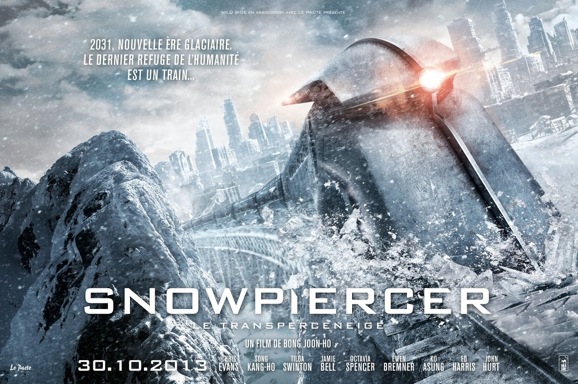
cannot be denied that Snowpiercer's premise – based off the
French comic Le Transperceneige – has to be taken with a
grain of salt, at the risk of sounding utterly ludicrous. Set in the
year 2031, seventeen years after a worldwide attempt to halt global
warming by dispersing cooling gasses into the atmosphere went
mercilessly awry, our planet suffers under an extreme ice age that
covers the globe in snow and ice. Humanity's last few survivors live
aboard a huge train, where a rigid class system has developed. The
poor masses are relegated to the back compartments of the train,
while the wealthy live in the front in relative comfort. Powered by a
perpetuum mobile, the train rages over the frozen planet's surface,
seemingly ad infinitum. While the haves play and party to their
leisure, the have-nots suffer endlessly, huddled together in
uninterrupted squalor and near-starvation. The rich are only
interested in their kids, which they take away at random for
undisclosed but doubtlessly sinister purposes. But biding their time
under the command of the calculating Curtis (Chris Evans), the
dispossessed plot their revolution, hellbent on overthrowing the
repressive system and taking over the train for themselves. Such a
plot line seems thirteen-a-dozen stuff when it comes to dystopian
cinema, but the unusual element of the train makes all the
difference, if you're willing to accept this rather bizarre concept.

'Bizarre'
is exactly right to describe Bong's approach to Snowpiercer,
if not to his whole oeuvre. With The Host, the Korean director
delivered a monster-on-a-rampage movie unlike any other, while his
celebrated but twisted thriller Memories of Murder firmly
rooted him as a student of and a commentator on the human capacity
for violence. Snowpiercer fits right into his resumé and
stylistically reveals him to have auteur tendencies. The cruel and
the weird go hand in hand in his clash of classes. Bong takes his
time to explore the train and its hierarchy, where the mysterious
designer and machinist of the vehicle,Wilford, is given divine status
by those he keeps alive. As the desperate rebels who want to put an
end to this dictatorship slowly but surely work their way to the
front of the train, Bong keeps surprising us as much as his
protagonists with each new compartment they enter. But, applying a
certain video game logic to the narrative, each discovery also comes
with new dangers, both physically and in terms of resolve of standing
united against a common foe, as Curtis moves ever closer to the 'end
boss' Wilford, and upon meeting him finds out the true machinations
of the powers-that-be.
Bong
tells his strange tale of revolution through an international
ensemble of actors, which underscores the thought that humanity has
collectively 'taken the same train' in the destruction of their
habitat and must deal with it accordingly or perish as a whole. You'd
be inclined to think of Evans as a typical all-American hero leading
the quest for freedom, but you'd be much mistaken, as the character
carries a particularly sordid past that would definitely write him
off as such. The same is true for Jamie Bell, apparently his
hotheaded sidekick, whose relationship with his older brother-in-arms
is much more disturbing than you would at first glance suspect. Bong
surprises you as much with the twisted interrelations between his
protagonists as with the various situations they encounter. John Hurt
seemingly plays an archetypal wise old man as he has done on many
prior occasions, but what we come to know about him in the course of
the film again subverts expectations, as do the motives of the
apparently unstable demolitions expert/drug addict Kang-ho Song (a
Bong regular) and his clairvoyant daughter. The audience is being
toyed with in their mental perception of “the good guys” on a
similar note as it is in regards to the physical appearance of the
leading baddie, minister Mason, played by an unrecognizable Tilda
Swinton in an outrageous costume and false teeth. Nevertheless, the
cast succeeds in relaying the fact this class conflict isn't as black
and white as you would initially believe, although with such morally
colourful characters, it makes you wonder with whom Bong wants you to
identify (if anyone): the line between good and bad characters is
indeed as thin as the rails that keep their train going.
Even
more colourful is Bong's sense of style. Clearly a confined space,
Bong makes good use of that fact to show off his train in
delightfully flexible cinematography and a colour scheme to match.
Starting off with the plight of the tormented oppressed, he sticks
with an abundance of brown tones – supplying a nearly monochromatic
touch – and cramped, crowded spaces for the first hour, before he
lets in the light and dazzles both the revolutionaries and the
audience with the rich and vibrant world of the oppressors, filled
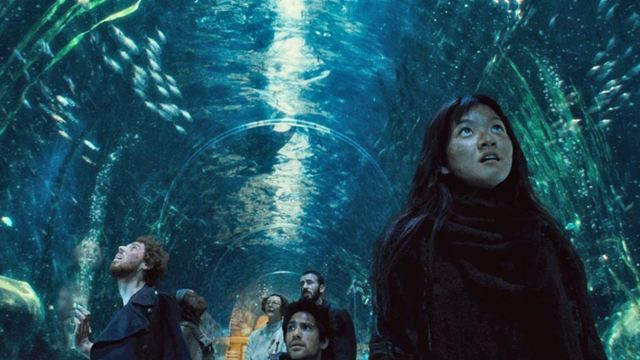
with all kinds of unexpected wonders. A huge vegetable garden, a
giant aquarium walkthrough (complete with manta rays), a classroom
car; we're confronted with whatever we expect the least, and Bong has
it all make appropriate sense. Which is not to say that he doesn't
throw us off-guard at times, also in terms of the flow of the
narrative. Bong makes use of the occasional off-beat, even absurdist
moment that only adds to his wonderfully weird train, but continues
to suggest the director's dark predilections. A brutal showdown
between the tyranny's minions and the insurgents is postponed by a
New Year celebration before the carnage ensues, while an overly
cheerful classroom scene explodes in a bloody shootout, the presence
of children notwithstanding. Not the type of thing you'd find in the
more generic American dystopian flicks, nor is the movie's big
revelation near the end (think The Matrix Reloaded, but
without sequel aspirations). The climax however does leave some room
for hope, which feels out of place and hints at studio interference,
most likely from the American investors (as the film is a
Korean/American/French/Czech co-production). As for the action
scenes, Snowpiercer contains many and they are all
sufficiently choreographed to make you bite into their mayhem,
despite the oddities Bong throws at you along the way. Unfortunately
many visual effects shots of the white world outside prove less than
stellar and more than a little bit digital, making you wish Bong
would stick more to the train, which is where nearly all of the
excitement happens anyway.

Snowpiercer's
premise and the logistics of its world might be hard to accept at
first, but Bong makes it work. Plus, he keeps surprising you,
confronting you with your own expectations, fed by having seen mostly
American takes on the conflict between good and evil in dystopian
societies. If you accept Bong's craziness and unwillingness to adhere
to orthodox storytelling, Snowpiercer proves quite an
intriguing ride, though admittedly not everyone will be able to stay
on board for this one, violent, disturbing and thoroughly messed up
as it deservedly can be called.