Posts tonen met het label tilda swinton. Alle posts tonen

zondag 13 april 2014

Today's Review: Snowpiercer


Snowpiercer: ****/*****, or 8/10

Blame it on the economic crisis or some such, but it continues to be a good time for post-apocalyptic cinema. Hollywood jumps on the-end-of-the-world bandwagon multiple times a year it appears, and there's no excuse for other countries not to also try their hand at exploring dystopian societies where human rights are nonexistant. A striking example from last year includes the big budget Elysium, wherein the majority of mankind is left to suffer on an overpopulated and heavily polluted Earth while the rich live a life of luscious luxury up in space. Directed by native South-African Neill Blomkamp, he utilized his home land settings and talent to great effect, though ultimately the Hollywood approach in terms of story and marketing prevailed (though it didn't much harm the film overall). Not so with Snowpiercer, which dabbles in very similar themes, but proves to be enriched as a viewing experience by a rather un-American sensibility, courtesy of South-Korean director Joon-ho Bong.

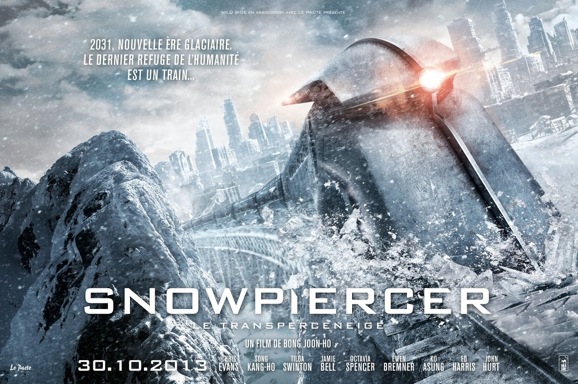
It cannot be denied that Snowpiercer's premise – based off the French comic Le Transperceneige – has to be taken with a grain of salt, at the risk of sounding utterly ludicrous. Set in the year 2031, seventeen years after a worldwide attempt to halt global warming by dispersing cooling gasses into the atmosphere went mercilessly awry, our planet suffers under an extreme ice age that covers the globe in snow and ice. Humanity's last few survivors live aboard a huge train, where a rigid class system has developed. The poor masses are relegated to the back compartments of the train, while the wealthy live in the front in relative comfort. Powered by a perpetuum mobile, the train rages over the frozen planet's surface, seemingly ad infinitum. While the haves play and party to their leisure, the have-nots suffer endlessly, huddled together in uninterrupted squalor and near-starvation. The rich are only interested in their kids, which they take away at random for undisclosed but doubtlessly sinister purposes. But biding their time under the command of the calculating Curtis (Chris Evans), the dispossessed plot their revolution, hellbent on overthrowing the repressive system and taking over the train for themselves. Such a plot line seems thirteen-a-dozen stuff when it comes to dystopian cinema, but the unusual element of the train makes all the difference, if you're willing to accept this rather bizarre concept.


'Bizarre' is exactly right to describe Bong's approach to Snowpiercer, if not to his whole oeuvre. With The Host, the Korean director delivered a monster-on-a-rampage movie unlike any other, while his celebrated but twisted thriller Memories of Murder firmly rooted him as a student of and a commentator on the human capacity for violence. Snowpiercer fits right into his resumé and stylistically reveals him to have auteur tendencies. The cruel and the weird go hand in hand in his clash of classes. Bong takes his time to explore the train and its hierarchy, where the mysterious designer and machinist of the vehicle,Wilford, is given divine status by those he keeps alive. As the desperate rebels who want to put an end to this dictatorship slowly but surely work their way to the front of the train, Bong keeps surprising us as much as his protagonists with each new compartment they enter. But, applying a certain video game logic to the narrative, each discovery also comes with new dangers, both physically and in terms of resolve of standing united against a common foe, as Curtis moves ever closer to the 'end boss' Wilford, and upon meeting him finds out the true machinations of the powers-that-be.

Bong tells his strange tale of revolution through an international ensemble of actors, which underscores the thought that humanity has collectively 'taken the same train' in the destruction of their habitat and must deal with it accordingly or perish as a whole. You'd be inclined to think of Evans as a typical all-American hero leading the quest for freedom, but you'd be much mistaken, as the character carries a particularly sordid past that would definitely write him off as such. The same is true for Jamie Bell, apparently his hotheaded sidekick, whose relationship with his older brother-in-arms is much more disturbing than you would at first glance suspect. Bong surprises you as much with the twisted interrelations between his protagonists as with the various situations they encounter. John Hurt seemingly plays an archetypal wise old man as he has done on many prior occasions, but what we come to know about him in the course of the film again subverts expectations, as do the motives of the apparently unstable demolitions expert/drug addict Kang-ho Song (a Bong regular) and his clairvoyant daughter. The audience is being toyed with in their mental perception of “the good guys” on a similar note as it is in regards to the physical appearance of the leading baddie, minister Mason, played by an unrecognizable Tilda Swinton in an outrageous costume and false teeth. Nevertheless, the cast succeeds in relaying the fact this class conflict isn't as black and white as you would initially believe, although with such morally colourful characters, it makes you wonder with whom Bong wants you to identify (if anyone): the line between good and bad characters is indeed as thin as the rails that keep their train going.
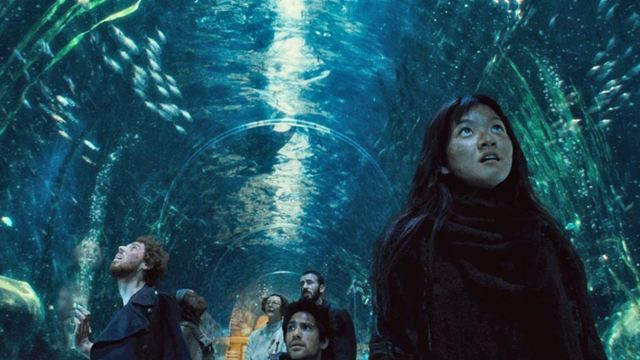


Even more colourful is Bong's sense of style. Clearly a confined space, Bong makes good use of that fact to show off his train in delightfully flexible cinematography and a colour scheme to match. Starting off with the plight of the tormented oppressed, he sticks with an abundance of brown tones – supplying a nearly monochromatic touch – and cramped, crowded spaces for the first hour, before he lets in the light and dazzles both the revolutionaries and the audience with the rich and vibrant world of the oppressors, filled with all kinds of unexpected wonders. A huge vegetable garden, a giant aquarium walkthrough (complete with manta rays), a classroom car; we're confronted with whatever we expect the least, and Bong has it all make appropriate sense. Which is not to say that he doesn't throw us off-guard at times, also in terms of the flow of the narrative. Bong makes use of the occasional off-beat, even absurdist moment that only adds to his wonderfully weird train, but continues to suggest the director's dark predilections. A brutal showdown between the tyranny's minions and the insurgents is postponed by a New Year celebration before the carnage ensues, while an overly cheerful classroom scene explodes in a bloody shootout, the presence of children notwithstanding. Not the type of thing you'd find in the more generic American dystopian flicks, nor is the movie's big revelation near the end (think The Matrix Reloaded, but without sequel aspirations). The climax however does leave some room for hope, which feels out of place and hints at studio interference, most likely from the American investors (as the film is a Korean/American/French/Czech co-production). As for the action scenes, Snowpiercer contains many and they are all sufficiently choreographed to make you bite into their mayhem, despite the oddities Bong throws at you along the way. Unfortunately many visual effects shots of the white world outside prove less than stellar and more than a little bit digital, making you wish Bong would stick more to the train, which is where nearly all of the excitement happens anyway.


Snowpiercer's premise and the logistics of its world might be hard to accept at first, but Bong makes it work. Plus, he keeps surprising you, confronting you with your own expectations, fed by having seen mostly American takes on the conflict between good and evil in dystopian societies. If you accept Bong's craziness and unwillingness to adhere to orthodox storytelling, Snowpiercer proves quite an intriguing ride, though admittedly not everyone will be able to stay on board for this one, violent, disturbing and thoroughly messed up as it deservedly can be called.


woensdag 20 juni 2012

Wes Anderson's kids are allright


Moonrise Kingdom: ****/*****, or 8/10

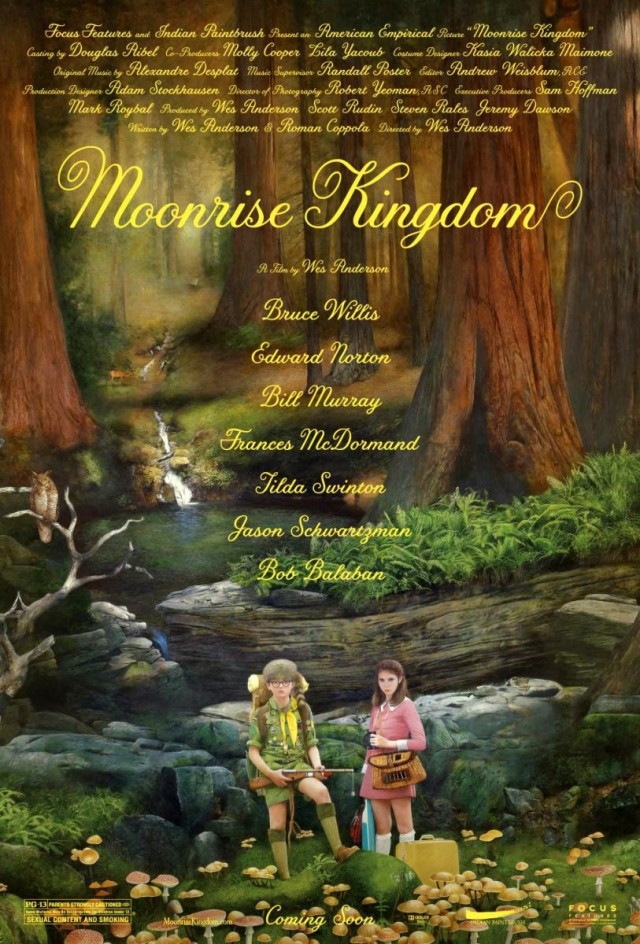
And so Wes Anderson, that overly creative director of delightful family comedy drama, returns to live action filming after having taken a short break from it in favour of proving his style is equally charming when applied to stop motion animation, which resulted in The Fantastic Mr. Fox, based on the classic children's novel by Roald Dahl. Anderson apparently picked up a thing or two in a narrative sense from the great author, considering the newest addition to his own oeuvre as a distinguished film auteur (his style always instantly recognizable in every scene) like many of Dahl's stories deals with intelligent kids breaking free from the often abusive world of angry adults that simply refuses to understand them, instead restricting their growth processes by incapsulating them in a repressive regime of habits. Whether inspired by Dahl or simply containing thematic similarities by pure coincidence, Moonrise Kingdom is a wonderful hommage to smart children and their first steps towards true self-reliance despite the obstacle that adults usually prove to be.


The stage for Moonrise Kingdom is provided by New Penzance, a fictional New England island like only Wes Andersonland can provide, complete with Native American cultural leftovers, red-and-white coloured lighthouse, ferry and mail plane, plus the addition of existing Rhode Island (where the movie was shot) natural beauty of stunning quality, the bare facts of all this being relayed to the audience by an odd looking old man in a red coat and a silly hat who simply acts as narrator, not as a relevant character otherwise. The year being 1965, it's the perfect spot for a boy scout camp, which is run by part time math teacher Scout Master Randy Ward (Edward Norton, Fight Club) in a tight and strictly organized manner, which makes it all the harder for the man to accept one of his scouts, the pipe smoking orphan boy Sam Shakusky (Jared Gilman) has gone AWOL. At the same time, the dysfunctional Bishop family is dismayed to discover their little girl Suzy (Kara Hayward) has also made a run for it without their knowledge or permission, upsetting her attorney parents Walt and Laura (Bill Murray, Anderson's go-to-guy – this film marking their sixth collaboration – and newcomer-to-his-work Frances McDormand, of Burn After Reading fame). A search for the pair of runaways is swiftly underway, spearheaded by local police officer Captain Sharp (Bruce Willis, also an Anderson first-timer), a likeable but lonely man who happens to have an affair with Laura. While the search progresses, it becomes blatantly clear the two kids have planned their escape much more effectively than the generally dimwitted adults are seen to conduct their pursuit of them, making for many an hilarious gag in the process as we have come to expect and enjoy from Wes Anderson.

In a flashback we learn Sam and Suzy, both only twelve years of age, met the year before at a local church play, which led to mutual intrigue at first, followed by a pen pal connection and an eventual love relationship, which led them to elope together in order to both escape their incompetent guardians and get married and live in the wilderness. It's a deliciously naive but romantic ploy only the mind of a child could conceive, despite the minds of both kids appearing to be in a better overall condition than those of their grown-up trackers. In fact, it's Scout Master Ward's relentless (and prone to violence) team of boy scouts who locate the runaways first, leading to a surprisingly suggestive moment of aggression and a dead scout mascotte, proving Sam and Suzy are ready to fight for their freedom and their now hard earned right to live alone on a beautiful private beach.


Unfortunately the timing for their escape could have been better, as a devastating hurricane and the resulting flood threatens their island paradise, adding a sense of urgency to the plot. Fortunately for them – or not – the adults find them in time, but by now both Captain Sharp and the boy scouts have come to respect the sensible pair's honest wishes and fully understand their desire to get away from their messed up guardians. Despite the bloody incident earlier between them, in a surprising turn of events the scouts spring both Sam and Suzy from their confinement and relocate them to a church during the now raging storm. Again cornered by the ones they tried to get away from, as well as confronted by a lady from Social Services (Tilda Swinton) – a nameless character simply referred to by everyone, including herself, as 'Social Services', a joke the Dutch subtitling sadly does not pick up – Sam and Suzy again make a now desperate run for it, risking their lives to prove the world their love is real, as is their desire to fight for their independence.

Overall, it's not a complicated plot and a brief synopsis might only make it sound childish, but it's Wes Anderson's approach to things that makes it work as well as it does. As is his usual style, the film is as quirky and colourful as his previous works, making every scene vibrantly appealing and cramped with little details, most of them only visible a brief moment, thus in itself making the film worthy of a second viewing if only to take in all the hidden jokes. Fortunately there's an abundance of not so hard to miss gags as well, both visual and in dialogue, all the actors chipping in to make the jokes as well timed and performed ad they need be. To add to the movie's charm, the film is shot using a 16 mm camera (a first for Anderson), thus enhancing the general 'old movie' feel, making it subconsciously feel more realistically like 1965, which only shows Anderson still isn't afraid to experiment a little bit here and there to discover what works best to convey a style all his own as compellingly as possible. As for experimenting, extra credit is due to him for the fact he dares to explore the blossoming sexual feelings of his two underage main characters, resulting in a 'French kissing' scene in underwear that will undoubtedly make conservative America cringe and whine, but in the context of the scene feels perfectly justified and innocent, as are all the activities he allows this pair, considering the rigid and awkward people they attempt to escape from.


Visual style and experimentation aside, as always it's the actors that make a Wes Anderson movie feel the most like a Wes Anderson movie, utilizing a typical acting style that carefully balances between introvert and emotionally disconnected on the one side and completely over the top on the other. In Moonrise Kingdom's case the greatest accomplishment in this regard comes courtesy of Hayward and Gilman, both completely inexperienced as actors with no previously established acting skills to back them up, yet both delivering a surprisingly successful and engaging performance, making it feel like they've been playing around in Anderson's movies for years. Of course, Bill Murray, who has been doing just that, also succeeds in adding yet another zany character to his repertoire, as does Jason Schwartzmann, whose bit part as an amoral and corrupt Scout leader unfortunately proves all too short. Frances McDormand, Tilda Swinton and Edward Norton fit right in, too, quickly adopting the less emotional and more dysfunctional manner of acting we've grown accustomed too in Anderson's work, despite never having appeared in one of his films before. The weakest link in this star-studded ensemble proves to be Bruce Willis, oddly enough considering his long range of expertise, who, despite portraying Captain Sharp convincingly as a sympathetic but not all too bright character, simply feels both out of place and out of touch in this film, as if not having been able to fully master the acting style required for a Wes Anderson movie. Fortunately this never gets too frustratingly apparent, nor does it ruin any of the scenes he appears in. But no matter how well any of the established actors do in Moonrise Kingdom, its genuine tour-de-force of acting is supplied by the two young main characters who carry the majority of the movie and steal our hearts in the process, making us only hope we'll be hearing more of them in the future.

Moonrise Kingdom could be called a return to form on Wes Anderson's part, a redemption after the wholesomely disappointing The Darjeeling Limited in 2007, were it not that the off-beat Fantastic Mr. Fox, despite being an animated movie, was too blatantly 'Andersonesque' to be deservedly called a deviation from his specific form. As a live action film, his latest release proves a very nice reminder just wat he's capable of, ranking among his best right alongside Rushmore (1998) and The Life Aquatic with Steve Zissou (2004), for being both genuinely funny and admittedly adorable to watch, while also containing enough heart and soul to be raised above average comedy. Be they live action or be they animation, Moonrise Kingdom strongly reaffirms the fact Wes Anderson films are always something to truly look forward to.

And watch the trailer here:


maandag 7 mei 2012

Constantine


Rating: ***/*****, or 7/10


Fascinating mix of horror and action, based on the DC comic book series Hellblazer. Keanu Reeves stars as John Constantine, a cynical, rude chain smoking exorcist who has had the misfortune of having the ability to see the angels and demons secretly roaming our world all around us since childhood. Despite having dispatched scores of demons back to hell, he's on his last legs suffering from terminal lung cancer, soon doomed to a final one-way trip to the underworld. Reeves is reunited with Rachel Weisz (they starred opposite each other in Chain Reaction (1996), who plays a detective investigating the apparent suicide of her mentally ill Catholic twin sister. She soon finds out it was a part of a much larger plot that might involve the sudden End of Days as the son of Satan means to overthrow his father's reign and release hell on Earth. Despite the two of them not getting along, Constantine is forced to team up with her to stop this imminent Apocalypse, but finds himself being hindered by both angels and demons alike, all with their own agenda, including a androgynous deranged Gabriel (Tilda Swinton). Though visually impressive – especially the hellish version of Los Angeles – and containing a bunch of solid action and horror scenes, the weird potpourri of historical and Apocalyptic elements and Biblical role-reversals has to be taken with quite a grain of salt. Reeves also falls back into his already firmly established Messiah routine (and it wouldn't be the last time), while Weisz clearly proves who is the better actor of the two. A sequel has been in the works for years, but always fails to materialize beyond mere planning.


Starring: Keanu Reeves, Rachel Weisz, Tilda Swinton


Directed by Francis Lawrence


USA: Warner Bros., 2005


maandag 30 april 2012

Chronicles of Narnia: The Lion, The Witch and the Wardrobe, The


Rating: **/*****, or 4/10


Obvious attempt by Disney to cash in on the sudden popularity of the fantasy genre in the wake of the fantastic Lord of the Rings movie trilogy. The trick seemed simple: take a book from a well known fantasy series and adapt it into a sweeping epic of a film, and build an easily exploitable franchise around it. Granted, this first Narnia film did pretty well at the box office, but remains maligned by critics the world over and is an altogether feeble movie based on the classic book by C.S. Lewis. During WW II, the four Pevensie children are sent to live at a big mansion on the English countryside, where they discover a wardrobe that turns out to be a doorway to the fantasy world of Narnia. However, this realm is in the grip of a severe ice age because the evil White Witch (Tilda Swinton doing a good job at playing a ruthless villain) rules the land. The coming of four human children means the dawn of a return to peace and prosperity under the benign rule of the lion god Aslan (voice by Liam Neeson), but the White Witch doesn't surrender her regime so easily and a grand battle for the freedom of Narnia erupts, with the Pevensies at the heart of it (fortunately Father Christmas equips them with the necessary deadly tools to kill their opponents: good job, giving weapons to kids!). Laced with extremely obnoxious Christian overtones (including the annoying parallels between a certain carpenter/magician and Aslan, who dies for the sins of another but is resurrected), this movie at many turns feels like it means to convert us to Christianity, while it's also a poorly acted - especially those pesky kids and a vast array of irritating digital talking animals - and humorless piece of work that takes its fantasy concepts a little too serious, which seems an odd move for director Adamson, who previously delivered two superb Shrek films. The audience, apart from Christian fanatics who obviously loved it, quickly grew tired of it as they demonstrated by making the sequel Prince Caspian do quite poorly at the box office, after which Disney swiftly abandoned the franchise, selling the rights to Fox, where its right wing religious overtones were more at home. Still, general interest in the franchise remains low.


Starring: Tilda Swinton, James McAvoy, Liam Neeson


Directed by Andrew Adamson


USA: Walt Disney Pictures, 2005