Posts tonen met het label Bruce Willis. Alle posts tonen

zaterdag 25 januari 2014

Today's Triple News: the vice of mocking Triffids


This is what you get if you don't get around to posting your own news for a few days: it just piles up:

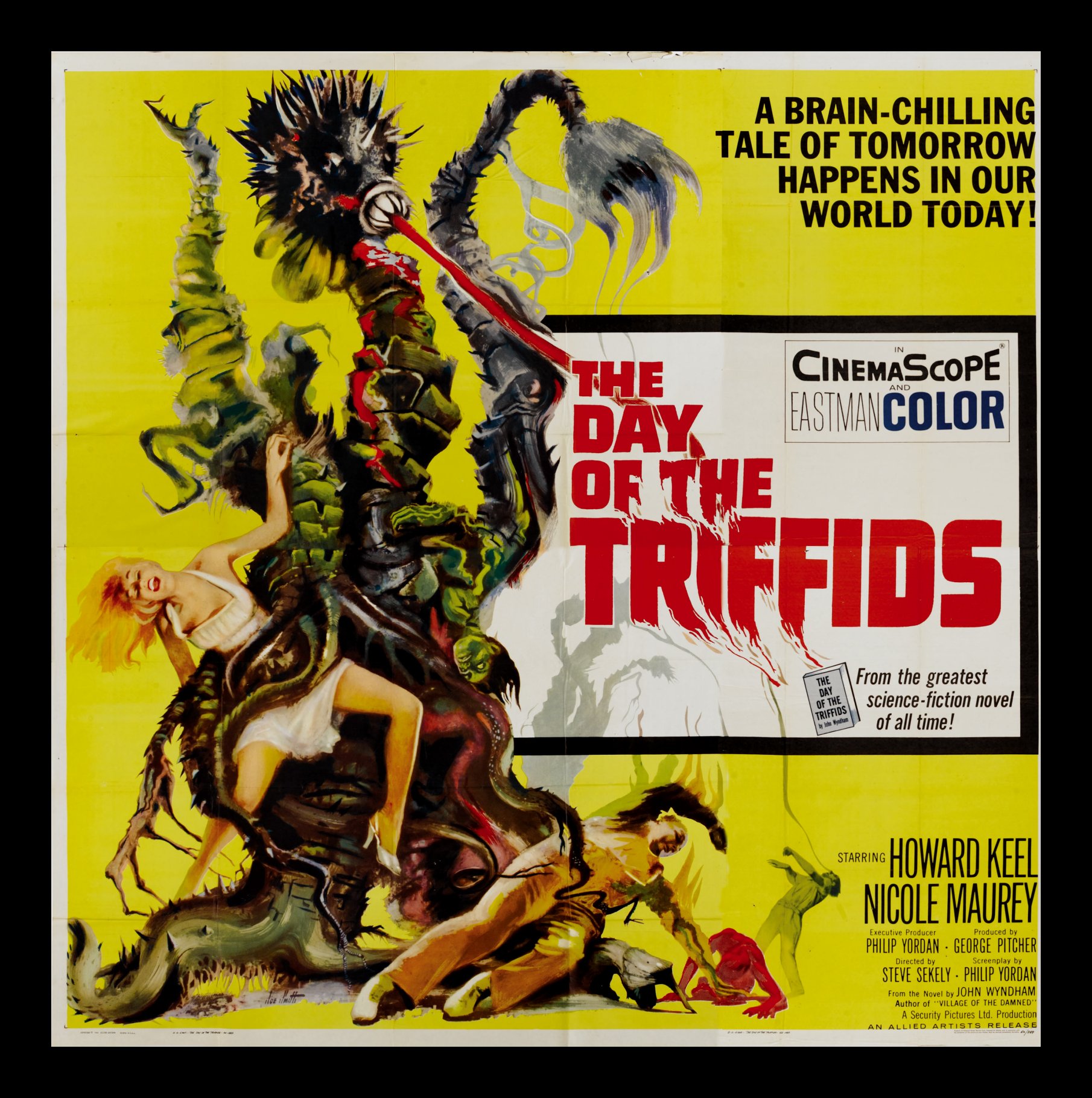
http://www.moviescene.nl/p/153308/potter_regisseur_maakt_remake_triffids

http://www.moviescene.nl/p/153285/eerste_poster_hunger_games_mockingjay_part_1

http://www.moviescene.nl/p/153241/bruce_willis_speelt_hoofdrol_in_sci-fi_thriller_vice

All fairly predictable news really. The Day of the Triffids is not specifically a commonly known science fiction movie, but has a certain cult following that assured more would be done with the property in the future than to stick to lousy miniseries on TV. It was a given the first Mockingjay poster would continue the trend in showing the bird logo in an altered fashion not so subtly parallelling Katniss Everdeen's rise to rebellion. As for Vice, that is probably the most surprising bit of news, in two ways. First, it's basically a Westworld copy ('synthetic staff of holiday resort abused by visitors strike back in a rage of vengeance' sounds suspiciously familiar, does it not?). Second, Bruce Willis supposedly plays a bad guy (it sure sounds that way judging by the film's plot synopsis), which doesn't happen every day. I'm not saying it's a first; e.g. Planet Terror or Perfect Stranger for example. But Hollywood movie stars of his stature have a tendency to stick to playing the formulaic role of an heroic character, as that's what their agents and studio execs expect the audience wants to see them play. Why change a winning routine that keeps bringing in the big bucks after all? Maybe because these stars themselves get bored doing the same thing over and over again? A change of pace also helps them gain respect as true actors (which some of them really aren't) as they get a chance to reveal their versatility by playing a type of character they usually avoid. I know Willis is talented enough to play a convincingly brutal villain, so that's not what's wrong with Vice in my mind. I just don't care much for an uninspired story like this. Again, judging solely by the synopsis (as nothing else is available yet), which seems clear enough. Especially when there's a Westworld TV series in the making at HBO, which assuredly promises us every vice this movie could come up with, and more.

As for the Triffids remake, it had to happen sooner or later, and the powers-that-be opted for sooner. The last adaptation, a dreadful miniseries of ill repute, debuted less than five years ago, so the name (which doesn't seem mistakable for anything else), may still be fresh on some people's minds, but likely not for the better. So undo the damage done by throwing another adaptation our way, overseen by a notable talent. Newell surely is talented enough, having earned his reputation with a diverse range of movies including Four Weddings and a Funeral, Prince of Persia: The Sands of Time, Donnie Brasco and of course his most famous (and undoubtedly most lucrative) film, Harry Potter and the Goblet of Fire. Carnivorous extraterrestrial plants seem like something he could handle between breakfast and tea easily enough. Still, as is the case with Vice, there's a danger of thematic repetition here. Day of the Triffids already sounds similar to the better know Invasion of the Body Snatchers in terms of story (already remade a few year back, also pretty dismal). What's  more, the Triffids themselves are largely incidental, as the story is more about human intereaction in times of major crises, specifically man's ability to work together in (a lack of) harmony when society collapses. This theme, though still one that has the power to attract viewers easily, has been done a bazillion times already by now. In this regard, there's actually little narrative difference between Day of the Triffids and, say, The Walking Dead, except the latter already has succeeded in getting the audience's attention and respect as a serious (well, mostly) piece of audiovisual entertainment. A zombie Apocalypse is one thing, but the whole notion of an invasion by man devouring vegetables generally sounds ludicrous to most people, so if Newell wants his audience to take it seriously - which decidedly was the intention of the original novel at the least - he'll have to work hard to make us get over our initial negative expectations that would work against the film's favour. Thankfully he has also done Great Expectations, that might help.


As for expectations and thematic repetition (segue!), there's the new Hunger Games poster. This was one bit of repetition most people expected. As such, it's far from original, but given the rise of quality in the movies in question, no less welcome to inflame our hopes for an even more compelling finale (despite being cut in half to allow the studio to scrape every bit of milk out of Jennifer Lawrence's teats, pardon my expression). The movie isn't very subtle in terms of symbolism, and it's easy to deduce the shit has now hit the fan from comparing this poster to its predecessors, which showed a more obsequious jay, despite the constant appearance of flames indicating there's a lot of bottled-up anger involved. This time the repression has failed to keep the rage at bay and the mockingjay is finally spreading its wings in aggressive pride, its head held high as a symbol of defiance. It makes for a striking image, nevermind the little variation as opposed to earlier promotional artwork. Considering the number of different posters released for Catching Fire, I'm sure more inspired artwork will follow soon. This is only a tease after all. Plus, as the same piece of imagery concluded the second movie it isn't even wholly novel stuff to begin with. As such, you could also consider it a cheat. However, it certainly will succeed in drawing attention in theaters (probably just because it looks so familiar, causing an instant shock of recognition from "hungry" fans), and as such it's certainly a successful piece of work. The fact it saves money in terms of design costs is just a bonus for the studio, and a welcome one no doubt, as it's a given Mockingjay Parts 1 and 2 will cost a fair amount of cash to produce. Not the least of which will go to Jennifer Lawrence's bank account, as a raise in salary seems inevitable for such a "hot" (pun? You decide!) actress people can't seem to get enough of.

zaterdag 17 augustus 2013

Today's Mini-Reviews: oldies packing some punch


The Lone Ranger: ***/*****, or 6/10

Big budget remake of the classic radio play and television series appropriates the success formula formerly applied to the Pirates of the Caribbean films, which is not surprising considering the same people and studio that made those swashbucklers are behind this project. Produced by Jerry Bruckheimer for Disney and directed by Gore Verbinski, The Lone Ranger once again makes ample use of Johnny Depp's uncanny talent for playing weird, seemingly mentally unbalanced outcasts, considered a main audience draw for which Depp as usual received top billing, even though he does not play the titular character (in that regard it's Alice in Wonderland all over again). This time Depp assumes the mantle of the Lone Ranger's iconic Indian sidekick, Tonto, who recalls his adventures with the movie's actual hero at extreme old age, stuck in a sideshow tour as a noble savage. This framing of a tale within a tale is rather annoying as the movie tends to swivel from one version of Tonto to the other at moments where such distraction is not at all warranted and takes the pace out of the piece. Armie Hammer (The Social Network) plays John Reid, an overly morally righteous lawyer who must cope with the fact that the rules of law simply don't apply in the Wild West, especially when those in power make their own law. As a result, his valiant brother is killed and he himself is left for dead, until Tonto “resurrects” him and helps him get in shape as a masked Ranger who fights for justice and protects the weak from those who would corrupt the law for their own nefarious purposes. Enter an unscrupulous railroad tycoon and his sinister henchman with a taste for excessive violence (the ever eerie William Fichtner), who mean to instigate a war with the Indians in order to move in on their territory that contains huge silver deposits. Reid and Tonto, who is also an outcast amongst his own tribe for being a supposed nutcase, must find a way to expose the plot as well as save Reid's sweet sister-in-law and her young son.

This results in the usual action driven plot, moving from setpiece to setpiece through all the old Western locales, including a whorehouse run by Helena Bonham Carter (equipped with an ivory faux leg of large calibre), Native American teepee villages and the indispensable classic Fordian landscapes of canyons and unusual rock formations no Western ought to do without. Except from the climactic train chase, which admittedly is one of the finest and funniest ever put on film, most action scenes cannot escape a sense of staleness. Depp does his usual thing on autopilot, playing Tonto as a psychologically ambiguous character that gets into trouble regularly but always manages to pull himself out, more with luck than through his wits as he stumbles into one Keaton-esque gag after the other, while the naive but handsome Reid follows the predictable path from idealistic city boy to genuine Western hero. As was the case with the Pirates movies, there is a distinct supernatural flavor to the story which both feels confusing and often out of place, though adding to Tonto's mystique but also to his establishment as a totally silly character. And what's the deal with having Fichtner cut out and consume the hearts of his adversaries while he's clearly a stupendously terifying character already? Despite Depp's presence, The Lone Ranger couldn't connect with American audiences and ended up a domestic flop, though at the moment of writing it's too early to tell whether the same is true from an international perspective. For this failure producers and actors, in an odd moment of anger made public, blamed the critics who according to them panned the movie for its numerous production troubles, but that's a wholly nonsensical notion since due to the ever growing advent of opinionated online writing about movies critics just aren't heeded to as they once used to be: also, many movies critics regard as bad continue to do well regardless (Transformers, Scary Movie, etc.). Apparently the people that made this movie just didn't see both the lack of creative quality in their own project – though it's not as bad as some would have you believe, it's definitely not a grand and memorable blockbuster flick either – and the overuse of Disney's formulaic line of thinking that already started to backfire on the Pirates movies. Incidentally, those that follow the current TV-series Hell on Wheels, that largely delves into the same historic and thematic material as this film, will find little in here that that show didn't do before (and better). Except for the train chase of course.


Red 2: ***/*****, or 7/10

Sequel to Red (2010) (Retired: Extremely Dangerous), based on the graphic novels by Warren Ellis, continues the simple tradition its predecessor so successfully kicked off, delightfully combining well respected grand actors with dynamic action sequences and any number of nifty explosions. Bruce Willis, John Malkovich and Helen Mirren reunite as a band of retired government agents, all still extremely accomplished killers nevertheless. Morgan Freeman has been traded in for Anthony Hopkins and David Thewlis, which is not the worst deal imaginable though Freeman's charming character is still sorely missed (but even in an over-the-top action franchise like this, dead is dead). Living a quiet, everyday life with his new girlfriend Sarah (Mary-Louise Parker), ex-CIA operative Frank Moses (Willis) has no intention of getting mixed up with gunfights and conspiracies again, but such things tend to find him regardless. When his paranoid, mentally unhinged pal Marvin resorts to faking his own death, Moses finds himself sucked into another plot revolving around a portable nuclear bomb hidden in the Kremlin, something he is rumoured to be involved in. As was the case in the previous film, it's necessary for him and his friends to travel around the globe in order to piece together the puzzle, which brings them to exotic (or close to), luxurious locales including Moscow and Paris, a staple of spy films but delivered with ample fervour not to get noticed. Thrown in the mix are Hopkins as an unbalanced inventor of weapons of mass destruction who has spend 20 years in a looney bin, Thewlis as a shady information dealer who much prefers the good things in life (like hideously expensive rare wines) over gunplay and gratuitous violence, Catherine Zeta-Jones as a foxy agent sharing a history with Moses and out to seduce him once more, and, as before, Brian Cox as a former Russian KGB-officer and hopeless romantic who appreciates the sight of his beloved Helen Mirren offing people over all else. As the merry band of aging killers shoots and bombs its way through the plot, Moses must also come to terms with his younger and inexperienced girlfriend, who now considers this sort of bloody adventure a neat holiday trip and bonding experience, and takes as much points as she can in the art of mayhem, much to his chagrin (and a far cry from the not quite so enthusiastic Sarah from the first film). Suffice to say, if you're not a fan of guns and other assorted weaponry, this movie is definitely not recommended to you. However, like the first Red, this successor is nothing but a highly entertaining action flick that appropriates the huge talents of the renowned actors it has brought together to great effect, clearly enabling the ensemble to have a blast itself. Though the movie is otherwise devoid of narrative surprises, the high levels of good fun and a decent number of high paced action scenes make for a decent way to spend your two hours.


woensdag 20 juni 2012

Wes Anderson's kids are allright


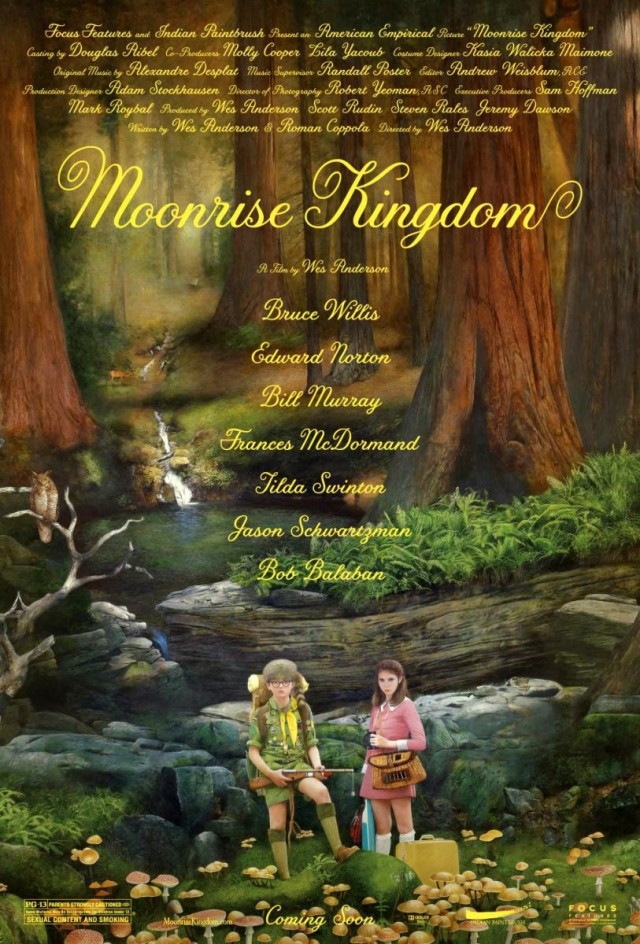
Moonrise Kingdom: ****/*****, or 8/10

And so Wes Anderson, that overly creative director of delightful family comedy drama, returns to live action filming after having taken a short break from it in favour of proving his style is equally charming when applied to stop motion animation, which resulted in The Fantastic Mr. Fox, based on the classic children's novel by Roald Dahl. Anderson apparently picked up a thing or two in a narrative sense from the great author, considering the newest addition to his own oeuvre as a distinguished film auteur (his style always instantly recognizable in every scene) like many of Dahl's stories deals with intelligent kids breaking free from the often abusive world of angry adults that simply refuses to understand them, instead restricting their growth processes by incapsulating them in a repressive regime of habits. Whether inspired by Dahl or simply containing thematic similarities by pure coincidence, Moonrise Kingdom is a wonderful hommage to smart children and their first steps towards true self-reliance despite the obstacle that adults usually prove to be.


The stage for Moonrise Kingdom is provided by New Penzance, a fictional New England island like only Wes Andersonland can provide, complete with Native American cultural leftovers, red-and-white coloured lighthouse, ferry and mail plane, plus the addition of existing Rhode Island (where the movie was shot) natural beauty of stunning quality, the bare facts of all this being relayed to the audience by an odd looking old man in a red coat and a silly hat who simply acts as narrator, not as a relevant character otherwise. The year being 1965, it's the perfect spot for a boy scout camp, which is run by part time math teacher Scout Master Randy Ward (Edward Norton, Fight Club) in a tight and strictly organized manner, which makes it all the harder for the man to accept one of his scouts, the pipe smoking orphan boy Sam Shakusky (Jared Gilman) has gone AWOL. At the same time, the dysfunctional Bishop family is dismayed to discover their little girl Suzy (Kara Hayward) has also made a run for it without their knowledge or permission, upsetting her attorney parents Walt and Laura (Bill Murray, Anderson's go-to-guy – this film marking their sixth collaboration – and newcomer-to-his-work Frances McDormand, of Burn After Reading fame). A search for the pair of runaways is swiftly underway, spearheaded by local police officer Captain Sharp (Bruce Willis, also an Anderson first-timer), a likeable but lonely man who happens to have an affair with Laura. While the search progresses, it becomes blatantly clear the two kids have planned their escape much more effectively than the generally dimwitted adults are seen to conduct their pursuit of them, making for many an hilarious gag in the process as we have come to expect and enjoy from Wes Anderson.

In a flashback we learn Sam and Suzy, both only twelve years of age, met the year before at a local church play, which led to mutual intrigue at first, followed by a pen pal connection and an eventual love relationship, which led them to elope together in order to both escape their incompetent guardians and get married and live in the wilderness. It's a deliciously naive but romantic ploy only the mind of a child could conceive, despite the minds of both kids appearing to be in a better overall condition than those of their grown-up trackers. In fact, it's Scout Master Ward's relentless (and prone to violence) team of boy scouts who locate the runaways first, leading to a surprisingly suggestive moment of aggression and a dead scout mascotte, proving Sam and Suzy are ready to fight for their freedom and their now hard earned right to live alone on a beautiful private beach.


Unfortunately the timing for their escape could have been better, as a devastating hurricane and the resulting flood threatens their island paradise, adding a sense of urgency to the plot. Fortunately for them – or not – the adults find them in time, but by now both Captain Sharp and the boy scouts have come to respect the sensible pair's honest wishes and fully understand their desire to get away from their messed up guardians. Despite the bloody incident earlier between them, in a surprising turn of events the scouts spring both Sam and Suzy from their confinement and relocate them to a church during the now raging storm. Again cornered by the ones they tried to get away from, as well as confronted by a lady from Social Services (Tilda Swinton) – a nameless character simply referred to by everyone, including herself, as 'Social Services', a joke the Dutch subtitling sadly does not pick up – Sam and Suzy again make a now desperate run for it, risking their lives to prove the world their love is real, as is their desire to fight for their independence.

Overall, it's not a complicated plot and a brief synopsis might only make it sound childish, but it's Wes Anderson's approach to things that makes it work as well as it does. As is his usual style, the film is as quirky and colourful as his previous works, making every scene vibrantly appealing and cramped with little details, most of them only visible a brief moment, thus in itself making the film worthy of a second viewing if only to take in all the hidden jokes. Fortunately there's an abundance of not so hard to miss gags as well, both visual and in dialogue, all the actors chipping in to make the jokes as well timed and performed ad they need be. To add to the movie's charm, the film is shot using a 16 mm camera (a first for Anderson), thus enhancing the general 'old movie' feel, making it subconsciously feel more realistically like 1965, which only shows Anderson still isn't afraid to experiment a little bit here and there to discover what works best to convey a style all his own as compellingly as possible. As for experimenting, extra credit is due to him for the fact he dares to explore the blossoming sexual feelings of his two underage main characters, resulting in a 'French kissing' scene in underwear that will undoubtedly make conservative America cringe and whine, but in the context of the scene feels perfectly justified and innocent, as are all the activities he allows this pair, considering the rigid and awkward people they attempt to escape from.


Visual style and experimentation aside, as always it's the actors that make a Wes Anderson movie feel the most like a Wes Anderson movie, utilizing a typical acting style that carefully balances between introvert and emotionally disconnected on the one side and completely over the top on the other. In Moonrise Kingdom's case the greatest accomplishment in this regard comes courtesy of Hayward and Gilman, both completely inexperienced as actors with no previously established acting skills to back them up, yet both delivering a surprisingly successful and engaging performance, making it feel like they've been playing around in Anderson's movies for years. Of course, Bill Murray, who has been doing just that, also succeeds in adding yet another zany character to his repertoire, as does Jason Schwartzmann, whose bit part as an amoral and corrupt Scout leader unfortunately proves all too short. Frances McDormand, Tilda Swinton and Edward Norton fit right in, too, quickly adopting the less emotional and more dysfunctional manner of acting we've grown accustomed too in Anderson's work, despite never having appeared in one of his films before. The weakest link in this star-studded ensemble proves to be Bruce Willis, oddly enough considering his long range of expertise, who, despite portraying Captain Sharp convincingly as a sympathetic but not all too bright character, simply feels both out of place and out of touch in this film, as if not having been able to fully master the acting style required for a Wes Anderson movie. Fortunately this never gets too frustratingly apparent, nor does it ruin any of the scenes he appears in. But no matter how well any of the established actors do in Moonrise Kingdom, its genuine tour-de-force of acting is supplied by the two young main characters who carry the majority of the movie and steal our hearts in the process, making us only hope we'll be hearing more of them in the future.

Moonrise Kingdom could be called a return to form on Wes Anderson's part, a redemption after the wholesomely disappointing The Darjeeling Limited in 2007, were it not that the off-beat Fantastic Mr. Fox, despite being an animated movie, was too blatantly 'Andersonesque' to be deservedly called a deviation from his specific form. As a live action film, his latest release proves a very nice reminder just wat he's capable of, ranking among his best right alongside Rushmore (1998) and The Life Aquatic with Steve Zissou (2004), for being both genuinely funny and admittedly adorable to watch, while also containing enough heart and soul to be raised above average comedy. Be they live action or be they animation, Moonrise Kingdom strongly reaffirms the fact Wes Anderson films are always something to truly look forward to.

And watch the trailer here:


dinsdag 6 maart 2012

Armageddon


Rating: **/*****, or 4/10


Overly noisy and bombastic action spectacle featuring the imminent demise of our planet by a giant asteroid, so an unlikely group of oil drillers is send into space to drill a hole in this threat and plant a nuclear bomb into it so it can be blown up in space before it kills us all. Though the movie features a deliciously good cast and plenty of action, its at times completely asinine plot, cheesy jokes, focus on loud explosions and abundance of annoying moments of blatant American patriottism clearly betray this film to be yet another obnoxious Michael Bay product, dragging on for 150 minutes from one silly catastrophe to another until we simply cannot care about the characters' plight any more. Too bad, since the film starts out pretty good with a convincing and spectacular action scene of small meteorites hitting landmarks around the globe. After that, the movie only goes progressively downhill, despite the solid score and the many fine actors involved.


Starring: Bruce Willis, Ben Affleck, Steve Buscemi


Directed by Michael Bay


USA: Touchstone Pictures, 1998


zaterdag 4 februari 2012

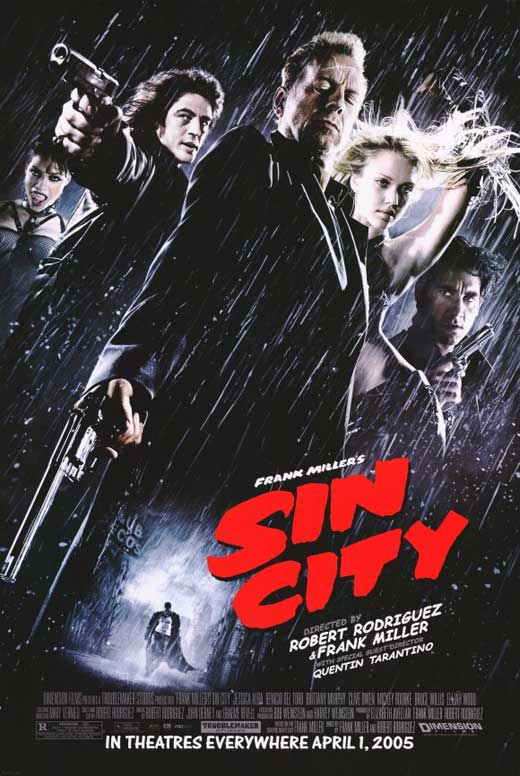
Sin City


Rating: *****/*****, or 10/10

Stad der Zonde blijkt geslaagd kunstwerk

Wat is de beste manier om een graphic novel succesvol naar het witte doek te vertalen? Waar sommige regisseurs een geheel eigen draai aan het bronmateriaal geven en het eindproduct vervolgens geenszins meer lijkt op het originele werk, ondanks de behouden kwaliteit, is er ook de compleet tegenovergestelde methode: het beeld-voor-beeld omzetten van plaatje naar shot. Robert Rodriguez gebruikte deze drastische methode bij zijn bewerking van Frank Millers klassieke 'Sin City'. En verdomd, het werkt! En dat is nog een understatement...

Nadat hij in de jaren tachtig het respect voor doorsnee comics terugbracht met zijn werk in de 'Daredevil'-reeks en het magistrale 'Batman: The Dark Knight Returns' begaf Miller zich begin jaren negentig definitief op het terrein van de 'graphic novel', getekend literair hoogstaand werk dat absoluut verschilt van de laatdunkende term 'strips' waarmee het nog te vaak in associatie gebracht wordt. Millers Sin City vormt een hommage aan de 'film noir' Hollywoodfilms van de dertiger jaren, en handelt over de stad Basin City, een verdorven Sodom en Gomorra vol met hardhandige vigilantes, 'femme fatales' en moordlustige psychopaten. De diverse verhalen vertellen over enkele stoere rouwdouwers die op hun eigen (gewelddadige) wijze nog een beetje orde en gerechtigheid in het door God verlaten oord handhaven, getoond in een grotendeels zwart/witte tekenstijl met hier en daar een mopje kleur.


Regisseur Rodriguez, die furore maakte met zowel hardcore actiefilms (Desperado, From Dusk Till Dawn) als films voor de hele familie (Spy Kids) toont zich in zijn bewerking een devote liefhebber van Millers magnum opus te zijn, door elke pagina, ieder plaatje, volledig te respecteren en liefdevol naar het grote scherm te verplaatsen, en daarbij zelden af te wijken van hoe Miller het voor ogen had. Dit is niet merkwaardig, aangezien hij Miller zelf als co-regisseur inschakelde om Sin City zoveel mogelijk recht te doen. Alsof twee regisseurs nog niet genoeg is draaft ook Quentin Tarantino, wiens eigen films geheel in het straatje van Sin City passen, op als gastregisseur van een enkele scène. Met dergelijk talent achter de camera is het niet vreemd dat Sin City een op alle fronten geslaagde bioscoop-ervaring is geworden.

Het eindresultaat bestaat uit vier afzonderlijke verhalen die elkaar slechts sporadisch kruisen. De geharde anti-held Marv (een uitstekende comeback van Mickey Rourke die de laatste jaren nauwelijks nog serieus te nemen viel) jaagt op de moordenaar van het hoertje Goldie (Jaime King) dat hem de beste nacht van zijn leven gunde. Een opgejaagde vrouw schakelt een huurmoordenaar (een zwoele Josh Hartnett) in voor haar zelfdoding. De sluwe Dwight (Clive Owen) schiet de prostituees van de Stad der Zonde te hulp als zij uit zelfverdediging een politieagent (een bijzonder hufterige Benicio del Toro) hebben gedood. En de laatste eerlijke agent Hartigan (de altijd betrouwbare actieheld Bruce Willis) verlaat na acht jaar de gevangenis om zijn laatste onopgeloste zaak af te ronden en een jongedame (een wulpse Jessica Alba) uit de klauwen van een gestoorde verkrachter (glansrol voor Nick Stahl) te houden. Vier verhalen die samen één film vormen, een geheel dat nooit saai wordt dankzij het grote aantal markante personages (inclusief het overschot aan bekende namen in de cast), de zinderende actiescènes en vooral de schitterende en ongeëvenaarde stijl die de film een compleet eigen karakter geeft.


Want hoewel de verhaallijnen zelf absoluut niet teleurstellen, maakt Sin City er geen geheim voor presentatie boven inhoud te verkiezen. Zoals de artiest Frank Miller elke bladzijde van de graphic novel tot een stilistisch meesterwerk tekende, zo transformeert diens discipel Rodriguez letterlijk Millers visie trouw naar bewegend beeld. Het ene na het andere fantastisch gecomponeerde shot volgt elkaar in dynamisch tempo op, alsof de camera het bronmateriaal zelf registreert. Het gehalte zwart/wit voelt sterk aan als een typische 'film noir' klassieker, ondanks het steeds terugkerende minimalistisch kleurenspel. De kunst van de graphic novel blijft zodanig intact en zelfs verbeterd in Rodriguez' liefdevolle adaptatie: een blauwe auto in een grauwe stroom verkeer, een rode das in een donker steegje, een gele engerd die zijn zoveelste hulpeloze slachtoffer naar het leven staat... Het kleurenpalet van Sin City leidt een geheel eigen leven, en blijft niet alleen van begin tot eind de sfeer bepalen, maar ook de hele film door fascineren. De filmversie van Sin City blijkt evenzeer geslaagde kunst als Millers originele werk dat destijds was (en nog steeds is).


En laten we vooral de vele liters bloed, nu wit, dan weer rood op de kleurloze achtergrond niet vergeten. Want de zondige stad en haar sinistere inwoners bieden ook een keur aan excessief geweld, wat volledig in de sfeer van de film past. Tijdens Marv's wraakactie snijdt hij de ledematen van een man af en voert hem vervolgens aan zijn hond. Hartigan slaat een maniak letterlijk tot pulp na hem met blote handen ontmand te hebben. Het klinkt allemaal extreem gruwelijk, maar is zo stilistisch, soms zelfs cartoonesk, in beeld gebracht dat het de pret niet kan drukken en een geaccepteerd onderdeel van de film vormt. Immers, in de Stad der Zonde zijn zulke praktijken aan de orde van de dag.

Sin City is zonder twijfel één van de meest geslaagde graphic novel verfilmingen tot nu toe, zowel in haar vertaling van boek naar film als in de kwaliteit van de film an sich. Het predicaat 'visuele kunst' misstaat absoluut niet, terwijl de film bovendien een zeer onderhoudende actiefilm is met een dynamisch tempo, een cast van louter grote namen in topvorm en de nodige toepasselijke zwarte humor. Waar collegae als Alan Moore hun werk verminkt zagen worden door de harteloze filmindustrie mag Frank Miller zich gelukkig prijzen met een talentvolle regisseur als Robert Rodriguez die bewijst diens originele werk de volledige eer te bewijzen door dit om te zetten in een film die meer Millers stempel drukt dan zijn eigen. Of een dergelijke situatie zich in de toekomst voor zal doen bij vergelijkbare graphic novel adaptaties valt nog te bezien, maar naar het al aangekondigde Sin City 2 kan, ook door Miller zelf, terecht reikhalzend uitgekeken worden.