Moonrise Kingdom: ****/*****, or
8/10
And so
Wes Anderson, that overly creative director of delightful family
comedy drama, returns to live action filming after having taken a
short break from it in favour of proving his style is equally
charming when applied to stop motion animation, which resulted in The
Fantastic Mr. Fox, based on the classic children's novel by Roald
Dahl. Anderson apparently picked up a thing or two in a narrative
sense from the great author, considering the newest addition to his
own oeuvre as a distinguished film auteur (his
style always instantly recognizable in every scene) like many of
Dahl's stories deals with intelligent kids breaking free from the
often abusive world of angry adults that simply refuses to understand
them, instead restricting their growth processes by incapsulating
them in a repressive regime of habits. Whether inspired by Dahl or
simply containing thematic similarities by pure coincidence, Moonrise
Kingdom is a wonderful hommage to smart children and their first
steps towards true self-reliance despite the obstacle that adults
usually prove to be.
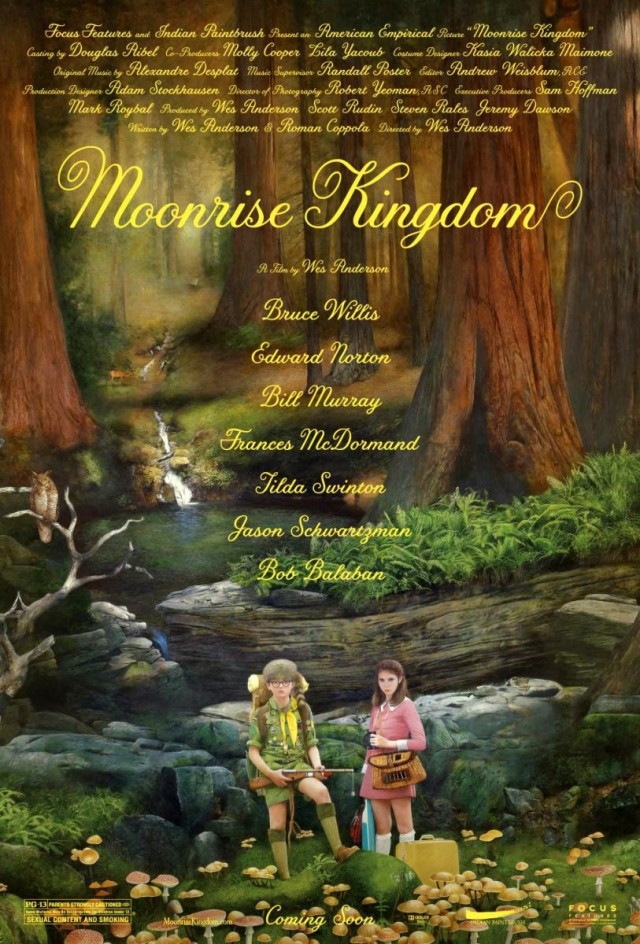
The
stage for Moonrise Kingdom is provided by New Penzance, a
fictional New England island like only Wes Andersonland can provide,
complete with Native American cultural leftovers, red-and-white
coloured lighthouse, ferry and mail plane, plus the addition of
existing Rhode Island (where the movie was shot) natural beauty of
stunning quality, the bare facts of all this being relayed to the audience by an odd looking old man in a red coat and a silly hat who simply acts as narrator, not as a relevant character otherwise. The year being 1965, it's the perfect spot for a
boy scout camp, which is run by part time math teacher Scout Master
Randy Ward (Edward Norton, Fight Club) in a tight and strictly
organized manner, which makes it all the harder for the man to accept
one of his scouts, the pipe smoking orphan boy Sam Shakusky (Jared Gilman) has
gone AWOL. At the same time, the dysfunctional Bishop family is
dismayed to discover their little girl Suzy (Kara Hayward) has also
made a run for it without their knowledge or permission, upsetting
her attorney parents Walt and Laura (Bill Murray, Anderson's
go-to-guy – this film marking their sixth collaboration – and
newcomer-to-his-work Frances McDormand, of Burn After Reading
fame). A search for the pair of runaways is swiftly underway,
spearheaded by local police officer Captain Sharp (Bruce Willis, also
an Anderson first-timer), a likeable but lonely man who happens to
have an affair with Laura. While the search progresses, it becomes
blatantly clear the two kids have planned their escape much more
effectively than the generally dimwitted adults are seen to conduct
their pursuit of them, making for many an hilarious gag in the
process as we have come to expect and enjoy from Wes Anderson.
In a
flashback we learn Sam and Suzy, both only twelve years of age, met
the year before at a local church play, which led to mutual intrigue
at first, followed by a pen pal connection and an eventual love
relationship, which led them to elope together in order to both
escape their incompetent guardians and get married and live in the
wilderness. It's a deliciously naive but romantic ploy only the mind
of a child could conceive, despite the minds of both kids appearing
to be in a better overall condition than those of their grown-up
trackers. In fact, it's Scout Master Ward's relentless (and prone to
violence) team of boy scouts who locate the runaways first, leading
to a surprisingly suggestive moment of aggression and a dead scout
mascotte, proving Sam and Suzy are ready to fight for their freedom
and their now hard earned right to live alone on a beautiful private
beach.

Unfortunately
the timing for their escape could have been better, as a devastating
hurricane and the resulting flood threatens their island paradise,
adding a sense of urgency to the plot. Fortunately for them – or
not – the adults find them in time, but by now both Captain Sharp
and the boy scouts have come to respect the sensible pair's honest
wishes and fully understand their desire to get away from their
messed up guardians. Despite the bloody incident earlier between
them, in a surprising turn of events the scouts spring both Sam and
Suzy from their confinement and relocate them to a church during the
now raging storm. Again cornered by the ones they tried to get away
from, as well as confronted by a lady from Social Services (Tilda
Swinton) – a nameless character simply referred to by everyone,
including herself, as 'Social Services', a joke the Dutch subtitling
sadly does not pick up – Sam and Suzy again make a now desperate
run for it, risking their lives to prove the world their love is
real, as is their desire to fight for their independence.
Overall,
it's not a complicated plot and a brief synopsis might only make it
sound childish, but it's Wes Anderson's approach to things that makes
it work as well as it does. As is his usual style, the film is as
quirky and colourful as his previous works, making every scene
vibrantly appealing and cramped with little details, most of them
only visible a brief moment, thus in itself making the film worthy of
a second viewing if only to take in all the hidden jokes. Fortunately
there's an abundance of not so hard to miss gags as well, both visual
and in dialogue, all the actors chipping in to make the jokes as well
timed and performed ad they need be. To add to the movie's charm, the
film is shot using a 16 mm camera (a first for Anderson), thus
enhancing the general 'old movie' feel, making it subconsciously feel
more realistically like 1965, which only shows Anderson still isn't
afraid to experiment a little bit here and there to discover what
works best to convey a style all his own as compellingly as possible.
As for experimenting, extra credit is due to him for the fact he
dares to explore the blossoming sexual feelings of his two underage
main characters, resulting in a 'French kissing' scene in underwear
that will undoubtedly make conservative America cringe and whine, but
in the context of the scene feels perfectly justified and innocent,
as are all the activities he allows this pair, considering the rigid
and awkward people they attempt to escape from.

Visual
style and experimentation aside, as always it's the actors that make
a Wes Anderson movie feel the most like a Wes Anderson movie,
utilizing a typical acting style that carefully balances between
introvert and emotionally disconnected on the one side and completely
over the top on the other. In Moonrise Kingdom's case the
greatest accomplishment in this regard comes courtesy of Hayward and
Gilman, both completely inexperienced as actors with no previously
established acting skills to back them up, yet both delivering a
surprisingly successful and engaging performance, making it feel like
they've been playing around in Anderson's movies for years. Of
course, Bill Murray, who has been doing just that, also succeeds in
adding yet another zany character to his repertoire, as does Jason
Schwartzmann, whose bit part as an amoral and corrupt Scout leader
unfortunately proves all too short. Frances McDormand, Tilda Swinton
and Edward Norton fit right in, too, quickly adopting the less
emotional and more dysfunctional manner of acting we've grown
accustomed too in Anderson's work, despite never having appeared in
one of his films before. The weakest link in this star-studded
ensemble proves to be Bruce Willis, oddly enough considering his long
range of expertise, who, despite portraying Captain Sharp
convincingly as a sympathetic but not all too bright character,
simply feels both out of place and out of touch in this film, as if
not having been able to fully master the acting style required for a
Wes Anderson movie. Fortunately this never gets too frustratingly
apparent, nor does it ruin any of the scenes he appears in. But no
matter how well any of the established actors do in Moonrise
Kingdom, its genuine tour-de-force of acting is supplied by the
two young main characters who carry the majority of the movie and
steal our hearts in the process, making us only hope we'll be hearing
more of them in the future.
Moonrise
Kingdom could be called a return to form on Wes Anderson's part,
a redemption after the wholesomely disappointing The Darjeeling
Limited in 2007, were it not that the off-beat Fantastic Mr.
Fox, despite being an animated movie, was too blatantly
'Andersonesque' to be deservedly called a deviation from his specific
form. As a live action film, his latest release proves a very nice
reminder just wat he's capable of, ranking among his best right
alongside Rushmore (1998)
and The Life Aquatic with Steve Zissou
(2004), for being both genuinely funny and admittedly adorable to
watch, while also containing enough heart and soul to be raised above
average comedy. Be they live action or be they animation, Moonrise
Kingdom strongly reaffirms the
fact Wes Anderson films are always something to truly look forward
to.
And watch the trailer here:


