Posts tonen met het label racism. Alle posts tonen
zaterdag 30 april 2016
Today's Review: Monsieur Chocolat
This one's near two weeks old now, but circumstances didn't allow me to repost it here until today:
Monsieur Chocolat - recensie
Monsieur Chocolat is one of those typical period dramas that tells a story of days of human degradation gone by more for the sake of the present day than for the desire to accurately reflect the times depicted. Though the director and writers proclaimed their intention of re-introducing a once famous French artist who by the dawn of the 21st Century had slipped into obscurity for a contemporary audience, the issues of race, though certainly a factor of Chocolat's life, are addressed far more strongly than they most likely were back in the days. Of course, Chocolat's entire career was based around his otherness and influenced more by the ignorant cultural notions of white audiences than they were by reality, but that didn't stop him from becoming one of the top theatrical artists of his day. And he was known to be proud of that achievement, even though much of his acts involved getting his arse kicked by a white clown.
But the blatant, painful melodrama of his life suggested by Monsieur Chocolat is more of an attempt to remind modern audiences of the insanity and humiliation on which his career was based rather than on actually reported events. Not to mention Chocolat's private demons involving women, booze, drugs and gambling, which add further obstacles to his career beyond simply attempting to add diversity to his stage acts. Basically, by adding all these other troubles, the writers make it clear that Chocolat is an artist like any other, dealing with the same pitfalls of fame that other artists experienced. It makes for rather generic situations beyond the ever degrading scenes of racial subjugation and does little to push Monsieur Chocolat above the myriad of similar films involving struggling performers of any ilk.
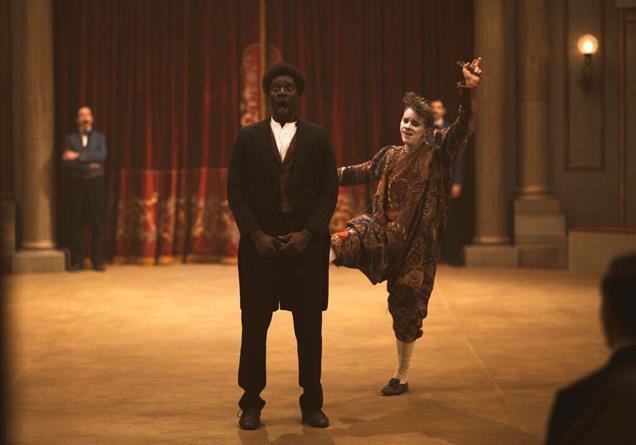
The performances, less so. Omar Sy may actually have hit a career high note in this one, delivering what certainly can be called his most convincing performance since Intouchables. He moves from merry clown entertaining women and children to broken, down-on-his-luck artist plagued by rampant racism seemingly effortlessly. Not to mention he and his co-star James Thierrée are equally matched, with the latter playing a perfect counterpart as the stage obsessed but otherwise grumpy and serious clown Footit, a total opposite to the light hearted Chocolat in many other respects beyond race. The duo makes for a strikingly different pair of personalities you could hardly imagine sharing the circus, though the ultimate break-up feels an inevitable event from the get-go. The circumstances involving their separation were not as 'black and white' as this film suggests though. Again, Monsieur Chocolat feels the need for distorting the truth to underscore the malign racism of the era. That message is well received, but the historical character of Chocolat is not aided by hammering home the message so harshly. However, thanks to this film, he is also not forgotten, so the makers succeeded in that regard as well.
maandag 7 mei 2012
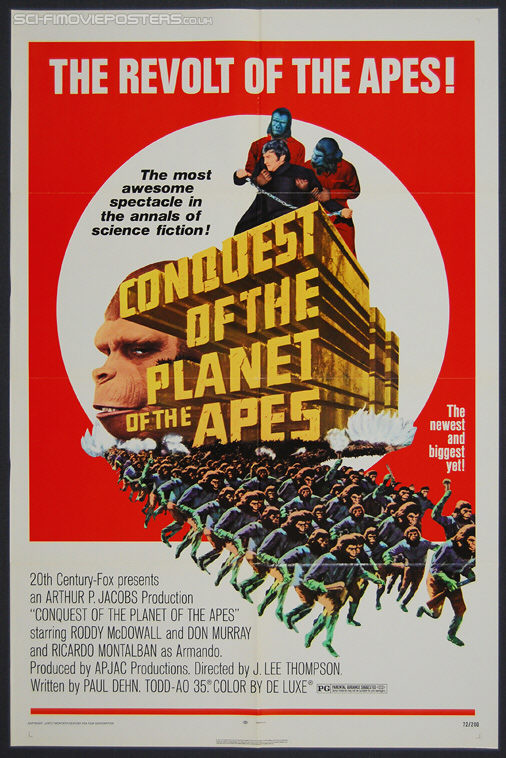
Conquest of the Planet of the Apes
Rating:
***/*****, or 6/10
Third
sequel to the original Planet of the Apes film from 1968.
After the overall lighter tone from its predecessor Escape from
the Planet of the Apes (1971),
the franchise takes a much darker turn in this film, as we finally
witness the origin of the apes and their hatred towards mankind. In
the not too distant future (1991, so don't worry, it didn't happen),
a mysterious disease has wiped out all cats and dogs, so apes are
kept as replacements pets, but are soon found to be more suitable for
slave labour and as such are ruthlessly exploited by their human
overlords in a gritty dystopian setting. The son of former 'future
apes' Zira and Cornelius, dubbed Caesar (played by Roddy McDowall,
who previously performed Cornelius as well) by his human surrogate
father (all too small part for Ricardo 'Khan' Montalban), finds
himself without his protector who is viciously brutalized and killed
by the human regime – it's not an all too happy future for humans
either – after which he finds himself amongst his fellow simians
and becomes their Messiah. Under Caesar's command, the apes rise in
revolt and violence sweeps the nation as they fight for their freedom
and start a conflict that will change the fate of the world. Easily
the most controversial and most violent entry into the franchise, as
the provocative display of abused and chained apes evokes haunting
imagery of human slavery based on racial segregation, which is of
course a parallel that has driven the continuing overall plot since
the first film, but is most effectively fleshed out here. It is also
painfully reminiscent of the race riots of the late sixties and early
seventies, something the writers sure were aware of. Despite its
convincing and intriguing social parallels, the fairly limited budget
and resulting small scale look of the film hinder the impact of the
story on a visual level for looking so cheap. Plus, the clear
delineation between good apes and bad humans makes for pretty
two-dimensional, oversimplified characterization. The plot was
partially appropriated to great acclaim by the latest Planet of
the Apes reboot, Rise of the Planet of the Apes (2011),
thankfully resulting in grander imagery.
Starring:
Roddy McDowall, Don Murray, Ricardo Montalban
Directed
by J. Lee Thompson
USA: 20th
Century-Fox, 1972
woensdag 1 februari 2012
Amistad
Rating ***/*****, or 7/10
Spielberg's
testimonial against the nineteenth-century African slavery industry. On the slaver
vessel La Amistad in 1839, a group of slaves revolted, after which
the ship was steered towards the USA, where a lengthy string of
courtroom sessions controlled the mutineers' fate. Spielberg
unfortunately lets the courtroom scenes dominate the film too much,
which makes for a rather static and lengthy view that often fails to
compel its audience, but the flashback scenes that illustrate the
deplorable suffering of Africans aboard slaver ships fully
underscores the horrors they underwent and the issues at stake for
the Amistad slaves, and feels like a fist punch in the face of
viewers who might otherwise have fallen asleep. The various parties
involved, including the Southern and Northern American states, the
British Navy and the Spanish royalty provide for an historically
intriguing but narratively chaotic overall plot line. Spielberg made
this film with the best intentions, but it's obviously not as much
his cup of tea as the Second World War or the Holocaust proved to be.
The movie does include some powerful performances though, both by
veteran actors the likes of Anthony Hopkins and Morgan Freeman, as
well as relative newcomers Matthew McConaughey and Djimon Hounsou.
Starring:
Morgan Freeman, Djimon Hounsou, Anthony Hopkins
Directed
by Steven Spielberg
USA:
Dreamworks SKG, 1997
American History X
Rating
****/*****, or 8/10
Unsettling
and disturbing portrait of an ex neo-nazi (Edward Norton in a
powerful role) who, after seeing the error of his ways when sentenced
to prison, desperately tries to keep his younger brother (Edward
Furlong), who worships him and his former convictions, from going
down the same destructive path. The story being told about how lower
class youths are being corrupted by neo-nazi ideals and the dramatic
effects this has on their own family and any neighbours belonging to
an ethnic minority is displayed in an extremely gripping narrative
which includes downright shocking scenes of violence, most notably a
very suggestive sidewalk murder and a grizzly shower rape, which make
the movie hit you hard but also certainly succeeds in relaying its
anti-radicalisation message. Fantastic debut by Tony Kaye, who since
has fallen into almost total obscurity.
Starring:
Edward Norton, Edward Furlong, Avery Brooks
Directed
by Tony Kaye
USA: New
Line Cinema, 1998
Abonneren op:
Posts (Atom)