Posts tonen met het label Keanu Reeves. Alle posts tonen

maandag 10 februari 2014

Today's Review: 47 Ronin


47 Ronin: **/*****, or 4/10

'To understand the story of the 47 ronin is to understand Japan' this movie states as its introduction, attempting to place what's to come in a historical context for audiences unfamiliar with ancient, feudal Japan. The story of these 47 samurai, who witnessed the death of their master which caused them to become shamed ronin and afterwards successfully plotted and executed their revenge to regain their honour and die a noble suicide, is one of Japan's most popular and enduring legends. Such a serious tale of death and dishonour is not the usual stuff of grandiose Hollywood productions and therefore this original saga was embellished with plenty of action, romance and expensive effects to make it more worthy of being turned into a blockbuster movie. However, the heart of the story was left unchanged (something Japanese traditionalists at least will appreciate) and as a result, 47 Ronin proves a rather uncomfortable and uneasy mix of Japanese and western storytelling.

47 Ronin is told from the perspective of Kai, a mysterious halfbreed orphan who is found by Lord Asano of Ako province. Despite the advice of his samurai who consider him a demon child, Asano takes him in because he sees 'something' in the boy. Raised alongside Asano's daughter Mika the orphan grows up to be Keanu Reeves, and they develop a typical secret desire for one another (credibility of which is hindered by the fact that Keanu looks and is much older than the actress playing his love interest, though they are meant to be about the same age). Kai is of course an all too obvious attempt to make it easier for western audiences to identify with the strange and unknown Japanese way of life, but as is usually the result of such additions, Kai gets too important for the story's good, as if the movie's 'natives' are unable to carry out their bold plan without a white man's help. Identification is ever a challenge for the audience where the stoic Reeves is concerned, and 47 Ronin proves no different, though his emotionless expression at least suits the subject matter. However, Asano was right, as Kai is no ordinary boy but is indeed connected with the supernatural. Which is just as well, as it turns out 18th Century Japan, unlike the original legend told us, was surprisingly infested with the occult, monsters and wraiths. Did I mention 47 Ronin is also a fantasy movie? Well, it is.
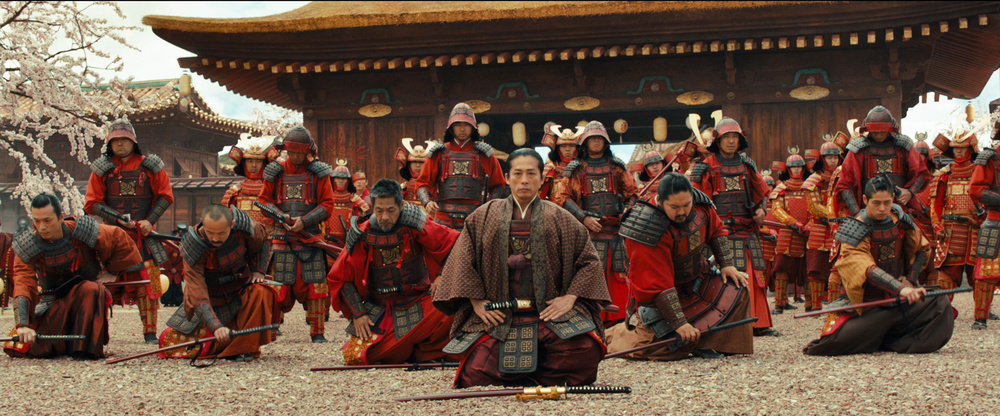


Asano suffers a rivalry with the ruthless Lord Kira (who ironically is played by Tadanobu Asano). Hellbent on taking over Ako (and as is typical, everything else too in the long run), Kira employs the talents of a shapeshifting witch (Pacific Rim's Rinko Kikuchi) to stir things up. Kikuchi is evidently enjoying the role of seductive sorceress, but like her boss plays evil only for evil's sake, which makes for a rather poorly motivated, dull duo of bad guys. Their schemes succeed as Asano is tricked into openly attempting to kill Kira in the presence of their shogun, for which he is sentenced to seppuku. Romanticising this act of suicide, Asano's death is overly poetic and bloodless, despite the fact he's disemboweling himself and getting his head struck off. After his death, his samurai are declared dishonoured ronin and, to turn insult into agony, Mika is forced to wed Lord Kira. This will not do, after which Asano's captain Oishi (Hiroyuki Sanada, grave and cold as often) plots revenge. And even though he never liked him, he asks Kai to join the quest. Good thing too, as the revelation of his upbringing by forest ghosts sure aids in defeating their monstrous and demonic opponents. Most of which were already defeated in terms of convincing the audience due to the poor visual effects job done on them.


Amidst all the beheadings and dismemberment that follows, it's evident that a different kind of cutting called editing also did not work in 47 Ronin's favour. At times it's obvious that material was discarded, making for an occasionally jumbled flow of the movie's plot, especially in the case of the scenes on the 'Dutch Island', where Kai is sold into a brief life of slavery and gladiatorial servitude. An impressively tattooed pirate, heavily used in the film's marketing campaign, is seen only for a short moment, while the perceptive eye is able to spot a brief appearance by Yorick van Wageningen: aggressive changes in the post-production process reduced his part to the quickest of cameos. At least there is nothing wrong with the design of the movie, which does at times look sensational and exotic, even in 3D. Though little effective use is made of that technology, as the straightforward quest for vengeance is otherwise quite two-dimensional. Despite all the added fantasy spectacle, the story remains the tale of a group of angry knights seeking revenge for the death of their lord. Their sense of honour is all that matters, a point which the movie gets across, but is hard to be approved by everybody. Despite the addition of various grotesqueries and scenes of supernatural suspense to make the story more entertaining and acceptable for the non-Japanese, the general mood of the film is overly sombre and devoid of relatable humour. Not counting a particularly fat ronin who, as overweight people tend to do in Hollywood blockbusters, is supposed to introduce a bit of comedy to occasionally lighten the tone, but fails miserably.


The only understanding western audiences will take away with them from seeing 47 Ronin is that Hollywood and Japanese legend don't mix to everybody's satisfaction. We understand that Japanese notions of honour are obsessed with ritual suicide, choosing death over life even when the situation, from our point of view, would definitely dictate differently. As the movie is transformed into otherwise fairly standard fantasy fare, the conclusion of the legend is left unchanged: evil has been vanquished, the land made safe, but still the 47 ronin are ordered to die, as per the climax of the original story. No happy end by western standards here, as Keanu and his fellow warriors take their own life (gladly, even!), leaving their grieving loved ones behind, for such is their way of honour. At times it feels like 47 Ronin means to make suicide a popular trend by extolling its virtues. Western audiences can only stand amazed by what at times appears to be a genuine glorification of seppuku. In this regard, the Japanese can be glad Hollywood left the core of their legend untampered despite the addition of witches and monsters to make things more exciting, but a 'gaijin' audience is left estranged as their notions of what constitutes a satisfactory ending – even if it would have been the stuff of cliché – are shattered. To understand the story of the 47 ronin is to acknowledge the extreme clash of cultures between Japan and Hollywood in this matter: 47 Ronin makes that much painfully clear.


zondag 5 januari 2014

Today's Mini-Review: The Day the Earth Stood Still (remake)


Rating: **/*****, or 4/10

Starring: Keanu Reeves, Jennifer Connelly, Jadem Smith
Directed by Scott Derrickson
USA: 20th Century-Fox, 2008

The thing about remakes is they need to retell a story of old (or at least apply its general concepts) while giving it meaning that reflects contemporary society, instead of carbon-copying the meaning of their original counterpart to little avail in a changed world. In that regard, the remake of the Sci-Fi classic The Day the Earth Stood Still (1951) is spot-on, replacing a warning against the dangers of nuclear weapons for an ecological message against man's carelessness where the health of the world's environment, and thus his own, is concerned. In most other respects, this new The Day the Earth Stood Still feels like a redundant exercise in how not to redo a well remembered movie.


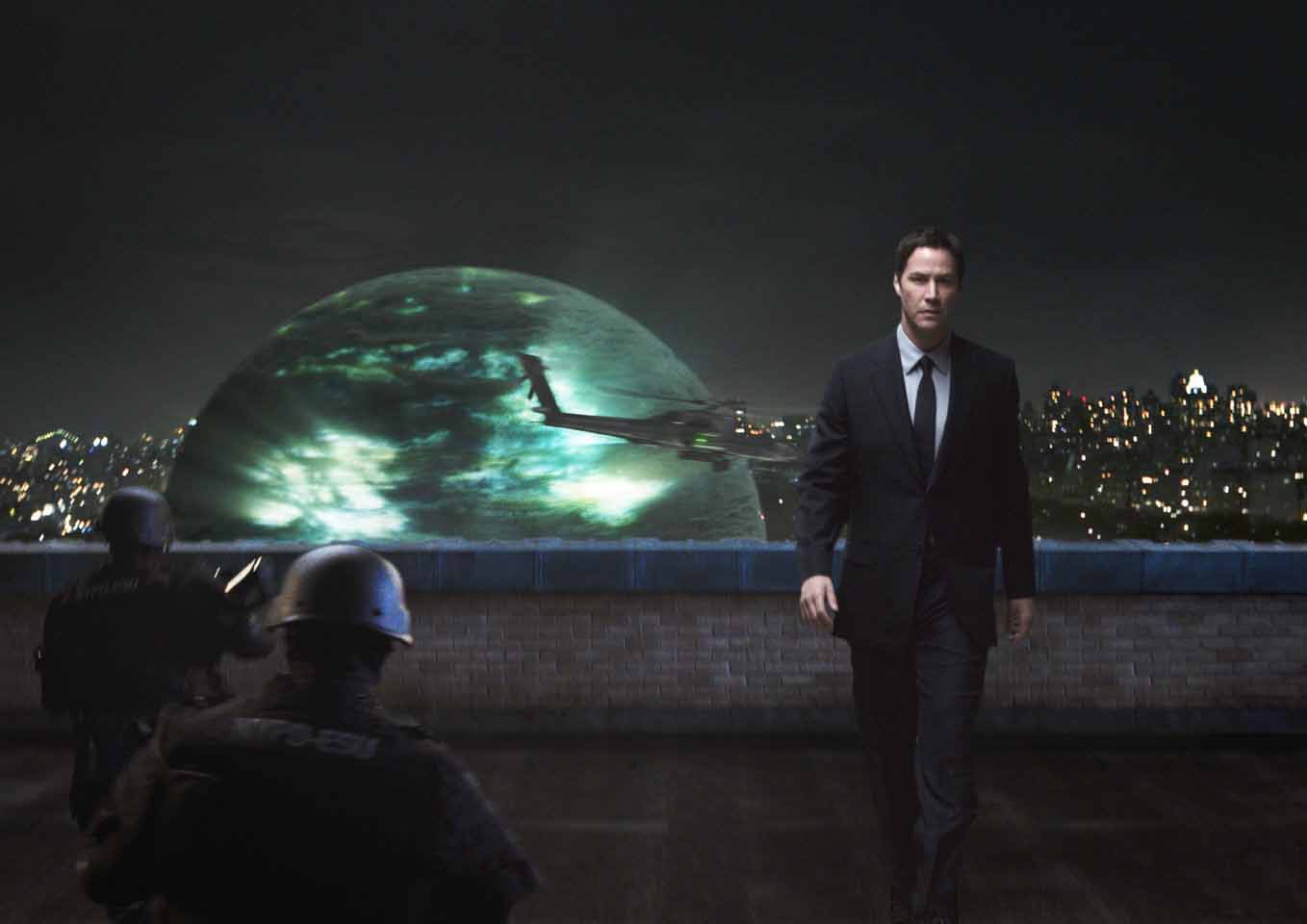
Like its predecessor from the Fifties, the film revolves around an extraterrestrial visitor, with a giant robot in tow, who is met with hostility and fear on our planet. Darker and grittier than the original, there is good cause to treat the stranger (an aptly emotionless (as always) Keanu Reeves) with aggressive caution, as he's not here delivering an ultimatum telling us to change our ways for the better, but has instead come to eradicate the human infestation from the face of the galaxy in an attempt to save all other life forms spawned by Mother Earth. Life, he says, is rare in the vast limitless of space and therefore a precious thing, but life endangering all other life must be swiftly dealt with: the ends clearly justify the means. Arriving in a sphere (as opposed to a saucer, like before) the alien called Klaatu has come not as a Christ figure like in the original film, but as an Anti-Christ, hellbent on unleashing his own weapon of mass destruction upon our not so innocent world. Said weapon proves to be his artificial companion Gort, who appears to be a metallic giant in humanoid shape, but actually consists of huge numbers of nanites capable of devouring everything they come into contact with. Thankfully humanity has its on secret weapons to combat Klaatu's convictions, namely a smart and strong female scientist (played by Jennifer Connelly) who manages to dissuade the alien from his destructive plans, backed up by the effective reasoning of an aged professor (John Cleese) who morally convinces him humanity must be allowed to make its own choices in the natural process of its evolution. Even though Klaatu's frozen heart is thawed and his role is turned around a full 180 degrees so Keanu can once again play the Messiah (e.g., The Matrix trilogy and Constantine), his original point is amply illustrated as the military tampers with his devices in a botched attempt to destroy them, only unleashing their horrors as nanites swarm the land and the FX department is given the opportunity to go all-out so as to obscure the fact this version of The Day the Earth Stood Still hardly proves as emotionally compelling as its forebear did.


Aside from an update in themes and special effects, this remake offers little improvement over its predecessor. Religious overtones are obviously still to be found: aside from Klaatu's messianistic role, there is the notion of 'space arks' for example, small spheres evacuating all animal species off-world before being engulfed by a sea of nanites. The movie walks a fine line between being too obvious and too subtle, but the representation of religion is the least of its problems. This new The Day the Earth Stood Still has a hard time convincing the spectator that an alien intelligence can so easily be persuaded to alter its agenda, which from the start felt so ruthlessly unalterable thanks to Reeves' emotionless portrayal. What's worse, his turnaround is accomplished through interaction with the scientist and her kid, a terribly obnoxious and ungrateful little brat (Jaden Smith, ofcourse), the latter more often given the audience the impression Klaatu was right from the start and humanity really is a plague better wiped out for the universe's sake, than making it easy for us to accept the otherworldly being is starting to appreciate contact with mankind and suddenly considers humans worth saving after all. The talents of both Connelly and Cleese remain underused in favor of this irritating child character, while it's they who deliver the truly valid arguments as to why humanity is just not so black and white as Klaatu feared. Meanwhile, being a big winter release, the current The Day the Earth Stood Still all too eagerly uses the tools at its disposal thank to the wonders of digital technology by adding many a bombastic scene of computer generated imagery fighting soldiers, reducing the film to the level of the average type of big FX driven action flick, instead of ending up as a smart and sensible science fiction drama like the far superior 1951 incarnation. Nowhere does this film feature either the intellectual impact or the trend setting production design the original was blessed with. Instead, its eco-message is delivered in a bland and forgetful new groove, the impression the film leaves as tiny as the nanites it showcases.


A retooling of the original film where the phrase 'nuclear weapons' would simply have been substituted with 'global pollution' would probably have made for a more agreeable and certainly cheaper way to update that film for today's public, as the 2008 version of The Day the Earth Stood Still adequately illustrates that changing the message to fit the times while throwing huge sums of money at the project to give it that slick blockbuster feel coupled with ignoring the character aspects that ought to make us care doesn't make for a good film, let alone for an effective means to convince the audience of the value of the themes addressed.

And Happy Birthday, Sis!!

maandag 7 mei 2012

Constantine


Rating: ***/*****, or 7/10


Fascinating mix of horror and action, based on the DC comic book series Hellblazer. Keanu Reeves stars as John Constantine, a cynical, rude chain smoking exorcist who has had the misfortune of having the ability to see the angels and demons secretly roaming our world all around us since childhood. Despite having dispatched scores of demons back to hell, he's on his last legs suffering from terminal lung cancer, soon doomed to a final one-way trip to the underworld. Reeves is reunited with Rachel Weisz (they starred opposite each other in Chain Reaction (1996), who plays a detective investigating the apparent suicide of her mentally ill Catholic twin sister. She soon finds out it was a part of a much larger plot that might involve the sudden End of Days as the son of Satan means to overthrow his father's reign and release hell on Earth. Despite the two of them not getting along, Constantine is forced to team up with her to stop this imminent Apocalypse, but finds himself being hindered by both angels and demons alike, all with their own agenda, including a androgynous deranged Gabriel (Tilda Swinton). Though visually impressive – especially the hellish version of Los Angeles – and containing a bunch of solid action and horror scenes, the weird potpourri of historical and Apocalyptic elements and Biblical role-reversals has to be taken with quite a grain of salt. Reeves also falls back into his already firmly established Messiah routine (and it wouldn't be the last time), while Weisz clearly proves who is the better actor of the two. A sequel has been in the works for years, but always fails to materialize beyond mere planning.


Starring: Keanu Reeves, Rachel Weisz, Tilda Swinton


Directed by Francis Lawrence


USA: Warner Bros., 2005


donderdag 1 maart 2012

Animatrix, The


Rating ***/*****, or 6/10


A total of nine short films makes up the whole Animatrix, which in itself is an expansion of the Matrix universe as seen in the trio of Matrix films. Released on home video (though one of these did make it to cinemas as a short film attached to Dreamcatcher) between the release dates of The Matrix Reloaded and The Matrix Revolutions, the Animatrix seemed largely an attempt to cash in on the Matrix hype (like the video game Enter the Matrix did too, simultaneously) at its height when the second film has just been released and confused audiences worldwide, and before the third film would hit theaters and disappoint... well, everybody. The Animatrix does honor the many Japanese influences of the Matrix films, and is animated for the most part in typical anime style, while also directed for the most part by Japanese directors. The quality of the films varies. Of most interest are those films dealing with the origin of the machines and the Matrix itself (The Second Renaissance Parts 1 and 2), while some of the other films touching upon the Matrix world less directly range from being modestly entertaining (Beyond, Program) to utterly bizarre (Matriculated). A true mixed bag, but a worthy attempt.


Starring: a great number of voice artists, among them Keanu Reeves and Carrie- Anne Moss


Directed by numerous directors, including Peter Chung and Mahiro Maeda


USA: Warner Bros, Pictures, 2003