Posts tonen met het label Jennifer Connelly. Alle posts tonen

zondag 20 april 2014

Today's Review: Noah


Noah: ***/*****, or 6/10

You have to applaud his boldness, as Darren Aronofsky isn't afraid to seek out controversy with his first blockbuster movie. After sticking to the experimental and independent corners of contemporary American cinema for decades and continuously teasing the industry with his alleged plans to direct a big budget film for a major studio on more than one occasion (RoboCop for example), Aronofsky finally did just that. He hasn't made it easy on himself, opting for a Biblical epic that needs to appease both the religious spectators and the general international audience that does not care much for Old-Testament overtones, in a time where the divide between the tastes of both has parted as wide as Moses did the Red Sea. With Noah, Aronofksy makes a brave attempt to keep everybody emotionally invested in the story of the man chosen by God to preserve His creation, but it proves an undertaking as monumental as saving the whole of the animal kingdom on a single boat.

Noah's main problem is it must be faithful enough to the source material without being so religious as to scare away non-believers, as the studio can't afford to choose one part of the film's potential audience over the other to recuperate from its 125 million dollar budget. Concessions to both parties had to be made, and the result is an obvious, uncomfortable attempt at making a Biblical epic feel less Biblical but no less epic. If the studio ever thought they could have made a final cut of this movie that wouldn't be prone to harsh judgment from Christian groups, screentesting three different rough cuts – none of them in line with Aronofsky's own vision – to strong criticism from a religious audience made them aware of the impossibility of that endeavour. And so Aronofksy's cut is the one shown in theaters, bound to undergo the inevitable public scrutiny.

Noah follows Russell Crowe as the titular character. A descendant from the line of Seth, he and his family live a life of vegetarian righteousness and solitude, away from the rest of mankind, the offspring of the murderer Cain, which has deteriorated into a semi-industrial yet barbaric state and devoured the natural world. Avoiding contact with other people, Noah and his wife (Jennifer Connelly) have kept their three sons sheltered, teaching them to respect creation above al else. Naturally, the boys prove curious as to the way of life from their violent brethren, the rebellious middle son, Ham (Logan Lerman) most of all. Plagued by disturbing visions of humanity suffering under a great flood and inexplicable signs of the Creator – a being adressed only as such throughout the piece, as the term 'God' appears taboo – Noah seeks out his grandfather Methuselah (Anthony Hopkins) to learn what It has in store for him. The strange and somewhat childish hermit informs him that the Creator is planning on cleansing His world by water, washing away all the wickedness of man, while Noah is destined to save the innocent, the animals, from extinction. And thus Noah sets out to built a vessel to do just that.


Even a man as tough as Crowe cannot hope to perform such a Herculean task by himself, but thankfully Aronofksy has added some stone giants to aid him in his divine labour. Fallen angels that were abandoned by God because they desired to help the sons of Cain in their growth, they exist as supernatural beings of light trapped in volcanic rock bodies, deformed and in agony over the fact men returned their kindness with mayhem and war. Of course, a man as obnoxiously righteous and noble as Noah wins them over easily. These so-called Watchers now do more than observe, helping Noah to complete his task and protect the Ark they construct together over eight years time. The stone giants form a welcome addition to the rather dreary Noah and his one-note family, dull to watch thus far. It's also clear that much of the budget for visual effects went into designing them, at least more so than the budget allocated to rendering the animals that come pouring into the Ark when it is completed. Their design, which bears to mind both utterly fantastic and prehistoric creatures, compels the audience to consider Noah even more of a fantasy picture: unless Aronofsky means to take some sort of evolutionary process into account, envisioning these animals as almost their contemporary counterparts, but not just quite there yet.

Naturally, it's the human element that proves key in making us care about Noah's plight. The selfless man must confront the vicious king Tubal-Cain (Ray Winstone) and his legion of followers as the rains start to fall and the monarch gets wind of the Creator's purpose for his people. Winstone as always makes for an alarming villain, but there is an uneasy truth in the king's philosophical rhetoric as well: God made man in his image, so does that not also include his capacity for destruction? After all, how much difference is there between a God who feels like destroying mankind to save His creation and a king who kills to feed his people? Though the resulting thunderstorm battle between Noah and the Watchers and Tubal-Cain's vast forces proves a fairly thrilling battle – a comparison to the Helm's Deep battle from The Two Towers does not feel inappropriate – it's such exploration of the nature of man and his relation to the Creator's purpose that make for Noah's most interesting aspect, as could be expected from Aronofsky. Unfortunately, once the battle is over and the waters swallow the world, the film has reached its narrative climax, but Aronofsky spends another 45 minutes examining the emotional climax, as Noah's family finally gets to evolve into more than cardboards characters. A little late to the game, as an overdrawn ending forces itself upon the spectator.


It's in this third act of the film that Noah emerges as a true religious fanatic, claiming to alone understand his Creator's purpose as His chosen one. The protagonist feels that God intended for humanity to die out entirely, including him and his family, for the greater good of the innocent animals. Fortunately the only woman in his company eligible for breeding, a young girl once rescued on the road (Emma Watson, with an overly strong off-putting English accent), was barren, but proves no more thanks to Methuselah's convenient magic. As his oldest son gets her pregnant, Noah makes no secret from his intention to murder her child if it's a girl. And so the noble hero quickly degenerates into a violent misogynist terrorizing his family for months on end. Suffice to say, the audience quickly loses all sympathy for him. Maybe this new side of Noah is what ticked off the religious audience in the first place, as it wanted to make clear that not all true believers condone such homicidal, fanatically zealous behavior. To make matters worse, the king managed to slip aboard the Ark unseen and lick his wounds in the lower levels aided by the rebellious teenager Ham, who is angry with his father for not allowing him to find a girl to share his life with before the Apocalypse. It takes nine months for the waters to recede and Noah's crisis of faith to reach its crescendo, while the king is eating his way through the animal kingdom in the lower decks and Noah doesn't even notice species dying out rapidly on his watch. Of course Noah predictably chooses love over blind faith in the end and kills the king: and so generic Hollywood conventions triumph over Aronofksy's fascinating but at times disturbing notions on the human condition in relation to its supreme being.

For those that feared Aronofsky's signature style is lost adhering to the rules of Hollywood, they can rest assured to some extent as it is only tempered. Aronofsky still gets to revel in fast cutting montages and creepy dream sequences as often before, applying the former into a neat but contextually awkward sequence of life's evolution. The director also makes wonderful use of the fabulous landscapes provided by the Iceland locations to give the viewer a sense of awe throughout the picture. And as in his earlier work, he's not afraid to occasionally outright shock the audience, illustrated by a nightmarish sequence in which Noah visits Tubal-Cain's encampment in secret and witnesses animals being torn apart alive by hungry mobs, who have also taken to cannibalism. The disturbing imagery effectively evokes dark and moody paintings of hell and Judgment Day by the likes of Bosch and convinces us that whatever truth there is in the king's words, Tubal-Cain is not a good guy. So we are left with picking the side of a man who makes his family cry as he threatens to kill newborns on behalf of a God who destroys the world to start over, in the hopes of getting it right this time. It's ironic the studio tried to do a similar thing in the editing room to get that final cut of Noah that appeases everybody, despite the misgivings of the director who had to do all the hard work. Man failed God (again) as was bound to happen, and though there's solid action galore and a decent time allotted for thoughtfully debating the relationship between man and his creator, Aronofksy similarly could never have succeeded in making Noah work for everybody.


zondag 5 januari 2014

Today's Mini-Review: The Day the Earth Stood Still (remake)


Rating: **/*****, or 4/10

Starring: Keanu Reeves, Jennifer Connelly, Jadem Smith
Directed by Scott Derrickson
USA: 20th Century-Fox, 2008

The thing about remakes is they need to retell a story of old (or at least apply its general concepts) while giving it meaning that reflects contemporary society, instead of carbon-copying the meaning of their original counterpart to little avail in a changed world. In that regard, the remake of the Sci-Fi classic The Day the Earth Stood Still (1951) is spot-on, replacing a warning against the dangers of nuclear weapons for an ecological message against man's carelessness where the health of the world's environment, and thus his own, is concerned. In most other respects, this new The Day the Earth Stood Still feels like a redundant exercise in how not to redo a well remembered movie.


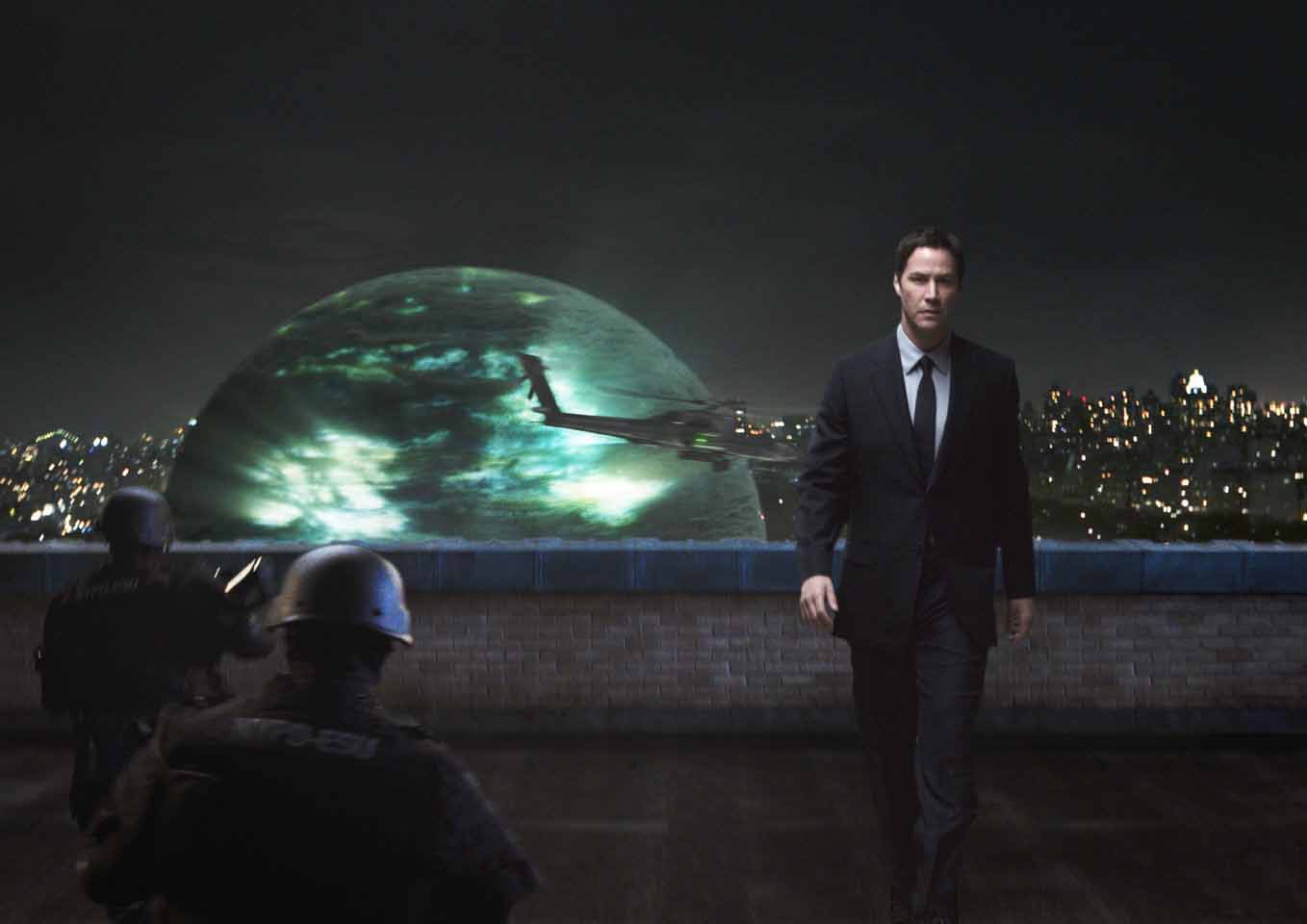
Like its predecessor from the Fifties, the film revolves around an extraterrestrial visitor, with a giant robot in tow, who is met with hostility and fear on our planet. Darker and grittier than the original, there is good cause to treat the stranger (an aptly emotionless (as always) Keanu Reeves) with aggressive caution, as he's not here delivering an ultimatum telling us to change our ways for the better, but has instead come to eradicate the human infestation from the face of the galaxy in an attempt to save all other life forms spawned by Mother Earth. Life, he says, is rare in the vast limitless of space and therefore a precious thing, but life endangering all other life must be swiftly dealt with: the ends clearly justify the means. Arriving in a sphere (as opposed to a saucer, like before) the alien called Klaatu has come not as a Christ figure like in the original film, but as an Anti-Christ, hellbent on unleashing his own weapon of mass destruction upon our not so innocent world. Said weapon proves to be his artificial companion Gort, who appears to be a metallic giant in humanoid shape, but actually consists of huge numbers of nanites capable of devouring everything they come into contact with. Thankfully humanity has its on secret weapons to combat Klaatu's convictions, namely a smart and strong female scientist (played by Jennifer Connelly) who manages to dissuade the alien from his destructive plans, backed up by the effective reasoning of an aged professor (John Cleese) who morally convinces him humanity must be allowed to make its own choices in the natural process of its evolution. Even though Klaatu's frozen heart is thawed and his role is turned around a full 180 degrees so Keanu can once again play the Messiah (e.g., The Matrix trilogy and Constantine), his original point is amply illustrated as the military tampers with his devices in a botched attempt to destroy them, only unleashing their horrors as nanites swarm the land and the FX department is given the opportunity to go all-out so as to obscure the fact this version of The Day the Earth Stood Still hardly proves as emotionally compelling as its forebear did.


Aside from an update in themes and special effects, this remake offers little improvement over its predecessor. Religious overtones are obviously still to be found: aside from Klaatu's messianistic role, there is the notion of 'space arks' for example, small spheres evacuating all animal species off-world before being engulfed by a sea of nanites. The movie walks a fine line between being too obvious and too subtle, but the representation of religion is the least of its problems. This new The Day the Earth Stood Still has a hard time convincing the spectator that an alien intelligence can so easily be persuaded to alter its agenda, which from the start felt so ruthlessly unalterable thanks to Reeves' emotionless portrayal. What's worse, his turnaround is accomplished through interaction with the scientist and her kid, a terribly obnoxious and ungrateful little brat (Jaden Smith, ofcourse), the latter more often given the audience the impression Klaatu was right from the start and humanity really is a plague better wiped out for the universe's sake, than making it easy for us to accept the otherworldly being is starting to appreciate contact with mankind and suddenly considers humans worth saving after all. The talents of both Connelly and Cleese remain underused in favor of this irritating child character, while it's they who deliver the truly valid arguments as to why humanity is just not so black and white as Klaatu feared. Meanwhile, being a big winter release, the current The Day the Earth Stood Still all too eagerly uses the tools at its disposal thank to the wonders of digital technology by adding many a bombastic scene of computer generated imagery fighting soldiers, reducing the film to the level of the average type of big FX driven action flick, instead of ending up as a smart and sensible science fiction drama like the far superior 1951 incarnation. Nowhere does this film feature either the intellectual impact or the trend setting production design the original was blessed with. Instead, its eco-message is delivered in a bland and forgetful new groove, the impression the film leaves as tiny as the nanites it showcases.


A retooling of the original film where the phrase 'nuclear weapons' would simply have been substituted with 'global pollution' would probably have made for a more agreeable and certainly cheaper way to update that film for today's public, as the 2008 version of The Day the Earth Stood Still adequately illustrates that changing the message to fit the times while throwing huge sums of money at the project to give it that slick blockbuster feel coupled with ignoring the character aspects that ought to make us care doesn't make for a good film, let alone for an effective means to convince the audience of the value of the themes addressed.

And Happy Birthday, Sis!!

vrijdag 3 februari 2012

Rocketeer


Rating: ***/*****, or 6/10

Tweede vlucht mist opnieuw net doel

Twee jaar geleden regisseerde Joe Johnston de vermakelijke sciencefiction-komedie Honey, I Shrunk the Kids, waarin een warrige uitvinder een apparaat uitvindt waarmee objecten verkleind kunnen worden dat vervolgens per ongeluk zijn gezinsleden tot miniaturen reduceert. Het was een onderhoudende variatie op het sciencefictiongenre dat hoofdzakelijk de hele familie ter vermaak diende, en op dat niveau met vlag en wimpel slaagde. Inhoudelijk was het weinig verbijsterend of innovatief, maar dat mocht de pret niet drukken. Johnston herhaalt het kunstje nu met Rocketeer, waarbij hij dezelfde formule toepast door sciencefiction, komedie en avontuur te mengen tot een brouwsel dat alle leeftijdsgroepen zal bekoren, maar niet beklijft en geen verrassingen levert.

Dit keer richt Johnston zijn blik op de pulp-wortels van het sciencefictiongenre, aan de hand van de strip 'The Rocketeer' van schrijver en tekenaar Dave Stevens. Diens werk is één grote hommage aan de serials van de dertiger jaren (specifiek King of the Rocket Men), korte films vol avontuur en sensatie die destijds aan reguliere bioscoopfilms gekoppeld werden. Al eerder vormden dergelijke serials een rijke bron van inspiratie voor hedendaagse films, waarbij Steven Spielbergs Raiders of the Lost Ark het meest geslaagde voorbeeld vormt. Serials leverden spanning, humor en romantiek ineen, en Rocketeer mixt dezelfde elementen tot een rommelige potpourri van vertier. Johnston blijkt echter geen tweede Spielberg en zijn poging komt dan ook minder goed uit de verf dan diens Indiana Jones trilogie, maar desondanks is zijn variatie op het thema geen volledige mislukking.


Het is 1938, en piloot Cliff Secord (Billy Campbell, acteur in TV-series als Dynasty en Crime Story) heeft de pech dat zijn sportvliegtuig en bron van inkomsten bij een vuurgevecht tussen gangsters en de FBI aan flarden wordt geschoten. De reden voor deze confrontatie vindt hij vervolgens verstopt in zijn hangar: een draagbare raket die hem de vleugels geeft die hij zojuist verloor. De machine blijkt onweerstaanbaar voor de vliegenier die het vervolgens wil gebruiken als broodwinning. Echter, het mysterieuze apparaat blijkt fel begeerd door verschillende partijen, waarop Secord alles op alles moet zetten om zichzelf en zijn geliefde Jenny Blake (de bekoorlijke Jennifer Connelly van Some Girls en The Hot Spot) uit de handen van de megalomane filmster Neville Sinclair (een heerlijk schmierende en hufterige Timothy Dalton (de recente 007 van License to Kill)) moet houden, die zijn eigen schimmige agenda hanteert. Dit resulteert in een klopjacht vol gangsters, vuurgevechten, nazi's en dolle stunts van Secord die door de pers tot de 'Rocketeer' gebombardeerd wordt en vervolgens als een soort superheld de schurken moet verslaan.

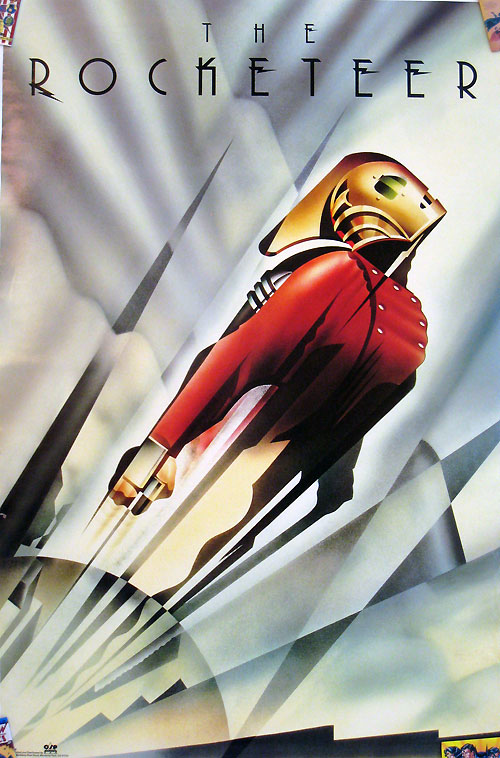
De kracht van Rocketeer ligt vooral in de liefdevolle wijze waarop Johnston eer betoont aan de pulpseries waarop zijn film zich baseert. Zijn visie op de dertiger jaren, gevuld met Hollywoodglamour, zeppelins en maffia is zeer geslaagd en een lust voor het oog. Ook de look van de raketman zelf, raketten op de rug gebonden en bizarre helm op, is heerlijk nostalgisch. Johnston verraadt zijn achtergrond in de special effects industrie – hij werkte onder andere achter de schermen van de Star Wars trilogie – in het visuele aspect van Rocketeer: Zowel de uiterlijke stijl als de trucages zijn puik verzorgd en vormen de grootste attractie van de film.

Helaas is het acteerwerk van mindere kwaliteit, waarbij hoofdrolspeler Billy Campbell de zwakste schakel vormt. Op de televisie heeft hij zich tot dusverre prima staande weten te houden, maar als leading man in een Hollywoodproductie blijkt hij geen hoogvlieger. Campbell laat zich compleet overschaduwen door de visuele pracht om hem heen en weet nergens een geloofwaardige superheld in spe neer te zetten. Hij staat erbij en kijkt ernaar. Helaas voor Jennifer Connelly heeft het duo Secord en Blake amper chemie, waardoor ook de romantiek tekort schiet. Gelukkig weet Timothy Dalton, bijna als enige acteur in deze film, beter uit de voeten te kunnen met zijn rol: als Neville Sinclair, een verwende Hollywoodster met een opgeblazen ego die het raketpak voor eigen doeleinden wil gebruiken, zet Dalton een aalgladde narcist neer, een fijne schurk die vanaf de eerste seconde zowel intrigerend als walgelijk is. Dankzij Daltons optreden blijkt dat acteren en visuele effecten prima samen kunnen gaan met de juiste casting: de Rocketeer zelf is helaas verkeerd gekozen.

Als geheel is Rocketeer een vermakelijke maar imperfecte avonturenfilm die de romantische sfeer en retro-stijl van het sciencefictiongenre in de dertiger jaren anderhalf uur lang een tweede leven gunt, maar de toeschouwer niet lang bijblijft. De capriolen van de raketvlieger in diens strijd tegen de maffia en de nazi's is hoogst onderhoudend, maar na afloop snel vergeten. De acteurs schieten doorgaans tekort terwijl het visuele gehalte uitstekend blijkt, iets waarvan Honey, I Shrunk the Kids ook al last had. Hopelijk leert Johnston op den duur een betere balans te slaan tussen acteerwerk en stijl in plaats van altijd de middenweg te verkiezen en vermakelijke maar vergetelijke producten af te leveren. Want ook zijn tweede vlucht als regisseur mist helaas net zijn doel.