Posts tonen met het label ice age. Alle posts tonen

zondag 13 april 2014

Today's Review: Snowpiercer


Snowpiercer: ****/*****, or 8/10

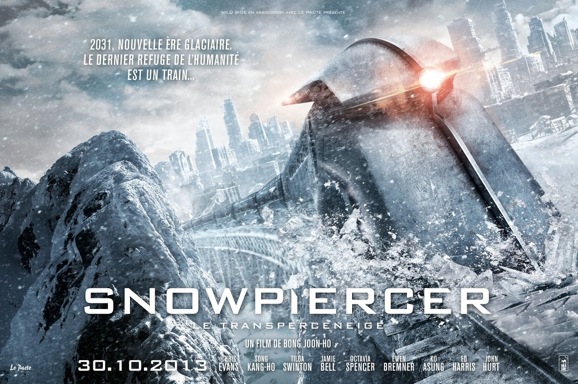
Blame it on the economic crisis or some such, but it continues to be a good time for post-apocalyptic cinema. Hollywood jumps on the-end-of-the-world bandwagon multiple times a year it appears, and there's no excuse for other countries not to also try their hand at exploring dystopian societies where human rights are nonexistant. A striking example from last year includes the big budget Elysium, wherein the majority of mankind is left to suffer on an overpopulated and heavily polluted Earth while the rich live a life of luscious luxury up in space. Directed by native South-African Neill Blomkamp, he utilized his home land settings and talent to great effect, though ultimately the Hollywood approach in terms of story and marketing prevailed (though it didn't much harm the film overall). Not so with Snowpiercer, which dabbles in very similar themes, but proves to be enriched as a viewing experience by a rather un-American sensibility, courtesy of South-Korean director Joon-ho Bong.

It cannot be denied that Snowpiercer's premise – based off the French comic Le Transperceneige – has to be taken with a grain of salt, at the risk of sounding utterly ludicrous. Set in the year 2031, seventeen years after a worldwide attempt to halt global warming by dispersing cooling gasses into the atmosphere went mercilessly awry, our planet suffers under an extreme ice age that covers the globe in snow and ice. Humanity's last few survivors live aboard a huge train, where a rigid class system has developed. The poor masses are relegated to the back compartments of the train, while the wealthy live in the front in relative comfort. Powered by a perpetuum mobile, the train rages over the frozen planet's surface, seemingly ad infinitum. While the haves play and party to their leisure, the have-nots suffer endlessly, huddled together in uninterrupted squalor and near-starvation. The rich are only interested in their kids, which they take away at random for undisclosed but doubtlessly sinister purposes. But biding their time under the command of the calculating Curtis (Chris Evans), the dispossessed plot their revolution, hellbent on overthrowing the repressive system and taking over the train for themselves. Such a plot line seems thirteen-a-dozen stuff when it comes to dystopian cinema, but the unusual element of the train makes all the difference, if you're willing to accept this rather bizarre concept.


'Bizarre' is exactly right to describe Bong's approach to Snowpiercer, if not to his whole oeuvre. With The Host, the Korean director delivered a monster-on-a-rampage movie unlike any other, while his celebrated but twisted thriller Memories of Murder firmly rooted him as a student of and a commentator on the human capacity for violence. Snowpiercer fits right into his resumé and stylistically reveals him to have auteur tendencies. The cruel and the weird go hand in hand in his clash of classes. Bong takes his time to explore the train and its hierarchy, where the mysterious designer and machinist of the vehicle,Wilford, is given divine status by those he keeps alive. As the desperate rebels who want to put an end to this dictatorship slowly but surely work their way to the front of the train, Bong keeps surprising us as much as his protagonists with each new compartment they enter. But, applying a certain video game logic to the narrative, each discovery also comes with new dangers, both physically and in terms of resolve of standing united against a common foe, as Curtis moves ever closer to the 'end boss' Wilford, and upon meeting him finds out the true machinations of the powers-that-be.

Bong tells his strange tale of revolution through an international ensemble of actors, which underscores the thought that humanity has collectively 'taken the same train' in the destruction of their habitat and must deal with it accordingly or perish as a whole. You'd be inclined to think of Evans as a typical all-American hero leading the quest for freedom, but you'd be much mistaken, as the character carries a particularly sordid past that would definitely write him off as such. The same is true for Jamie Bell, apparently his hotheaded sidekick, whose relationship with his older brother-in-arms is much more disturbing than you would at first glance suspect. Bong surprises you as much with the twisted interrelations between his protagonists as with the various situations they encounter. John Hurt seemingly plays an archetypal wise old man as he has done on many prior occasions, but what we come to know about him in the course of the film again subverts expectations, as do the motives of the apparently unstable demolitions expert/drug addict Kang-ho Song (a Bong regular) and his clairvoyant daughter. The audience is being toyed with in their mental perception of “the good guys” on a similar note as it is in regards to the physical appearance of the leading baddie, minister Mason, played by an unrecognizable Tilda Swinton in an outrageous costume and false teeth. Nevertheless, the cast succeeds in relaying the fact this class conflict isn't as black and white as you would initially believe, although with such morally colourful characters, it makes you wonder with whom Bong wants you to identify (if anyone): the line between good and bad characters is indeed as thin as the rails that keep their train going.
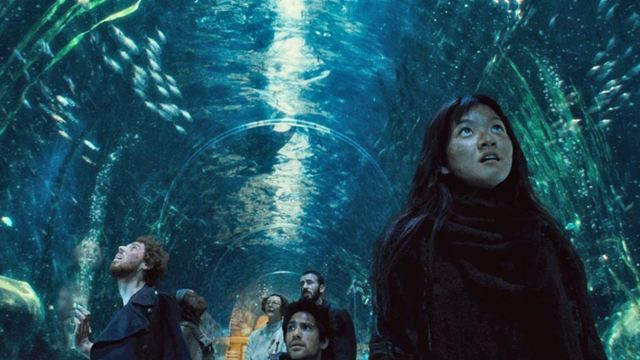


Even more colourful is Bong's sense of style. Clearly a confined space, Bong makes good use of that fact to show off his train in delightfully flexible cinematography and a colour scheme to match. Starting off with the plight of the tormented oppressed, he sticks with an abundance of brown tones – supplying a nearly monochromatic touch – and cramped, crowded spaces for the first hour, before he lets in the light and dazzles both the revolutionaries and the audience with the rich and vibrant world of the oppressors, filled with all kinds of unexpected wonders. A huge vegetable garden, a giant aquarium walkthrough (complete with manta rays), a classroom car; we're confronted with whatever we expect the least, and Bong has it all make appropriate sense. Which is not to say that he doesn't throw us off-guard at times, also in terms of the flow of the narrative. Bong makes use of the occasional off-beat, even absurdist moment that only adds to his wonderfully weird train, but continues to suggest the director's dark predilections. A brutal showdown between the tyranny's minions and the insurgents is postponed by a New Year celebration before the carnage ensues, while an overly cheerful classroom scene explodes in a bloody shootout, the presence of children notwithstanding. Not the type of thing you'd find in the more generic American dystopian flicks, nor is the movie's big revelation near the end (think The Matrix Reloaded, but without sequel aspirations). The climax however does leave some room for hope, which feels out of place and hints at studio interference, most likely from the American investors (as the film is a Korean/American/French/Czech co-production). As for the action scenes, Snowpiercer contains many and they are all sufficiently choreographed to make you bite into their mayhem, despite the oddities Bong throws at you along the way. Unfortunately many visual effects shots of the white world outside prove less than stellar and more than a little bit digital, making you wish Bong would stick more to the train, which is where nearly all of the excitement happens anyway.


Snowpiercer's premise and the logistics of its world might be hard to accept at first, but Bong makes it work. Plus, he keeps surprising you, confronting you with your own expectations, fed by having seen mostly American takes on the conflict between good and evil in dystopian societies. If you accept Bong's craziness and unwillingness to adhere to orthodox storytelling, Snowpiercer proves quite an intriguing ride, though admittedly not everyone will be able to stay on board for this one, violent, disturbing and thoroughly messed up as it deservedly can be called.


donderdag 14 november 2013

Today's Review: The Colony (Blu-Ray release)


Here's my second home cinema release review for MovieScene:

http://www.moviescene.nl/p/151545/the_colony_-_blu-ray_recensie

Another lousy flick. Though not nearly as bad and bizarre as the Nazisploitation cult curiosity called Salon Kitty, which I had the distinct displeasure of reviewing at home earlier this year. In fact, the failure in The Colony's case in many ways lies in the exact opposite method of sticking to a trite and true format instead of exploring its own merits, of which there are definitely some. Though it starts off pretty good, it soon slides into a worn out narrative that has been done to death, and almost always to better results. Nevertheless, on a rainy Sunday afternoon there's worse movies to sit through for those who happen to love dystopian and/or post-apocalytic action vehicles, with or without vicious cannibals.

zaterdag 24 november 2012

Today's Film: The Day After Tomorrow


The Day After Tomorrow


Rating: ***/*****, or 7/10


Probably Roland Emmerich's most typical disaster movie, delivering grandiose spectacle as catastrophe strikes and actors attempt to survive the many pixels the visual FX departments throw at them accordingly. Joining on the doomsday bandwagon of both scientists and laymen alike, Emmerich depicts the coming of a new ice age due to mankind's arrogant tampering with the planet's environment. Caused by global warming, ocean currents change and a series of super storms evolve, hitting the northern hemisphere hard, resulting in giant tornadoes levelling Los Angeles and tsunamis engulfing New York City. Things get even worse when temperatures drop rapidly and the latter town freezes over completely, leaving a boy (Jake Gyllenhaal) and his friends trapped in the city library, with his father (Dennis Quaid) setting out on a desperate trek across the frozen wasteland to come and save him. Though the prospects of global warming (or global meltdown for that matter) aren't particularly attractive in real life either, Emmerich goes all-out without really bothering with the laws of nature for realism's sake. The movie is therefore much maligned amongst the scientific community for its preposterous display of dramatic natural effects supposedly caused by global warming, but the message stands that we had better try to avoid the Earth cooling down or warming up for our own health anyway. Like any disaster movie, the true star of the film is the disaster itself which makes for a highly entertaining watch, while the human drama in-between moments of thrilling calamities is less compelling, at times even obnoxious for getting into the way of the action. Most spectacular is the flooding of New York, despite the overly digital quality of the piece. After that, the big freeze and a wolf attack upon the protagonists provide some more thrills but the best bits have come and gone, though all too brief moments of satire, like Americans crossing their southern border to get into Mexico illegally, generate a good laugh occasionally. Emmerich would find even more stuff to demolish in his disaster flick to-end-all disaster flicks 2012, as the fate of whole mankind and indeed the entire world lies in the balance: after all, the southern hemisphere got off too lightly in this film.


Starring: Jake Gyllenhaal, Dennis Quaid, Emmy Rossum


Directed by Roland Emmerich


USA: 20th Century-Fox, 2004

donderdag 19 juli 2012

This Ice Age has lost its cool


Ice Age: Continental Drift: **/*****, or 4/10

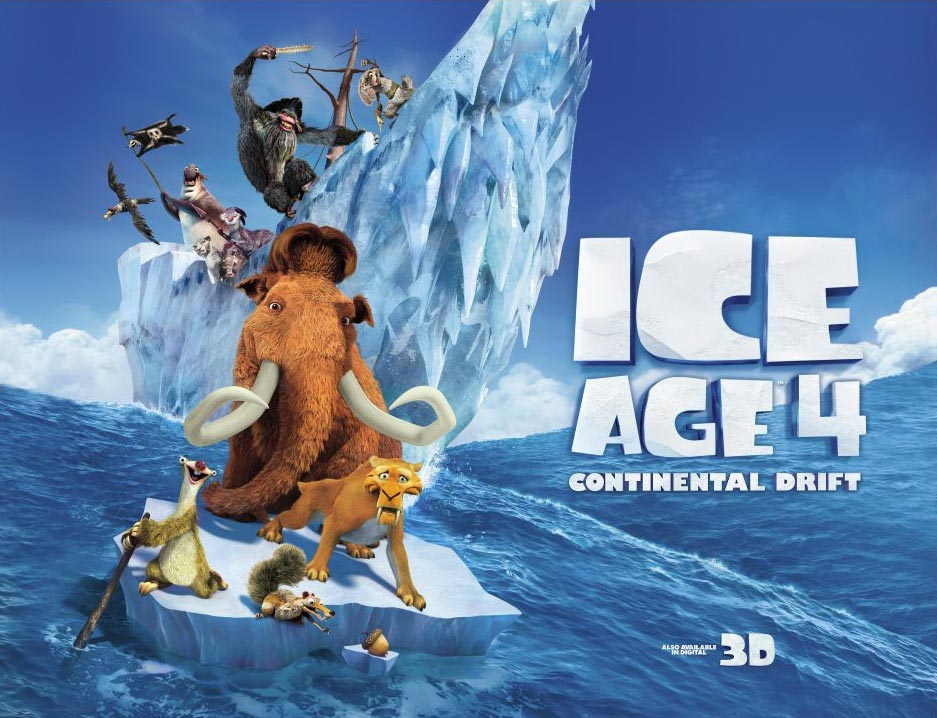
Say what you will about the writers of the Ice Age films, in hindsight they're not afraid to admit the faults in their previous work. When Sid the sloth is visited by his family in the latest addition to the series, Ice Age: Continental Drift, he states 'we had an adventure with dinosaurs, it made no sense but it sure was exciting!' and he hits the nail on the head. That description fits the predecessor Ice Age: Dawn of the Dinosaurs perfectly, since it did feel rather nonsensical to have Ice Age mammals meet dinosaurs, but it did result in a decent amount of fun (though as a dinosaur fan, I could be biased in this opinion). Sadly, throwing yet another random element in the mix in the fourth entry into the franchise, pirates in this case, unfortunately backfires completely, leading to a rather dull series of events loaded with dirty jokes and preachy life lessons we would have preferred to do without.


Ice Age: Continental Drift picks up some time after the occurrences in Dawn of the Dinosaurs. Warning! Spoilers! Mammoth couple Manny (still voiced by Ray Romano) and Ellie (still voiced by Queen Latifah) are in the process of raising their daughter Peaches (Keke Palmer), who's hit puberty and proves to be quite feisty and headstrong. Like human teenage girls she's constantly irritated by her father's overprotection, and just wants to have fun with kids her own age, but needs to be accepted by them first. Her friendship with the cowardly but cute mole hog Louis (Josh Gad) makes that kinda hard, since everybody thinks little of him, but to nobody's surprise she'll eventually find he was always her best and most loyal friend to begin with, while the other teen mammoths are just a bunch of intolerant jerks. All very recognizable for teenagers, who undoubtedly will consider this film a Louis itself, since it's clearly aimed at a younger audience that still enjoys gags revolving around natural body wastes. Such an audience at least will not stop to think about the grotesquerie of a mole hog falling in love with a mammoth (interspecies romance? Eeewww!!).

Meanwhile, Sid (still voiced by John Leguizamo) gets a surprise visit from his family, a disgusting batch of smelly, unsympathetic characters that fortunately exit the film as suddenly as they entered it, but sadly leave Sid's grandmother (Wanda Sykes) behind, an extremely old and weathered sloth which soon becomes the target of every conceivable geriatric cliché, like Peaches provides the sterotypical teenager routine for this herd of prehistoric animals that have banded together over the last three movies to form an overly extended family, which in itself has become a narrative problem: there's now so many characters the movie can hardly accomodate them all into the plot (it's only running 94 minutes), which leads to many returning characters' involvement being reduced to bit parts, a few lines here and there. Fortunately the writers realized which characters remain the most important, namely the original trio of Manny, Sid and sabre tooth tiger Diego (still voiced by Denis Leary). And so the plot of the movie takes care of separating these three bosom friends from their family, tasking them with finding a way back to their loved ones to make sure the movie ends on a happy note. Unfortunately Granny tags along with them to make sure the writers' stream of lame smelly jokes flows uninterrupted.

The key to getting the story in motion is, as always, Scrat. Still the most beloved character of the franchise, his never ending quest for his nut and the usual catastrophes this leads to kickstart the continental drift of the title, splitting both the plot lines and the herd in two (our heroes and Granny on the one hand and the rest of the herd on the other) and once again keeping Scrat from attaining his seemingly simple goal, which continues the tradition of funny intermezzos this franchise has firmly established from day one, in which the squirrel continues his hunt for his nut, all the while enlarging everybody's problems because of his natural tendency towards causing major calamities in the process. His other talent, getting the best jokes, is also reaffirmed, as Scrat's appearances interrupting the main plot make for a sporadic hilarious moment in a movie otherwise filled with cringe worthy situations resembling attempts at humour, plus dreary moral lessons. The moment of calm the movie delivers when the protagonists are cut off from their family proves all too brief, as we witness one overload of characters being substituted by another in the shape of the pirate crew that forms the movie's main antagonist (not counting that darn nut). The notion of adding pirates to the franchise seems an attempt to capitalize on Disney's major successes with Pirates of the Caribbean, just a few years too late to successfully jump on that particular bandwagon.


The merry band of pirates are just as diverse a bunch of characters as the ones Manny, Sid and Diego just left behind, they're just a little less friendly. The ship shaped iceberg they set sail on the seven seas with is run by a giant gorilla named Captain Gutt (pleasantly voiced by Tyrion Lannister Peter Dinklage, who balances well between insincere politeness and ruthless villainy) running a tight ship over his scruffy looking band of buccaneers, which includes an obnoxious killer rabbit, a thick headed elephant seal (Nick Frost) and a sultry, seductive female saber called Shira (voiced by Jennifer Lopez), who is introduced to (romantically) spice up Diego's character a bit: not a bad idea considering the poor pussycat has had no interaction with his own kind since the first film of the series, and has since felt more and more like a redundancy character wise, with little development or purpose other than saving his friends from imminent danger every once in a while. Shira herself is a typical tough girl with a rough past, who would like a change in her life style but is afraid of being hurt again. Of course it will surprise nobody when she switches sides and turns against her captain, much to his chagrin. Captain Gutt is a fairly straightforward bad guy, uncompromisingly dominating his underlings, ruling by fear instead of respect: in this regard he's the polar opposite of Manny, the gentle giant running his herd with love and integrity instead. Of course both characters soon find themselves physically at odds, with Manny winning the first round, making Gutt swear vengeance against him and – oh woe! – his family. Unfortunately Gutt's reason for being a short tempered vicious villain remains unexplored, making him a largely one-dimensional character, except in his few interactions with Shira, sort of his surrogate daughter (more by abduction than adoption).

Escaping the clutches of Gutt the first time, our heroes (and Granny) continue their journey home, which leads to the occasional nod to Homer's Oddyssey, including a confrontation with Sirens, monstrous creatures with hypnotic powers out to lure animals to their death. Though adding references to classic literature (Coleridge's Rime of the Ancient Mariner is also hailed at least once) to the already chaotic mix at least results in a suspenseful scene like this, it's not enough to keep the movie from becoming tiresome and continuing to feel like a string of random events, except for the scenes centering on Scrat. Unfortunately some of his scenes have already been used in the movie's trailer campaigns, so these will feel overly familiar. In fact, it might be a better idea altogether from here on out to ditch the rest of the Ice Age gang entirely and keep producing theatrical shorts of Scrat chasing his nutty dream attached to other family movies, as used to be the tradition with the classic Looney Tunes sketches this squirrel's shenanigans were obviously inspired by. Scrat's adventures as a castaway on a tiny island, his own Siren encounter and him causing the downfall of Scratlantis (featuring a delightful little voice role for Patrick Stewart as 'Ariscratle') prove insufficient to carry the whole film, but could easily carry themselves on separate occasions. No doubt, this would clash with the studio's financial interests, even though it would waste much less of everybody's time.


Though the quality of both the story and the gags has deteriorated progressively since the first Ice Age film, the same cannot be said for the animation. Whereas it could be called more than primitive in 2002, in this day and age it looks absolutely marvelous, courtesy of a vast army of nameless pixel pushing desk slaves no doubt. It almost feels cruel to realize such an amount of work amounted to such a disappointing final product, as if the animation talents had better put their efforts to use elsewhere. However, Continental Drift does not beat Dawn of the Dinosaurs on the visual front, since it's largely a return to the well known territory of the first two films as far as character and landscape style is concerned. While Dawn of the Dinosaurs opened up a whole new array of possibilities provided by the lush underground jungle realm populated by reptilian/avian creatures, Continental Drift returns to the icy vistas inhabited by furry mammals, its only addition numerous wide seascapes of water, water everywhere. Though adding dinosaurs to the franchise seemed silly from a narrative perspective (it was, really), it succeeded wonderfully in adding grandiose new environments and creatures to the whole, making it the most original movie of the bunch from a visual point of view. In every regard, be it in terms of story, humour or characters, the top of the franchise has clearly been reached before, and Continental Drift as such only goes over it, speeding downhill, snowballing its plot and gags to lower depths as it nears the end of 94 minutes of excrement jokes, pirate lunacy and worn out, tiresome family values involving sticking by your faithful friends and trusting in fatherly love.

Even though it's clear by now the writers are out of original ideas, the current box office results for Ice Age: Continental Drift will undoubtedly pave the way for a fifth addition to the franchise. This time, with aliens. Why? No reason. It makes no sense, but it might sure prove to be exciting! Or maybe the writers will admit to themselves there's little more to add to this Ice Age and finally melt it down for good. Ice Age: Extinction... sounds good, after this letdown of mammoth proportions!

And watch the trailer here: