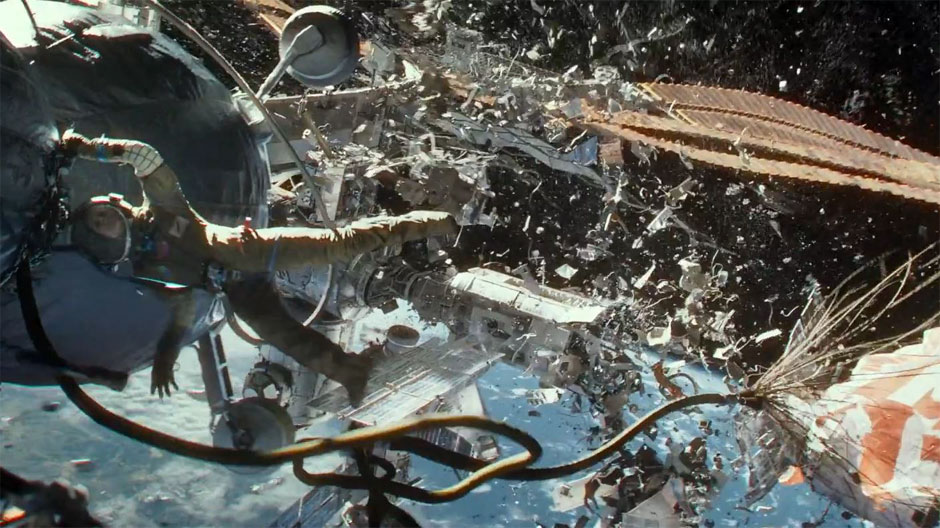
Gravity: ****/*****, or 8/10
It
is rare these days to encounter effects in movies that look so
astounding that they pull the audience in completely and won't let go
until the credits roll. After twenty-odd years of increasing overuse
of CGI, it seemed positive that everything had been done, also owing
to the plethora of home video releases containing behind-the-scenes
footage that reveals in detail the tricks of the trade, thus
enhancing the audience's expertise on what is real and what is not
when watching a film. It has diminished the emotional impact of the
contemporary blockbuster, which often tends to rely heavily on such
big budget effects work, because we spectators think we've seen it
all and know it all by now. But once in a while a movie comes along
that does manage to sweep us off our feet entirely and immerses us
completely into the world its director has envisioned for our viewing
pleasure. In such uncommon cases, the often derogatory term 'effects
film' turns out both wholly justified and incorrect: the effects it
contains do not make a film, but instead engage us into a full
fledged cinematic experience we cannot help but be captivated by so
strongly that all we can do is undergo it until it releases its grip
on us. And then we still sit back in awe for a while longer, with
that most pertinent of questions firmly on our minds: how on Earth
did they do that?! Alfonso Cuaron (Children of Men, Harry
Potter and the Prisoner of Azkaban) has crafted just such a
fantastic experience with Gravity, a superior science-fact
feature that adheres to the laws of physics but constructs its own
laws in terms of what you can accomplish cinematographically these
days. From a narrative point of view it's simply the struggle of two
astronauts (George Clooney and Sandra Bullock) to survive in our
planet's orbit after their space shuttle has been devastated by space
debris caused by the demolition of a Russian satellite. In every
other regard, there is nothing simple about Gravity.
It
is most definitely one of the greatest accomplishments in the field
of visual effects and 3-D technology in recent years and an
incredible tour-de-force on the part of both actors whose
capabilities are put to the most extreme test imaginable. In fact,
you are pulled in so deeply you neither have the time nor the
interest to agree the story is pretty bare and the few attempts at
introducing deeper levels of character development – including
Bullock's character still trying to cope with the death of her young
daughter – don't add all that much to the protagonists' plight. We
run with them because we cannot help but feel we are one of them, and
we too must get out of this ordeal in one piece before time (and
oxygen) runs out. Applying his signature use of the 'long take',
Cuaron opens the movie on a quiet, peaceful note as we witness “our
fellow astronauts” working on a telescope, a job that suddenly
turns extremely hazardous as the debris field hits their workplace
hard, cutting them loose, adrift into the endless black ocean of
space: all in a single, apparently uninterrupted shot (though few
will actually consider that fact as we are already engaged fully by
this point). We're slowly introduced to their Zero-G environment, but
soon must deal with intense camera movements as we float around the
shuttle in fast motions at first, and soon almost unchecked as the
mission is spiralling out of control. Their spacecraft lost, our
fellow pair of astronauts must make its way to the ISS before it too
gets hit by the rubble, and before they run out of breathable air, if
they ever hope to get back down to Earth. Unfortunately physics don't
make it easy on them and reaching their goal appears ever more
hopeless. All to our benefit, as we are treated to some of the most
spectacular visual imagery seen on the big screen in years. Gravity
is a prime showcase of what 3-D can add to a film other than a higher
admission price. Not only is the cinematography breathtaking, we feel
part of a three-dimensional environment at all times, surrounded by
pieces of space rubble on every side, or Bullock's sweat and tears
when we are locked in an escape pod with her in very close quarters.
The intricate shots of floating equipment and people going up, over
and around each other adds a layer of depth that is not likely to be
surpassed in film any time soon. Even though the lack of sound in
space deprives us of an auditory experience the likes of Star
Wars, the immersive visuals make us forget all about any lack
where other sense are concerned. Credit is also due to the seasoned
actors, Bullock in particular, that make the whole experience feel
that much more convincing – though the effect the film has on our
stomachs does half their work already – by delivering excellent
performances few of their colleagues could have matched as they play
off against each other and... yes, against what else, exactly? How
much, if anything, of what we seen on screen was there to aid them?
Even for a trained eye, it's nigh impossible to tell where the real
setting ends and the fictional construct begins. Yet we never get the
feeling we are watching visual effects, which is of course exactly
the trick such effects aim to pull off: don't let the audience know
you are only an effect. The result is a staggering, completely
compelling cinematic experience, one best seen on the big screen as
it is doubtful its full physical and emotional impact is done justice
on a home cinema release, though hopefully the latter can tell us
just how Cuaron and his team managed to accomplish this extraordinary
feat. One thing is for sure, Gravity is gravitating towards
well deserved Best Visual Effects and Best Cinematography Oscars.