Posts tonen met het label Colin Farrell. Alle posts tonen

zondag 24 februari 2013

Movies Gone By: the Continuation

As stated yesterday (two posts in as many days, waddayaknow?! Off to a good start I'd say!), I'll continue posting all too short reviews of movies I saw in the last few months but failed to comment on in more detail due to computer troubles at home. I might write more extensive reviews on a few of these somewhere in the future if time permits me (fat chance!), while I do plan to give these more coverage in the Movie Archives in the long run; which will be very long, since it's practically a work in progress forever (until the day I die most likely, or the day I turn blind and can't watch films no more). But so far there is cause for optimism, so let's focus on that, and on another batch of recently seen movies. Today's group, like yesterday's, consists entirely of films I had the pleasure of screening at Provadja.
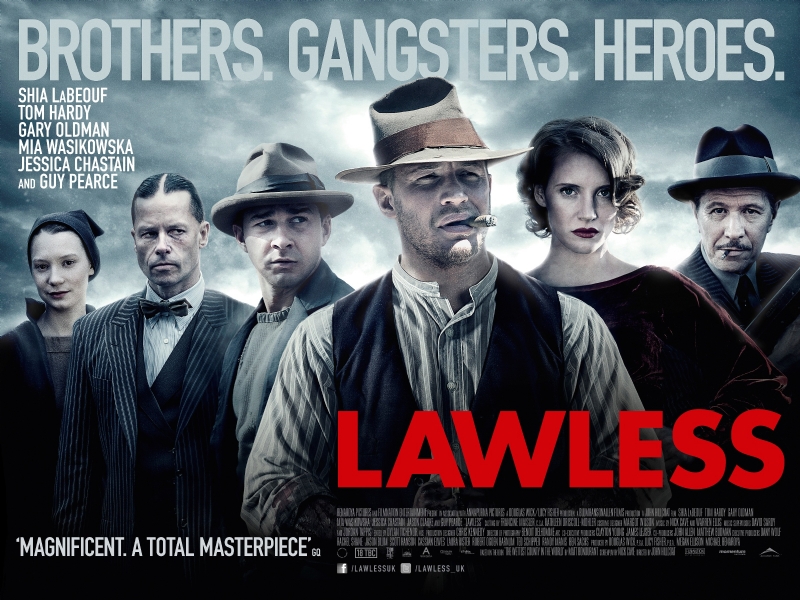


Lawless: ****/*****. Hard-edged, gritty and extremely violent Prohibition era set drama, sort of a substitute for people who don't have the time to watch Boardwalk Empire (which is superior in terms of story development, but showcases acts of violence not nearly as disturbing as this film does). Three brothers operate an illegal liquor business in a small town, but big city mobsters are closing in on their turf and give them the choice to cooperate or see their venture terminated. Not taking crap from nobody, also because of an urban legend regarding their supposed immortality, they respectfully decline and quickly find themselves the target of both the mob and a ruthless deputy trying to force the matter. Obviously, they retaliate against both the lawbreakers and the law itself, with deadly consequences. A more intelligent film then you might be inclined to believe judging from this brief synopsis, with strong performances by amongst others Guy Pearce and Tom Hardy. Director John Hillcoat (The Road) delivers an impessive look, also in regard to the period look of the Twenties, at the rough life of independent booze runners harassed by bigger fish and unscrupulous law enforcers on their payroll.

Amour: ****/*****. Excellent but still severely overrated social drama depicting the autumn days of a elder couple still absolutely in love. When the wife suffers a devatasting stroke leaving her helpless, her husband takes care of her despite being in a process of mental deterioration himself. Soon he comes to the realization there's only one solution to their problems and it's not a pretty one, shocking many a spectator (but not so much me since I found it only a logical and ultimately predictable step), as is usual for uncompromising director Michael Haneke who has a history of not making it easy on his audience. Though this is still a gripping and tragic film, in my mind it's marred by its slow pace and lazy cinematography. And someone explain to me why this foreign film is nominated not only for the correct 'Best Foreign Film' category at the Academy Awards, but also for four other categories despite not having a single word of English in it (as has always been the norm at the Oscars). Good film, but not so mindboggingly good as some would have us believe.


Cloud Atlas: ****/*****. Fascinating mosaic of connected lives throughout the ages. Quite reminiscent of Aronofsky's The Fountain, but not as compact (since it spans three more time frames). Telling six vastly different tales set from the 1700s to the distant future, it delves into the matter of acts, both good and bad, and their consequences leaving an impact lasting for hundreds of years. The point is made clear by an impressive international ensemble cast (including Tom Hanks, Jim Broadbent, Hugo Weaving and Halle Berry) turning up in completely different roles – bridging issues like gender and race – from tale to tale, sometimes with daring but also occasionally awkward results (most notably Hugo Weaving playing a woman and an Asian guy). The spectacular visual look and the different attitudes and styles of the various stories, incorporating social drama, comedy, horror and science fiction leave something to enjoy (and no doubt to detest as well) for everybody, while none of the stories suffer from an overly fragmented or complicated narrative. Courtesy of a fruitious cooperation between the Wachowskis (The Matrix trilogy) and Tom Tykwer (Lola Rennt).

Le Magasin des Suicides: ***/*****. Offbeat and quirky animated French film about a city so bleak and miserable that most people can't wait to end their life, aided by the many possibilities of dying offered by the local suicide shop. Run by a grim couple and their not so cheerful kids, eagerly exploiting the despair of their fellow man, the shop is a booming business, but matters are complicated when their third child turns out nothing but happy and obnoxiously optimistic, soon disrupting their livelihood as he means to bring a smile to everybody's face. Though wonderfully animated and stylistically inspired, making for a pleasant change from its American counterparts, the story cannot help but feeling overly random in the solutions offered to ending the omnipresent desire for death plaguing the town (and what's with that awkward nude dance?). Plus, some of the songs (this is, in fact, a musical too) just aren't very enjoyable to endure, though that might be a case of Francophobia on my part.

Seven Psychopaths: ***/*****. Oddball comedy from the director of the brilliant In Bruges. An aspiring screenwriter (Colin Farrell) is set to produce a screenplay about seven psychopaths but suffers from writer's block. However, he soon gets all the inspiration he needs from his flamboyant and basically lunatic pal (Sam Rockwell) who gets into trouble when his dognapping associate (Christopher Walken) kidnaps the wrong Shih Tzu, the best friend of a maniacal gangster (Woody Harrelson). Soon events lead to a colourful array of bizarre and quirky situations as the dim witted protagonists try to stay out of ever more explosive circumstances alive, resulting in the all too soon audience drawn conclusion that none of these people are in any way normal and the screenwriter is surrounded by all the psychopaths he could want. Though starting off promisingly, the narrative gets ever more convoluted and harder to follow while the number of jokes keeps feeling lacking, especially compared to the far superior predecessor (which also starred Farrell). The very definition of a mixed bag.


Anna Karenina: ***/*****. Unusual but still lavish (in some regards at least) adaptation of the classic Tolstoy novel. Keira Knightley stars as the Russian lady of noble blood torn between her romantic desires and the restrictions and traditional expectations placed on her by upper class Imperial society of the late 1900s. Will she compliantly stay with her boring husband Jude Law or be swept off her feet by the dashing young officer Aaron Taylor-Johnson instead? Whatever choice she makes, she will predictably suffer from it. In the meantime, young nobleman Domnhall Gleeson (son of Brendan) explores other possibilities offered by the rising revolutionary tides offering a vastly different but ultimately more simple and satisfactory life from high society. To underscore the feeling of being trapped in an upperclass setting in danger of being overtaken by the reality of the common people, most of this movie is set in a rundown theatre, which is an original choice (and undoubtedly budgetary inspired as well) but as the movie progresses not exactly a stylistically pleasing one. Contrary, Gleeson's character is the only one to explore the outside world, along with the traditonally snowy Russian plains. As is usual by now for a Keira Knightley film, excellent costume work. And some lovely acting to go with it.

zondag 16 september 2012

Hollywood didn't remember this one wholesale


Total Recall (2012): ***/*****, or 6/10

Total Recall (1990) is still a high point in Paul Verhoeven's oeuvre. At the time the most expensive movie ever made, it featured Arnold Schwarzenegger at the height of his career, running for his life from government conspirators in a provocative, nightmarish future setting both on Earth and on Mars, all the while messing with the spectator's mind in determining whether his tribulations were for real or just a sign of his brain being screwed up just moments before a lobotomy, in the typical sardonic and satirical Verhoeven style. Of course, nowadays nothing is sacred in Hollywood, and since more than two decades have passed the executive powers that be decided it was time for a fresh adaptation of Philip K. Dick's short story We Can Remember It for You Wholesale (1966). Adaptation, however, is too strong a term: inspiration would be more precise, something underscored by the end credits which state the new movie was only inspired by Dick's original work. In fact, it takes even more poetic license with his story than Verhoeven's version did. Unfortunately, various elements that made the previous film such a joy to watch are wholesomely neglected this time around, while the overall story remained the same. As a result, the new Total Recall is neither more sophisticated nor more fun to watch than its predecessor.


The narrative core of Verhoeven's Total Recall is carried over largely intact into the new movie. Douglas Quaid (Colin Farrell, who portrays a bored laborer more convincingly but less enjoyably than the hulking Schwarzengger did) is an everyday underpaid factory worker tired of his dull dead-end job, living in a lousy apartment with his beautiful wife Lori (Kate Beckinsale). Longing for an escape from the boring routine of his life, he visits Rekall, a company that implants fake memories the customer never experienced but that seem totally real as if the subject lived through them himself. In need of a dramatic change of pace, Quaid orders a set of secret agent memories injected in his mind, after which all hell breaks loose when apparently dormant but true experiences of a life as a spy manifest themselves, after which he finds himself on the run from the authorities, including his wife who proved to be an undercover operative, in their attempt to stop Quaid from exposing an elaborate government conspiracy involving corrupt officials out for personal gain at the expense of the lives of thousands of oppressed workers. Trouble is, are we sure all of Quaid's newfound experiences are real, or are they just what he ordered, with the problem being he can't separate truth from fiction as his mind has trouble processing it all?

Warning! Spoilers ahead! With the overall story of the remake identical to the original motion picture, the differences of the new script mostly involve setting and background history. Still set in the not too distant future, the plot now takes place on a post-apocalyptic Earth where chemical warfare has ravaged most of the planet, leaving only Western Europe and Australia habitable. Dubbed the United Federation of Britain and the Colony respectively, the former is the seat of power ruling what's left of the globe with an iron fist, while the latter houses the huge work force keeping things running, as well as home to the many dispossessed masses whose sole task in life is day-to-day survival. Travel between the UFB and the Colony is only possible via the Fall, a sort of giant subway system through the planet's core, allowing the laborers – Quaid among them – to journey to their work every day, deporting them back to the ass-end of the planet when the day is over just as easily. Of course there is resistance to this near-enslavement, most notably in the shape of a terrorist group run by the enigmatic Matthias (an all too small part for the great Bill Nighy), out to destroy the Fall and wreaking havoc in the process. Naturally, the terrorists are the ones we should feel sympathy for considering the hard exploitative regime that controls the workforce's life under the rule of the sinister Chancellor Cohaagen (Breaking Bad's Bryan Cranston), who is secretly hatching a diabolical scheme to get rid of all the miscreants and malcontents in the slums: his motivations for doing so differ from Total Recall's previous incarnation, where he sought to control alien technology. His venture in the current film involves replacing the human workers with robots, a scheme rather derivative of other science fiction works including the likes of I, Robot (2004): there's a reason Total Recall's mechanical men are so reminiscent to that movie's droids.


Unlike both the short story and Verhoeven's take on that, all the action is Earth bound and Mars is nowhere to be seen, other than being only briefly mentioned – in a post-John Carter Hollywood Mars is not a welcome location – so the script switches locations between the UFB and the Colony. Location wise, this turns out to be a mistake. Whereas the trip to Mars only worked to the predecessor's visual advantage, setting it apart from the action that had gone before and underscoring the eerie, dreamy quality of the piece, the visual look of the UFB and the Colony in this version is totally interchangeable. Both areas are defined by excessive urbanization, as overpopulation has led to ever upward building, with an elaborate maze of mile high towering constructions the result. Though the abundance of CGI thrown at these sets makes it look stunning at first, amazement soon turns to acceptance, and acceptance even faster turns to visual disinterest as the movie spends almost two hours following the protagonist being driven from one skyscraper to the next in a string of dynamic chase scenes that eventually make it hard to tell just where on the planet we are exactly. An all too brief excursion to the terrorists' secret layer in the desolate wastelands outside the habitable zone offers little reprieve from this monotonous setting, which in itself is very obviously inspired by undying science fiction classics like Blade Runner (1982) and Metropolis (1927), but used to much less dramatic effect because of its overexposure.

Equally overused is action. Of course, a big Hollywood blockbuster like Total Recall needs action scenes to draw crowds, but not in numbers this high. From the moment Quaid's unconscious cover is exposed in the Rekall salon, he spends most of the film running for cover as he's hunted by Cohaagen's minions, both robotic and flesh and blood, Lori chief among them. If Quaid's not running, he's fighting his way through scores of bad guys. The plot only allows short intermissions for the audience to catch its breath, at which time a great deal of exposition is delivered in as little time as is deemed necessary to warrant the next thirty minutes of relentless action, until the end credits start rolling. Just as the surroundings where such action takes place, the action scenes themselves are similarly interchangeable. Not even a flying car chase (a little too reminiscent of The Fifth Element (1997)) and a pursuit in a labyrinth of elevators offer enough diversion to keep the action from mentally becoming one big blur when the theater lights go back on. Director Wiseman knows action like few others, as he amply showed with movies like Underworld (2003) and Die Hard 4.0. (2007), but the script just kept him from balancing action and exposition to appropriate levels, while the ever singular looking environments didn't allow him to come up with interesting new ideas to shoot such action other than a bunch of general shoot-them-ups. At least his skill in directing fight scenes makes it easy for Total Recall's to look convincingly brutal, entertaining the viewers for a while before such scenes become too commonplace to really care less about them.


 With the focus a little too much on action, it comes as no surprise that other areas of the film's whole remain underexposed. Chief casualty is the emotional climax provided in Verhoeven's version, which made you guess until the very end just as to what's real and what isn't. The script largely follows the same pattern as the original did, but makes it clear all too soon and all too obvious whether its allegiance lies to fiction or reality, thus disabling the audience's pleasure to debate the exact chain of events since there's no room left for speculation. At times the film appears to turn the table on the audience's expectations, just as eager to switch it back mere moments later so the audience doesn't get to be confused, even though it would undoubtedly expect and like to be confused at least a little considering the picture deals with messing with man's mind. This lack of guts to smarten up the movie where it easily can be done makes it all the harder to accept a short lecture at the Rekall facility about the brain and its inner workings: in light of the lack of plot twists and the loads of dull action scenes to come, the movie at this point pretentiously seems to say 'here's how the brain works, now you can go and shot down yours for a few hours since there's really nothing more to our plot'. Worse even is the absolutely serious tone Total Recall adopts for the next ninety minutes, as it leaves little room for humour to put things in perspective considering the absence of intelligence. Among the car chases, the gun fights and the hand to hand combat there's no place for a laugh or two to remind the audience this isn't all as serious as it appears to be, unlike Paul Verhoeven's tone of witty sarcasm that only enhanced his Total Recall's sense of wonder and adventure. You'll find no Johnny-Cab in this film, though as time goes on you desperately want there to be...

Total Recall (2012) is a perfect example of a Hollywood exercise in futility as far as remakes go. It does not improve on the earlier version, nor does it address elements from the plot of the original short story the 1990 film might have ignored. It regurgitates a well crafted story and spits it out in a slicker and stylistically more modern variation that sadly fails to captivate the audience, taking itself way too seriously while simultaneously explicitly weeding out the plot hints that might have made for a more thought provoking, inconclusive ending. What remains is a generic high voltage chase flick filled with standard fisticuffs and gun fights in a visually impressive but monotonous and uninspired environment, which moderately entertain the viewer for two hours, but ultimately prove to be wholly forgetful. The only thing the producers apparently picked up from Paul Verhoeven's classic is the unforgettable image of a triple breasted prostitute, an all too brief pointless insert that only serves as a nostalgic nod to a superior take on this same story. Clearly it doesn't suffice to take a Verhoeven flick and throw out everything that makes it recognizable as such, since that's what makes it memorable. With remakes of Verhoeven's other excellent Sci-Fi/action films RoboCop (1987) and Starship Troopers (1997) in production, Hollywood executives best recall the many shortcomings of Total Recall (2012), unless they truly aim to make movies the audience will soon forget, so they can simply remake them again in another twenty years time.

And watch the trailer here:

maandag 14 mei 2012

Daredevil


Rating: ***/*****, or 7/10


One of the poorest of Marvel Comics adaptations, though still an entertaining action flick. As a kid, Matt Murdock comes into contact with toxic waste that blinds him for life but heightens all his other senses, including his need for justice. When his father is murdered by the mob, he makes it his life's cause to fight crime, by day as a lawyer, by night as the vigilante Daredevil who prowls the streets of New York in a red leather suit and beats up bad guys. This gets him on the radar of mob boss Kingpin (the huge Michael Clarke Duncan (R.I.P. 2012) is perfectly suited for the part, except the tone of his skin is not in sync with the original comic book character, but with such a neat actor, who cares?) and his crazed assassin Bullseye (Colin Farrell) who is ordered to give the Devil his due. Poor Matt also has to deal with the beautiful but deadly Elektra Natchios, a girl he has fallen in love with but who believes his alter ego to be her father's killer. Plenty of interesting characters and an abundance of solid action scenes cannot fully make up for the pale shadow this movie grew to be compared to Marvel franchises like Spider-Man or X-Men at that time. Most of the blame can be assigned to Ben Affleck, who just does a terrible job at making his character a compellingly blind guy tortured by remorse and anger over his father's demise and driven by a relentless need to avenge crime. Similarly, the romance with Elektra feels contrived and is never exposed as much as it needs to be to come over as believable or something the audience needs to care about, despite the dire consequences in store for this supposed passion. At least Kingpin feels like a true menace, while Bullseye is just a delightful amoral and wicked person Farrell plays with apparent appropriate enthusiasm. The Director's Cut, running a good half hour longer than its theatrical counterpart, is the preferred version to watch, adding more depth to the characters and a few more subplots to flesh out the whole, but it cannot compensate for Affleck's feeble performance. Marvel movies hit their lowest ebb with Daredevil's spin-off flick Elektra (2005), which was released as a direct-to-DVD feature in many territories and destroyed the femme fatale character even more eagerly. Director Johnson was responsible for a second disappointing Marvel adaptation with Ghost Rider in 2007.


Starring: Ben Affleck, Jennifer Garner, Michael Clarke Duncan


Directed by Mark Steven Johnson


USA: 20th Century Fox, 2003

woensdag 1 februari 2012

Alexander


Rating ***/*****, or 5/10

Epic biopic follows the life and times of Alexander the Great (Colin Farrell, refusing to loose his Irish accent, so all the other actors portraying Macedonians had to adapt to him), and highlights the man himself far more than his accomplishments. So while we are treated to large scale battle scenes and his brave trek across Persia and Asia in grand, sweeping scenes and vista shots, we also get a closer look at his troubled relationship with his parents (a seductive Angelina Jolie and a boorish, abusive Val Kilmer) and his love life, which included a supposed homosexual affair with his close friend Hephaistion (dreamy Jared Leto). Oliver Stone's focus on Alexander's screwed up personal relationships is a bold, but ultimately doomed attempt to explain the man's motives and his sometimes mysterious decisions, which undermines the picture as a whole by making it feel unbalanced and overly melodramatic. Stone himself wasn't really pleased with the final product either, and made a total of three released cuts, adding several scenes, loosing others and playing with the sequential order of events. A good try, but never satisfactory in whatever form.


Starring: Colin Farrell, Jared Leto, Angelina Jolie

Directed by Oliver Stone

USA, UK, Italy and many other countries: Warner Bros Pictures, 2004