Posts tonen met het label keira knightley. Alle posts tonen

zondag 24 februari 2013

Movies Gone By: the Continuation

As stated yesterday (two posts in as many days, waddayaknow?! Off to a good start I'd say!), I'll continue posting all too short reviews of movies I saw in the last few months but failed to comment on in more detail due to computer troubles at home. I might write more extensive reviews on a few of these somewhere in the future if time permits me (fat chance!), while I do plan to give these more coverage in the Movie Archives in the long run; which will be very long, since it's practically a work in progress forever (until the day I die most likely, or the day I turn blind and can't watch films no more). But so far there is cause for optimism, so let's focus on that, and on another batch of recently seen movies. Today's group, like yesterday's, consists entirely of films I had the pleasure of screening at Provadja.
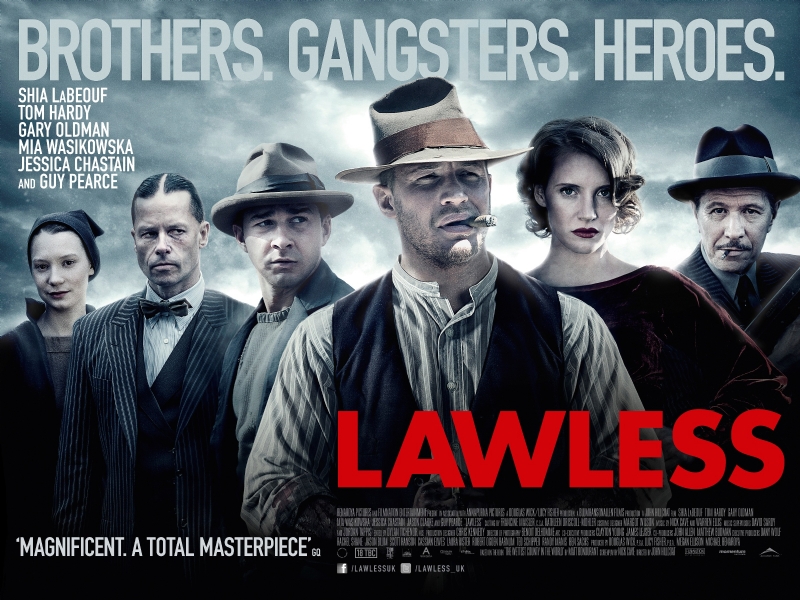


Lawless: ****/*****. Hard-edged, gritty and extremely violent Prohibition era set drama, sort of a substitute for people who don't have the time to watch Boardwalk Empire (which is superior in terms of story development, but showcases acts of violence not nearly as disturbing as this film does). Three brothers operate an illegal liquor business in a small town, but big city mobsters are closing in on their turf and give them the choice to cooperate or see their venture terminated. Not taking crap from nobody, also because of an urban legend regarding their supposed immortality, they respectfully decline and quickly find themselves the target of both the mob and a ruthless deputy trying to force the matter. Obviously, they retaliate against both the lawbreakers and the law itself, with deadly consequences. A more intelligent film then you might be inclined to believe judging from this brief synopsis, with strong performances by amongst others Guy Pearce and Tom Hardy. Director John Hillcoat (The Road) delivers an impessive look, also in regard to the period look of the Twenties, at the rough life of independent booze runners harassed by bigger fish and unscrupulous law enforcers on their payroll.

Amour: ****/*****. Excellent but still severely overrated social drama depicting the autumn days of a elder couple still absolutely in love. When the wife suffers a devatasting stroke leaving her helpless, her husband takes care of her despite being in a process of mental deterioration himself. Soon he comes to the realization there's only one solution to their problems and it's not a pretty one, shocking many a spectator (but not so much me since I found it only a logical and ultimately predictable step), as is usual for uncompromising director Michael Haneke who has a history of not making it easy on his audience. Though this is still a gripping and tragic film, in my mind it's marred by its slow pace and lazy cinematography. And someone explain to me why this foreign film is nominated not only for the correct 'Best Foreign Film' category at the Academy Awards, but also for four other categories despite not having a single word of English in it (as has always been the norm at the Oscars). Good film, but not so mindboggingly good as some would have us believe.


Cloud Atlas: ****/*****. Fascinating mosaic of connected lives throughout the ages. Quite reminiscent of Aronofsky's The Fountain, but not as compact (since it spans three more time frames). Telling six vastly different tales set from the 1700s to the distant future, it delves into the matter of acts, both good and bad, and their consequences leaving an impact lasting for hundreds of years. The point is made clear by an impressive international ensemble cast (including Tom Hanks, Jim Broadbent, Hugo Weaving and Halle Berry) turning up in completely different roles – bridging issues like gender and race – from tale to tale, sometimes with daring but also occasionally awkward results (most notably Hugo Weaving playing a woman and an Asian guy). The spectacular visual look and the different attitudes and styles of the various stories, incorporating social drama, comedy, horror and science fiction leave something to enjoy (and no doubt to detest as well) for everybody, while none of the stories suffer from an overly fragmented or complicated narrative. Courtesy of a fruitious cooperation between the Wachowskis (The Matrix trilogy) and Tom Tykwer (Lola Rennt).

Le Magasin des Suicides: ***/*****. Offbeat and quirky animated French film about a city so bleak and miserable that most people can't wait to end their life, aided by the many possibilities of dying offered by the local suicide shop. Run by a grim couple and their not so cheerful kids, eagerly exploiting the despair of their fellow man, the shop is a booming business, but matters are complicated when their third child turns out nothing but happy and obnoxiously optimistic, soon disrupting their livelihood as he means to bring a smile to everybody's face. Though wonderfully animated and stylistically inspired, making for a pleasant change from its American counterparts, the story cannot help but feeling overly random in the solutions offered to ending the omnipresent desire for death plaguing the town (and what's with that awkward nude dance?). Plus, some of the songs (this is, in fact, a musical too) just aren't very enjoyable to endure, though that might be a case of Francophobia on my part.

Seven Psychopaths: ***/*****. Oddball comedy from the director of the brilliant In Bruges. An aspiring screenwriter (Colin Farrell) is set to produce a screenplay about seven psychopaths but suffers from writer's block. However, he soon gets all the inspiration he needs from his flamboyant and basically lunatic pal (Sam Rockwell) who gets into trouble when his dognapping associate (Christopher Walken) kidnaps the wrong Shih Tzu, the best friend of a maniacal gangster (Woody Harrelson). Soon events lead to a colourful array of bizarre and quirky situations as the dim witted protagonists try to stay out of ever more explosive circumstances alive, resulting in the all too soon audience drawn conclusion that none of these people are in any way normal and the screenwriter is surrounded by all the psychopaths he could want. Though starting off promisingly, the narrative gets ever more convoluted and harder to follow while the number of jokes keeps feeling lacking, especially compared to the far superior predecessor (which also starred Farrell). The very definition of a mixed bag.


Anna Karenina: ***/*****. Unusual but still lavish (in some regards at least) adaptation of the classic Tolstoy novel. Keira Knightley stars as the Russian lady of noble blood torn between her romantic desires and the restrictions and traditional expectations placed on her by upper class Imperial society of the late 1900s. Will she compliantly stay with her boring husband Jude Law or be swept off her feet by the dashing young officer Aaron Taylor-Johnson instead? Whatever choice she makes, she will predictably suffer from it. In the meantime, young nobleman Domnhall Gleeson (son of Brendan) explores other possibilities offered by the rising revolutionary tides offering a vastly different but ultimately more simple and satisfactory life from high society. To underscore the feeling of being trapped in an upperclass setting in danger of being overtaken by the reality of the common people, most of this movie is set in a rundown theatre, which is an original choice (and undoubtedly budgetary inspired as well) but as the movie progresses not exactly a stylistically pleasing one. Contrary, Gleeson's character is the only one to explore the outside world, along with the traditonally snowy Russian plains. As is usual by now for a Keira Knightley film, excellent costume work. And some lovely acting to go with it.

zondag 2 september 2012

Laughing and crying at the face of doom

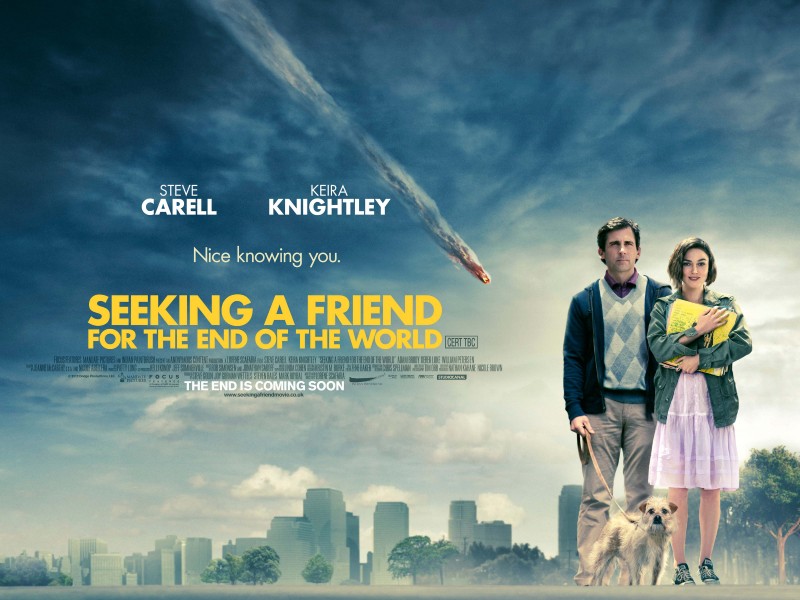
Seeking a Friend for the End of the World: ***/*****, or 6/10


Hollywood has been continuously reminding us of the upcoming end of the world slated for December 21st 2012 – be sure to note it in your agenda if you haven't yet, so you don't plan early Christmas or New Year activities on the same date only to end up seeing your festivity appointments ruined – in the recent years, delivering a stream of films either revolving around the day of reckoning itself or the harsh and cruel life afterwards (examples include but are not limited to 2012 (2009), The Book of Eli (2010) and The Road (2009), some of them good, others not so much). Though such films all incorporated their own take on global annihilation, the one thing they had in common was the fact the world's demise is not a laughing matter, echoing the billions of lives lost and/or the endless suffering of those left alive. Even in multimillion dollar blockbuster popcorn movies that feature some good-spirited levity to keep the piece from becoming to much to bear for the spectator, the catastrophe is taken seriously and is often treated as having a genuine basis in reality for keeping it from being too alienating for audiences, even though the implicated scientific foundations of the films are utter bollocks (again, 2012). Only months before the expected event itself, Seeking a Friend for the End of the World is added to the genre of Doomsday movies, reassuring us that the Apocalypse is such a grand, large scale and unavoidable thing it's okay to laugh about it instead of succumbing to depression. Unfortunately, the delightful tone of hilarity dominating the first hour of the film soon devolves into a melodramatic frenzy running the second, which once again makes it hard for viewers to determine just what to do when the end of times does arrive.


In Seeking a Friend for the End of the World, the Apocalypse is caused by that good old Number One suspect of worldwide destruction, the big bad asteroid about to smash into the face of the planet. Hardly a new thing for the genre, the film playfully reminds us of similar occurrences in past movies, i.e. Michael Bay's noisy and overly hyperactive Armageddon (1998), by having a radio announcer state in the very opening scene that an attempt to send astronauts on a space shuttle to the humongous rock, nicknamed Matilda, in order to blow it up has failed: only three weeks are now left for all of us, in which time we will get regular updates on Matilda's approach accompanied by all our classic rock favorites. And so the tone of the plot is set, in two different ways. First, it's clear from the get-go this is not a blockbuster movie all about showcasing spectacular effects in ever more grandiose action sequences: in fact Matilda herself is never even shown anywhere but on the movie's poster. This movie simply isn't about the Doomsday event itself, but about how life is spent in the time preceding it. Second, it's clear there's no getting out of this one, so humanity might as well enjoy all life has to offer until then, a simple truth most people all too eagerly accept. But not insurance salesman Dodge (Steve Carell), who finds little has changed for him despite the fact his wife has just ran out of his life. While his friends are all too happy engaging in carefree sexual relations, illegal experimentation with vast arrays of mind expanding substances and other activities generally considered to be against the law, the only thing Dodge needs to do is convince his Hispanic cleaning lady she doesn't need to come in next week if she doesn't want to.

Warning! Spoilers! Though admittedly a story about a man who keeps on living his dreary life while all around him is quickly degenerating into full blown anarchy is funny in its own right, the title of this film makes it blatantly clear Dodge isn't going to face the end alone much longer. Enter his neighbour Penny (Keira Knightley), a likeable young woman who in many ways is his polar opposite, being much more emotional and impulsive, but she too has just found her relationship shattered and thus the two of them make for decent soulmates about to spend their final weeks alone together as they share their personal dreams and make a deal to help each other realize them. For Dodge, it's a reunion with his first sweetheart Olivia, who sent him a letter, which much to his dismay had been stuck at Penny's mail box for months due to being wrongly delivered, in which she claims that their break-up was a mistake since he was the love of her life. For Penny, it's the promise of finding a plane (since air traffic has been shut down entirely) to take her back home to England – you didn't think someone with Keira's heavy accent was passing for an American here, did you? – so she can reunite with her family for their final days. Soon confronted with gangs of plunderers sweeping through the city and threatening their safety, the pair embarks on a road trip to search for solutions to both their challenges, taking in tow a dog someone tied to Dodge's foot with a note simply saying 'sorry', which therefore becomes the canine's new name. A man, a woman and a dog, soon sure to be deceased: it sounds like a good recipe for a road movie containing ample amounts of hilarity, but unfortunately from here on out the movie only goes downhill as much as the time left to them to succeed in helping each other get what they want.


Their trip starts off promising though, involving scenes that manage to keep the surprisingly feel-good Apocalyptic humour despite Dodge and Penny's serious intentions. For example, a sequence that sees them hitching a ride with a man in a pick-up truck who acts increasingly suspicious as if he means to kill them – who would care after all? – manages to turn audience's expectations on their head to successfully hilarious effect when he gets shot through the head instead, revealing he had hired a hitman to kill him and assumed the two hitchhikers were about to pull off that particular job. Also good for a few laughs is a scene based at Friendsy's, a restaurant where the excessively cheerful and positive waiters aim to be the customers' friend, where Penny's simple remark that it's Dodge's birthday ends up starting an orgy. For a while these and similar scenes suffice to keep the audience enchanted and engaged, but it soon becomes clear the direction the story maneuvers in exchanges comedy for drama, with a blatantly predictable and unavoidable romance between Penny and Dodge as its centerpiece: however, it seemingly takes forever to get both characters to come to the same conclusions, much to the viewers' chagrin.

Such shortcomings in the plot can hardly be attributed to the leading actors carrying the piece. For Carell, it's yet another opportunity to portray an agreeable but lethargic character, an ordinary man thrown into an extraordinary situation and unsure as how to proceed. We feel sorry for him as it becomes painfully clear there's just nobody to share the end with him but us, something he doesn't even seem to care much about until Penny walks into his life with the letter he always hoped Olivia had sent him, giving him a final mission at last. Knightley is equally suited to the part of Penny, a nice, caring girl with an unfortunate talent for chaos due to being a hypersomniac, but her lust for life and willingness to see Dodge's quest through to the end makes up for this flaw. The vibrant (when awake) Knightley plays off quite well against Carell's more ataraxic Dodge and their shared road trip succeeds into eliciting ample amounts of warm humorous moments until it becomes simply too obvious the two of them are made for each other, a realization that just comes all too soon for the audience to keep it compelled in the film's second half, a flaw in the story we can only attribute to first time director Lorene's Scafaria's inexperience as a writer (as this is her second movie, the first being Nick and Norah's Infinite Playlist (2008)).


The movie's plot is based around the simple question of what people would do if they knew their time had almost ran out, resulting in the obvious answer – whatever they like, preferably if it was formerly frowned upon – dished up in a not too gratuitous fashion, refraining from too much sex and violence despite the movie being rated R. It makes for a fun movie for a while, until the realization that Dodge and Penny's own ideas about their end won't come to fruition the way they initially insisted upon, though together they can find a good way to die, something the audience is aware off a full hour before they are, which leads to a frustratingly drawn out string of scenes in which both characters are dancing around the obvious conclusion, still clinging to their final wishes and the need to make them come true despite getting ever more impossible to achieve. In the meantime, the atmosphere of general hilarity that dominated the film at first has been traded in for unabashed melodrama, as the characters are continuously confronted with their growing affection for each other and their mutual refusal of such feelings in favor of helping the other reaching their obviously already lost causes: even after the pair has engaged in coitus, evaded dangerous situations involving looting and murder and has spend the seemingly happiest time of both their lives the truth continues to elude them, and the audience can only sit back and watch the inevitable being postponed, wondering what happened to all the jokes that got the movie off on such a good start.

As a whole, Seeking a Friend for the End of the World means to be both funny and serious, an inner conflict between two opposites that clashes as hard as a giant asteroid would with the Earth. The lighthearted comedic tone of the first half just doesn't reconcile with the more serious but overly melodramatic quality of the latter half of the film, leaving the audience confused just as to what to make of this oddball movie. It's admirable to see a movie take a whole different approach to the by now largely worn out though still popular 'end of the world' routine, but the movie fails to fully cash in on its original and offbeat intentions. The first hour of the movie delivers some witty jokes and hilarious gags that fortunately save the overall movie from full failure and make it worth a watch at least once, but in hindsight it would have been preferable if director Scafaria had stuck to this side of the story completely despite her laudable desire to touch upon more serious themes as well. Unfortunately mere comedy was not enough for her, resulting in a haphazard plot that means to put no less than two genre spins on a concept usually reserved for blockbusters, comedy on the one hand, romantic drama on the other. The fact the movie can only do one of these justice is a damn shame, but it's not the end of the world.

And watch the trailer here:

donderdag 5 juli 2012

David Cronenberg's new frame of mind


Yesterday I worked my first shift as a volunteer running the film projector at the local arthouse theater Provadja, something I will now do each Wednesday evening. I had an easy start, playing only one film, whereas for the next two months it will be three a night. The film in question was David Cronenberg's second to most recent film, A Dangerous Method, a movie I had wanted to see in regular theaters upon its initial release in March, but I never got around to do so. That's the good thing about this new job, I get another chance to see arthouse, or generally good quality, films I missed the first time (I don't think I'll get another shot at Piranha 3DD though, which has now left movie theaters much to my chagrin), since Provadja gets a lot of these as their weekly movie a few months down the road. Projecting the film was a real piece of cake, thanks to the advantages of digital projection (that same progress got me kicked out of the operator's booth at Pathé though, so it's not all fun and laughs), and I had a fair sized audience of no less than fourteen people (the room the movie played at can hold about 45). If you're lucky, you can watch the whole film from the projector's booth, but sadly, I needed to occasionally focus on other chores, so I missed about 15 minutes, which included a few important scenes here and there. Having missed those, I can't honestly write a full review of this film (that would be a rather dangerous method for any critic), so I'll have to make due with some more general observations: after all, despite not having seen it in its entirety, I still have an opinion on the bits I did get to see, which lead me to believe that A Dangerous Method would be rated by me as about ****/*****, 7or 8 out of 10.


It's fascinating to see how much David Cronenberg has shifted towards other genres. He's still best known as the director of usually extremely graphic horror films, the foremost expert on 'bodily horror', i.e. playing with, deforming or metamorphizing the human body to often shocking effects, having created various grotesque body transformations in films such as The Fly (1986) – Jeff Goldblum's DNA mixed with that of a fly, thus making him devolve into a bizarre human/insect hybrid – or the even more disconcerting Videodrome (1983) – James Woods equipped with a huge orifice, quite explicitly resembling a female's naughty bits, in his abdomen so he can insert and “play” videotapes in his body – which for a long time was really Cronenberg's signature: if you saw the shit he pulled, you immediately realized beyond doubt you were watching a Cronenberg flick! However, in recent years he mellowed quite a bit, increasingly shying away from such gory effects. Though in his suspense thriller A History of Violence (2005) he still applied a few brief moments of universal disgust (hence the 'violence'), it otherwise hardly felt like a Cronenberg film. Eastern Promises (2007), a film in the same genre, even less so. With A Dangerous Method, a film containing virtually no gore at all, Cronenberg seems to have definitively broken with his status as a director once considered an auteur of horror. In fact, the body no longer seems to interest him, as he sets his sights completely on the human mind this time: though not exactly new to this subject matter – for example, Spider (2002) – compared to the wonders of the body it's still largely terra incognita for him. And what better place to start than with the founding fathers of psychoanalysis, Sigmund Freud and Carl Jung?

In examining these two noted historical characters, Cronenberg not only treads on different subject matter, but also explores a genre he has not worked in before, the period drama piece. This is his first motion picture set in past times, but you would hardly notice his inexperience since he proves all too capable of compellingly and accurately portraying the pre-WW I era of Vienna and Zürich, including excellent costume work and the occasional temporal signifiers as beautiful early cars and horse carriages. Of course, it's not all that impressive, since A Dangerous Method is hardly a full-on historical epic and focuses on characters much more than on their settings, but it's a good sign Cronenberg has no trouble expanding his existing oeuvre to include genres he's as yet unaccustomed to. A good start, and hopefully he won't be afraid to turn his scope on the past more often, now that we know he can pull it off seemingly without effort.


As mentioned above though, it's the characters that drive A Dangerous Method, and as such it's the actors portraying them making or breaking the piece. Cronenberg has often proved to get stellar performances out of the top actors in their field, and continues this trend here, reuniting with his present day muse Viggo Mortensen (their third collaboration in a row), as well as Vincent Cassel (second time working together), while adding Michael Fassbender and Keira Knightley to his already outstanding resumé of phenomenal actors he has directed. The latter pair has the hardest job in carrying the whole picture, but neither fails in this regard. In the case of Fassbender, who portrays Jung, this was to be expected, considering his status as one of the most sought after and popular actors of today. Knightley surprises much more in her role of his patient Sabina Spielrein, a young woman suffering from hysteria, who soon turns into something more than just another case for the good doctor as the two of them embark on a wild sexual affair. Knightley maneuvers shrewdly from an out of control and insane girl at one moment and a calm and perfectly rational woman the next, being both disturbingly repulsive and sexually intriguing at the same time, and thus an irresistable mark for Jung from a professional point of view, and soon after as a secret mistress. Plus, Knightley seems to have the perfect facial bone structure for this role, as demonstrated by the way in which she alarmingly protrudes her lower jaw in her many fits of rage. Fassbender and Knightley show to have ample chemistry in their roles, initially as doctor and patient, and soon after as lovers on more or less equal footing. Whereas Fassbender plays Jung with the necessary decorum and stoic restraint in the former relationship, he's seen as a more emotional and angry character in the latter, being able to blow off some steam in her company over his guilt ridden marriage with his bland wife Emma (Sarah Gadon), who has an awkward fixation over producing male offspring with him, and his ultimately tumultuous relation with his one time mentor Freud. Together, Spielrein and Jung can be themselves, as they don't need to ignore their sexual fantasies, such as Sabina's desire for spanking due to a childhood trauma. We root for them because of their genuine affections for each other, but certainly in Jung's case (he's a married man with kids after all), abhor them for having taken this inappropriate route.


No matter how good Fassbender and Knightley are on screen together, it's Mortensen who delivers the most impressive performance playing Sigmund Freud. Mortensen, by now fully versed in Cronenberg's routine, proves himself a genuine chameleon yet again, hardly resembling anything we've seen him look like before, older and fatter, smoking a huge cigar in every scene as if it's an actual body part. He portrays Freud as an old man emotionally detached from everyone, including his star student Jung, despite their shared beliefs concerning the benefits of psychoanalysis, while also wholesomely inflexible when the latter tries to convince him not everything can be reduced to subconscious sexual desires. At the same time we see a Freud who desperately means to cling to his acclaimed social status and tries to weed out subversive elements among his circle of (almost exclusively Jewish) associates in fear of all their work being undone by his many enemies in science and politics who are just eager for some controversy to take him out. Apart from the cigar and the talk about sex, Mortensen gives us a whole new Freud, refusing any relation with the usual cliché ridden versions of the character we are so often unfairly treated to. Also noteworthy is the fact Mortensen does not repeat his role from his earlier collaborations with Cronenberg, not taking center stage this time in favour of Fassbender. Undoubtedly the director and his favourite actor realize full well they will work together again many times God willing, and instead of pulling off a Burton/Depp on us, they know they should explore different set-ups if their professional relationship is to continue to prosper, instead of sinking into a dreary routine of overly repeating their previous work.

Aside from the acting and the look of A Dangerous Method, as well as its place in Cronenberg's repertoire, I dare not say anything conclusively about the movie, especially about its overall story, considering I missed several sequences that seemed of great importance plot wise. For instance, at one moment Freud and Jung arrived in New York in good spirits, but when I returned five minutes later they were back home and detesting one another vigorously. I have no idea what went on there, but it was obviously a vital scene. Overall I can say for sure that A Dangerous Method covers an intriguing subject from an equally intriguing director who is not afraid to try and reinvent himself, making the film look gorgeous, and squeezing top performances out of his main cast. However, I did get the feeling the film's plot was fairly predictable (and not just because it's historic subject matter) and delivered in an overly straightforward way, thus not the most exciting stuff imaginable or presented to us in a really gripping, thought provoking manner; but hey, psychoanalysis isn't for everybody. At least the fourteen people in the room all responded in a mildly enthusiastic mood. Given the average age of this audience, I'm sure this would not have been the case if I had projected some of Cronenberg's earlier, more “visually rebellious” (to put it mildly!) work.

And watch the trailer here:


maandag 12 maart 2012

Bend it Like Beckham


Rating: ****/*****, or 7/10


Delightful multiculti feel-good comedy about a teenage girl (Parminder Nagra) from orthodox Sikh parents who loves playing football despite her parents' objections and joins an all-girl football team after being encouraged to do so by a local white girl (Keira Knightley in her breakthrough role). Matters are complicated when both of them fall in love with their handsome trainer (Jonathan Rhys Myers) with a place in the Finals in the balance. Good spirited film successfully delivers the age old message that people should follow their own dreams to find happiness, no matter what others think or be afraid to break with traditions. Though such a statement seems a total cliché, the amount of fun this film provides makes it well worth a watch, plus the social conventions of modern day muticultural England explored here make for an interesting overall background. Nagra convincingly portrays a teenage girl despite being 27 years old, while she has excellent chemistry with Knightley who was a decade younger at the time of filming.


Starring: Parminder Nagra, Keira Knightley, Jonathan Rhys Myers


Directed by Gurinder Chadha


UK: Kintop Pictures, 2002