Posts tonen met het label vampires. Alle posts tonen
dinsdag 9 september 2014
Today's Column: True Blood has died the True Death
Overdue by a few days (by no fault of mine, I upheld my deadline as always), but here's my latest online column:
http://www.moviescene.nl/p/157062/column_de_ware_dood_van_true_blood
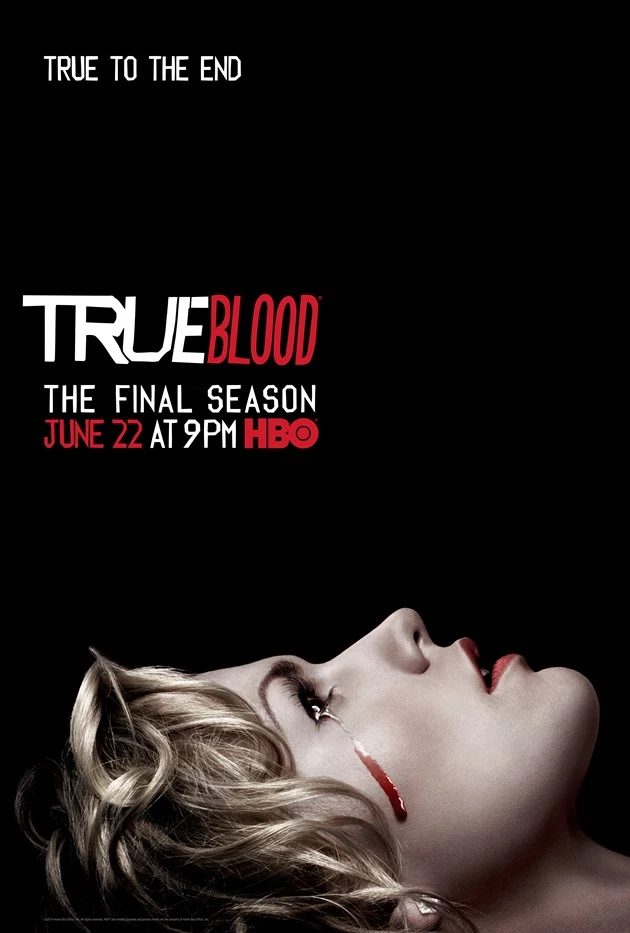
Boy, am I glad that is over and done with. And not because it was so dismally bad as some would have you believe, though the finale did leave a lot to be desired. But so did the rest of the season, so at least there is some inner consistency. There's a lot to be said against this last season in terms of story, but there were still several plot lines and especially characters I continued to enjoy and appreciate. And in that case, True Blood at least can boast a genuine ending, unlike most other shows that suffer increasing deteriorating ratings and heavy fan critique. The greatest thing about this finale is that it does indeed feel quite final and the show was permitted a decent send-off in that regard, rather than face cancellation and leave us all in the dark as happened to so many shows (and a lot of them deserved better). We can now all close the Sookie Stackhouse chapter of our lives peacefully, as to my mind any show should be ended. Of course, there were a few story threads that didn't feel wholly resolved and more of those that I felt should have been handled entirely different, but there's few shows that even get to this point without screwing a thing or two up. Only two recent examples of shows that were granted a final farewell sprung to mind, Breaking Bad and Spartacus. Admittedly, both of those ended on a superior note, but they were much more coherent in their quality throughout their run, while True Blood from the get-go tended to meander between well executed plot threads and those less so, featuring both wonderfully charismatic characters and their barely watchable counterparts. We'll have to make do without both, from now on. No more Maenad orgies, conniving witch covens and endless droning about who Sookie will jump into bed with this time, but also no more shrewd vampire politics, stupendously supernatural situations and Eric Northman. Not every blood type variety of Tru-Blood proved as delectable, but I still regret having to return to strictly human beverages again after seven years.
maandag 19 mei 2014
Today's Trailer: True Blood, the final season
Posted this interesting bit of advertising on MS yesterday:
http://www.moviescene.nl/p/155784/trailer_laatste_seizoen_true_blood_
Looks like True Blood means to go out with a bang. As it should. I know the show has seen its ups and downs, but even among all the silly Maenad blood orgies and wacky worshipping witches there was always enough left to keep you enticed. I've yet to see Season 6, so I don't know whether it too features dramatic qualitative deterioration or whether it keeps the momentum and strength of Season 5 going, but I'd like to think the odd numbered seasons provide the better fare, and hopefully Season 7 continues that trend and carries it to a formidable finale that once and for all defines the series as a true quality show beyond contestation. As for the trailer, it looks promising, showcasing that all our favorite characters are back - some of them we haven't seen for a while, and others we could have lived without for a while longer - for one final supernatural showdown, before we'll have to do without them forever. I bet there will be a fair amount of casualties among them, as the writers don't necessarily have to keep them alive for more any longer. Whoever gets fanged up, it better not be Eric, since I'm still hoping for his own spin-off show. Or maybe the end of True Blood would be a decent time to start watching Vikings then.
Labels:
anna paquin,
gore,
HBO,
horror,
moviescene,
romance,
sex,
television,
trailer,
true blood,
TV show,
vampires
zondag 16 februari 2014
Today's News: here's a dreadful trailer for ya
Got this up at MS yesterday:
http://www.moviescene.nl/p/153800/eerste_trailer_penny_dreadful
I hadn't heard of this new series yet, but I must admit it looks rather interesting. The beauty and squalor of Victorian era England, a time of refined culture, daring exploration and unapologetic conquest, the dark nature of literary characters from that period like Dorian Gray and Dracula, games of psychological misconduct and sexual manipulation, and a few good actors and writers/producers to make it all seemlessly come to life... what's not to like here? Maybe for some, the fact it sounds like an adult version of the film adaptation of The League of Extraordinary Gentlemen (which is a movie I, unlike most others, hold little umbrage against). As opposed to getting into fisticuffs with each other, in this upcoming Penny Dreadful they seem to jump into bed together and do the nasty instead. Or so it would appear, but as always, trailers can be highly deceiving. Just what these personae are up to and what the role of characters specifically written for this show might be all remains somewhat obscure from just this trailer. The show aims to be a mystery thriller serial (not unlike, say, HBO's Carnivale, which it appears to resemble in tone and mood), and in that regard the trailer delivers that aspect just sublimely. Whether the show itself will be any good is far too early to tell, but I like to think there's room for a gritty unusual terror/noir piece like this on contemporary television. And I have faith in the writers/producers, who have delivered mostly good stuff before (I'll forgive showrunner John Logan for his involvement in Star Trek: Nemesis, as he has redeemed himself with grand movies like Skyfall, Hugo and The Aviator). As for the actors bringing the characters and their strengths and flaws to life, they seem to be a mixed bag. Though I'm always pleased seeing sultry dame Eva Green, suffering Josh Hartnett's blank apathic stare on the small screen for hours on end is not something I hunger for, but I can live with it if needs be. And ah, Timothy Dalton... I sincerely hope this show will turn out as fascinating as the trailer suggests it will be, as the subject matter certainly has potential. In fact, it may just render that announced LXG TV-series redundant.
Labels:
dracula,
eva green,
frankenstein,
horror,
john logan,
josh hartnett,
literary,
penny dreadful,
psychology,
Sam Mendes,
sex,
showtime,
television,
thriller,
Timothy Dalton,
TV show,
tv-series,
vampires,
victorian
zondag 29 december 2013
Today's Mini-Review: Daybreakers
Rating:
****/*****, or 8/10
Starring:
Ethan Hawke, Willem Dafoe, Sam Neill
Directed
by Michael & Peter Spierig
USA:
Lionsgate, 2009
You'd
think that after 80 years of vampire movies there's little 'fresh
blood' to be added to the genre, but Daybreakers proved such
pessimist thinking wrong. Containing one of the most intriguing
premises I've ever come across, this film puts a wholly different
spin on the notion of the undead thriving on the blood of their human
victims. In the not too distant future, a viral outbreak has turned
most of the world population into vampires, while regular human
beings have become quite the endangered species. Since the vamps need
human blood to survive while they are as immortal as usual, blood
shortages are increasingly threatening the societal status quo (which
remains remarkably human in appearance). A hematologist (Ethan Hawke)
works tirelessly on a synthetic blood substitute, experiments which
continue to fail, partially because the CEO of the company that
controls the 'real deal' (a deliciously sinister Sam Neill) is rather
keen to keep making the big bucks off rich vampires that can afford
genuine blood. Vampires or not, money is still the driving factor
behind it all, to the detriment of civilization. The situation is
getting ever more untenable as poorer vampires are so desperate they
start feeding on each other or even on themselves, causing them to
mutate into crazed bat people (a funny take on the ever present
relationship between vampires and bats, which otherwise plays no
significant part in this film); freaks that are brutally exterminated
by the authorities. Hawke's sympathetic scientist, made vampire by
his brother against his will, proves a guilt ridden person determined
to change this upside down world for the better and sympathizes with
what few humans remain free, continuously hunted by the vampire
military as they are. After aiding a group of humans evade capture,
he is contacted by an underground resistance movement, led by
ex-vampire Willem Dafoe, that aims to develop a cure for vampirism,
the only viable way for both humans and vampires to survive their
impending doom. Hawke accepts their invitation and joins their cause,
which soon pits him and the rebels against Neill's profit driven
tyranny.
Daybreakers'
strongest moments are found in its first half, as we explore a world
where vampirism is the normal state of being and society has evolved
to accomodate it. Since the vampires of Daybreakers adhere to
many of the archetypal characteristics of the genre, they also cannot
abide ultraviolet light, and therefore “life” takes place at
night, so commonplace items like houses and cars are designed to
protect against sunlight. In other regards, this world differs little
from our own, as the vamps work in order to pay their bills, buy
their blood and live their immortal life. The disturbing imagery of
humans forcefully strapped to transfusion tubes and slowly drained of
their life essence in huge factory like environments successfully
evokes comparisons to how we ourselves as a species treat animals in
the bio-industry for our own basic needs without allowing them any
shred of dignity and natural behavior. The vampire world is living in
its 11th hour, close to self-annihilation caused by plain
and simple greed of those in power who prove unwilling to change for
the common good, in some regards echoing our own inability to alter
our ways for the better in fear of loosing what we gained. In the
second half of the movie, Daybreakers sheds such symbolism and
largely replaces the exposition of its fascinating dystopia in favor
of more trite and true action scenes and an overabundance of
traditional gore (it's still a horror film, you know!), including some almost orgiastic blood baths of
famished vampires feeding. Whether society is ultimately changed for
the better is left somewhat ambiguous, as the movie underscores the
notion that vampires, for all their superior physical strength, are
still always all too human in their limited line of thinking. Though
it's a pity the movie doesn't end as strongly as it started, it
doesn't undermine Daybreakers' position as one of the more
ingenious vampire films to date, a far cry from the currently popular
image of these undead as sexy hunks to appeal to teenage audiences.
woensdag 4 september 2013
Today's News: all blood things must come to an end
Suck on this, fanger!:
http://www.moviescene.nl/p/149798/true_blood_stopt_in_2014
It's not like we didn't see this coming. The moment a showrunner quits, you know the end is near. Alan Ball quit after True Blood's fifth season, and season 6 apparently suffered for it. I have yet to see that part of the show so I can't agree or disagree on its quality (nor can I say whether it was "bad" enough to justify ending the show), but the ratings spiralling downwards are an undeniable fact. The show followed a quality pattern as it was, where the odd number seasons were great and the even number seasons proved disappointing (but still watchable) by comparison. Hopefully the last season, number seven, will continue this trend and end the show on a grand note, worthwhile of what passed before. It's commendable HBO has decided to give True Blood a decent farewell run at all instead of just pulling the plug entirely and leaving us with many a cliffhanger to speculate over for all eternity. Imagine how frustrating that must be for someone who's among the living dead!
Oh well, we sure had some 'good times' with this show. Fortunately, we still have some more of Boardwalk Empire and Game of Thrones to look forward to on HBO. Plus, the money for its new Westworld show had to come from somewhere...
Farewell Sookie Stackhouse. And goodbye viking/entrepeneur vampire who always stole the show...
donderdag 16 augustus 2012
The secret role of vampires in the history of America according to Timur Bekmambetov
Abraham Lincoln: Vampire Hunter: ****/*****, or 7/10
A few
months ago the combination 'vampires' and 'Tim Burton' managed to
result in a flawed and disappointing movie named Dark Shadows,
despite the fact Burton initially seemed well suited for the project
due to his flair for Gothic visuals that are so commonly associated
with the vampire mythos. Various arguments could be provided as to
why the film fell short, but the haphazard script written by novelist
and screen writer Seth Grahame-Smith definitely had something do with
its lackluster performance. However, despite their failure to deliver
a fully compelling picture about a vampire waking up in the Seventies
after having been out of it for 200 years, both Grahame-Smith and
Burton apparently felt their collaboration merited a second vampire
movie on short notice, this time based on Grahame-Smith's own novel
Abraham Lincoln: Vampire Hunter. Obviously, a book with such a
campy title deserved an equally over-the-top movie adaptation: though
everybody who's familiar with Burton's oeuvre is well aware the man
himself might have succeeded in directing such a project, Burton
himself decided to forego the director's chair and instead hand it
over to his Russian “twin brother”, Timur Bekmambetov (the guy
behind the epic Russian Night Watch movies), who like few
others in the directing business manages to effectively balance the
camp with the cool and to combine fair amounts of utter silliness
with scenes of gripping action. Judging by how entertaining a movie
Abraham Lincoln: Vampire Hunter turned out to be, Burton
stepping down as director in favor of Bekmambetov was all for the
best.
Warning!
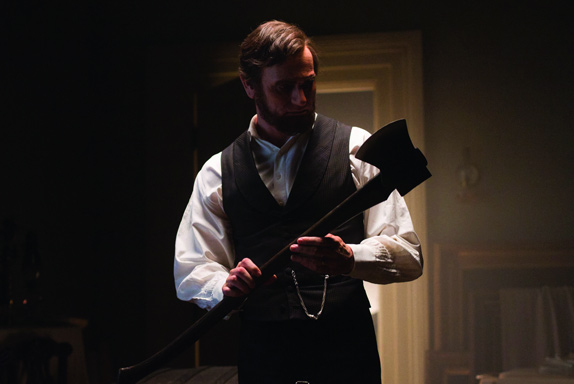
Spoilers! As indicated by the title, Abraham Lincoln:
Vampire Hunter simply pits
the historic character of the 16th President of the United
States against the bloodsucking living dead. The movie opens on a
young Lincoln who witnesses his mother being assaulted by a vampire
to fatal consequences, after her husband stepped in when their son
was whipped by the fiend for defending a helpless black child. Both
an aversion to slavery and a resentment towards vampires are thus
shown to be forged at a young age in our Abe, setting him on the path
towards righteousness. When he returns to avenge his mother as a
young man (now played by Benjamin Walker, a relative newcomer to
acting, but fitting the mood well enough to carry the picture), his
confrontation with the despicable Jack Barts (Marton Csokas, once
only slightly more than an extra in Lord of the Rings), a
sadistic slave trading vampire, almost ends in his own demise, but a
mysterious stranger saves him from certain death. This mystery man
named Henry Sturges (Dominic Cooper, The Devil's Double)
claims to be an experienced vampire hunter who is willing to teach
Abe the tricks of the trade, if he swears to devote his life to the
cause and not waste his time with getting attached to people in the
process. Lincoln hesitantly accepts and begins intensive training,
which allows him to detect and kill vampires, and, keeping in tone
with the levels of cheese, pull off impossible stuff like chopping
down a tree with a single stroke of his axe. After his training is
completed, on Sturges' orders he sets out to Springfield, Illinois,
to root out the vampiric presence there and dispatch as many of the
ghouls as he can with his trusted axe in a series of brief but bloody
scenes (it is a vampire movie after all!). When he meets the
beautiful Mary Todd (Mary Elizabeth Winstead, Scott Pilgrim vs.
The World), he cannot help himself but break his word to his
mentor and become romantically involved with her. He also finally
finds and kills his nemesis Barts, who prior to his death illustrates
the fact Sturges himself is a vampire to him, leaving Lincoln to
confront his mentor and learn the truth about his reasons for making
him a vampire hunter.
As it
happens, Barts was just the tip of the iceberg. The real power behind
both vampirism and slavery is the age-old vampire known as Adam
(performed enthusiastically by Rufus Sewell, who always manages to
play convincing scumbags and makes no exception here), a wealthy
plantation owner in the South. Slavery isn't simply a way for white
people to make money over the backs of black people, it's Adam's tool
to keep his vampires in line by supplying them with ample victims to
keep them from running rampant among mankind, and of course a means
to get rich in the process and secretly transforming the young United
States of America in a free haven for vampires, run behind the scenes
by vampires, with vampires controlling the major routes of import and
export. It's an ingenious scenario, firmly connecting Lincoln's
historical campaign of abolition to his fantastical fight against
vampire tyranny. Far from being a 'land of the free', America is
rapidly deteriorating in secret into a 'land of the undead', where
black people not only provide the means of hard labour for the
comfort of their white owners, but where, in a poignant parallel,
they also provide the main food source for the creatures controlling
their white owners without their knowledge. The notion of slavery for
vampirical feeding purposes is reminiscent of the human blood banks
of the recent and excellent movie Daybreakers (2009), where
humans simply served as cattle in bio-industrial farms run by their
vampire overlords, like rows of Negroes are hung from the ceiling
upside down to be drained in Abraham Lincoln: Vampire Hunter.
Scenes like these reveal there's still many possible enjoyable
variations on the theme of human oppression by the living dead when
paired to distressing imagery of worthwhile social causes, be they
historical or contemporary. It would have been welcome to see an
intriguing premise like this explored in greater detail, but
Bekmambetov doesn't feel like risking the slavery theme becoming too
much of a serious issue in favor of providing us with a fun
rollercoaster ride of an action flick as Lincoln sets on his mission
to shut down Adam's business operation.
In fact,
only Lincoln can stop it, since the canonical vampire of Abraham
Lincoln: Vampire Hunter cannot
kill another vampire (though he can walk safely in the sunlight,
making it easier for him to handle his slaves). As the movie states,
only the living can kill the dead, while the dead are literally
physically unable to violently settle their differences among
themselves. As he explains to Abe, Henry tried to fight Adam but
failed, and has since resorted into training worthy humans as vampire
hunters for ages, a notion the movie repeats to great humorous
effect in its final scene as Henry is seen to recruit a man in a
present day bar the same way he recruited Lincoln back in his days
(and no, that man is not supposed to be Barack Obama, as some
overexcited audience members reading too much into this film would
have you believe, though that would have made the camp complete!).
Just like the bad vampires of the movie are living off humans, the
film's only good vampire is a parasite in his own way for having his
personal vendetta fought by humans in his stead: though in both cases
necessity is the key word, at least Henry has moral qualms about it,
making him a sympathetic double-crosser. Of course, the fact Henry
lied to Abraham to begin with makes the latter turn his back on him,
setting him off on his own path against the vampire regime – which
includes marrying Mary – leading through politics, so he abandons
the axe and turns to words instead, his rise to his historically most
famous level of political office displayed in a montage ending on the
beginning of his term as president, at which time the young, muscular
man we saw kicking vampire butt before has himself transformed into
the classic look of the older, slender built, bearded Abraham Lincoln
as we all know him. It's a credit to Walker's capabilities as an
actor to see he can carry the picture as well in his performance as
the older Lincoln, endowing him with the typical levels of gravitas
and thoughtfulness most commonly associated with the character in
both fiction and reality. By comparison, the actors playing vampires
have it much easier, since they can go on playing the same character
with the same motivations and character traits, not burdened by
prosthetics and similar aging make-up, or fake beards. Walker plays
the shift in Lincoln's character, both physically and mentally, with
a subtlety one would not expect from an action oriented movie like
this.
Of
course Lincoln's actions against slavery – and thus, the vampires'
food source – don't sit well with the ruthless Adam, who turns the
South against him, with the argument abolition would severely weaken
the slaving states economically. And so the American Civil War erupts
for the same apparent reasons as it did in reality, but with a hidden
agenda governing the upper echelons of both parties. However, amidst
all the bloodshed of the battle field, vampires do not need to hide
as much as usual, as Adam releases scores of vampire soldiers upon
the armies of the North, threatening to balance the war in the favour
of the South. Lincoln retaliates by ordering all silver of the
Northern states to be collected and melted down as bullets and
cannonballs to supply his troops with weapons capable of killing
vampires as well as humans. Silver as always remains the weapon of
choice against vampires – Abe's axe blade was dipped in silver too
– and the last act of the movie thus resolves around the issue of
how to get it to the front lines in time for the troops to fight back
before they are overwhelmed by the bloodsucking hordes. Keeping in
tone with the period setting of the movie, the railroad is employed
to swiftly transport the weaponry to the battlefield, but through
betrayal Adam gets word of it, which leads to a fight for control of
the train as the film's adrenaline driven action climax, complete
with a huge burning bridge to complicate matters for the good guys.
You got
to hand it to Bekmambetov, the man knows how to direct action scenes,
no matter how silly or bizarre the plot motivations behind them, as
he clearly illustrated in his Hollywood debut Wanted (2008).
Realism is of no consequence; as long as the results look good and
keep the audience engaged, he's game. This strategy of shooting
action is also employed by him for Abraham Lincoln: Vampire
Hunter, to greatest effect in
the climactic train sequence at the end of the film, as well as an
earlier chase on horseback as Abe pursues the fleeing Barts amidst a
wild mustang stampede where gravity itself seems suspended to make
the combination of horse riding and axe swinging in the fight between
man and vampire look both appealing and supernatural. Bekmambetov
also proves he was well aware the movie was produced in 3-D, as he
obviously took the opportunities of this extra dimension into
consideration while filming both action oriented scenes and calmer
moments in the plot. The various axe fights and other assorted
moments of spectacle make good use of 3-D on many occasions, adding
both true depth of vision and the usual attraction of things being
catapulted towards the spectator. Considering this is Bekmambetov's
first 3-D feature, that too is quite an accomplishment in his favor
as an action director. Similarly, he doesn't prove dismayed by the
historical side of the story, making the period parts of the film
come stunningly alive, ranging from fanciful costume work and grand
vistas of famous American landmarks in their Nineteenth Century state
of being. Though Abraham Lincoln: Vampire Hunter
focuses on the undead, under Bekmambetov's careful direction the film
always feels very much alive, though many scenes have to be taken
with a grain of salt in order to enable the viewer to fully immerse
him/herself in them.
In
summary, it turns out that in the triumvirate of Grahame-Smith,
Burton and Bekmambetov, the latter Russian element makes all the
difference between making a vampire movie feel stale, as happened to
Dark Shadows, and making it a total blast to watch.
Bekmambetov manages to appropriate a fairly ludicrous story, that
under other, less capable directors could have resulted in fulfilling the cheesy expectations undoubtedly spawned in many
audience members at first by its provocative title, and have it serve
his own style of making a thoroughly enjoyable action flick, thus
allowing the viewer to invest in it as much as its intended campiness
allows. If it wasn't for the fact the success of this film is mostly
due to Bekmambetov's input, one could say Burton and Grahame-Smith
redeemed themselves and are capable of producing a solid vampire film
after all. Though 2012 isn't done with vampires just yet – there's
still that final Twilight movie to look forward to, if you can
stand Twilight that is – it seems a given Abraham
Lincoln: Vampire Hunter is by
far the most appreciable addition to the cinematic vampire legacy in
years (since Daybreakers
really).
And
watch the trailer here:
Labels:
abraham lincoln,
action,
benjamin walker,
dominc cooper,
fantasy,
history,
horror,
lincoln,
rufus sewell,
slavery,
Tim Burton,
timur bekmambetov,
vampire hunter,
vampires
zondag 13 mei 2012
Dark shadows loom over Tim Burton
Dark
Shadows:
Rating: ***/*****, or 6/10
Sometimes a good notion backfires,
despite the right ingredients being present. In the case of Dark
Shadows, Tim Burton's latest, the main problem is these
ingredients have become stale and somewhat hard to swallow. Burton
presents us with yet another one of his specialty dishes, a typically
off-beat Gothic horror comedy, but it tastes old and mushy because it
offers little surprises. Burton's dark and brooding yet also
satirical and good spirited style has finally come to the point where
it feels it has reached its expiration date, after already
disappointing us two years ago with Alice in Wonderland. The
situation is all the more grave considering the letdown revolves
around a project Burton claims to have great affinity for, namely his
re-imagining of the classic cult TV show Dark Shadows, which
ran for well over a whopping 1,200 episodes from 1966 till 1971. The
strange supernatural occurrences of the Collins family, involving
vampires, werewolves, witches and the likes, sounds exactly like
Burton's cup of tea, and therein lies part of the problem, since
Burton apparently has become predictable, allowing his style to
dictate his projects for him.
Dark Shadows sees the eighth
collaboration between Burton and his personal muse Johnny Depp (for
those of you who must know, the previous joint ventures, in
chronological order of succession, were Edward Scissorhands
(1990), Ed Wood (1994), Sleepy Hollow (1999), Charlie
and the Chocolate Factory (2005), Corpse Bride (2005),
Sweeney Todd: The Demon Barber of Fleet Street (2007) and the
above mentioned Alice in Wonderland (2010)), which also comes
as no surprise, since the film has a wonderfully bizarre character
uncomfortable with his life and the people around him for a
protagonist, and Depp has shown to excel at playing such characters,
usually to the delight of the audience. The role of vampire Barnabas
Collins, who has spend nearly 200 years buried in a coffin and
finally awakens in 1972, setting off in an attempt to restore his
family's position, as such seems tailor made for Depp. After Barnabas
and his family have been cursed by a witch who strongly loved the
decent man he used to be, the bloodsucker finds himself locked away
into the grave for two centuries, only to be accidentally awakened by
a construction crew. Barnabas returns to his former home, the grand
Collinwood Manor from which his father used to run a fishing empire
along the Maine coast, only to find it in a state of decay with his
family decimated to a number of only four, the family fortune
seemingly lost. He takes it upon himself to protect his remaining
relatives from the forces that have plagued them for centuries, and
vows to return the family business to its former glory. Alas,
Angelique, the witch that turned Barnabas vampire so long ago (played
by a deliciously vile Eva Green, who energetically throws herself
into the role and obviously likes the bitchy character a lot) has
since expanded her ambitions from mere witchcraft to the realm of
economics, having taken over the Collins' family business, making her
a successful businesswoman and respected pillar of the community, so
the witch and the vampire find themselves at odds once more as the
latter tries to win back what was once his.
In this
struggle, Barnabas is backed by the Collins matriarch Elizabeth
(Michelle Pfeiffer, a woman of stature who's not afraid to make
sleazy deals to keep her family together), despised by her teen
daughter Carolyn (Chloë Grace Moretz nails this grumpy character
perfectly, and fortunately happens to be her exact age as a bonus),
distrusted by Elizabeth's brother Roger (Johnny Lee Miller playing
the family scumbag successfully) and revered by Roger's son David
(the young newcomer Gulliver McGrath), a boy who sees his dead
mother's ghost. Thrown into this mix are the groundskeeper Willie
(Jackie Earle Haley, ever creepy), David's new private teacher Vicky
(the beautiful Bella Heathcote playing the girl with the biggest
secret of the bunch) and the family psychiatrist and regular drunk
Dr. Hoffman, in which we recognize Burton's other muse, his fiancé
Helena Bonham Carter, who co-starred in six of his films before this
one, making us wonder just who Burton actually loves more, Depp or
the woman he means to marry. At least Barnabas does not stand alone,
but every member of his entourage has demons all their own, some
merely psychological, others all too real, adding to his existing
troubles. Plus he also has to deal with the strange new world of the
1970s, its technological advancements (like cars and televsion sets)
and cultural changes (including women's lib and youth subcultures)
alike, which turns out to be encompassing the film's most memorable
and hilarious moments, but unfortunately these get underexposed in
favour of the rather bland family story line and the battle against
the wicked witch.
Depp once again does his usual thing,
portraying Barnabas as a soul out of time who must come to terms with
a much changed world and unite his family against the evil witch that
has sought to destroy them, but it's less than a stellar piece of
acting simply because it all feels so familiar, as if we've seen this
performance often before, with only slight variations every time.
Fortunately Depp is not the only character in this film, though of
course he is supposed to be the biggest draw for the general
audience. Dark Shadows is seemingly blessed with a host of
characters, each with his or her own issues and secrets. Warning!
Here be spoilers! However, herein lies yet another problem,
since the film's plot comes with so many characters most of them do
not get a good chance to shine and remain poorly underdeveloped,
despite personal afflictions that haunt them and have impact on the
whole family struggle for survival. For one thing, Carolyn turns out
to be a werewolf, but this is revealed only in the climactic end
battle with Angelique, at which point it's too late in the film to be
of narrative use other than to provide some more creature action and
plot confusion. Similarly, Vicky is supposedly the reincarnation of
Barnabas' dead wife Josette, but the exact how-and-why to this
remains severely underexplained, though it does force a romantic
subplot on the movie's overall story, and even a love triangle of
sorts, since Barnabas still feels enough for his tormenter Angelique
to give into her seductions, resulting into a wild night of carnal
pleasure. Similarly, David talks to his dead mother, Roger plans to
run off with the family treasure Barnabas has exposed and Dr. Hoffman
infuses herself with Barnabas' blood in a scheme to live forever.
Each character comes with story baggage, much of which just won't fit
in the luggage compartment of the train that is Dark Shadows
as it moves onward to its destination, and many things get left
behind along the way.
This is all the more disappointing
considering the actors do a good job portraying their characters and
we would have liked to have seen them be put to more satisfying use:
it would not have been a bad idea if Burton and screenwriter Seth
Grahame-Smith – who wrote the novel Abraham Lincoln: Vampire
Hunter, the movie adapatation of which will reach theatres in
August of this year, so 2012 isn't done with vampire movies just yet
– would have scrapped a few of these subplots and twists in favour
of the overall feel of a coherent story line. The subplots may have
been moments of tease designed to be fleshed out in a potential Dark
Shadows sequel, but on their own they don't work to the advantage
of this movie on own. Also, the many characters and their separate
plot lines make it seem we've watched a compilation of the first 200
episodes of the original television show.
Despite the many downsides to the film,
most of which result in a messy overall plot, there's also things to
enjoy in Dark Shadows. The film knows many a comical note,
mainly in the moments Barnabas is faced with the vast differences
between his own era and the swinging Seventies. So he's confronted by
a huge McDonald's logo at the site of his resurrection, he mistakes
his own grand-grand-etc. niece for a 'lady of the evening' due to her
loose way of dressing, and he sits down for a philosophical debate
about love with a group of hippies, which he brutally kills
afterwards in his physical need for human blood (he's a vampire after
all). Also of great joy are the soapy love/hate moments between him
and Angelique, culminating in a passionate night of love making that
does not stay confined to the bed but takes place all over the room,
including the walls and the ceiling, after which Barnabas remarks
this was 'a regrettable turn of events' as they sit in a totally
wrecked room at the end of their sexual outburst. It's moments like
these that provide for the most entertaining part of the film, and
certainly the most memorable, considering the rest of the film proves
all too forgetful afterwards. Unfortunately, they only make the film
half decent, instead of actually good, a level the movie sadly does
not reach, also in part to the unsatisfactory way the film seems to
deliver its message that family should stick together no matter how
odd some of its members are. If that's so, how come Roger ran off
with the money, the house got burned down and the locals think the
Collins family is just a bunch of sinister freaks? Sure, the evil has
been vanquished, but it's a far cry from a happy end to conclude this
motion picture with.
After seven projects working with the
same director, usually in the same genre and the same visual style,
the fact is the combination Burton/Depp has really gotten worn out
and stale, indicating both men should probably take a long break from
each other and meet some new people to escape the dreary routine
they've succumbed to. Though Burton has used a grotesque style all
his own that made him Hollywood's leading auteur, by now it
has proven to be a huge 'been there, done that', resulting in
disappointing films that only see a continuation of his style instead
of some form of improvement upon it. Turning to a new genre
altogether could be a solution to the routine Burton seems stuck in.
Obviously, the director himself feels differently, since he's not
done with family oriented Gothic horror this year: come October his
latest stop motion piece Frankenweenie will be released. It
may use a different format, but seems overall typically Burtonesque.
At least it doesn't star Johnny Depp, maybe that will prove to be
enough of a change this time...
And watch the trailer here:
maandag 2 april 2012
BloodRayne
Rating:
***/*****, or 5/10
One of
Uwe Boll's best films, though that isn't saying much considering his
reputation as one of the worst directors alive. Still, despite its
obvious limited budget this is a fairly enjoyable action flick with a
surprisingly good cast (how Boll always manages to get such noted
actors for his otherwise bad films ever remains a mystery). In 18th
Century Romania, Rayne (Kristanna Loken, Terminator 3), a
young Dhampir (vampire/human hybrid), lives a meager life full abuse
travelling with a circus as a sideshow attraction, but decides to
jump ship, after which she finds out her father, Kagan (Ben
Kingsley), the king of vampires, raped her mother. Out for vengeance
against her father, she teams up with a group of vampire hunters,
including Vladimir (Michael Madsen) and Katarin (Michelle Rodriguez)
who are at war with Kagan's sinister forces. Kagan himself however
means to destroy humanity and has no qualms killing his daughter if
it stops her from interfering with his vile schemes. The plot is a
bit of a mess and at times hard to follow or nonsensical, while the
visual effects often are of poor quality. However, some fine acting
and adequate action scenes keep this film from being a total loss,
the fate to which many other Uwe Boll films were condemned. If you
expect a faithful adaptation of the original video game this movie is
based on, forget it.
Starring:
Kristanna Loken, Ben Kingsley, Michael Madsen
Directed
by Uwe Boll
USA/Germany:
Boll KG Productions, 2005
maandag 26 maart 2012
Blood of Dracula
Rating:
**/*****, or 4/10
Beware!
Misleading title here! This movie has nothing to do with the Dracula
character in whatever incarnation, despite some semi-vampiric
presence in the plot. A better title would have been 'I was a Teenage
Dracula', considering this was produced by the same company behind I
was a Teenage Werewolf, also released in 1957, to which it bears
more than just a coincidental resemblance story wise as it tells of a
troubled teenage girl (Sandra Harrison) dumped at a boarding school
by her father, who finds herself subjected to hypnotic experiments by
the evil headmistress (Louise Lewis), that turn her into a vampire at
her behest. This results in a few suspenseless murders here and there
and a dull subplot about police investigators trying to find out
what's going on. This movie was released as a double bill for
drive-ins with I was a Teenage Frankenstein. Production
company American International Pictures (AIP) was responsible for
many a lousy B-movie in the latter half of the fifties (many of them
with overly grandiose, incorrect and thus irresponsible titles):
though this flick is far from good, it's by no means the worst of
this extensive bunch.
Starring:
Sandra Harrison, Louise Lewis, Gail Ganley
Directed
by Herbert L. Strock
USA: AIP,
1957
Abonneren op:
Posts (Atom)