Posts tonen met het label Tim Burton. Alle posts tonen

woensdag 22 oktober 2014

Today's News: back on schedule!


Finally managed to catch up with commenting on my own news today, thanks to a drought of news this first half of the week:

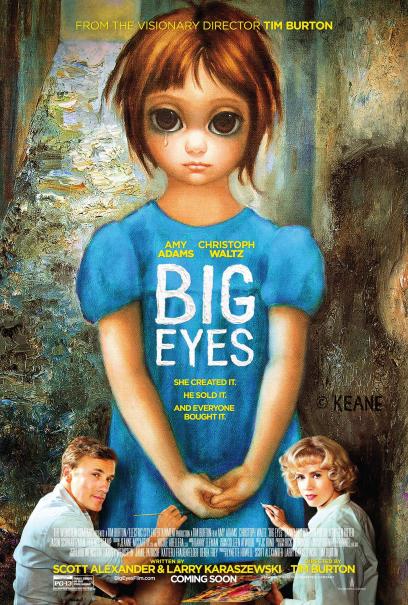
http://www.moviescene.nl/p/157621/eerste_poster_tim_burtons_big_eyes

Excellent poster and tagline to match, precisely portraying Big Eyes' narrative issue at hand while indicating a humourous, even whimsical tone. Not as Gothic as we're used to from Burton, which could be a nice reprief, since most of his films in that vein from recent years (Dark Shadows, Alice in Wonderland) failed to capture our imagination. Still, biopics are not new territory to the man, as he already made one of the finest I've ever seen with 1994's Ed Wood. Seems he has a thing for underdogs in the visual arts, though the exact finesse of that term is debatable when it comes to Wood's excessively amateuristic works. However, as that film illustarted and tBig Eyes might underscore yet again, it's all about the love and enthusiasm you put into the act of creation. Talent comes second, or sometimes sinply not at all. Burton also doesn't seem to rely on his usual actors this time, instead opting for new company (but fortunately for us, still delightfully watchable talented actors). Big Eyes in many ways seems like a change of pace for the director, though he's still not entirely leaving his comfort zone given the subject matter. I hope the film will reaffirm Burton is still one of the most unique and worthwhile directors in Hollywood.


http://www.moviescene.nl/p/157620/tom_hardy_beoogd_voor_x-men_en_suicide_squad

I'm not familiar with Suicide Squad. Sorry, I'm just a Marvel guy, while DC never really did grab my attention (aside from Batman, naturally). Such as it is, I am quite familiar with X-Men baddie Apocalypse. And I think Hardy is a fine choice to portray that ancient genocidal genius. Of course he looks nothing like Apocalypse does in the comics, but that's what computers are for. With Hardy, you may not even need those. After all, the Bane from the comics is as much of a hulking behemoth as Apocalypse, but Hardy's portrayal in The Dark Knight Rises, both physical and intellectual, made us forget all about the source material. Hardy definitely possesses the necessary gravitas and determination to make Apocalypse work on screen, as he did Bane. Though not in the same vein as Ian McKellen's Magneto (no, no no sir! That's the very top level of acting!), Hardy's Apocalypse could surely be a tour-de-force in supervillain acting, if he does opt for Marvel of course. Maybe his prior experience working for DC, though unrelated in terms of the DC Cinematic Universe which does not inculde Nolan's Dark Knight trilogy, will entice him to choose Suicide Squad after all. Marvel's loss would definitely be DC's gain. And I'm sure he would make for a formidable foe to whatever poor DC superhero crosses his path in that film (if any), but it would be a great loss for X-Men: Apocalypse. And that movie already has a few things going against it, what with Channing Tatum performing Gambit... Hardy would be a fine choice to balance the acting scales in that regard.


http://www.moviescene.nl/p/157667/james_wan_terug_voor_conjuring_2

I'm generally not fond of the concept of horror sequels, particularly to movies that made a valuable contribution to the genre. But if you gotta cash in by repeating a concept, you damn well better get the man behind the concept itself. Especially if that man could be held responsible for revitalizing the horror genre - at least in terms of popularity and audience attendance - over the last decade. James Wan sure can be said to have done so with Saw and Insidious, though particularly in the case of the former franchise, all the money spent on its many redundant sequels could have been put to better, more creative use. Now history is sort of repeating itself with The Conjuring, except that its success had already spawned a spin-off - Annabelle, currently in theaters and reportedly not all that bad - prior to a direct successor. Wan understands horror in its various incarnations, and if any genre director is capable of making this blatant cash grab work for audiences as well as for money hungry studio suits, it's him. Is his heart in it? It just might, since time has proven that he keeps returning to his horror roots despite the occasional break in that routine. Such a break is currently in progress as he's finishing Fast & Furious 7, so after all the tedious car chrashes and chase sequences, he'll probably be up for a few more oldfashioned scare tactics. And if he does finally miss the horror mark this time around, there's always the possibility of an Annabelle 2.


zaterdag 27 oktober 2012

Breathing new life into Tim Burton

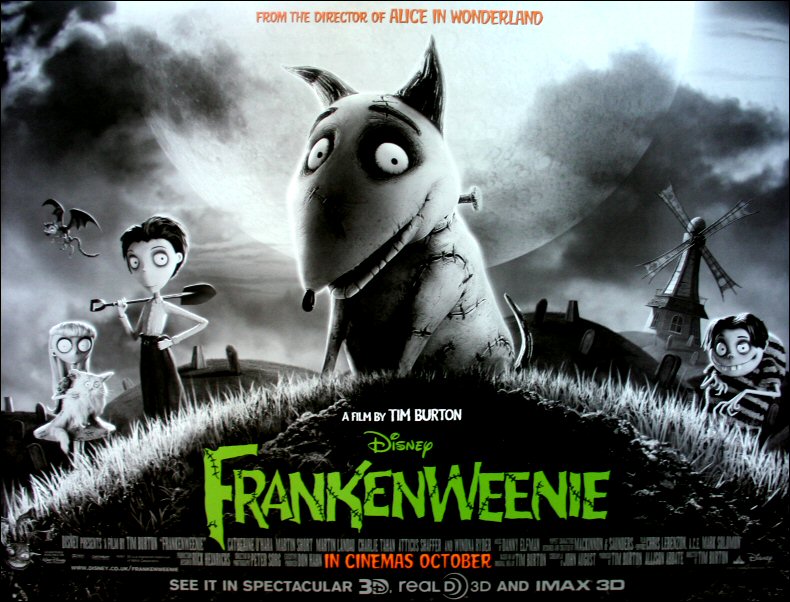
Frankenweenie: ****/*****, or 8/10

Moviebuffs familiar with Tim Burton's oeuvre will probably remember how one of his earliest projects for Disney backfired on him, though it ended up setting him in the right direction for a very fruitful career. In 1984 Burton directed a 29 minute family film named Frankenweenie, an homage to the iconic original Frankenstein films from the Thirties, involving a boy who loses his beloved dog but revives him via electricity, to the shock of his neighbourhood. Though it was a simple horror story for all ages, Disney was dismayed and deemed the short film too disturbing and scary for its target audience, denying it a theatrical run (but for some reason still giving it a home video release). Burton was fired from the studio and looked for jobs elsewhere, soon setting himself on the right track as he directed a number of smash hits, including Batman (1990), Edward Scissorhands (1990) and Batman Returns (1992), eventually becoming a major player in Hollywood despite (or because) continuing to utilize his own unorthodox visual style and displaying his love for outcasts and their encounters with the bizarre. Leaving Disney may have been the best thing that ever happened to Burton, but it didn't stop him from revisiting the failure that basically started his career, remaking his own short into a theatrical movie in an even darker and more off-beat fashion 28 years later, but still for the same Walt Disney Studios that didn't think much of him or his work all those years ago. Apparently Burton's acclaimed career, plus an earlier cooperation between the pair when doing the highly successful Alice in Wonderland (2010), ensured Disney gave Burton the benefit of the doubt and the chance to bring Frankenweenie back to life in an even more spectacular way than the dog in the story is reanimated.


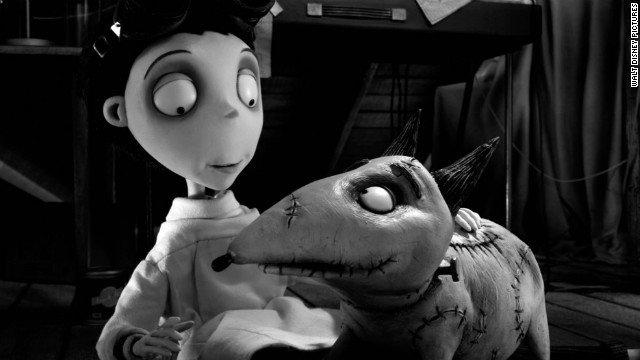
For despite the film now running 87 instead of only 29 minutes, surprisingly little has changed in terms of story. Warning! Spoilers! The protagonist is still a little boy named Victor Frankenstein, a nerdy and imaginative kid whose best buddy in the whole world is his dog, called Sparky (there's more than a little 'nomen est omen' in there somewhere I reckon). Together they do anything from just playing around on the streets to making home movies wherein the canine stars as a dinosaur slayer protecting cardboard cities from plastic monsters. Of course with hobbies like that, Victor isn't the most popular kid in school, but as long as he has Sparky, he doesn't mind. But soon, tragedy strikes and Sparky is fatally run over by a car and laid to rest, leaving an inconsolable Victor all alone, despite his parents' assurances Sparky moved on to a special place in his heart. However, when he learns of electricity and its effects on dead tissue at school, the boy turns to the dark art of science to bring his pet back to life by having its soulless body struck by lightning. Against all odds, the experiment is a success and his best friend is given a second chance at life, though not in a perfect physical state as parts of him occasionally come loose. Despite his efforts to keep Sparky's resurrection a secret, the rest of the town soon finds out and is appalled by this abominable obstruction of everyday life, turning into a typical angry mob out to make sure the dead dog stays dead this time. Tracking the pair to an old windmill, the construction catches fire and traps Victor inside until Sparky gives his second life to save his young master. Touched by his courage, the townspeople are convinced Sparky deserved to live, after which they help Victor restoring him to life once more in a total feel-good happy ending only Disney can deliver (though it's maybe a bit too cheerful for a Tim Burton picture).


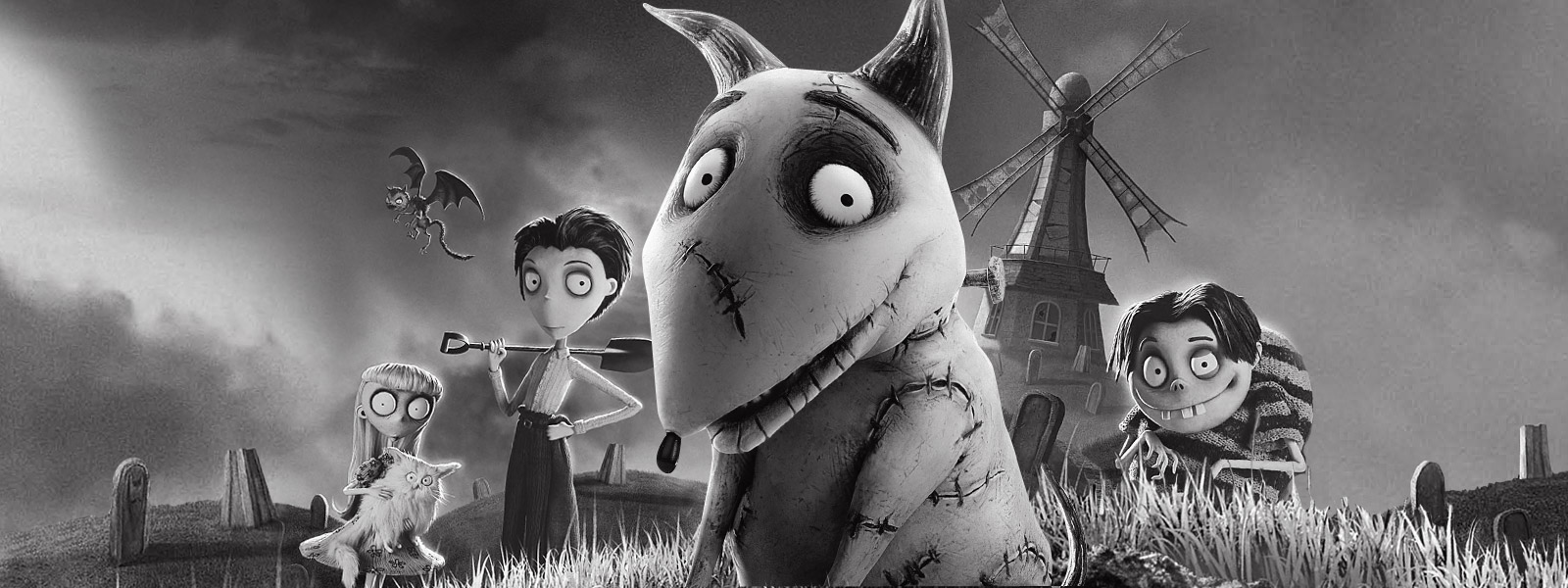
Though the plot has hardly changed, there couldn't have been a bigger difference in execution, as Burton turns to the much admired art of traditional stop motion animation for his second incarnation of Frankenweenie. Hardly a stranger to this type of filming, having produced The Nightmare Before Christmas (1993) and directed Corpse Bride (2005) before, Burton's use of stop motion turns out fully justified as it gives the movie a stylistic and visual edge over both the movie's predecessor as well as many a “regularly” animated Disney movie. The film's look is simply stunning, with some of the smoothest stop motion work to date, and it also fits into Burton's oeuvre in a completely consistent manner: the various characters, both human and animal, are all typically Burtonesque with their big eyes, pale faces and generally caricaturized physical features, while their brooding, often Gothic surroundings make no mistake Tim Burton's signature stamp is all over this film. Frankenweenie might as well be called Corpse Bride's twin sister, were it not for the fact that, unlike that film but like the original short, Frankenweenie is also shot in black and white to make it appear even more distinct, as well as perfectly in sync with the horror classics of old – particularly James Whale's brilliant original Frankenstein (1931) and The Bride of Frankenstein (1935), to which the movie knowingly owes more than a little, on the narrative side – the movie keeps referring to throughout the piece. While many a gag referring to such narrative and stylistic forebears, albeit visual or in dialogue, is undoubtedly missed by younger members of the audience, those even slightly versed in the genre will recognize a multitude of little nods and in-jokes softening the overall gloomy mood the style and story prescribe. That doesn't mean there's no fun to be had for the kids or the more uninformed spectators, as they too are treated to many an outrageously zany moment triggering a few good laughs.

At the same time, despite the many humourous occurrences, the movie isn't afraid to downplay its moments of grief, and much to the credit of the animation crew such instances are shot with the full range of emotion they necessitate, making even the toughest viewers feel sad as we witness Sparky's death – which fortunately remains largely obscured from vision, instead of seen in more detail than is necessary, underscoring the power of suggestion which Burton has also mastered – and the sorrow it inflicts on those left behind, the high point of tragedy remaining a simple shot of Sparky's neighbour dog, a female poodle with whom he used to play ball through a hole in the fence separating them: the poodle nods the ball through the hole, then waits for a return nod that never comes. Maximum emotional effect achieved through stylistic simplicity, and nobody ought to keep a dry eye.


Despite the overall story remaining largely identical to that of the original short film, a longer running time does warrant the inclusion of a few subplots to flesh things out just a bit more. The most noticeable difference in narration is the science contest dominating events in Victor's class as his school mates are all attempting to outthink each other in making the most spectacular contribution to science, encouraged by their new substitute teacher with his unpronouncable but decidedly Eastern European sounding name (impeccable voicework done by Burton veteran Martin Landau, who won an Academy Award for his role in Burton's masterpiece Ed Wood (1994)). When the word gets out on Victor's achievements, even though they were a personal project to be kept hidden from the rest of the town, the all too natural reaction of the other kids is imitation, as they understandably decide to resurrect their own deceased pets as well. However, their actions are motivated more by the desire for fame and glory than they are by heart, while their teacher explained to Victor the outcome of his experiment was fueled primarily by the love for his subject instead of the lust for self-enrichment. Naturally, the various rival experiments result in the creation of many monstrous mutations soon terrorizing the town, including a cat/bat hybrid and a giant dinosauresque turtle, enabling Burton and his partners in animation to go all out with the stop motion process, continuing the age old tradition of stop motion applied for breathing life into monsters, as pioneered by special effects legends like Willis O'Brien and Ray Harryhausen. It also results in a grander overall scale of the film, clearly setting it apart against the simpler original short movie, plus it adds some dynamic action for those audience members who find it hard to sit through all the genuine emotion the movie keeps evoking, if any. Ultimately though, Frankenweenie doesn't need such spectacle since its core plot about a boy and his dog is moving enough in itself and remains the picture's heart and soul, despite the additions made to make a short film longer.

Only a few months ago, I critiqued Burton's Dark Shadows and feared his signature style was overused by himself (and nowadays, by many others, too), which led to a deterioration of quality in his recent films, culminating in Dark Shadows ending up as one of Burton's biggest disappointments of the last decade. I'm only too glad to find myself positively surprised by Frankenweenie, one of his most delightful films to date, which has proven this director is still fully capable of delivering a satisfying viewing experience when his heart is truly in it. Getting even at Disney while coming full circle from the start of his career to the point where he is now clearly made sure Burton was fully invested in this project, and he is proven right after a quarter century: Frankenweenie was a thoroughly enjoyable short movie then as it is a full theatrical film now, for audiences both young and old. Apparently, in Burton's case revenge is a dish best served dead, and revived.


Sidenote: life is not without its cruel little ironies. For example, I got to watch Frankenweenie the same week I had to let go of (yet another) one of my cats. 2012 is not a good year for me, pet wise. Since I happen to like animals more than people – if you know me and this notion offends you, don't take it personally, it's just the way I am – I'm having some trouble letting go, even though it wasn't my favorite cat. In fact, the pet in question, poor little Akka, was always drooling, generally unhygienic and somewhat obnoxious, but I still loved her in her own right, and I will naturally miss her presence (unlike the other cats, who don't seem to miss her at all). Considering Frankenweenie revolves around the troubles of letting go of your beloved pets, it got me thinking. If I were a creative little boy and I lived in Tim Burton's imaginative world, I no doubt would go for the solution offered in the film and resurrect the hell out of my dead cat. However, I am not and I cannot, and even if it were scientifically feasible, I would not. Especially not after the animal in question had been rotting underground for a week (even if protected by the cover provided by a wooden box, as Sparky was given). After all, letting go when somebody or something dies is just a part of life, the dark side of life of course, but still life.


What would be achieved by keeping dead animals alive? Sure, you can stick to their presence forever, but would it really be the pets you knew and loved? As Frankenweenie showed, Sparky's resurrection, instigated by love or not, was the result of a lucky shot, while the same experiment failed with all the other ex-pets. Monstrous mutations were the result, creepy crawlies and towering behemoths that looked nothing like their living predecessors. Moreover, if they had been healthy and happy like they used to be, death would lose its impact. You could just keep on recharging your dead pet to breathe a semblance of new life into it over and over again, which would keep you from letting go and forming new special bonds with other animals. But of course, new animals would still be born, and soon the number of zombified creatures would grow to excessive rates and leave less room for the living. Death may not be a nice thing, but there is a definite natural purpose to it. My cat had a decent life for over 16 years and she got to live to a fair old age. It's more than I can say for my previous cat, who succumbed to organ failure at age nine, which was far too young for my taste. Instead of focusing on resurrecting pets, it seems more reasonable to turn attention towards extending the natural lifespan of pets, which usually lasts for only one or two decades, while their masters' life outlasts them for many more years. For the same reasons as stated above I feel it shouldn't be attempted by artificial means though. Besides, natural human lives last far longer nowadays than they did centuries ago. I reckon the same is increasingly true for pets' lives, who receive better care and food than they did in days gone by. Who knows, with a little luck cats will eventually live for many more years than they do today. And if not, the memories of a good cat will last a lifetime in that special place in our heart. Even though we would have preferred them to stay here with us in the flesh...


And watch the trailer here:

donderdag 16 augustus 2012

The secret role of vampires in the history of America according to Timur Bekmambetov


Abraham Lincoln: Vampire Hunter: ****/*****, or 7/10


A few months ago the combination 'vampires' and 'Tim Burton' managed to result in a flawed and disappointing movie named Dark Shadows, despite the fact Burton initially seemed well suited for the project due to his flair for Gothic visuals that are so commonly associated with the vampire mythos. Various arguments could be provided as to why the film fell short, but the haphazard script written by novelist and screen writer Seth Grahame-Smith definitely had something do with its lackluster performance. However, despite their failure to deliver a fully compelling picture about a vampire waking up in the Seventies after having been out of it for 200 years, both Grahame-Smith and Burton apparently felt their collaboration merited a second vampire movie on short notice, this time based on Grahame-Smith's own novel Abraham Lincoln: Vampire Hunter. Obviously, a book with such a campy title deserved an equally over-the-top movie adaptation: though everybody who's familiar with Burton's oeuvre is well aware the man himself might have succeeded in directing such a project, Burton himself decided to forego the director's chair and instead hand it over to his Russian “twin brother”, Timur Bekmambetov (the guy behind the epic Russian Night Watch movies), who like few others in the directing business manages to effectively balance the camp with the cool and to combine fair amounts of utter silliness with scenes of gripping action. Judging by how entertaining a movie Abraham Lincoln: Vampire Hunter turned out to be, Burton stepping down as director in favor of Bekmambetov was all for the best.


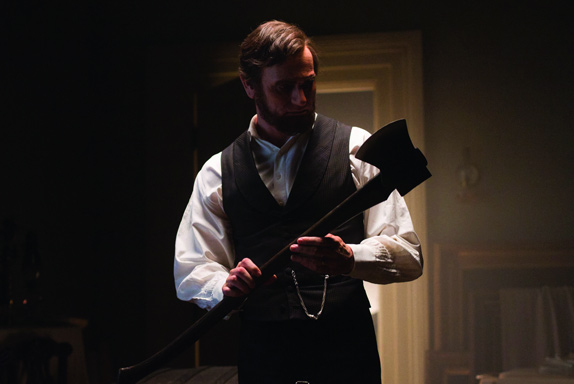
Warning! Spoilers! As indicated by the title, Abraham Lincoln: Vampire Hunter simply pits the historic character of the 16th President of the United States against the bloodsucking living dead. The movie opens on a young Lincoln who witnesses his mother being assaulted by a vampire to fatal consequences, after her husband stepped in when their son was whipped by the fiend for defending a helpless black child. Both an aversion to slavery and a resentment towards vampires are thus shown to be forged at a young age in our Abe, setting him on the path towards righteousness. When he returns to avenge his mother as a young man (now played by Benjamin Walker, a relative newcomer to acting, but fitting the mood well enough to carry the picture), his confrontation with the despicable Jack Barts (Marton Csokas, once only slightly more than an extra in Lord of the Rings), a sadistic slave trading vampire, almost ends in his own demise, but a mysterious stranger saves him from certain death. This mystery man named Henry Sturges (Dominic Cooper, The Devil's Double) claims to be an experienced vampire hunter who is willing to teach Abe the tricks of the trade, if he swears to devote his life to the cause and not waste his time with getting attached to people in the process. Lincoln hesitantly accepts and begins intensive training, which allows him to detect and kill vampires, and, keeping in tone with the levels of cheese, pull off impossible stuff like chopping down a tree with a single stroke of his axe. After his training is completed, on Sturges' orders he sets out to Springfield, Illinois, to root out the vampiric presence there and dispatch as many of the ghouls as he can with his trusted axe in a series of brief but bloody scenes (it is a vampire movie after all!). When he meets the beautiful Mary Todd (Mary Elizabeth Winstead, Scott Pilgrim vs. The World), he cannot help himself but break his word to his mentor and become romantically involved with her. He also finally finds and kills his nemesis Barts, who prior to his death illustrates the fact Sturges himself is a vampire to him, leaving Lincoln to confront his mentor and learn the truth about his reasons for making him a vampire hunter.


As it happens, Barts was just the tip of the iceberg. The real power behind both vampirism and slavery is the age-old vampire known as Adam (performed enthusiastically by Rufus Sewell, who always manages to play convincing scumbags and makes no exception here), a wealthy plantation owner in the South. Slavery isn't simply a way for white people to make money over the backs of black people, it's Adam's tool to keep his vampires in line by supplying them with ample victims to keep them from running rampant among mankind, and of course a means to get rich in the process and secretly transforming the young United States of America in a free haven for vampires, run behind the scenes by vampires, with vampires controlling the major routes of import and export. It's an ingenious scenario, firmly connecting Lincoln's historical campaign of abolition to his fantastical fight against vampire tyranny. Far from being a 'land of the free', America is rapidly deteriorating in secret into a 'land of the undead', where black people not only provide the means of hard labour for the comfort of their white owners, but where, in a poignant parallel, they also provide the main food source for the creatures controlling their white owners without their knowledge. The notion of slavery for vampirical feeding purposes is reminiscent of the human blood banks of the recent and excellent movie Daybreakers (2009), where humans simply served as cattle in bio-industrial farms run by their vampire overlords, like rows of Negroes are hung from the ceiling upside down to be drained in Abraham Lincoln: Vampire Hunter. Scenes like these reveal there's still many possible enjoyable variations on the theme of human oppression by the living dead when paired to distressing imagery of worthwhile social causes, be they historical or contemporary. It would have been welcome to see an intriguing premise like this explored in greater detail, but Bekmambetov doesn't feel like risking the slavery theme becoming too much of a serious issue in favor of providing us with a fun rollercoaster ride of an action flick as Lincoln sets on his mission to shut down Adam's business operation.

In fact, only Lincoln can stop it, since the canonical vampire of Abraham Lincoln: Vampire Hunter cannot kill another vampire (though he can walk safely in the sunlight, making it easier for him to handle his slaves). As the movie states, only the living can kill the dead, while the dead are literally physically unable to violently settle their differences among themselves. As he explains to Abe, Henry tried to fight Adam but failed, and has since resorted into training worthy humans as vampire hunters for ages, a notion the movie repeats to great humorous effect in its final scene as Henry is seen to recruit a man in a present day bar the same way he recruited Lincoln back in his days (and no, that man is not supposed to be Barack Obama, as some overexcited audience members reading too much into this film would have you believe, though that would have made the camp complete!). Just like the bad vampires of the movie are living off humans, the film's only good vampire is a parasite in his own way for having his personal vendetta fought by humans in his stead: though in both cases necessity is the key word, at least Henry has moral qualms about it, making him a sympathetic double-crosser. Of course, the fact Henry lied to Abraham to begin with makes the latter turn his back on him, setting him off on his own path against the vampire regime – which includes marrying Mary – leading through politics, so he abandons the axe and turns to words instead, his rise to his historically most famous level of political office displayed in a montage ending on the beginning of his term as president, at which time the young, muscular man we saw kicking vampire butt before has himself transformed into the classic look of the older, slender built, bearded Abraham Lincoln as we all know him. It's a credit to Walker's capabilities as an actor to see he can carry the picture as well in his performance as the older Lincoln, endowing him with the typical levels of gravitas and thoughtfulness most commonly associated with the character in both fiction and reality. By comparison, the actors playing vampires have it much easier, since they can go on playing the same character with the same motivations and character traits, not burdened by prosthetics and similar aging make-up, or fake beards. Walker plays the shift in Lincoln's character, both physically and mentally, with a subtlety one would not expect from an action oriented movie like this.


Of course Lincoln's actions against slavery – and thus, the vampires' food source – don't sit well with the ruthless Adam, who turns the South against him, with the argument abolition would severely weaken the slaving states economically. And so the American Civil War erupts for the same apparent reasons as it did in reality, but with a hidden agenda governing the upper echelons of both parties. However, amidst all the bloodshed of the battle field, vampires do not need to hide as much as usual, as Adam releases scores of vampire soldiers upon the armies of the North, threatening to balance the war in the favour of the South. Lincoln retaliates by ordering all silver of the Northern states to be collected and melted down as bullets and cannonballs to supply his troops with weapons capable of killing vampires as well as humans. Silver as always remains the weapon of choice against vampires – Abe's axe blade was dipped in silver too – and the last act of the movie thus resolves around the issue of how to get it to the front lines in time for the troops to fight back before they are overwhelmed by the bloodsucking hordes. Keeping in tone with the period setting of the movie, the railroad is employed to swiftly transport the weaponry to the battlefield, but through betrayal Adam gets word of it, which leads to a fight for control of the train as the film's adrenaline driven action climax, complete with a huge burning bridge to complicate matters for the good guys.

You got to hand it to Bekmambetov, the man knows how to direct action scenes, no matter how silly or bizarre the plot motivations behind them, as he clearly illustrated in his Hollywood debut Wanted (2008). Realism is of no consequence; as long as the results look good and keep the audience engaged, he's game. This strategy of shooting action is also employed by him for Abraham Lincoln: Vampire Hunter, to greatest effect in the climactic train sequence at the end of the film, as well as an earlier chase on horseback as Abe pursues the fleeing Barts amidst a wild mustang stampede where gravity itself seems suspended to make the combination of horse riding and axe swinging in the fight between man and vampire look both appealing and supernatural. Bekmambetov also proves he was well aware the movie was produced in 3-D, as he obviously took the opportunities of this extra dimension into consideration while filming both action oriented scenes and calmer moments in the plot. The various axe fights and other assorted moments of spectacle make good use of 3-D on many occasions, adding both true depth of vision and the usual attraction of things being catapulted towards the spectator. Considering this is Bekmambetov's first 3-D feature, that too is quite an accomplishment in his favor as an action director. Similarly, he doesn't prove dismayed by the historical side of the story, making the period parts of the film come stunningly alive, ranging from fanciful costume work and grand vistas of famous American landmarks in their Nineteenth Century state of being. Though Abraham Lincoln: Vampire Hunter focuses on the undead, under Bekmambetov's careful direction the film always feels very much alive, though many scenes have to be taken with a grain of salt in order to enable the viewer to fully immerse him/herself in them.


In summary, it turns out that in the triumvirate of Grahame-Smith, Burton and Bekmambetov, the latter Russian element makes all the difference between making a vampire movie feel stale, as happened to Dark Shadows, and making it a total blast to watch. Bekmambetov manages to appropriate a fairly ludicrous story, that under other, less capable directors could have resulted in fulfilling the cheesy expectations undoubtedly spawned in many audience members at first by its provocative title, and have it serve his own style of making a thoroughly enjoyable action flick, thus allowing the viewer to invest in it as much as its intended campiness allows. If it wasn't for the fact the success of this film is mostly due to Bekmambetov's input, one could say Burton and Grahame-Smith redeemed themselves and are capable of producing a solid vampire film after all. Though 2012 isn't done with vampires just yet – there's still that final Twilight movie to look forward to, if you can stand Twilight that is – it seems a given Abraham Lincoln: Vampire Hunter is by far the most appreciable addition to the cinematic vampire legacy in years (since Daybreakers really).


And watch the trailer here:


zondag 13 mei 2012

Dark shadows loom over Tim Burton


Dark Shadows: Rating: ***/*****, or 6/10

Sometimes a good notion backfires, despite the right ingredients being present. In the case of Dark Shadows, Tim Burton's latest, the main problem is these ingredients have become stale and somewhat hard to swallow. Burton presents us with yet another one of his specialty dishes, a typically off-beat Gothic horror comedy, but it tastes old and mushy because it offers little surprises. Burton's dark and brooding yet also satirical and good spirited style has finally come to the point where it feels it has reached its expiration date, after already disappointing us two years ago with Alice in Wonderland. The situation is all the more grave considering the letdown revolves around a project Burton claims to have great affinity for, namely his re-imagining of the classic cult TV show Dark Shadows, which ran for well over a whopping 1,200 episodes from 1966 till 1971. The strange supernatural occurrences of the Collins family, involving vampires, werewolves, witches and the likes, sounds exactly like Burton's cup of tea, and therein lies part of the problem, since Burton apparently has become predictable, allowing his style to dictate his projects for him.


Dark Shadows sees the eighth collaboration between Burton and his personal muse Johnny Depp (for those of you who must know, the previous joint ventures, in chronological order of succession, were Edward Scissorhands (1990), Ed Wood (1994), Sleepy Hollow (1999), Charlie and the Chocolate Factory (2005), Corpse Bride (2005), Sweeney Todd: The Demon Barber of Fleet Street (2007) and the above mentioned Alice in Wonderland (2010)), which also comes as no surprise, since the film has a wonderfully bizarre character uncomfortable with his life and the people around him for a protagonist, and Depp has shown to excel at playing such characters, usually to the delight of the audience. The role of vampire Barnabas Collins, who has spend nearly 200 years buried in a coffin and finally awakens in 1972, setting off in an attempt to restore his family's position, as such seems tailor made for Depp. After Barnabas and his family have been cursed by a witch who strongly loved the decent man he used to be, the bloodsucker finds himself locked away into the grave for two centuries, only to be accidentally awakened by a construction crew. Barnabas returns to his former home, the grand Collinwood Manor from which his father used to run a fishing empire along the Maine coast, only to find it in a state of decay with his family decimated to a number of only four, the family fortune seemingly lost. He takes it upon himself to protect his remaining relatives from the forces that have plagued them for centuries, and vows to return the family business to its former glory. Alas, Angelique, the witch that turned Barnabas vampire so long ago (played by a deliciously vile Eva Green, who energetically throws herself into the role and obviously likes the bitchy character a lot) has since expanded her ambitions from mere witchcraft to the realm of economics, having taken over the Collins' family business, making her a successful businesswoman and respected pillar of the community, so the witch and the vampire find themselves at odds once more as the latter tries to win back what was once his.

In this struggle, Barnabas is backed by the Collins matriarch Elizabeth (Michelle Pfeiffer, a woman of stature who's not afraid to make sleazy deals to keep her family together), despised by her teen daughter Carolyn (Chloë Grace Moretz nails this grumpy character perfectly, and fortunately happens to be her exact age as a bonus), distrusted by Elizabeth's brother Roger (Johnny Lee Miller playing the family scumbag successfully) and revered by Roger's son David (the young newcomer Gulliver McGrath), a boy who sees his dead mother's ghost. Thrown into this mix are the groundskeeper Willie (Jackie Earle Haley, ever creepy), David's new private teacher Vicky (the beautiful Bella Heathcote playing the girl with the biggest secret of the bunch) and the family psychiatrist and regular drunk Dr. Hoffman, in which we recognize Burton's other muse, his fiancé Helena Bonham Carter, who co-starred in six of his films before this one, making us wonder just who Burton actually loves more, Depp or the woman he means to marry. At least Barnabas does not stand alone, but every member of his entourage has demons all their own, some merely psychological, others all too real, adding to his existing troubles. Plus he also has to deal with the strange new world of the 1970s, its technological advancements (like cars and televsion sets) and cultural changes (including women's lib and youth subcultures) alike, which turns out to be encompassing the film's most memorable and hilarious moments, but unfortunately these get underexposed in favour of the rather bland family story line and the battle against the wicked witch.


Depp once again does his usual thing, portraying Barnabas as a soul out of time who must come to terms with a much changed world and unite his family against the evil witch that has sought to destroy them, but it's less than a stellar piece of acting simply because it all feels so familiar, as if we've seen this performance often before, with only slight variations every time. Fortunately Depp is not the only character in this film, though of course he is supposed to be the biggest draw for the general audience. Dark Shadows is seemingly blessed with a host of characters, each with his or her own issues and secrets. Warning! Here be spoilers! However, herein lies yet another problem, since the film's plot comes with so many characters most of them do not get a good chance to shine and remain poorly underdeveloped, despite personal afflictions that haunt them and have impact on the whole family struggle for survival. For one thing, Carolyn turns out to be a werewolf, but this is revealed only in the climactic end battle with Angelique, at which point it's too late in the film to be of narrative use other than to provide some more creature action and plot confusion. Similarly, Vicky is supposedly the reincarnation of Barnabas' dead wife Josette, but the exact how-and-why to this remains severely underexplained, though it does force a romantic subplot on the movie's overall story, and even a love triangle of sorts, since Barnabas still feels enough for his tormenter Angelique to give into her seductions, resulting into a wild night of carnal pleasure. Similarly, David talks to his dead mother, Roger plans to run off with the family treasure Barnabas has exposed and Dr. Hoffman infuses herself with Barnabas' blood in a scheme to live forever. Each character comes with story baggage, much of which just won't fit in the luggage compartment of the train that is Dark Shadows as it moves onward to its destination, and many things get left behind along the way.

This is all the more disappointing considering the actors do a good job portraying their characters and we would have liked to have seen them be put to more satisfying use: it would not have been a bad idea if Burton and screenwriter Seth Grahame-Smith – who wrote the novel Abraham Lincoln: Vampire Hunter, the movie adapatation of which will reach theatres in August of this year, so 2012 isn't done with vampire movies just yet – would have scrapped a few of these subplots and twists in favour of the overall feel of a coherent story line. The subplots may have been moments of tease designed to be fleshed out in a potential Dark Shadows sequel, but on their own they don't work to the advantage of this movie on own. Also, the many characters and their separate plot lines make it seem we've watched a compilation of the first 200 episodes of the original television show.

Despite the many downsides to the film, most of which result in a messy overall plot, there's also things to enjoy in Dark Shadows. The film knows many a comical note, mainly in the moments Barnabas is faced with the vast differences between his own era and the swinging Seventies. So he's confronted by a huge McDonald's logo at the site of his resurrection, he mistakes his own grand-grand-etc. niece for a 'lady of the evening' due to her loose way of dressing, and he sits down for a philosophical debate about love with a group of hippies, which he brutally kills afterwards in his physical need for human blood (he's a vampire after all). Also of great joy are the soapy love/hate moments between him and Angelique, culminating in a passionate night of love making that does not stay confined to the bed but takes place all over the room, including the walls and the ceiling, after which Barnabas remarks this was 'a regrettable turn of events' as they sit in a totally wrecked room at the end of their sexual outburst. It's moments like these that provide for the most entertaining part of the film, and certainly the most memorable, considering the rest of the film proves all too forgetful afterwards. Unfortunately, they only make the film half decent, instead of actually good, a level the movie sadly does not reach, also in part to the unsatisfactory way the film seems to deliver its message that family should stick together no matter how odd some of its members are. If that's so, how come Roger ran off with the money, the house got burned down and the locals think the Collins family is just a bunch of sinister freaks? Sure, the evil has been vanquished, but it's a far cry from a happy end to conclude this motion picture with.


After seven projects working with the same director, usually in the same genre and the same visual style, the fact is the combination Burton/Depp has really gotten worn out and stale, indicating both men should probably take a long break from each other and meet some new people to escape the dreary routine they've succumbed to. Though Burton has used a grotesque style all his own that made him Hollywood's leading auteur, by now it has proven to be a huge 'been there, done that', resulting in disappointing films that only see a continuation of his style instead of some form of improvement upon it. Turning to a new genre altogether could be a solution to the routine Burton seems stuck in. Obviously, the director himself feels differently, since he's not done with family oriented Gothic horror this year: come October his latest stop motion piece Frankenweenie will be released. It may use a different format, but seems overall typically Burtonesque. At least it doesn't star Johnny Depp, maybe that will prove to be enough of a change this time...


And watch the trailer here:
maandag 7 mei 2012

Corpse Bride


Rating: ****/*****, or 8/10


Tim Burton's love for traditional stop motion animation, already evident in The Nightmare Before Christmas (1993), is further displayed in Corpse Bride, which also sees his fifth collaboration with his muse Johnny Depp (and the third with his lover Helena Bonham Carter). A young man (Depp) is forced to wed a woman (Emily Watson) by both their obnoxious greedy parents, though the pair carries genuine affections for one another. When practicing his vows alone in the dark woods, he accidentally places his ring around a female corpse's finger, after which he finds himself married to this woman (Carter) in the afterlife. Though it's a far more cheerful and colorful place than the one he just left behind, he wants to return to the world of the living to finish the marriage before his bride is suckered into marrying a ruthless impostor out for her money. Meanwhile the corpse bride herself has some unfinished business up above. Applying his typical dark Gothic visual style to every aspect of the animation process, the movie is first and foremost a celebration of life, love and (the unavoidability of) death (which makes it ironic the movie is done with puppets instead of real actors, save for the voice work). Why be gloomy over death when you can't escape it anyway? Stop worrying about it and learn to love life instead! Such life lessons are most effectively, and wonderfully devoid of cheesiness, delivered via a series of swinging songs, courtesy of Burton's regular composer Danny Elfman (11th collaboration) which provide the most fun in this delightful movie. However, the off-beat look to the animation and a decent number of visual and dialogue gags also make for a great time to be had by young and old alike. Burton would return to stop motion for Frankenweenie (2012).


Starring: Johnny Depp, Helena Bonham Carter, Emily Watson


Directed by Tim Burton and Mike Johnson


USA/UK: Warner Bros., 2005


maandag 16 april 2012

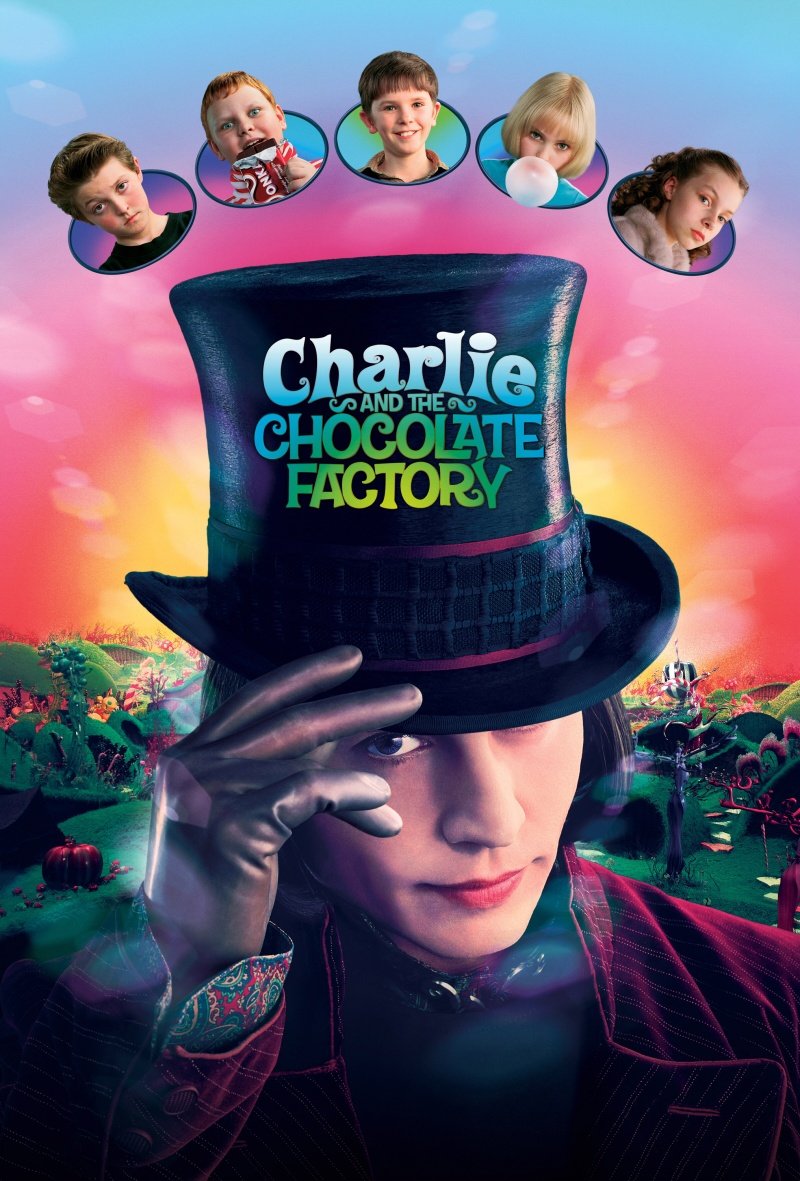
Charlie and the Chocolate Factory


Rating: ****/*****, or 8/10


One of Tim Burton's finest and most underrated films, based on the equally great book by Roald Dahl. Poor Charlie Bucket (Freddie Highmore) is in for a major change in his life when he finds a coveted Golden Ticket in a chocolate bar, which allows him and his grandfather (David Kelly) to visit the grand chocolate factory run by the mysterious hermit Willy Wonka (another wacky character performed with the necessary flair and theatricality by Johnny Depp, in his fourth collaboration with Burton). Together with four other lucky kids, each with his/her own unique depraved character defect (making them generally unsympathetic little bastards), and their equally abhorring parents, young Charlie is in for the ride of his life when he's confronted with the dazzlingly delightful wonders of Wonka's works in a vast array of mouth-watering scenes of candy fantasy. However, the factory has its dark sides too, as the nasty kids soon discover when their flaws get the better of them, leading them to their so deserved doom. Burton's Gothic visual style and witty sense of dark irony lend themselves perfectly for adapting Dahl's chocolate fairy tale to the big screen, with fabulous results. Includes some excellent and memorable songs performed by the Oompa-Loompas, a race of Lilliputians from a far-off land in Wonka's employ, as well as a wicked bit part for the brilliant Christopher Lee as Wonka's dentist father, adding a bit of depth to the character of this amazing but obviously mentally unstable chocolateer.


Starring: Johnny Depp, Freddie Highmore, David Kelly


Directed by Tim Burton


USA: Warner Bros, 2005

maandag 19 maart 2012

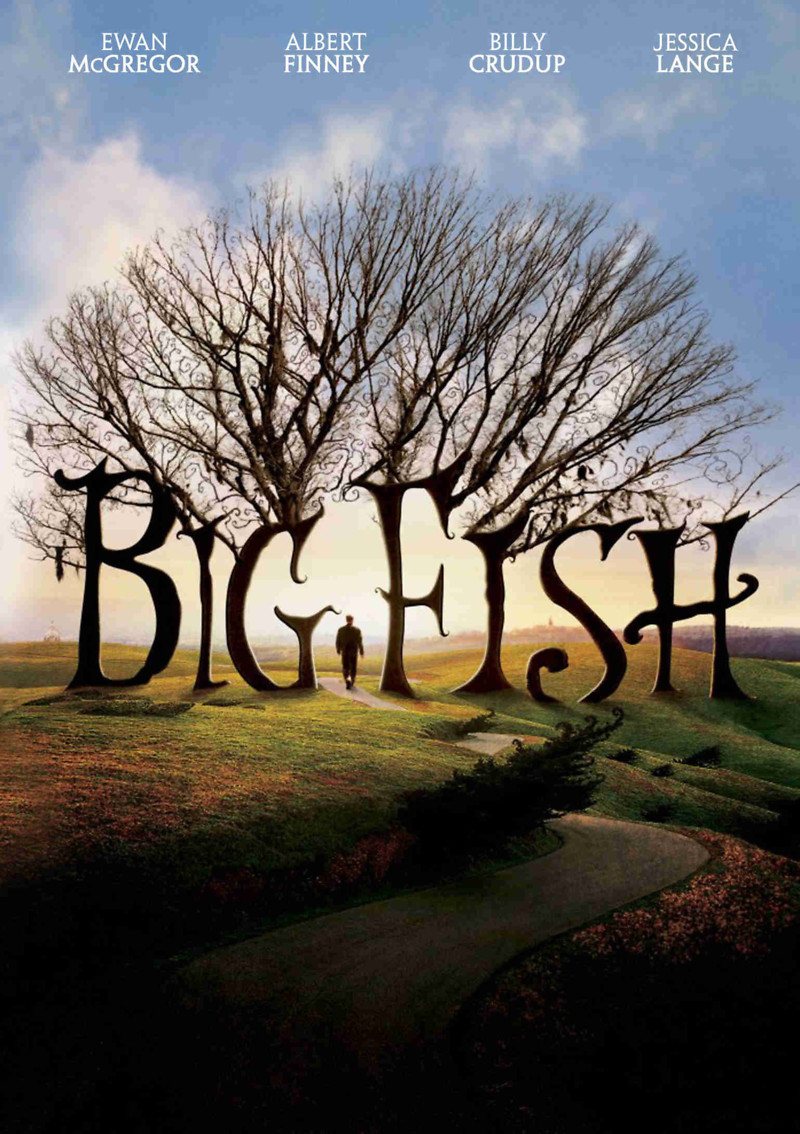
Big Fish


Rating: ****/*****, or 8/10


Delightful tragicomedy like only Tim Burton can give us, regarding a man (Albert Finney) who spends his entire life telling tall tales, to such an extent his son (Billy Crudup) can't separate fiction from reality, much to his chagrin. In search for the truth the son meets a variety of characters from his father's life, while the audience is treated to a wide array of very amusing and charming stories about the man's past, from his birth and his youth, the first time he falls in love as a young man (played with apparent enthusiasm by a vigorous Ewan McGregor), his days in the army and as a janitor at a circus to his dying days where he is fondly remembered by those he has touched in his eventful life. A wonderful ode to life, Burton mixes his oddball Gothic visual style with a decidedly positive attitude to the very nature of human existence, effectively relaying his carpe diem message of 'don't worry about anything and just enjoy life one day at a time'. In the end, the son and the viewer learn that the tales make the man, and it doesn't really matter what's true and what's not. Both visually and story wise, this is one of Burton's finest achievements – despite (or because of?) the absence of Johnny Depp – as well as a very fun but poignant film in general. Plus, it contains an always useful and welcome guide to conquering the girl of your dreams' heart.


Starring: Ewan McGregor, Albert Finney, Helena Bonham Carter


Directed by Tim Burton


USA: Columbia Pictures, 2003


woensdag 1 februari 2012

Alice in Wonderland


Rating ***/*****, or 7/10

Lavish and wonderfully bizarre looking reimagination of the classic novel by Lewis Caroll, directed by Tim Burton, who unfortunately chooses style over substance a bit too much. As we could have expected from Burton, it all looks fabulous and has a fantastic cast, but this semi-sequel to the original story feels a bit sloppy and jumbled together. Alice (the credibly overwhelmed but also naturally dreamy enough to go-along-with-it-all Mia Wasikowska) revisits Wonderland and gets caught up in a battle for supremacy over this grotesque realm between the vicious Red Queen (Helena Bonham Carter, obviously having the time of her life with a really big head) and the peaceful White Queen (a pixie-esque Anne Hathaway), in which she is aided by the Mad Hatter (Johnny Depp is sufficiently crazy enough to pull this role off). The original series of random weird encounters between Alice and Wonderland's inhabitants is now strung together by an all too typical battle between good and evil. Plus, the Mad Hatter's role has been enlarged a lot so Depp gets enough screen time to warrant his face being on all the marketing materials, which undermines the very title 'Alice in Wonderland'. Still, enjoyable flick anyhow.


Starring: Mia Wasikowska, Johnny Depp, Helena Bonham Carter

Directed by Tim Burton

USA: Walt Disney Pictures, 2010