Posts tonen met het label jews. Alle posts tonen

zaterdag 6 juni 2015

Today's Review: Dancing Arabs


Finally another review up. Another one to come soon, I promise.

Dancing Arabs - recensie

Not the best way to tackle a topic about identity. The first act of the movie differs in huge ways from the last and despite a light touch of wry humour applied to the scenes between both, you cannot help but wonder how the one (d)evolved into the other so distinctly. Opening on a comedic tone bordering on the absurd, at the end of the film you're watching a heavy emotional drama about a young man's life altered forever. Of course people change over the years, especially under the less than perfect conditions the protagonist lives through, but the viewer has a hard time accepting the unfolding of events in the way told here, and ultimately feels like he/she is watching two separate movies slapped together. It's not wrong to apply some humour to a topic otherwise devoid of that sense, especially if it helps to underscore both parties have more in common than apart. But it must feel like a coherent whole to make it work for audiences. In some ways, the writer says that any sense of optimism  Israeli Arab youths harbour in their country will only be squashed by the rampant discrimination they undergo in their formative years, and thus they will inevitably end up as unhappy, pessimist young adults. Maybe that is exactly what the screenwriter wants us to think, considering it's the conclusion he himself drew eventually, which made him move to the USA for good. At the same time however, the plot tells us there is plenty of positive things that could have avoided the bleak outcome presented here. It's not like the protagonist didn't have any friends or couldn't find love. Eventually, it was his own choices that hindered his career as much, if not more so, as the social exclusion on which the film closes.

It's not the Arabs that are dancing in this film, it's the writing that makes the plot dance around various possible outcomes and makes it pick the bleakest where it need not have, and considering the tone of the opening, should not have. Case in point: the life of the writer himself, who did very well in his career despite very similar conditions. And it's the audience that suffers most, by being offered a rather unsettling and unsatisfying close.

maandag 3 februari 2014

Today's Mini-Review: Defiance


Rating: ****/*****, or 8/10

Starring: Daniel Craig, Liev Schreiber, Jamie Bell
Directed by Edward Zwick
USA: Paramount Vantage, 2008


As far as WW II/Holocaust movies go, Edward Zwick's Defiance is basically the Spartacus version of the bunch, as opposed to the likes of Schindler's List (which, if you want to further draw comparisons with Roman epics of old, has more overtones of Quo Vadis or The Robe, in which a man “in league with the enemy” opens his eyes to the shameful horrors inflicted on the minority and turns to their aid). The specific act of defiance this movie revolves around is mere survival in a world where the Jewish minority has been sentenced to death under the ruthless rule of the German Third Reich during the occupation of Poland. As their parents are murdered by the Nazis and their Polish lapdogs, the Bielski brothers retreat into the primordial woods hellbent on revenge. As they are confronted with growing numbers of Jewish refugees also seeking shelter in the forest, the brothers find themselves divided on which course of action to take as those in need of help name them their leaders in the struggle for basic survival. What will it be: vengeance at all costs, or the needs of the many over a personal vendetta?


At the heart of the movie is the ideological conflict between the three brothers. The oldest, Tuvia (Daniel '007' Craig), unwittingly finds himself given command over this group, which soon numbers in the hundreds, and first and foremost aims to keep them safe as he feels it is his moral responsibility, like it or not, to do so. His younger brother, the hotheaded Zus (Liev Schreiber) instead feels attacking their persecutors and killing as many Germans as possible takes precedence, and as their rivalry deepens he leaves the camp to join local Soviet resistance cells to do just that. Their younger brothers, including Asael (Jamie Bell) opt to stick with Tuvia. As the forest community grows, so does the risk of being discovered, which soon leads to an all-out assault by the German forces which the refugees have to fight off with little means at their disposal, nor the help of Zus' band of partisans, who will not risk their lives to save Jews. Can Tuvia save “his” people from annihilation, or will the Bielski Jews be massacred despite all their efforts? Only a reconciliation of the brothers seems like it might stay their doom.
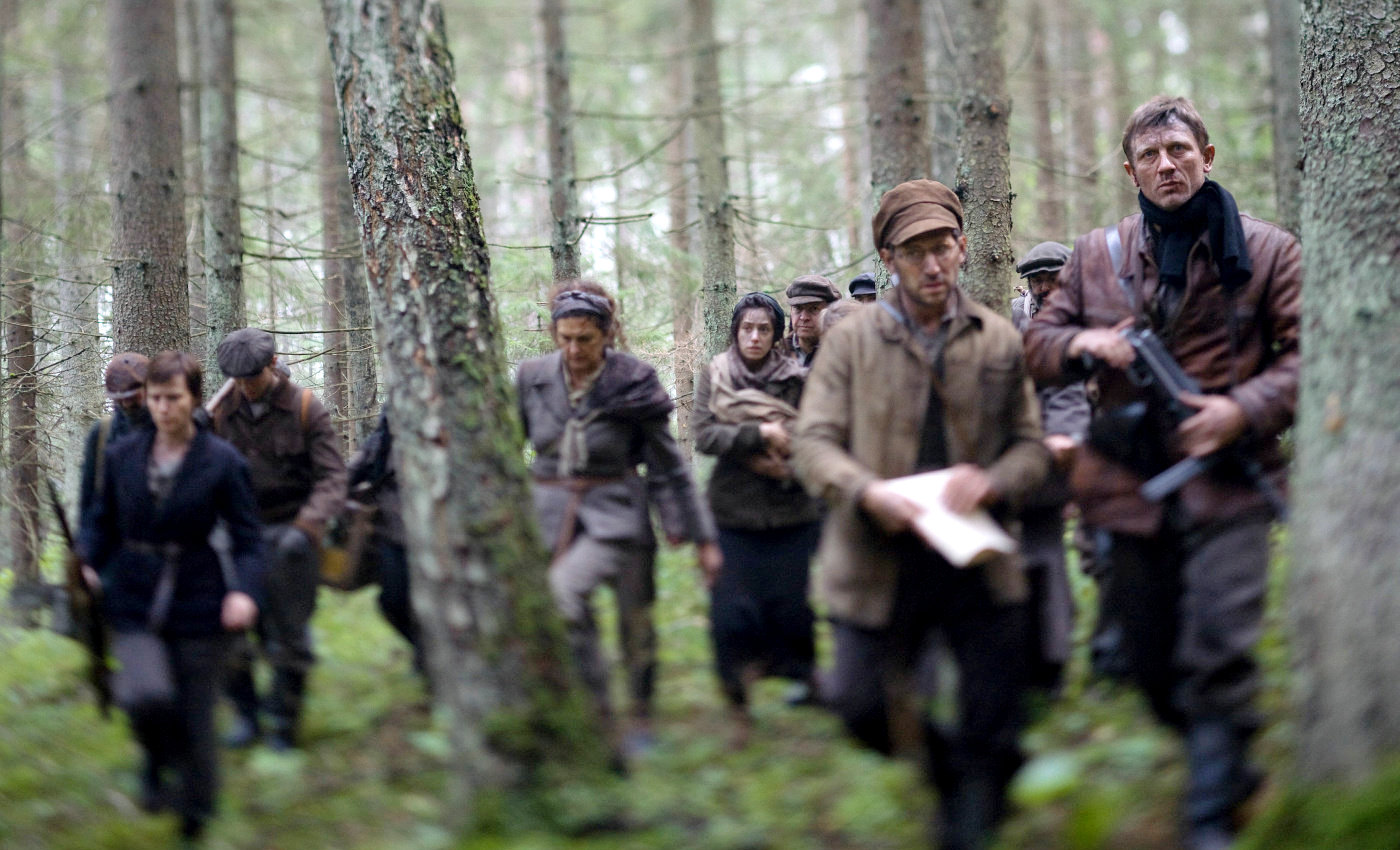

Defiance proves a chilling war epic (albeit on a smaller budget that most, since this is a more confined movie in terms of characters and locations) making ample use of the assembled talent in front and behind of the camera. Not to mention appropriating the beautiful forest environment to such great effect that it's not hard to conceive of it as a character in itself: lush and warm in summer, but unforgiving and uncompromising in the cold Polish winter, which is as lethal as the human enemy. Against all odds, the community flourishes, but the fear of being rooted out and brutally killed persists. And Zwick doesn't flinch at showing that this new formed society is far from idyllic, as hunger, disease and most of all, basic human behavior, continue to threaten their survival.


A story that focuses on the ordeals of man living with man through a period of intense crisis is incomplete if it wouldn't address the issue of man's darker side getting the better of him. Defiance too tells of the strong in the group exploiting the weak, taking their food, sexual integrity and if they resist, their lives. Tuvia soon rises to the occasion of exorcising such immoral behavior from his people by exacting 'zero tolerance' type punishment upon the perpetrators. The Bielksi Jews are not living in a democracy and freedom is still a rather abstract concept, but fortunately Tuvia accepts a role of the benevolent leader who generally has his people's best interest at heart, despite his continuing desire for vengeance. Meanwhile, even among his new brothers in arms, Zus is still an outsider because of his status as a Jew, despite being a formidable fighter. Defiance isn't afraid to admit that antisemitism wasn't limited to the Germans, as the Jews are shown to also suffer under the hands of their Polish neighbours, offering a less black and white view than simply stating 'Germans are bad and all others are good'. As the Germans exploit the Polish population, Poles exploit Jews and even among the refugees Jews are found exploiting other Jews. Tuvia's main act of defiance is rising above such base humanity for the greater good. It does at times make him feel overly saint like, but when he unhesitatingly shoots troublemakers amongst his own people, you know he's still as human as the rest of them.


With Defiance, Zwick once again proves himself a certified craftsman of effective historical drama, the kind that encompasses a fine mix of solid acting throughout (though not avoiding the use of the occasional off-putting foreign accent), dynamic action and thematic value, but for some reason just doesn't stick with you as much as similar movies from better known directors tend to do. Defiance is unmistakably an excellent film, but not in the same league as similar entries in the Holocaust subgenre like Schindler's List or The Pianist, movies with which it cannot avoid comparison because of the subject matter. On the page it all should work, and when watching the movie it does, but afterwards Zwick's movies for some inexplicable reason just seem to slip from mind somehow. Likewise, even though his films have been awarded their fair share of Academy Award nominations, actual wins are few and far between. Nevertheless, upon viewing Defiance defies all sense of whatever shortcomings might plague Zwick's body of work to stand out despite their undeniable quality.


woensdag 3 juli 2013

Today's Mini-reviews: Hannah and the Call Girl


Hannah Arendt: ***/*****, or 7/10

Biopic about the noted 20th century Jewish-German philosopher Hannah Arendt (1906-1975), played impeccably by Barbara Sukowa. Directed by Margarethe von Trotta, the movie mainly examines Arendt's reports on the trial of Nazi war criminal Adolf Eichmann in Israel for the American magazine The New Yorker, as well as the overwhelming critique, following their publication, on her controversial findings regarding the mentality of the architects of the Holocaust. Arendt's conclusion is that they were not evil inhuman monsters, nor even purely driven by antisemitist motivations, but instead that they were everyday bureaucratic nobodies who viewed their atrocities simply as a job that needed to be carried out as effectively as possible. This new concept of the 'banality of evil' caused widespread criticism of Arendt's philosophical thinking, and caused her to be much maligned by fellow Jews, including people close to her. The movie covers all of this turbulence in Arendt's life, but does so in an overly stiff manner, rendering both Hannah and her intellectual antagonists rather emotionlessm thus sadly underscoring the popular opinion that philosophy is dull. It also makes it uneasy for the audience to really care about Hannah's tribulations as she undergoes them with minimal visible emoting. Nevertheless, from a historical perspective the topics covered remain intriguing, aided by good performances throughout as well as the terrific use of actual footage of the real Eichmann at his trial, indeed showing him to be a single-minded man devoid of critical thinking or even remotely interested in the moral issues while carrying out his former onslaught. The movie does do a botched job of portraying the romantic relationship between Arendt and her mentor – and eventual Nazi philosopher – Heidegger, which is touched upon in a series of short flashbacks which hint at its importance, but eventually fails in being fleshed out in a satisfactory manner that helps us beter understand Arendt. It's a missed opportunity, but ultimately not completely harmful to the overall plot. Warning! Due to heavy smoking by Arendt throughout the whole of this picture, this movie may cause irreversible damage to your lungs.


Call Girl: **/*****, or 5/10

Swedish thriller regarding prostitutes and politicians in the Seventies, which caused quite a stir in its own country due to its suggestion that a popular prime mininster of that era engaged in secret sexual hook-ups with underage girls who were forced into this sleazy business. Though in truth the movie only briefly touches upon that particular subject, it's no surprise many Swedes would take offense at the rather bleak and harsh view Call Girl offers of the political arena of the day and its subversive fascination with young female flesh, as seen through the eyes of a troubled teenage girl, locked away in a juvenile rehabilitation center. As she escapes her confinement she and her friend soon meet up with all the wrong people and are ushered into a world of glitter and power where they can have whatever they want, but for a price. Under the “care” of an unscrupulous older woman, a terrifying role by Pernilla August (once Anakin's warm and caring mum), she finds herself landing the job of underage hooker, being shipped from one dirty old powerful man to the other, seemingly with no hope of escape. Meanwhile, a political news reporter gets wind of the whole affair and means to expose it, but finds himself intimidated by the agents of the powers-that-be at every turn, until there is no way out but death or victory. Call Girl cannot be denied to be a gutsy movie, handling a sensitive topic with nerve and bravery, but there's various elements against either enjoying it as a thriller or taking its contents too seriously. For one thing, there is the excessive running time of 140 minutes, which surely could have been shorter to make for a more compelling film, since several scenes of political corruption and debauchery, heroic investigative journalism and plenty of bare boobs feel redundant. For another, the main girl the movie revolves around is a rather stupid, obnoxious and spoiled young cow, making one stupid decision after the other to predictable effects, making it hard to really care about her fate since she so obviously did everything to deserve it. Though the ice cold, wholesomely disturbing role by August and the shocking, uncompromising climax make up for it quite a bit, it's not enough to make the movie feel like its overstaying its welcome, while appearing to warn teenagers to behave and stay away from strangers a little too overtly.

maandag 2 april 2012

Borat: Cultural Learnings of America for Make Benefit Glorious Nation of Kazakhstan


Rating: ****/*****, or 8/10


Hilarious, subversive and playful comedy about a journalist from Kazakhstan, Borat Sagdiyev (undoubtedly Sacha Baron Cohen's most memorable character), who is sent by his government to the 'U, S and A' to make a report on life in its various aspects in the greatest country of the world, together with his short tempered and less than enthusiastic producer Azamat. On a trip across the country, traveling from one great sketch to another, Borat falls in love with Pamela Anderson (after seeing her only once on TV) and aims to track her down and marry her the Kazakh way, whether she likes to or not. Though the scenes in Borat's village in Kazakhstan are quite obviously staged (to great comedic effect), since such a wonderfully silly place just can't exist anywhere, the question remains just how much of the American part of the film is for real, as Borat interviews many different average Americans and manages to get great reactions out of his subjects, most feeling very natural and many of them quite disturbing, but all of them the object of very funny, often completely politically incorrect gags involving every conceivable minority out there (Jews, gypsies, coloured people, women, homosexuals, prostitutes, etc.): if Cohen didn't happen to be Jewish himself, it's likely he wouldn't have gotten away with the stunts he pulls here, though after the success of this film (both in terms of reception and box office) he got into many a lawsuit for his outrageous behavior regardless. The funniest scenes of this film include the 'Running of the Jew' event in Borat's home town, Borat singing the Kazakhstan national anthem on the melody of the American national anthem at a rodeo in front of hundreds of conservative flag waving American citizens, and a fight between Borat and Azamat in the nude in a hotel that goes on for much longer than is comfortable to anyone. Cohen would repeat the formula verbatim in 2009 with the much less impressive and fairly predictable BrΓΌno.


Starring: Sacha Baron Cohen, Ken Davitian, Luenell


Directed by Larry Charles


USA: Four By Two Production, 2006

maandag 19 maart 2012

Ben-Hur


Rating: ****/*****, or 8/10


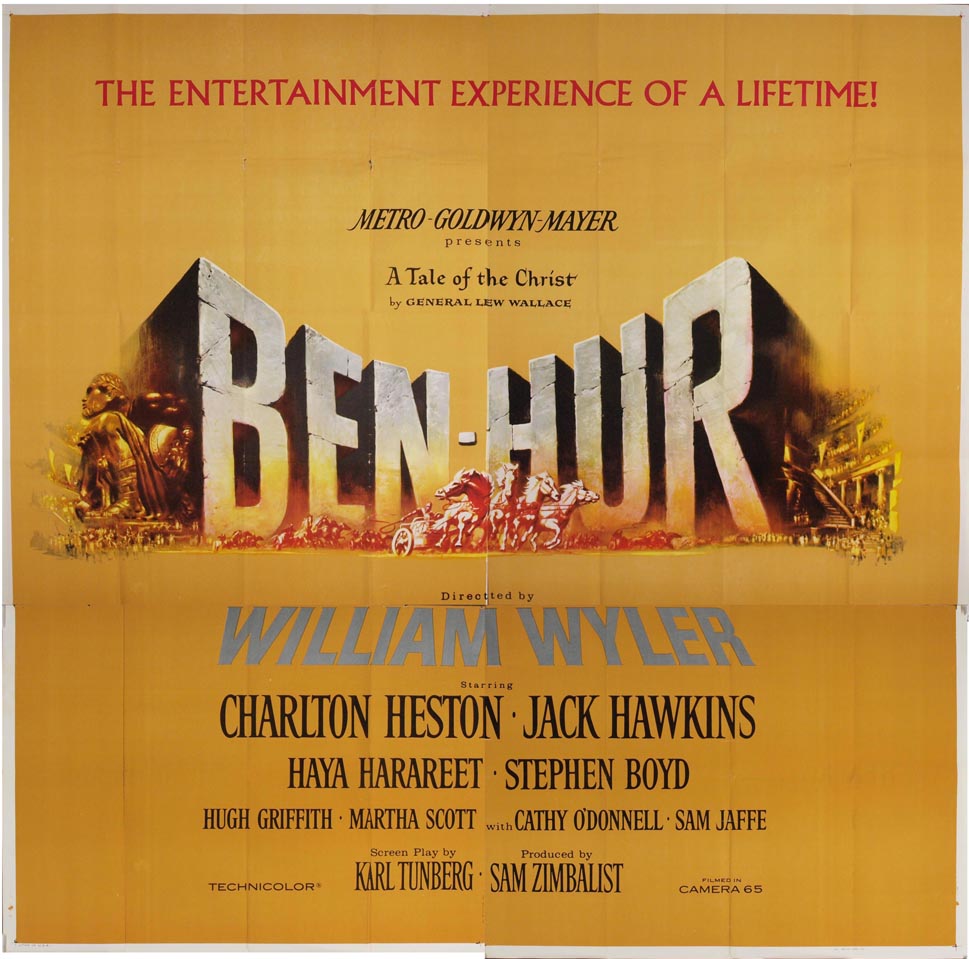
One of the greatest Hollywood epics of all time, the first film ever to win the record amount of 11 Academy Awards, most of them well deserved. Charlton Heston stars as the Jewish nobleman Juda Ben-Hur, who finds out his once close friendship with the young Roman aristocrat Messala (Stephen Boyd) has succumbed to his strict duties as a Roman officer. This new distrust between them soon turns to hatred when, after an accident that leaves the new Roman governor of Judea wounded, Messala condemns Juda to the galleys as a slave and sends his family to the dungeons. However, Juda survives his ordeal, fueled by his hate, and in a grandiose naval battle between the Roman fleet and pirates, rescues the life of Roman Consul Arrius (Jack Hawkins), after which he is redeemed by the Emperor, adopted by Arrius and embarks on a star career as a charioteer before returning to Judea to seek vengeance on Messala in the sands of the most famous chariot race in film history. However, winning the race and fatally crippling his adversary in the process does not return his family or his happiness, things only Christ can give him on the Cross. For the majority of modern day viewers, the overt Christian overtones in the final third of the movie – the film is subtitled 'a Tale of the Christ after all – are hard to bear in their cheesiness, but this movie remains a solid undying classic in every other respect (with extra credit going to the great CinemaScope cinematography, the wonderful, catchy music and the excellent production design): the fabulous naval battle and the highly exciting chariot race remain unsurpassed.


Starring: Charlton Heston, Stephen Boyd, Jack Hawkins


Directed by William Wyler


USA: MGM, 1959