Posts tonen met het label princess. Alle posts tonen

maandag 23 december 2013

Today's Mini(?)-Review: Frozen


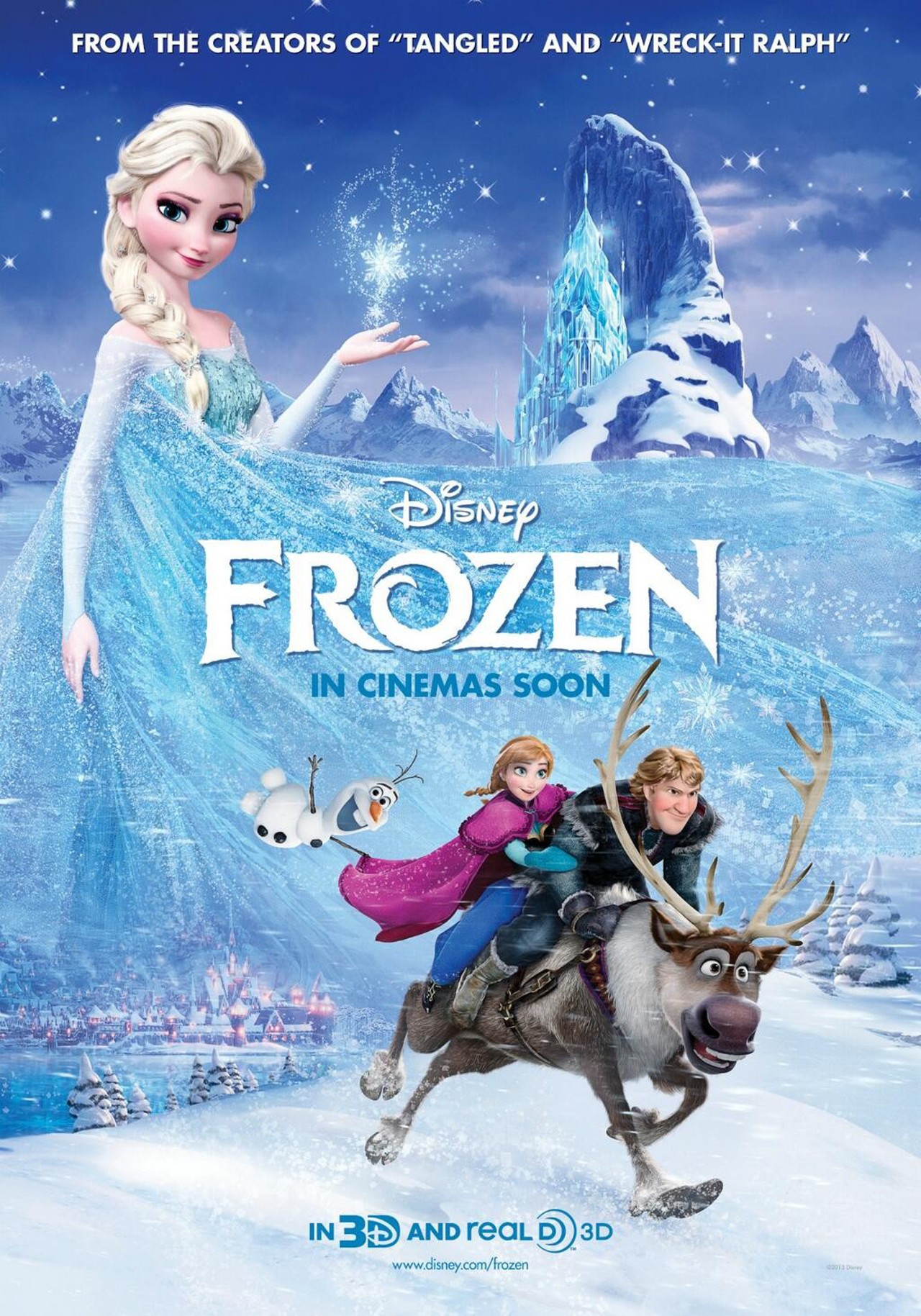
Frozen: ****/*****, or 8/10

Say what you will about conservative Disney, there is some form of modernization in progress in that studio. You might even label it a feminist wave of sorts. Frozen marks Disney's first feature length animated film (co-)directed by a woman and only the second whose screenplay was written by such a creature. Not counting Pixar, since then it would have to contend with Brave, a movie where the girl power backfired, as did the quality of the piece as a whole. And while Frozen largely stays within the trite-and-true boundaries we've come to expect from Disney's fairy tale movies, including princesses, charming princes, faraway lands, comedic (animal) sidekicks and plenty of catchy songs, enough of such regularly exploited material is directionally changed to make the film feel as fresh and cool as the imagery the title inspires. Jennifer Lee's directorial debut introduces not one, but two beautiful young princesses, Elsa (voiced by Idina Menzel) and her younger sister Anna (Kristen Bell), heirs to the kingdom of Arendelle. Both are kind, independent and energetic spirits, but the older girl carries a terrible secret: she's basically a mutant with the power to control ice and snow, except she doesn't control it at all, since her fear to wield it controls her instead. She has cause to be afraid of her powers, as she nearly killed Anna at play as a child. Her parents tried to keep her out of harm's way by largely keeping her confined to her chambers, much to the dismay of her sister, who had her injury and memory of the incident erased by a nice wizard troll (this is a work of fantasy, need I say more?). After the death of their parents and the coming-of-age of the elder sister, a coronation takes place where Elsa is crowned queen and where Anna – hilariously – meets her apparent groom-to-be, the latter event uterly disrupting the former as Elsa unwittingly gets pushed so far she sparks an endless winter that covers the entire kingdom in frost. Fleeing the palace to built her own on a high mountain precipice where she finally starts to accept her powers in her moments of isolation, Anna is determined to bring back her sister and get her to undo her unintentional damage to the realm, which leaves her land vulnerable to the shady ambition of certain visiting foreign dignitaries. Accompanied by a simple but reliable young backwoods man named Kristoff, his carrot obsessed reindeer Sven and a wacky living snowman named Olaf, Anna sets out on a tough voyage to reunite with her wayward sister and bring summer back to Arendelle. And, in typical Disney fashion, to discover True Love in the process. But not in the usual sense of old.


Frozen proves a worthy successor to the similarly themed, equally wonderful Tangled (2010), which also re-established Disney's formidable talent to craft charming, adventurous and romantic fantasy films for all ages after over a decade of creative drought, as well as updating its female characters to the 21st century, a time in which the main focus of a woman is no longer a man to marry (but also not excluding the possibility as not to upset the traditionalists in the audience). Frozen introduces two solid female characters who care first and foremost about eachother, though one of them does not allow herself to show said fact. Both women are sizzling with recognizable character flaws and strengths, familiar emotional family conflict and the talent to burst into song, so despite their ultimately antagonistic nature (though the traditional 'good versus bad' set-up is carefully avoided in their strained relationship), you root for them and their sibling affection both to survive against all odds. Simultaneously, while the sterotypical good looking prince to wed is not an image to be discarded, it develops into quite another direction than is usual, and the expected notion of cheesy True Love messages doesn't end up covering the usual sexual connection between boy and girl. The voice cast delivers impeccable acting and shares an audible chemistry, standout performances including a hilarious Scandinavian tradesman (jå!) and Olaf, the token sidekick, who is not nearly as irritating as he could have been and actually warms everybody's heart with his simple but unattainable desire. Similarly enjoyable are the clan of stone trolls, Kristoff's surrogate family, a group of Smurfesque creatures with the ability to succesfully camouflage themselves as rocks, and who unfortunately don't nearly have as much screen time or background exploration as we would have liked. And if you're afraid the reindeer talks (since animals with the ability to speak are an oft dreaded Disney staple still), fear not: his master does so for him to witty, almost self-reflective results. The songs are a welcome return to tradition; though for a moment at the start of the film they seem to comprise most of the dialogue, better balance to the music is applied later on. Apart from pleasing the aural senses, Frozen offers a delightful visual feast as well with its wondrous winter landscapes and ever present snow motifs, but considering the darkness of many scenes coupled with the obligatory 3D effect, not all the imagery ends up looking as amazing as it could have been. However, many of the 3D shots in the lighter scenes hit their mark, especially those involving snow and icicles, so seeing the 2D version instead isn't wholly recommended either.

In a time where Pixar is increasingly going down the drain creatively because of its lack of inspiration and its current focus on prequels and sequels, a thoroughly wonderful and ideologically original pure Disney film like Frozen is a welcome sight. Even the coolest minds and the coldest hearts will find it hard not to melt due to this film's built-in warmth, and with the dominant motif of snow and ice, Frozen proves to be a perfect Holiday movie for old and young alike.


maandag 13 augustus 2012

Pixar finally fully Disneyfied


Brave: ***/*****, or 6/10

It was a given Pixar's long running winning streak of top movies had to come to an end sooner or later, and judging from the quality of the latest addition to the Pixar oeuvre, Brave, that time has now finally come. After two years of releasing sequels only – one very good (Toy Story 3 (2010)), the other not so much (Cars 2 (2011)) – and with the studio focusing on similar milking dry of past glory (for example, next year's Monsters University and the already announced Toy Story 4 and even Finding Nemo 2...), Brave was supposed to have been the last apparent vestige of Pixar's once supreme creative ingenuity, but unfortunately the final product feels lacking in almost every respect and thus only endorses the fact Pixar's days of making original animation of the highest quality, unsurpassed by its various competitors in the industry (Blue Sky and Dreamworks Animation its closest rivals, this year entering the field with Ice Age 4 and Madagascar 3 respectively), are now truly behind them. It was feared this would happen ever since Disney officially took over the fledgling studio back in 2006, but several fabulous Pixar projects already in the making (including Ratatouille (2007) and Wall·E (2008) held off this imminent quality deterioration for a few years. Whatever deals Pixar and Disney have officially stated to have made concerning Pixar's creative control, judging from Brave and the upcoming slate of sequel abundance, Disney has finally managed to get Pixar in line with its own creative agenda. Unfortunately, the audience turns out to be the biggest loser in the process.


Like so many of Disney's classic (and less classic) animated films, Brave revolves around a young princess and her struggle to fulfill her dreams and life ambitions despite the wishes of her parents/guardians who would instead see her become someone she never wanted to be. The princess in question is named Merida (voiced by Kelly Macdonald) and is the eldest child and only daughter of the Scottish monarchs King Fergus (performed with audible joy by Billy Connolly) and Queen Elinor (played by Emma Thompson), ruling over several clans in the ancient Scottish highlands in an unspecified period in history, or put otherwise, in the typical magic kingdom Disney does best, though this kind of fantasy setting is new to Pixar. While Elinor is a genuinely regal lady of royal blood, the boorish loudmouth Fergus obsessed with bear hunting – especially the huge demon bear Mor'Du that once took his leg – seems her exact opposite, though the pair of them is deeply in love regardless: Merida has inherited the best of both worlds, and has grown into a beautiful and intelligent but adventurous and overly independent young woman who does not take kindly to being told what to do and much prefers typical male occupations like hunting, hiking and horse riding over the feminine arts like poetry and embroidery her mother would prefer to see her spend her time with. In fact, the strict and stern Elinor tries hard to shape her daughter into the perfect princess, at all times directing her attention to the social graces of the Scottish nobility, but much to her chagrin (and to Fergus' enjoyment, as well as our own) Merida's tomboyish nature always wins out. Merida herself has little qualms over being told what to do by her dominant mother, until the day she learns the clan leaders are visiting the royal castle to have their firstborn sons compete for the princess' hand in marriage.

Unlike the Disney princesses of old, who usually couldn't wait to marry any number of interchangeable charming princes, Merida does not take kindly to be auctioned off and means to take her destiny into her own hands. One could argue the whole notion of a princess fighting her imminent wedlock instead of willfully embracing it could be taken as a narrative role-reversal in an attempt by Pixar to pay homage to the age-old Disney tradition. However, the solution to Merida's marital issues ultimately fail to feel like any sort of intertextual nod: in fact, it feels more like the marriage of the formerly free spirited Pixar and the proudly traditional Disney has reigned in the creative temperament of the former to keep it more in line with the boringly conservative ideological policy of the latter. Whereas Merida might win the freedom to choose her own partner, Pixar apparently is only allowed to produce fully Disneyesque movies, at least for the foreseeable future.

In the case of Brave, the combination of princess and marriage is hardly the only element present in the plot to remind us of past Disney films. The film goes so far as to incorporate a number of songs, much like the ones that used to dominate the soundtrack of many a Disney classic (think Pocahontas (1995), Beauty and the Beast (1991) and The Little Mermaid (1989)), except you shouldn't expect to see these songs win any Academy Awards anytime soon, considering their rather poor and forgetful quality (which fortunately does mean they won't get stuck in your head for many days to come as they used to do). The lyrics literally enter one ear only to immediately exit the other, but they go a little like 'I'm a Scottish lass, hair all red Firing arrows makes me glad But now my mom wants me to wedI wannae, so now I'm sadOooh, I wish my mom were dead'; the usual Disney stuff really, except far from catchy, all for the best.


Warning! Spoilers! Of course, a headstrong teenage girl like Merida doesn't mean to get suckered into holy matrimony so easily and tries to get out of it by proving her superiority in archery over her prospected suitors. Despite her remarkable skills at shooting arrows this attempt fails because she breaks clan rules by competing in this wholly male tournament, much to the dismay of the clan leaders. When she gets into a huge argument with her outraged mother over her conduct unbecoming a princess of the realm, she simply makes a run for it and flees into the forest, where she encounters a strange elderly woman masquerading as a wood carver, but of course an obvious witch, though not as stereotypically evil or sinister as Disney witches once tended to be, opting instead for the routine of the bumbling old lady impaired by memory loss. Merida agrees to buy all her carvings if the aged sorceress supplies her with a single spell to change her mother's mind, but like all princesses making deals with magic hags, she doesn't quite get what she hoped for, as she sees her mother transformed into a bear. This unfortunate metamorphosis is made even more unfortunate by reminding us of the much maligned Disney feature Brother Bear (2003), a movie not deserving the title of 'Disney Classic' at all, and Brave does an equally adequate job at making us wish we had forgotten all about that film by also making the plot of a human transforming into a bear feel wholesomely underwhelming.

Since Fergus has little love for bears, especially in his own castle, Merida must smuggle her now furry mother out to the safety of the woods in a scene devoid of suspense and filled with silly gags instead. Afterwards, Merida sets out to reverse the spell with her mother, a human in the body of a bear, in tow, learning that if she does not break the curse within two days her mother will become a real bear permanently. In a few all too brief scenes Elinor demonstrates a loss of her human faculties in favor of bear instincts, threatening Merida's plight to save her (and in fact, her very life), but for most of this mother-daughter bonding experience, director Mark Andrews opts for levity instead, making the bear feel less like Merida's queen mum and more like a hairy sidekick the likes of Chewbacca (except less funny). Most of their time in the forest is spent showing Merida's ability to survive in the wild as opposed to her stiff mother's total inexperience with outdoor activities, bear instincts not withstanding, which leads to various scenes intended as comedy, but feeling too forced to be truly comically successful. In the long run, a cure against the bear spell is the objective and when Merida finds a method she must smuggle her mother back into the castle, keeping her out of her father's spear, while she herself must take care not to fall prey to Mor'Du, who also turns out to be royalty cursed to be a bear for all eternity (seems like it was the witch's answer to any problem). Eventually she succeeds in the nick of time and all's well that ends well: Elinor is human again and Merida is no longer forced to marry, all because of – or in spite of? – Merida's bravery to rebel against traditions but her willingness to accept responsibility when things go awry. Plot wise, it's clear Pixar didn't turn out very brave.


In fact, Brave is most fun when its characters don't act particularly brave at all. Merida's rebellious shenanigans in the first half of the film are far more enjoyable than her tiresome and predictable efforts to set things right in the second half. King Fergus steals the show not by being brave (though he's certainly shown to be capable of heroism when protecting his clan from the terrifying Mor'Du on several occasions), but by being a somewhat childish ruler apt at telling compelling tall tales, drinking and fighting his fellow clan leaders in an overall devil-may-care attitude that makes it clear where Merida gets it from. Similarly, the rulers of clans Macintosh (only one of many little Steve Jobs tributes in this film), MacGuffin (cute Hitchcock reference there) and Dingwall are most convincing and most appreciable when they're shown engaging in petty bickering and arguing as they're overly proudly introducing they're equally not so brave sons to Fergus' court. It's the first half of the movie, when the various zany Scotsmen and their families are introduced and compete over Merida's affections, where Brave witnesses its strongest moments. As soon as the movie enters a more serious tone, at least as much as it can with a bear acting like a human being, spectator's interest in the overall plot starts to wane. Still, there's something to enjoy for everybody in Brave. However, it's just much less than we're used to from a supposedly original Pixar product. For adults, especially those that have seen their fair share of both Disney and Pixar films, it's certainly not the worn out story. They'll have to make due with several good jokes in the first 45 minutes, and the excellent visual look throughout (after all, the technological prowess of computer animation continues to deliver staggering results, and at least Brave makes ample uses of these). Such impressive visuals are however hindered by unnecessary 3-D effects, which add little moments of true depth but make a rather dark film look even more colourless.

In conclusion, Brave is the definite proof for the growing numbers of naysayers who predicted the end of the Age of Pixar at the hands of insidious Disneyfication from within years ago. There's simply nothing brave about mindlessly copying Disney's style, which by itself hasn't yielded a truly good film since the late nineties. For the moment, with the plethora of sequels in store for us, a further loss of quality seems inevitable for Pixar. Hopefully they'll pull yet another miraculous Toy Story 3 out of their hat, but this seems wishful thinking. In the meantime, until another non-sequel is produced, Brave will be lamented as Pixar's last original film, one that simply didn't prove to contain much originality. In the current Disney/Pixar mindset, Brave 2 seems a more likely thing to happen...


And watch the trailer here: