Today I finally had my first bit of work posted on my new employer MovieScene.nl. Here's the result:
http://www.moviescene.nl/p/142125/patrick_stewart_en_ian_mckellen_gecast_in_x-men:_days_of_future_past
Expect to see this sort of thing, links and all, more often around here. For legal reasons I'm not allowed to directly copy what I wrote for MovieScene on this, my blog. But since I don't want to choose one over the other, this is a viable alternative, indicating that I'm still active on both fronts. It may not look very appealing, but for me substance is more important than style. Properly spelled of course.
And yes, I'm hugely looking forward to X-Men: Days of Future Past. The original comic book story is widely renowned as one of the best X-Men stories ever, Bryan Singer has earned my trust with his previous X-Men installments, First Class was top-notch, and both Patrick Stewart and Ian McKellen are among my favorite actors ever. With so many rights, what could possibly go wrong?
Probably a few things, but let's keep a little optimism for a change...
dinsdag 27 november 2012
zaterdag 24 november 2012
Today's Film: The Day After Tomorrow
The
Day After Tomorrow
Rating:
***/*****, or 7/10
Probably
Roland Emmerich's most typical disaster movie, delivering grandiose
spectacle as catastrophe strikes and actors attempt to survive the
many pixels the visual FX departments throw at them accordingly.
Joining on the doomsday bandwagon of both scientists and laymen
alike, Emmerich depicts the coming of a new ice age due to mankind's
arrogant tampering with the planet's environment. Caused by global
warming, ocean currents change and a series of super storms evolve,
hitting the northern hemisphere hard, resulting in giant tornadoes
levelling Los Angeles and tsunamis engulfing New York City. Things
get even worse when temperatures drop rapidly and the latter town
freezes over completely, leaving a boy (Jake Gyllenhaal) and his
friends trapped in the city library, with his father (Dennis Quaid)
setting out on a desperate trek across the frozen wasteland to come
and save him. Though the prospects of global warming (or global
meltdown for that matter) aren't particularly attractive in real life
either, Emmerich goes all-out without really bothering with the laws
of nature for realism's sake. The movie is therefore much maligned
amongst the scientific community for its preposterous display of
dramatic natural effects supposedly caused by global warming, but the
message stands that we had better try to avoid the Earth cooling down
or warming up for our own health anyway. Like any disaster movie, the
true star of the film is the disaster itself which makes for a highly
entertaining watch, while the human drama in-between moments of
thrilling calamities is less compelling, at times even obnoxious for
getting into the way of the action. Most spectacular is the flooding
of New York, despite the overly digital quality of the piece. After
that, the big freeze and a wolf attack upon the protagonists provide
some more thrills but the best bits have come and gone, though all
too brief moments of satire, like Americans crossing their southern
border to get into Mexico illegally, generate a good laugh
occasionally. Emmerich would find even more stuff to demolish in his
disaster flick to-end-all disaster flicks 2012, as the fate of
whole mankind and indeed the entire world lies in the balance: after
all, the southern hemisphere got off too lightly in this film.
Starring:
Jake Gyllenhaal, Dennis Quaid, Emmy Rossum
Directed
by Roland Emmerich
USA: 20th
Century-Fox, 2004
Labels:
dennis quaid,
disaster movie,
flood,
ice age,
jake gyllenhaal,
roland emmerich,
science fiction,
survivors,
the day after tomorrow,
tomorrow,
tornado,
visual effects,
wolves
donderdag 22 november 2012
Today's Film: Dawn of the Dead (2004)
Dawn
of the Dead
Rating:
****/*****, or 8/10
Few
remakes ever surpass their predecessors, but this one gets remarkably
close, if it's not a definite improvement over the already great
original George A. Romero zombie classic from 1978. Zack Snyder, who
would go on to direct 300, Watchmen and unfortunately
Sucker Punch, first proved his talent for adapting – in this
case re-adapting – other people's work with this gripping, gory and
hugely entertaining horror flick. A zombie plague engulfs America
after which a band of survivors barricades itself in a shopping mall
for safety. Tensions run high in the group as its members continue to
find themselves attacked by the living dead and eventually a choice
must be made: do these people decide to stay in their safe haven
where they got everything they need except their freedom, or do they
take their chances storming out in an attempt to find out whether
there's other people still alive out there in some remote and secure
location, with the hopes of joining them.
The story remains largely
the same (except for the absence of a violent, marauding biker gang
invading the mall), but the hungry undead are more lethal than ever,
this time also adding speed to help satiate their lust for devouring
human flesh, making them much easier to take seriously than Romero's
slow, lumbering walking dead, thus only enhancing the suspense (and
the body count). Fantastic make-up efects galore in this picture,
providing a wide array of eerie zombies and disturbing scenes of
dismemberment and bloodshed. Still, Snyder doesn't let the gore rule
the film, but prefers to locate the horror in the story itself. Of
particularly great shock effect is the film's fabulous opening, which
starts off very restrained and seemingly normal with a nurse just
going home after a hard day's work, going to bed at night and waking
up the next morning finding her neighbourhood burning in utter chaos
and despair as it has suddenly fallen prey to a zombie apocalypse.
Though the movie treats us to many a memorable moment of naked,
merciless terror later on, this gruesome opening stands out as its
most horrifying scene. The TV show The Walking Dead –
though itself based on a graphic novel – would later feature
a very similar world of undead post-apocalyptics, clearly inspired by
this remake and building on its premise of a ragtag group of
survivors trapped in a hellish world ruled by hungry corpses.
Starring:
Sarah Polley, Ving Rhames, Jake Weber
Directed
by Zack Snyder
USA:
Strike Entertainment, 2004
zondag 18 november 2012
I'm back!
I've been gone for quite a while, as some of you might have noticed. I had some nasty start-up problems with my computer, forcing me to return it to the store I bought it from for a full reboot. It's back now (though as of yet without sound...), and thus so am I. However, the status quo has changed. I recently joined MovieScene.nl as an editor and poster of film news and reviews, meaning I'll be posting many items there, some of which I would usually have posted here. I'm sadly not allowed to post the same pieces of writing on both sites, so occasionally you'll find a very short post here with a link redirecting you to my latest item(s) for MovieScene. For The Day the Nerd Stood Still it's not an ideal situation, but it's better than full scale neglect.
Of course I'll continue posting reviews and such here whenever I can (though I seriously have to practice the art of keeping things brief instead of going into to much detail as I did so far, since I'll lack the time for overly long pieces of writing). I also hope to keep updating the Movie Archives continuously, and I have been thinking about making every new entry into a sort of 'Movie of the Day' feature, even though I'll still post movies alphabetically and many movies among them I wouldn't recommend to anyone, but that will only encourage my readers to actually read my work instead of mindlessly assuming the Movie of the Day is any good. For those of you who end up missing this vital piece of information, I apologize in advance for the dreadful movies you will have to endure.
We'll see where things go from here. There's bound to be change, some of it good, some of it not so much, but believe me when I say the Nerd won't be Standing Still for good, even though you might have been inclined to think otherwise due to recent inactivity here.
To the Undiscovered Country! The future...
zaterdag 27 oktober 2012
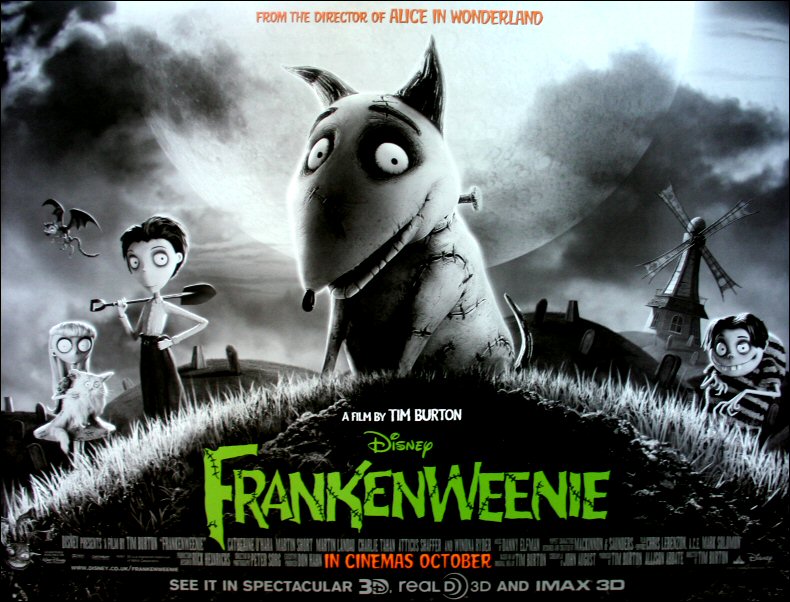
Breathing new life into Tim Burton
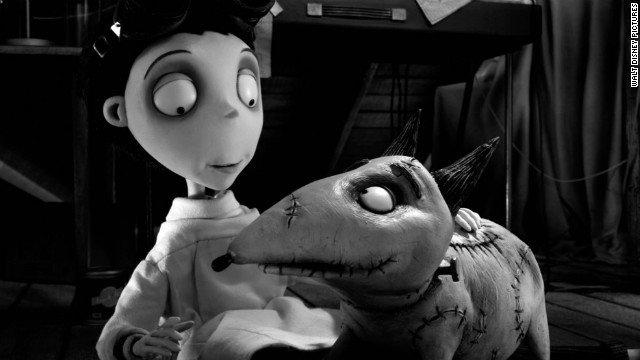
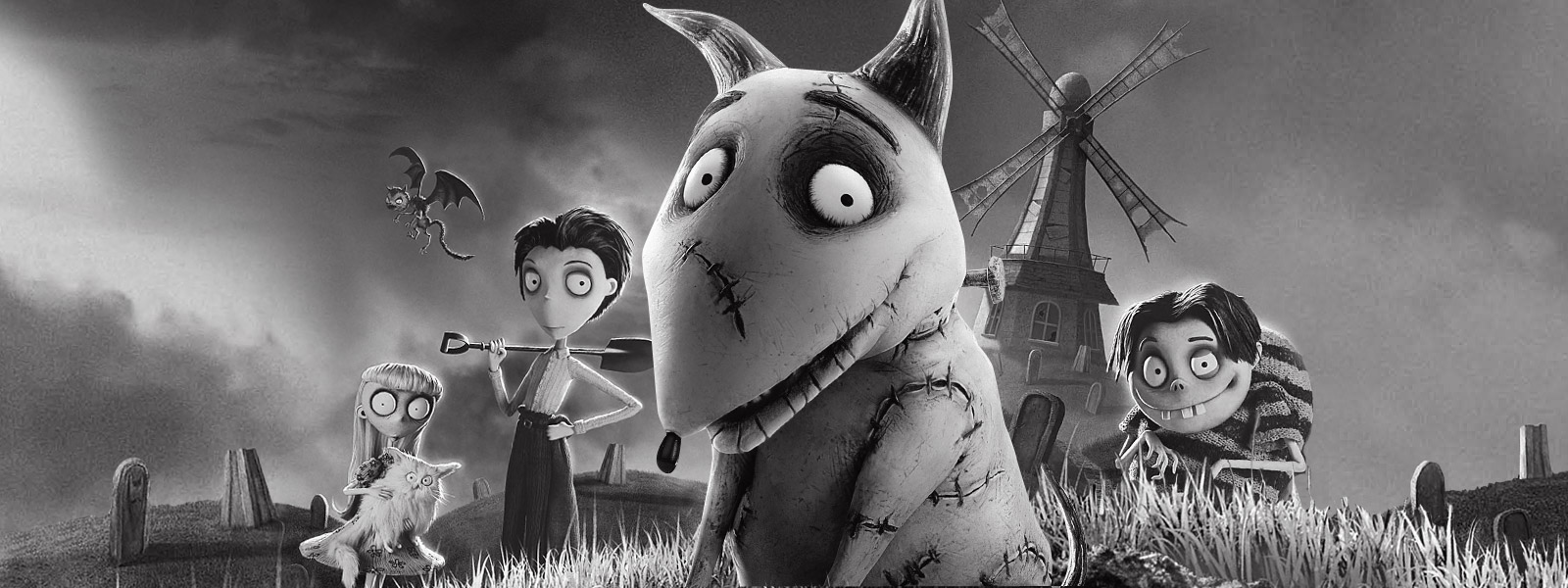
Frankenweenie: ****/*****, or
8/10
Moviebuffs
familiar with Tim Burton's oeuvre will probably remember how one of
his earliest projects for Disney backfired on him, though it ended up
setting him in the right direction for a very fruitful career. In
1984 Burton directed a 29 minute family film named Frankenweenie,
an homage to the iconic original Frankenstein films from the
Thirties, involving a boy who loses his beloved dog but revives him
via electricity, to the shock of his neighbourhood. Though it was a
simple horror story for all ages, Disney was dismayed and deemed the
short film too disturbing and scary for its target audience, denying
it a theatrical run (but for some reason still giving it a home video
release). Burton was fired from the studio and looked for jobs
elsewhere, soon setting himself on the right track as he directed a
number of smash hits, including Batman (1990), Edward
Scissorhands (1990) and Batman Returns (1992), eventually
becoming a major player in Hollywood despite (or because) continuing
to utilize his own unorthodox visual style and displaying his love
for outcasts and their encounters with the bizarre. Leaving Disney
may have been the best thing that ever happened to Burton, but it
didn't stop him from revisiting the failure that basically started
his career, remaking his own short into a theatrical movie in an even
darker and more off-beat fashion 28 years later, but still for the
same Walt Disney Studios that didn't think much of him or his work
all those years ago. Apparently Burton's acclaimed career, plus an
earlier cooperation between the pair when doing the highly successful
Alice in Wonderland (2010), ensured Disney gave Burton the
benefit of the doubt and the chance to bring Frankenweenie back
to life in an even more spectacular way than the dog in the story is
reanimated.
For
despite the film now running 87 instead of only 29 minutes,
surprisingly little has changed in terms of story. Warning!
Spoilers! The protagonist is still a little boy named Victor
Frankenstein, a nerdy and imaginative kid whose best buddy in the
whole world is his dog, called Sparky (there's more than a little
'nomen est omen' in there somewhere I reckon). Together they
do anything from just playing around on the streets to making home
movies wherein the canine stars as a dinosaur slayer protecting
cardboard cities from plastic monsters. Of course with hobbies like
that, Victor isn't the most popular kid in school, but as long as he
has Sparky, he doesn't mind. But soon, tragedy strikes and Sparky is
fatally run over by a car and laid to rest, leaving an inconsolable
Victor all alone, despite his parents' assurances Sparky moved on to
a special place in his heart. However, when he learns of electricity
and its effects on dead tissue at school, the boy turns to the dark
art of science to bring his pet back to life by having its soulless
body struck by lightning. Against all odds, the experiment is a
success and his best friend is given a second chance at life, though
not in a perfect physical state as parts of him occasionally come
loose. Despite his efforts to keep Sparky's resurrection a secret,
the rest of the town soon finds out and is appalled by this
abominable obstruction of everyday life, turning into a typical angry
mob out to make sure the dead dog stays dead this time. Tracking the
pair to an old windmill, the construction catches fire and traps
Victor inside until Sparky gives his second life to save his young
master. Touched by his courage, the townspeople are convinced Sparky
deserved to live, after which they help Victor restoring him to life
once more in a total feel-good happy ending only Disney can deliver
(though it's maybe a bit too cheerful for a Tim Burton picture).
Though
the plot has hardly changed, there couldn't have been a bigger
difference in execution, as Burton turns to the much admired art of
traditional stop motion animation for his second incarnation of
Frankenweenie. Hardly a stranger to this type of filming,
having produced The Nightmare Before Christmas (1993) and
directed Corpse Bride (2005) before, Burton's use of stop
motion turns out fully justified as it gives the movie a stylistic
and visual edge over both the movie's predecessor as well as many a
“regularly” animated Disney movie. The film's look is simply
stunning, with some of the smoothest stop motion work to date, and it
also fits into Burton's oeuvre in a completely consistent manner: the
various characters, both human and animal, are all typically
Burtonesque with their big eyes, pale faces and generally
caricaturized physical features, while their brooding, often Gothic
surroundings make no mistake Tim Burton's signature stamp is all over
this film. Frankenweenie might as well be called Corpse
Bride's twin sister, were it not for the fact that, unlike that
film but like the original short, Frankenweenie is also shot
in black and white to make it appear even more distinct, as well as
perfectly in sync with the horror classics of old – particularly
James Whale's brilliant original Frankenstein (1931) and The
Bride of Frankenstein (1935), to which the movie knowingly owes
more than a little, on the narrative side – the movie keeps
referring to throughout the piece. While many a gag referring to such
narrative and stylistic forebears, albeit visual or in dialogue, is
undoubtedly missed by younger members of the audience, those even
slightly versed in the genre will recognize a multitude of little
nods and in-jokes softening the overall gloomy mood the style and
story prescribe. That doesn't mean there's no fun to be had for the
kids or the more uninformed spectators, as they too are treated to
many an outrageously zany moment triggering a few good laughs.
At the
same time, despite the many humourous occurrences, the movie isn't
afraid to downplay its moments of grief, and much to the credit of
the animation crew such instances are shot with the full range of
emotion they necessitate, making even the toughest viewers feel sad
as we witness Sparky's death – which fortunately remains largely
obscured from vision, instead of seen in more detail than is
necessary, underscoring the power of suggestion which Burton has also
mastered – and the sorrow it inflicts on those left behind, the
high point of tragedy remaining a simple shot of Sparky's neighbour
dog, a female poodle with whom he used to play ball through a hole in
the fence separating them: the poodle nods the ball through the hole,
then waits for a return nod that never comes. Maximum emotional
effect achieved through stylistic simplicity, and nobody ought to
keep a dry eye.
Despite
the overall story remaining largely identical to that of the original
short film, a longer running time does warrant the inclusion of a few
subplots to flesh things out just a bit more. The most noticeable
difference in narration is the science contest dominating events in
Victor's class as his school mates are all attempting to outthink
each other in making the most spectacular contribution to science,
encouraged by their new substitute teacher with his unpronouncable
but decidedly Eastern European sounding name (impeccable voicework
done by Burton veteran Martin Landau, who won an Academy Award for
his role in Burton's masterpiece Ed Wood (1994)). When the
word gets out on Victor's achievements, even though they were a
personal project to be kept hidden from the rest of the town, the all
too natural reaction of the other kids is imitation, as they
understandably decide to resurrect their own deceased pets as well.
However, their actions are motivated more by the desire for fame and
glory than they are by heart, while their teacher explained to Victor
the outcome of his experiment was fueled primarily by the love for
his subject instead of the lust for self-enrichment. Naturally, the
various rival experiments result in the creation of many monstrous
mutations soon terrorizing the town, including a cat/bat hybrid and a
giant dinosauresque turtle, enabling Burton and his partners in
animation to go all out with the stop motion process, continuing the
age old tradition of stop motion applied for breathing life into
monsters, as pioneered by special effects legends like Willis O'Brien
and Ray Harryhausen. It also results in a grander overall scale of
the film, clearly setting it apart against the simpler original short
movie, plus it adds some dynamic action for those audience members
who find it hard to sit through all the genuine emotion the movie
keeps evoking, if any. Ultimately though, Frankenweenie doesn't need such spectacle since its core plot about a boy and his dog is moving enough in itself and remains the picture's heart and soul, despite the additions made to make a short film longer.
Only a
few months ago, I critiqued Burton's Dark Shadows and feared
his signature style was overused by himself (and nowadays, by many others, too), which led to a
deterioration of quality in his recent films, culminating in Dark
Shadows ending up as one of Burton's biggest disappointments of
the last decade. I'm only too glad to find myself positively
surprised by Frankenweenie, one of his most delightful films
to date, which has proven this director is still fully capable of
delivering a satisfying viewing experience when his heart is truly in
it. Getting even at Disney while coming full circle from the start of
his career to the point where he is now clearly made sure Burton was
fully invested in this project, and he is proven right after a
quarter century: Frankenweenie was a thoroughly enjoyable
short movie then as it is a full theatrical film now, for audiences
both young and old. Apparently, in Burton's case revenge is a dish
best served dead, and revived.
Sidenote:
life is not without its cruel little ironies. For example, I got
to watch Frankenweenie the same week I had to let go of (yet another)
one of my cats. 2012 is not a good year for me, pet wise. Since I
happen to like animals more than people – if you know me and this
notion offends you, don't take it personally, it's just the way I am
– I'm having some trouble letting go, even though it wasn't my
favorite cat. In fact, the pet in question, poor little Akka, was
always drooling, generally unhygienic and somewhat obnoxious, but I
still loved her in her own right, and I will naturally miss her
presence (unlike the other cats, who don't seem to miss her at all).
Considering Frankenweenie revolves around the troubles of letting go
of your beloved pets, it got me thinking. If I were a creative little
boy and I lived in Tim Burton's imaginative world, I no doubt would
go for the solution offered in the film and resurrect the hell out of
my dead cat. However, I am not and I cannot, and even if it were
scientifically feasible, I would not. Especially not after the animal
in question had been rotting underground for a week (even if
protected by the cover provided by a wooden box, as Sparky was
given). After all, letting go when somebody or something dies is
just a part of life, the dark side of life of course, but still life.
What would be achieved by keeping dead animals alive? Sure, you can stick to their presence forever, but would it really be the pets you knew and loved? As Frankenweenie showed, Sparky's resurrection, instigated by love or not, was the result of a lucky shot, while the same experiment failed with all the other ex-pets. Monstrous mutations were the result, creepy crawlies and towering behemoths that looked nothing like their living predecessors. Moreover, if they had been healthy and happy like they used to be, death would lose its impact. You could just keep on recharging your dead pet to breathe a semblance of new life into it over and over again, which would keep you from letting go and forming new special bonds with other animals. But of course, new animals would still be born, and soon the number of zombified creatures would grow to excessive rates and leave less room for the living. Death may not be a nice thing, but there is a definite natural purpose to it. My cat had a decent life for over 16 years and she got to live to a fair old age. It's more than I can say for my previous cat, who succumbed to organ failure at age nine, which was far too young for my taste. Instead of focusing on resurrecting pets, it seems more reasonable to turn attention towards extending the natural lifespan of pets, which usually lasts for only one or two decades, while their masters' life outlasts them for many more years. For the same reasons as stated above I feel it shouldn't be attempted by artificial means though. Besides, natural human lives last far longer nowadays than they did centuries ago. I reckon the same is increasingly true for pets' lives, who receive better care and food than they did in days gone by. Who knows, with a little luck cats will eventually live for many more years than they do today. And if not, the memories of a good cat will last a lifetime in that special place in our heart. Even though we would have preferred them to stay here with us in the flesh...
And
watch the trailer here:
zondag 21 oktober 2012
Doing the Judge justice
Dredd 3D: ****/*****, or 7/10
In the
annals of cinema, you'll find few instances of remakes surpassing
their predecessors in quality. The lack of creative originality and
the general feeling of déja vù all too often prohibit a remake from
living up to the name of its forebear, usually rendering them highly
derivative products produced simply for making more money by cashing
in on an established franchise's name. However, one of the latest
additions to the ever growing but already overly long list of
remakes, reboots, re-imaginings and the like, Dredd 3D proves
a pleasant deviation from the norm in this regard. However, it will
surprise few people familiar with the former Judge Dredd movie
from 1995 (which starred Sylvester Stallone as Dredd) that its
successor improves upon that film on just about every level,
considering it ranks considerably high on nigh on every list of
'worst comic book adapations' in existence. Judge Dredd is
just an easy movie to top, and Dredd 3D does so with a
vengeance appropriate for its titular character.
Transporting
us to a typical post-apocalyptic future world where humanity has made
a big mess of things via nuclear war and global pollution, we are
introduced to the setting of the film, a vast metropolis named
Mega-City One, where the remaining 800 million people live in a state
of near anarchy on the remains of the world-that-was, huddled
together in slums and giant skyscrapers. Of course so many people in
a single spot is a recipe for crime running rampant, but fortunately
for the decent citizens of the city (if any) the Hall of Justice has
a small army of Judges patrolling the town, acting as judge, jury and
if needs be, executioner in any conflict.. Sporting intimidating
outfits with eerie helmets to match, a wide range of explosive
weaponry and an overall 'don't fuck with us' mentality and attitude,
this future police force roams the street delivering swift justice to
any offenders unlucky enough to cross their path; which is still only
a small percentage of total crime levels, aptly indicating the need
for such a seemingly excessive justice system. Among the hardened
veteran Judges is a character simply named Dredd, a paragon of virtue
even amongst his fellow law enforcers, highly skilled in making sure
criminals get their just due if he happens upon their shady
activities. Playing Dredd is Karl Urban, who, given his fairly
impressive resumé of similar Sci-Fi action flicks (examples include
Priest (2011), Doom (2005) and The Chronicles of
Riddick (2004), though he's undoubtedly best known for his
performance as Eomer of Rohan in the two final installments of The
Lord of the Rings trilogy), seems the perfect choice for the
role, which fits in neatly with the rest of his oeuvre. His Dredd
carries the neccessary gravitas for the character of an
uncompromising badass cop, meeting out punishment with a total lack
of prejudice, simply adhering to the laws in a dystopian world where
very few seem to care about said law, so he refuses to shy away from
intimidation and violence if warranted.
Of
course such a character proves difficult to feel much empathy for, so
we – and Dredd himself – are introduced to rookie
Judge-in-training Anderson (Olivia Thirlby, The Darkest Hour
(2011)) to help guide us into this gritty, bleak future world,
working alongside Dredd on her first day as he assesses her qualities
as a potential Judge. Though she failed for her first exams in
training, Dredd's superiors are eager to keep her on the force since
she is a mutant, possessing psychic abilities to read minds and such,
which would make her a great asset to the force. That is, if she
survives her first day: unfortunately she and Dredd stumble upon
quite a tricky situation as they are faced with a vicious gang murder
in a skyscraper which proves to be just the tip of the iceberg in a
huge narcotics operation under control of the highly dangerous
psychopathic Ma-Ma (another terrific, and horrific, bad lady for Lena
Headey, who once played the protector of mankind's future in her own
series Terminator: The Sarah Connor Chronicles, but since her
performance as the devious, scheming Cersei Lannister in the superb
HBO series Game of Thrones ironically excels at playing
convincingly evil dames). When she learns these Judges are onto her,
she immediately seals off the enormous building from the outside and,
in order to get rid of the evidence most effectively, orders her
legions of creepy minions to kill them both in whatever nasty way
they see fit. All too soon, Dredd and Anderson find themselves
cornered and have to mow their way through scores of bad guys, while
attempting to break the perimeter and call for back-up. If this story
sounds somewhat familiar, it's not because this movie is a remake,
but because much of the plot is overly reminiscent of the recent
Indonesian action hit The Raid: Redemption, which featured a
police squad under siege in an apartment building on the orders of a
ruthless crime lord who orders the local tenants to exterminate the
law enforcers. Were it not for the fact both movies were produced
more or less simultaneously, the plethora of similarities would seem
just a little too suspicious. Luckily, Dredd 3D at least
differs in its execution by its future setting and the fact the plot
is less used as a showcase for impressive martial arts and more as a
standard Hollywood type action flick (though the film was produced
independently from the studio system) applying “ordinary” gun
fights and stunts as its main visual draws.
Speaking
of visuals, it's ironic drugs offer the most successful FX shots of
the movie, despite the protagonist's insistence on shutting this drug
operation down, thereby aiming to end the fabulous visual flair
applied to the effects the drugs in this film have on its characters
for the audience to enjoy. The drugs in question are nicknamed
'Slo-Mo' and their effects revolve around the apparent slowing down
of time to a fraction of its actual speed. This results in the
movie's most stunning 3D shots (it's called Dredd 3D after
all), where we see the image slowing down accompanied by a glittering
haze that adds some much desired colour to this otherwise dreary and
bleak future. Whenever Slo-Mo is used, dazzling, almost lyrical
visuals brighten the gloomy mood, allowing for wonderful dimensions
of visual depth to be revealed, which are however also applied for
further enhancing the levels of gore, already disturbing at times.
When we see characters fall to their death from the great heights of
Ma-Ma's complex, we're both fascinated and revulsed by the image of
seeing them hit the ground and splattering across the screen in the
graphic depth and detail such slow-motion effects allow for. It takes
a strong stomach for sure, but such shots form the visual highlight
of the film, and their ingenuity in 3D justifies the '3D' in the
film's title, considering for most of the film two dimensions appear
to suffice.
Ultimately,
such visuals plus the basic action and violence are Dredd 3D's
main assets, since both the story and the character development leave
something to be desired. As for character development, Dredd
basically has none. One might say the title is grossly misleading,
considering it's really not Dredd's story at all, it's Anderson's.
Though we see the film from both their perspectives, it's mostly
about her. It's her first day on duty, being trained in the ways of
the Judges by her mentor. For Dredd, it's all in a day's work, while
for Anderson, it's a life defining experience that sees both her
physical and her mental faculties tested to their limits as she must
confront one creepy criminal after another, almost getting (mind)
raped in the process, while Dredd, who simply shoots and maims his
way through the baddies, experiences no such ordeals. Credit must be
given to Thirlby for playing such a demanding role (especially
considering she has never done this type of film before, unlike Urban
who we already know revels in it) and pulling it off compellingly,
thus adding some heart, cause and emotion to the film (though we
would like to have seen a bit more explanation on the role of mutants
like her in Mega-City One, something the movie alludes to on more
than one occasion but never fleshes out sufficiently), whereas Dredd
stays a rather bland character throughout. However, in Dredd's case,
revealing more about his persona isn't at all necessary. Staying true
to the comics on which the movie is based, nowhere in this film is he
seen removing his helmet or showing his face, other than his mouth –
which houses a well suited grumbly, raspy low voice (think Christian
Bale as the similar themed Batman character in the recent Dark
Knight trilogy) – since as the truest servant of the law, he
must feel like something beyond simply human, more like an ideal than
an actual man of flesh and blood. Dredd is made out to be just that
by staying underdeveloped, unexplored, a walking talking enigma, a
man without a past and without clearly defined motivations, who only
lives to uphold the law, the one thing holding this screwed up
society together. Undoubtedly such a character has a colourful past
to explain his one sided rationale, but explaining that all away
would defeat Dredd's effectiveness in this film: it would remove his
helmet metaphorically, so it's as much a no-go as is removing his
actual helmet, something Stallone back in 1995 had less issues with
in his take on the character, which is one of the reasons his Judge
Dredd failed to properly adhere to the character.
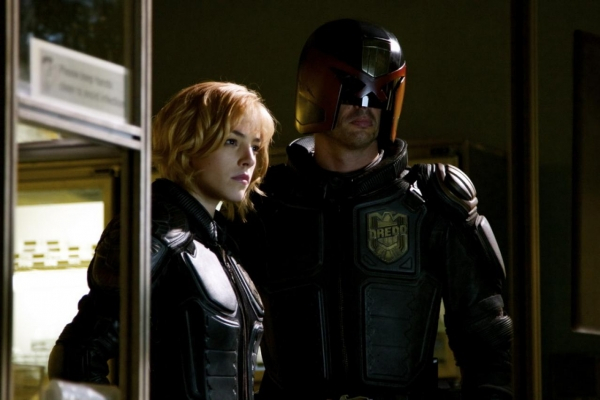
In
short, Dredd 3D is a decent new shot at adapting the original
comic book, superior to its feeble predecessor. It offers little new
material to the genre though, since both the story and the dystopian
future setting have been done before (and better) in the past, but
that doesn't stop the film from being a wholesomely entertaining
Sci-Fi action flick, sporting some thoroughly thrilling scenes of
violence and gore and impressive visuals at times, aiding the
otherwise hardly noticeable 3D effects. The unfathomable Dredd as
played by Urban proves a memorable re-imagining of the iconic comic
character, a sentry of the law making a lawless city just a little
bit safer. Considering its various plot similarities to The Raid:
Redemption, Dredd 3D fortunately also renders the much
dreaded American remake of that particular film redundant. Sadly
Dredd 3D underperformed at the domestic box office, so it may
be quite a while before we see Dredd in action again, but until that
time, this is without the doubt the best rendition of the character,
effecting some much needed justice upon the franchise name by making
us completely forget the lackluster 1995 film.
Sidenote:
despite its shortcomings, consciously or not, Dredd 3D ultimately
proved to be inspiring. Taking the metro on the way home at night, I
noticed a woman harassed by some vagabonds. I stood at some ten
metres distance, but nobody appeared to come to her aid (though there
was quite a number of people around), despite her obvious distress. I
simply walked down the tram towards the incident and demanded to know
what was going on. The assailants told me in a rude and agressive
tone to fuck off, but I stood my ground and told them to end their
intimidation and public disturbance, at which point they directed
their attention toward me. Though I got increasingly nervous, I
didn't let them notice and simply looked at them very sternly
uninterruptedly. The forbidding relentless eye contact clearly made
them unhinged and though they continued slinging (racist) insults and
threats my way, they didn't go so far as to resort to more physical
measures to underscore their intentions. My tactic proved effective
as several other people joined me in pointing out the hoodlums'
faults in the matter and when reaching the next station, the
agressors made a swift though noisy departure, clearly intimidated by
the now greater numbers opposing them, exposing them for the cowards
they were. Looking back, I seemed to have quickly judged the
situation and acted upon it, likely extinguishing an explosive
situation publicly, and I didn't need a cool helmet (quite the
opposite in fact), a gun or other weaponry to do so.
Or
did I? When the loudmouths had left, I realized I unknowingly had
zipped open my coat's left pocket and had clutched a pen I always
keep in there. Though one wasn't necessary in the end (thankfully!),
I apparently unconsciously had looked for a weapon to defend myself
with if it had come down to a brawl. Maybe my antagonists had noticed
and feared I harbored something more formidable in there, thus
hastening their decision for a quick exit. I cannot help but wonder
what would have happened if it had come to a fight. A pen may
normally not constitute a lethal weapon, but people have been
severely hurt with less. I'm just grateful I never had to find out
how such alternate situations would have developed. Unlike is usual
for Dredd, this particular incident only warranted his typical quick
assessment and unrelenting domineering posture to bring it to a happy
end (as the woman thanked me and I received credit from numerous
people on the tram for my action). But then, Amsterdam is hardly
Mega-City One. Still, if I had seen a different motion picture in the
hours before, would I have been in the right mood to defuse a
potentially violent situation like this...?
And
watch the trailer here:
zondag 14 oktober 2012
Provadja's Past Presentations
Autumn
continues to deliver a rather sad stream of unremarkable movies
wedged in-between a great summer and a hotly anticipated winter that
will conclude the otherwise excellent year of 2012 with a much
anticipated bang. The lack of appealing movies has kept me from going
to cinemas for a few weeks now, something I hope to remedy soon.
However, it's also caused me from revisiting this blog much too often
of late, and that's not what I intended. Thank heaven for Wednesday
nights though, since they offered me a solution! Running the show
every week at the local arthouse theater Provadja
provides for something to occupy my thoughts with so I can use my
experiences there in times of cinematic drought like these. The
downside is I'm watching these films from the projector's booth where
the movies' sound is being drowned by the noisy humming of the
machines, plus I occasionally leave the room to check on other
things, at which point I am likely to miss scenes of interest if not
importance to the overall picture. Therefore, I can't consciously
write an in-depth review of such films since I just didn't get to
fully appreciate the film as it was seen by the regular audiences and
I might have missed vital clues that upon closer inspection harbored
the filmmakers' intentions, which I would be likely to misinterpret.
However, I do get to see enough of these films to form a decent
opinion on the overall narrative (if any (eh, Holy
Motors!)), the general
direction and the actors' performances. That gives me at least
something to work with here. So which films did I get to project for
Provadja's clientele lately? Here's a few from the last month.
Et si
on vivait tous ensemble?
Rating:
***/*****, or 7/10
Stéphane
Robelin wrote and directed this socially engaged movie, released in
France a year earlier than it arrived in the Netherlands. This
thoughtful dramedy (drama with a comedic note to keep it from
becoming too much to bear) provides an intriguing solution to the
question what should be done with old people. Rather than stick them
all together in a retirement home, the seniors in this movie (played
compellingly by such notable actors as Jane Fonda, Geraldine Chaplin
and Pierre Richard) decide they might do better spending their last
days and defeating the isolation commonly associated with old age by
living in a small commune where they can just keep an eye on each
other instead of having to hire total strangers to do it for them. Of
course having five headstrong and short tempered elderly people
sharing the same house also isn't the best of ideas, as they soon
discover a level of intrigue and discord between them they had not
anticipated, which ultimately ends up in a revelation of some sordid
secrets from the past that might shatter their friendship.
Fortunately
they had the good sense to hire the young German ethnology student
Dirk (Daniel Brühl, Inglourious Basterds, Good Bye Lenin!)
to do the housekeeping in exchange for the opportunity to study the
elderly up close for his research. Dirk manages to keep the old folks
from falling out with each other entirely, indicating the younger
generation should still take good care of their predecessors, without
placing restrictions on their lives as is done in retirement homes.
The difference between the protagonists' life style and the situation
of their peers behind lock and key for their “own good” is
effectively made clear when one of their number falls ill and his
friends rescue him from the clutches of ruthlessly institutionalized
elderly care as they break him out of a shamefully prison like
facility. Of course growing old it's not all as depressing as this,
as Dirk finds out when one of the old ladies supplies him with ample
details on her sexual activities for his research, much to his
embarrassment (and ours!). Robelin's call for mutual understanding
between the old and the young is laudable, but the movie fails to
fully answer the question whether old people becoming each other's
room mates would truly be a workable solution. Age detrimentally
catches up with everybody after all, and as the movie perfectly
illustrates with the character of Dirk, the intervention and guidance
of the young remains vital, even though many seniors wouldn't want to
admit it. However, Robelin's suggestion we can and should do better
in our attempts to care for the elderly is decently underscored:
nobody would want to whither away in retirement homes, certainly not
without their dearest friends closeby.
This
movie was distributed in Holland under the shorter and simpler title
Tous Ensemble, while it was released accordingly as All
Together in most English speaking territories.
To
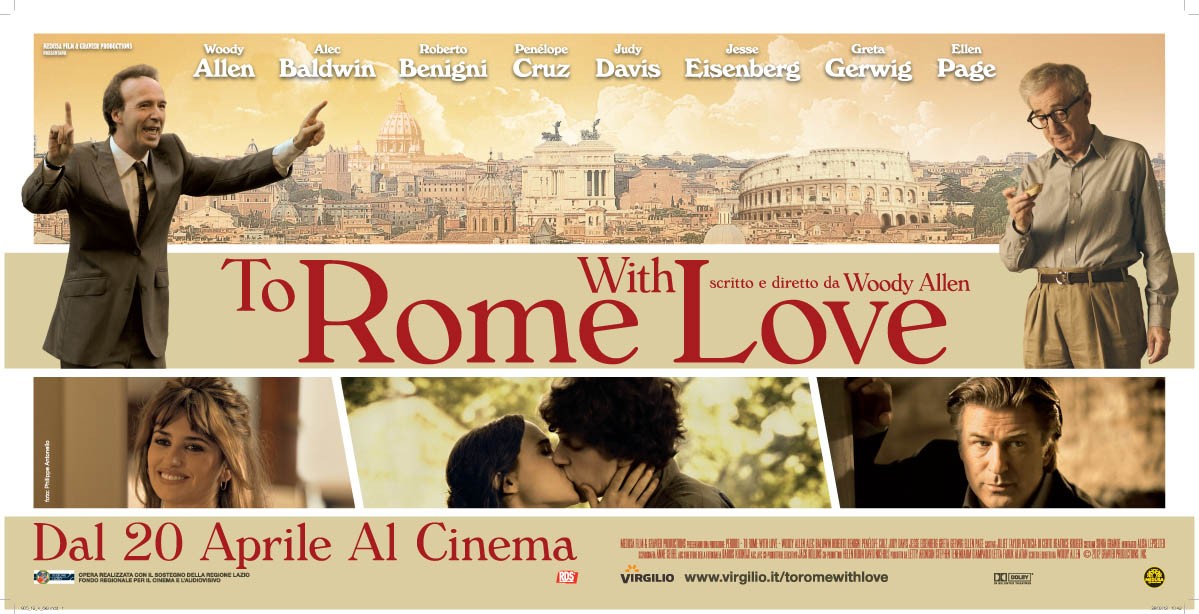
Rome with Love
Rating:
***/*****, or 6/10
Woody
Allen continues to pay homage to the great cities of the world and
this time directs his attention to Rome, where he has an ensemble
cast of noted actors play in four different stories set in the
Eternal City, though never overlapping one another.
First,
famed architect John (Alec Baldwin) revisits Rome where he supposedly
meets a young student of architecture Jack (Jesse Eisenberg) and
guides him in his ever complicated dealings with his girlfriend and
her friend Monica (Ellen Page, always a joy) who he quickly falls in
love with, despite his intentions not to. Question is, is John simply
reliving his Roman experiences of thirty years past and criticizing
what he should have thought about Monica then?
Second,
the young American Hayley (Alison Pill) and Italian Michelangelo
(Flavio Parenti) decide to get married, after which her parents
Phyllis and Jerry (Judy Davis and of course Woody Allen himself) fly
to Rome and meet his family, including his father Giancarlo, an
undertaker. Bored to death in retirement, Jerry overhears Giancarlo
singing operas in the shower and quickly plans to make a star out of
him, but since his talents only work in the shower, Jerry is forced
to make unorthodox decisions to allow his plans for fame and glory to
come to fruition.
Third,
newlyweds Milly (Alessandra Mastronardi) and Antonio (Alessandro
Tiberi) visit Rome on their honeymoon, but events swiftly separate
them, setting both of them on their own adventures as Antonio is
mistaken for somebody else by a prostitute (Penélope Cruz) after
which he applies her talents to ensure a good business deal goes
through as planned, while his new wife finds herself ensnared by a
famous Italian actor and is lured into a passionate affair, only to
be interrupted – and saved – by a robbery.
Fourth,
average Roman citizen Leopoldo (Roberto Benigni, love him or hate
him, as usual) lives a mundane life but all of a sudden finds himself
the centerpiece of attention for the media as he rises to full-fledged
but short-lived stardom for no reason whatsoever.
Utilizing
Rome's many fabulous settings to great effect, Allen's various
stories prove to be less compelling, driven by simple and predictable
plot twists. In the hands of a lesser director this would only spell
doom for the film, but in Allen's capable hands it at least results
in a cheerful viewing experience as the cast fully embraces and
enjoys their roles (and their pleasant stay in Rome no doubt). Still,
the quality of the four stories differs considerably, with the tale
of Milly and Antonio the film's high point as both characters are
swept off their feet by Rome's turbulent life offering them ample
opportunities for inappropriate passion, with the both of them
struggling to escape fate's ironic turn of events to return to their
true love. Aided by Penélope Cruz' joyful and memorable performance
as a hooker this story stands out the most, while at the other end of
the spectrum the tale of Jerry's attempt to bring Giancarlo's voice
to full on-stage recognition results in the predictable answer of
having him perform operas while showering, a resolution only
appreciable for those not familiar with Donald Duck comics. And while
the story of Leopoldo offers plenty of opportunities to critique the
Italian paparazzi media Allen forgoes this chance in favor of a
simple story of a normal man living his fifteen minutes of fame which
blows over as suddenly as it started, resulting in Benigni jumping
through the Roman streets with his pants pulled down in hopes of
recapturing his glory that so unexpectedly has come and gone. To
Rome with Love makes it clear Allen, who was offered to direct a
film in Rome with full financial support of local distributors, never
intended for this film to be more than the sum of its rather bland
parts, but it's a credit to his capabilities as a director and the
quality of his assembled cast the film at least succeeds in giving us
two hours of simple fun in the Roman sun. Accept it as Allen's way of
sending the world a postcard, from Rome, with love.
And
watch the trailers here:
Et si on vivait tous ensemble?:
To Rome with Love:
Labels:
alec baldwin,
arthouse,
comedy,
drama,
geraldine chaplin,
jane fonda,
Jesse Eisenberg,
old people,
Rome,
sex,
stephane robelin,
to rome with love,
tous ensemble,
Woody Allen
Abonneren op:
Posts (Atom)