woensdag 6 juni 2012

It Came from Cold War America, Chapter 6: Terrestrial creature movies

Been away for a few days and haven't seen any new movies. I almost went to the local sneak preview while on vacation, but my niece asked me to watch In Bruges with her instead and I never turn down an opportunity to watch that movie, because it's so brilliant (if you haven't seen it yet, correct this mistake ASAP!). There's little noteworthy movie news today, so I once again dust off my bachelor paper It Came from Cold War America, since I'm still not done posting that piece yet. Plus, I only posted 5 new main page messages last month (though I did also post like 40 archive messages if you hadn't noticed, so the lack of main page activity wasn't due to laziness on my part), and I'd like to do better in June. ICfCWA opened May, so it might as well do the same this month. It's still not in English, and considering the time it would take to translate it, it may never well be translated. 


Paragraaf 6.1: Definitie subgenre
 
Het terrestrial creature genre is in veel opzichten vergelijkbaar met het alien invasion genre, maar thematisch verschilt het er sterk mee. Beide subgenres onderhouden nauwe banden met horror en tonen wezens die op grote schaal vernietiging veroorzaken, maar waar de monsters in alien invasion films gekenmerkt worden door hun technologie is dit bij terrestrial creature films niet het geval. Integendeel, de monsters worden gekenmerkt door hun band met de natuur, en dus een afwezigheid van technologie.
Het voornaamste thema dat dit subgenre aanspreekt is Man against Nature. De monsters zijn, direct of indirect, producten van de Aardse natuur. Vandaar de specifieke benaming die ik dit subgenre heb toegeschreven: deze link met de Aarde en natuur maakt de creaturen terrestrial. De natuur is een uiting van ‘Otherness1. De mensheid moet zich in de films uit dit subgenre verdedigen tegen vervormde scheppingen van Moeder Natuur, die hij per ongeluk door zijn eigen hoogmoed en kennisdrift heeft opgeroepen. Biskind duidt het aan als ‘a conflict between culture and nature2.
Want hoewel de creaturen vaak alledaagse producten van de natuur zijn, is de reden dat zij zich tegen de mens keren vaak door diezelfde mens en zijn technologie afgeroepen. De menselijke cultuur heeft het met haar technologie aangedurfd Moeder Natuur te tergen, en zij slaat terug door natuurlijke wezens, gewekt of vervormd, als resultaat van deze technologie op de mensheid los te laten3. Sobchack beschrijft de monsters als een representatie van ons collectieve schuldgevoel over het ontwikkelen van zulke angstaanjagende technologie4. Niet voor niets zijn veel monsters in dit subgenre geschapen door atoomexperimenten. De mieren in Them! waren slechts normale insecten totdat zij dankzij langdurige atoomproeven in hun leefgebied muteerden en tot monsterlijke afmetingen groeiden. De Rhedosaurus – uiteraard is voor de moderne mens een dinosaurus niet zozeer een alledaagse verschijning (en in het geval van de Rhedosaurus geldt dit nog sterker, aangezien het hier een fictieve soort betreft), maar de natuur zelf discrimineert niet op basis van een dergelijke leeftijd: voor haar is een prehistorisch wezen niet minder haar schepping dan een hedendaags wezen – in The Beast from 20,000 Fathoms werd uit zijn miljoenen jaren durende slaap in het poolijs gewekt door eenzelfde atoomproef. Het gerommel met kernproeven leidde ertoe dat deze wezens dood en verderf zaaien, hoewel zij dit niet bewust doen. Zij gaan slechts door met het uiten van hun natuurlijke gedrag. De mieren verschuiven de schaal van hun standaardgedrag: in plaats van insecten eten zij nu mensen, en zij nestelen nu in rioolbuizen in plaats van normale mierentunnels. De Rhedosaurus trekt na zijn ontwaken naar zijn voormalige nestgronden, waar nu New York staat. De mensen staan deze wezens in de weg, maar hebben dit aan zichzelf te danken.
Ook op dit thema zijn variaties te vinden. Hoewel veruit de meeste monsters in dit subgenre ontstaan als – onbedoeld!5 – gevolg van experimenteren met technologie, zijn ook andere menselijke karaktereigenschappen verantwoordelijk voor hun woede. Zo wordt hebzucht en gebrek aan respect voor de natuur ook bestraft, zoals gebeurd in Creature from the Black Lagoon en de sequels Revenge of the Creature (USA: Jack Arnold, 1955) en The Creature Walks Among Us (USA: John Sherwood, 1956), waarin mensen eerst arrogant binnendringen in het territorium van het creatuur (een prehistorisch aquatisch wezen) om het te onderwerpen, vervolgens het creatuur gevangen nemen en het exploiteren door het als attractie tentoon te stellen, en er tenslotte op experimenteren om het tot een mens om te vormen. Geen wonder dat het creatuur zulk weerzinwekkend gedrag afstraft en vernielingen aanricht.
Want hoewel de vijand in dit subgenre de natuur lijkt, vloeit dit slechts voort uit de reflexiviteit van dit subgenre. De mens is zijn eigen grootste vijand, en het publiek leert hier over na te denken. Menselijke overmoed en hebzucht verwoesten en vervormen de natuur, waardoor de natuur geen optie heeft behalve terug te slaan. Dit subgenre doet mensen inzien dat zij niet de natuur moeten willen overheersen, maar een vreedzame balans moeten vinden. De monsters in dit genre zijn slechts metaforisch. Vernietiging van de natuur leidt tot de vernietiging van de mensen zelf. Deze boodschap is vandaag nog net zo actueel als in de vijftiger jaren. Als een atoombom de Rhedosaurus uit zijn slaap wekt, mogen we wel uitkijken dat het smelten van de ijskappen door klimaatsverandering niet hetzelfde resultaat heeft…

De films uit dit subgenre volgen doorgaans een formule die sterke overeenkomsten vertoont met de typische narratie van het alien invasion subgenre6. Ook hier is de protagonist een intelligente man, meestal een wetenschapper, vergezeld van een aantrekkelijke dame, die als één van de eerste mensen met het monster in aanraking komt. In een aantal gevallen komt dit omdat hij al bekend is met het schepsel of zijn schepper, waardoor hij beter op de hoogte is van manieren om het te bestrijden en daardoor wordt ingelijfd bij het team dat het onschadelijk moet maken. Ook hier bestaat het team uit wetenschappers en militairen die nauw samenwerken. De protagonist bedenkt meestal de oplossing van het probleem, en dus de manier om het monster onschadelijk te maken. Dit lukt, waarna hij en zijn vrouwelijke metgezel een wederzijdse romantiek wacht. Deze formule is een variatie op Lucanio’s 'klassieke tekst'7, maar bevat vaak ook kenmerken van de 'Prometheustekst', waar het draait om het experimenteren en ingrijpen van de mensheid in natuurlijke processen, waarbij zij door haar overmoed verantwoordelijk is voor de rampspoed die erop volgt8. Overigens noemt Lucanio alleen deze twee teksten in zijn boek; hij behandelt hen als onderverdeling van het alien invasion genre en schaart wat ik hier het terrestrial creature genre noem onder dit alien invasion genre. Ik ben het niet eens met deze onderverdeling, aangezien sommige sciencefictionfilms elementen van beide teksten bevatten, terwijl andere onder geen van beide geschaard kunnen worden. Bovendien zijn de meeste indringers in dit subgenre niet ‘alien’, aangezien het grotere versies van alledaagse (en dus herkenbare) wezens zijn (zoals mieren en spinnen). Deze creaturen worden gekoppeld aan de Aarde, in tegenstelling tot de indringers uit het alien invasion genre die van buiten de Aarde komen, en daardoor daadwerkelijk ‘alien’ zijn.

Paragraaf 6.2: Wetenschap in terrestrial creature movies

In tegenstelling tot de indringers in het alien invasion subgenre hebben de indringers in dit subgenre geen eigen wetenschap. De representatie van wetenschap vinden we alleen aan de kant van de mensheid. Wel kunnen we kijken naar de effecten van wetenschap op de monsters, aangezien wetenschap vaak verantwoordelijk is voor hun ontstaan, en altijd voor hun vernietiging. 
 
Ook in dit subgenre slaan wetenschap en leger de handen ineen om de monsters te bestrijden, waarbij wetenschap opnieuw dominant is9, aangezien zij beter weet hoe de monsters te vernietigen met een minimum aan menselijke slachtoffers. Wetenschap en leger zorgen samen voor het bewaken van de sociale orde tegen de monsters10. Ook hier is het inzetten van alle beschikbare wapens tegen de wezens niet per definitie de beste oplossing. Zorgvuldige analyse van de monsters of de normale versies daarvan – de monsters zijn immers vaak uitvergrote versies van normale wezens, zoals de mieren in Them! – leidt tot een beter begrip van de monsters, hun drijfveer, en hun zwakke punten. Als de wetenschappers hun werk gedaan hebben komt het leger pas in actie om ze af te maken, waarna normaliteit hervat kan worden.
De meeste creaturen in dit subgenre ontstaan door atoomproeven. In enkele gevallen bestaan ze al, maar worden ze gewekt door de atoomproef (zoals in The Beast from 20,000 Fathoms). Desondanks kan wetenschap zeer frequent verantwoordelijk worden gehouden voor hun ontstaan, en dus voor de ravage die zij aanrichten. Het ontstaan van de wezens is altijd een onbedoeld zijeffect van wetenschappelijke experimenten. Wetenschap is in dit subgenre een symbool voor de arrogantie en trots die de mensheid koestert ten opzichte van technologische vooruitgang. Via wetenschappelijke macht probeert de mens de natuur te onderwerpen. Wetenschap wordt aanvankelijk gezien als waarheid en autoriteit, en wetenschappers als uitdragers hiervan, die door hun kennis en capaciteit de natuur menen te mogen beheersen11. De natuur zet de mensheid weer op haar plaats door te bewijzen dat deze trots vaak misplaatst is, aangezien de wetenschap ook nadelige effecten met zich meebrengt. Technologische vooruitgang kent een prijs. Zo leert de mensheid weer een les, en kent zij haar plaats in de alles overheersende kracht van de natuur weer12.
Hoewel wetenschap verantwoordelijk is voor de monsters, is zij ook verantwoordelijk voor het vernietigen van de monsters13. Wetenschappers in dit subgenre komen, net als in het alien invasion genre, na gedegen studie van de indringers met een oplossing voor de dag. Vaak zijn het bovendien diezelfde wetenschappers die de oplossing verzinnen als de wetenschappers die de experimenten uitvoerden die hen deden ontstaan. Zo neemt de wetenschapper verantwoordelijkheid voor de puinhoop die hij heeft aangericht. Na afloop van de ultieme confrontatie met de monsters beseft de wetenschap net zo goed als iedereen dat vooruitgang niet alles is, en de natuur gerespecteerd en niet voorbij gestreefd dient te worden. Als dat niet gebeurt, verwoest en vervormt wetenschap de natuur, en daarmee ook de menselijke beschaving14. Wetenschap moet constructief en voorzichtig worden gebruikt.
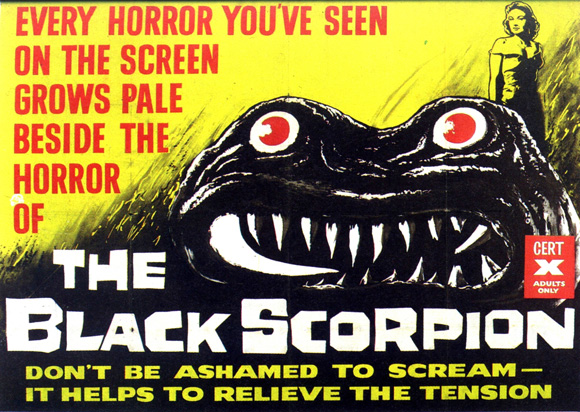
In enkele gevallen is wetenschap niet verantwoordelijk voor het ontstaan van de monsters, maar schept de natuur ze spontaan. Dit is bijvoorbeeld het geval in The Black Scorpion (USA: Edward Ludwig, 1957), waarin reuzenschorpioenen door een vulkaanuitbarsting ontwaken. Een ander voorbeeld is Earth vs. The Spider (USA: Bert I. Gordon, 1958), waarin de oorsprong van het monster niet vermeld wordt. Wetenschap treft in deze gevallen geen blaam, maar het thema Man against Nature overheerst hier ook. In deze gevallen is de natuur de indringer, vergelijkbaar met de vijandige aliens in het alien invasion genre. Dit geldt niet zozeer voor de wel door wetenschap voortgebrachte monsters in het terrestrial creature genre, aangezien de mens in deze gevallen de rampspoed over zichzelf afroept, en de monsters hier geen “indringers” maar “wrekers” zijn. In deze variant op het subgenre is de wetenschap slechts de redder, en niet de verwoester.

Casestudy 2: The Beast from 20,000 Fathoms

The Beast from 20,000 Fathoms houdt zich aan de definities van de klassieke tekst die Lucanio noemt. Het creatuur in deze film, de Rhedosaurus (een fictieve dinosaurus), is in alle opzichten terrestrial. Het wezen heeft miljoenen jaren onder het poolijs in slaap gelegen, maar wordt bruut gewekt door een atoomproef. Ontwaakt uit zijn slaap komt het wezen in een voor hem compleet nieuwe wereld terecht die anders in dan wat hij gewend is, maar zijn instinct is hetzelfde, en hij trekt terug naar zijn oorspronkelijke nestgronden, een grottenstelsel in de buurt van New York. Hierop valt het monster de stad binnen, waar het dood en verderf zaait en grote paniek veroorzaakt. 
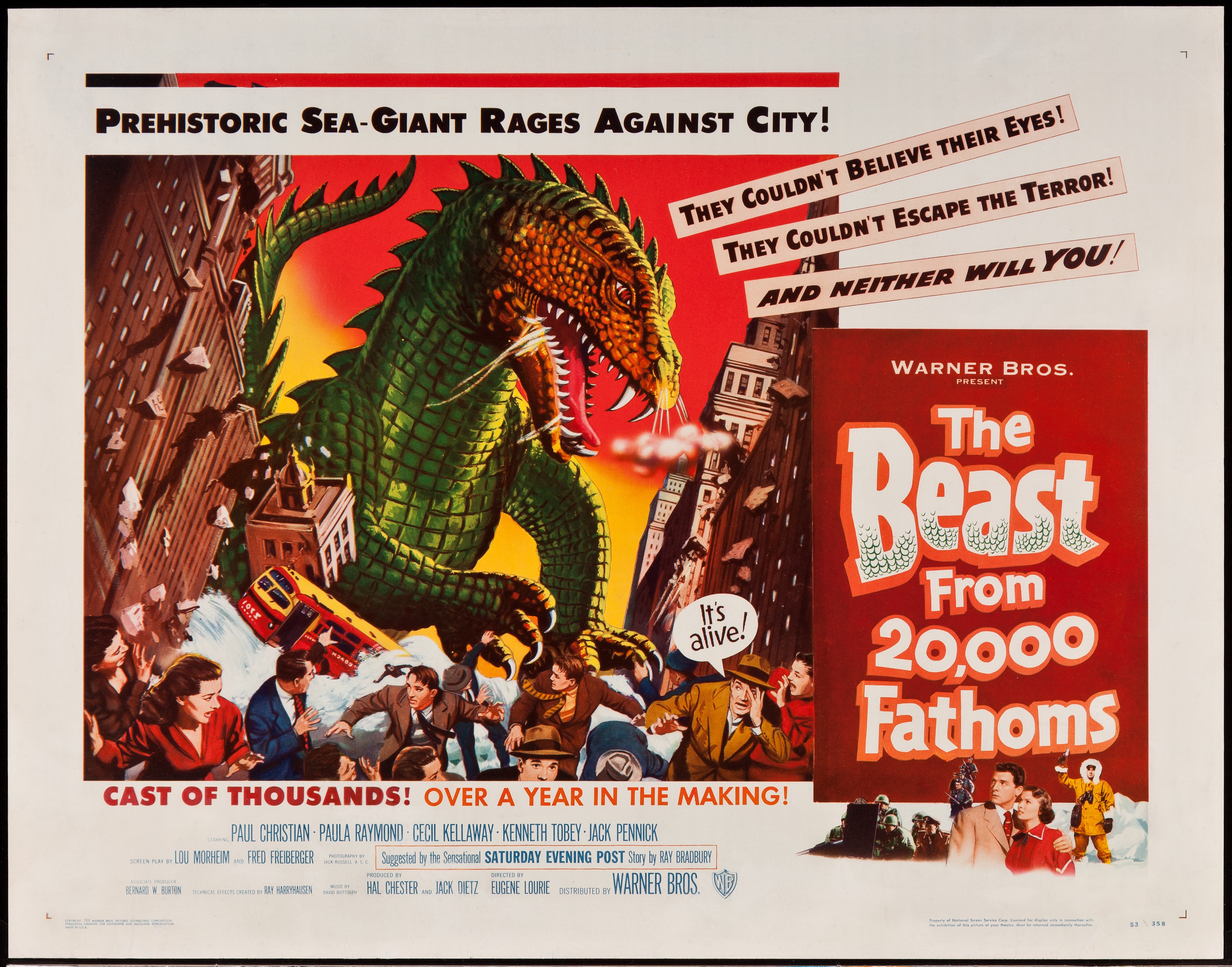
 
De precieze reden voor de atoomproef in deze film wordt niet vermeld. Zoals de meeste atoomproeven in films uit de jaren vijftig heeft het iets te maken met het testen van atoombommen, mogelijk het ontwikkelen van een waterstofbom (de narrator maakt gewag van ‘H-hour’, staat 'H' voor hydrogen bomb wellicht?). De geleerden die de proef overzien, waaronder de typische scientist hero professor Nesbitt (Paul Hubschmid), hebben hun twijfels over het gebruik van atoomenergie, maar zien het als een noodzakelijk kwaad voor het opdoen van wetenschappelijke kennis, zoals de volgende conversatie illustreert:

Nesbitt: ‘The world’s been here for millions of years. Man’s been walking upright for a comparatively short time. Mentally, we’re still crawling. This test will add to our knowledge.’
Ritchie: ‘Every time one of these things goes off I feel as if we were helping to write the first chapter of a new Genesis.
Nesbitt: ‘Let’s hope we don’t find ourselves writing the last chapter of the old one.’
Evans: ‘You sound like a man who’s scared, Tom.’
Nesbitt: ‘What makes you think I’m not?’15

Dit gesprek toont aan dat de geleerden op de hoogte zijn van het gevaar dat atoomenergie kan opleveren, maar dat ze het risico durven te nemen omwille van wetenschappelijke vooruitgang. Ze zijn er zich van bewust dat hun test dodelijke straling heeft opgewekt, maar aangezien de proef gedaan werd in het niemandsland van de ijskappen op de Noordpool lijkt dit gerechtvaardigd, aangezien er toch niemand woont. De gevolgen voor de natuur worden niet in ogenschouw genomen. Maar de natuur laat zich niet zo respectloos behandelen. Als gevolg van het menselijk verstoren van de natuur wordt de Rhedosaurus uit zijn slaap gewekt, als wreker van de natuur.
Zijn ontwaken blijft niet onopgemerkt. Twee wetenschappers, waaronder Nesbitt, die de resultaten van de atoomproef controleren, worden met het schepsel geconfronteerd, waarbij één van hen het leven verliest. Nesbitt overleeft het, en vertelt bij terugkomst op de basis over het wezen, maar zijn verhaal wordt niet geloofd. Dit is typisch voor het terrestrial creature genre: de persoon die het eerst met het creatuur in aanraking komt wordt voor gek versleten. Vaak is de persoon in kwestie de scientist hero: hoewel deze de wetenschap, een instituut dat geacht wordt ware kennis op te doen en feiten te checken, representeert, klinkt zijn verhaal in zulke gevallen te onwaarschijnlijk. Desondanks krijgt de wetenschap in het genre altijd alsnog gelijk als de indringer zijn aanwezigheid laat gelden; want de wetenschap(per) liegt niet. Dit geldt ook voor Nesbitt, die na zijn confrontatie op zoek gaat naar bewijs om de waarheid aan te tonen. De mogelijkheid dat hij hallucineerde slaat hij af, want zoals hij het zegt: ‘I’m not inclined to let my imagination run away with me, I’m a scientist’.
Nesbitt is een typische scientist hero, enigszins stijf en emotieloos - normaal voor protagonisten in de klassieke tekst - maar toch sympathiek en met een zekere charme (zie ook casestudy 1, waarin meer verteld werd over de koele uitstraling van scientist heroes in de klassieke tekst). Om een second opinion over zijn monsterverhaal te krijgen probeert hij de steun van vooraanstaand paleontoloog professor Elson (Cecil Kellaway, als archetypische wise old man), te krijgen. In een debat over de mogelijkheid dat een prehistorisch wezen 100 miljoen jaar in het ijs gezeten heeft maar nog leeft, weet Elson alle verklaringen die Nesbitt geeft rationeel te ontkrachten. Desondanks trekt Nesbitt’s gedrevenheid de aandacht van Elsons assistente Lee Hunter (Paula Raymond), die niet alleen in zijn verhaal maar ook in Nesbitt zelf geïnteresseerd is (waarop een welhaast clichématige relatie zich ontvouwt tussen Nesbitt en Hunter). Hunter is een goed voorbeeld van de nieuwe rol voor vrouwen in de wetenschap. Ze heeft klaarblijkelijk verstand van zaken en is niet bang haar mening te uiten in het gezelschap van mannelijke wetenschappers. Haar mentor heeft het volste vertrouwen in haar capaciteiten, wat genoeg reden is voor Nesbitt om ook op haar expertise te vertrouwen. Desondanks is ze nog een assistente: waarschijnlijk heeft men geprobeerd het publiek het ongeloof van een vrouw als belangrijk paleontoloog te besparen. Een oude man die veel weet van uitgestorven dieren lijkt waarschijnlijker dan een knappe jongedame met dezelfde kennis.
In tegenstelling tot haar mentor gelooft Hunter wel in Nesbitts verhaal: ze typeert hem als een briljant wetenschapper, wat voor haar genoeg reden is om hem te vertrouwen. Als Nesbitt vraagt waarom hij haar sympathie heeft, antwoordt ze: ‘I have a deep, abiding faith in the work of scientists. Otherwise I wouldn’t be one myself’. Voor haar is de mogelijkheid dat Nesbitt ongelijk heeft ontkracht domweg omdat hij een medewetenschapper is. Ook Elson gaf in voorgaande scène aan Nesbitt te willen geloven. Kennelijk hebben wetenschappers onder elkaar meer vertrouwen in ongeloofwaardige verhalen dan niet-wetenschappers. Mogelijk haakt dit in op de anti-intellectualistische sfeer die begin jaren vijftig heerste (zie ook paragraaf 4.2): wetenschappers werden beschouwd als een vreemde intellectuele elite die onder andere brabbelde over raketten naar de maan. Maar ook dit ongeloofwaardige verhaal werd een decennium later werkelijkheid. Vreemde verhalen horen bij de wetenschap, en wetenschappers zelf onderstrepen dit feit.

Hunter besluit het onderzoek naar het monster analytisch aan te pakken. Ze geeft Nesbitt een willekeurige stapel illustraties van dinosauriërs, waaruit hij de zijne moet pikken. Vervolgens neemt ze contact op met de overlevende van een scheepsramp, die beweert dat zijn schip aangevallen werd door een zeeslang. Zijn ondervraging wordt op dezelfde onpartijdige manier aangepakt: uit een stapel illustraties van dinosauriërs pikt hij dezelfde dinosauriër, de Rhedosaurus, als schuldige. Zo wordt Nesbitts verhaal een stuk waarschijnlijker, waarop Elson hem ook gelooft. Dit, en de melding van een reeks rampen in de media, is reden genoeg voor het gezelschap een trip te ondernemen naar de nestgronden van de Rhedosaurus, de Hudson-zeegrotten in de buurt van New York, voor verder onderzoek naar het wezen. Elson stelt voor het monster te vangen als het echt bestaat. Als hem gezegd wordt dat het gevaarlijk is, antwoordt hij: ‘the risk would be worth it if one thinks of the benefit to science’. Eens te meer wordt gesteld dat risico’s acceptabel zijn ten bate van de wetenschap. De prijs die in het vooruitzicht wordt gesteld, de accumulatie van wetenschappelijke kennis, is groot genoeg om wetenschappers zulke risico’s te doen nemen. Al snel blijkt dat deze gedachte mogelijk misplaatst is: bij de grotten aangekomen blijkt de Rhedosaurus inderdaad springlevend, waarop Elson verslonden wordt door het wezen. Een interessante observatie: in een shot van een krant, waarin melding wordt gemaakt van Elsons dood, staat naast dit artikel een artikel over wetenschappers die een nieuwe röntgentechniek hebben ontwikkeld. Zo toont dit shot ons de dualiteit van wetenschap: ontdekking gaat gepaard met verlies. Het feit dat het artikel over Elsons dood een stuk groter is afgebeeld dan het andere artikel laat vragen open over wat dominant is: de vergroting van wetenschappelijke kennis, of het verlies dat het vergaren van deze kennis kan opleveren. Hunter vraagt zich ook af of Elsons dood wel zin had, ongeacht de kennis die het opleverde.
Door Elsons dood krijgt Nesbitt echter gelijk, en daarom krijgt hij de leiding over de militaire eenheden die het wezen moeten vernietigen. Het feit dat hij een atoomexpert is, en geen paleontoloog, speelt daarbij geen rol, en blijkt later handig voor de oplossing van het probleem. Het is dus puur een plot device16. Eens te meer werken wetenschap en leger samen om de samenleving te beschermen, waarbij de wetenschap door haar inzicht in de situatie dominant is. Het thema Man against Nature komt hier sterk naar voren. Het creatuur wordt domweg geleid door zijn natuurlijk territoriale instinct, maar zijn nestgrond is vervangen door een menselijk bolwerk. Als hij de stad, gebouwd op wat hij als zijn territorium ziet, binnenvalt, wordt hij gezien als de indringer. Voor hem is geen plaats in deze veranderde wereld, en daarom moet hij verdwijnen. Nesbitt, degene die hem door het experimenteren met atoomenergie gewekt heeft, gaat hem nu ook weer doen inslapen. De wetenschapper neemt zo verantwoordelijkheid voor het door hem aangerichte probleem.
Het blijkt echter moeilijker dan aanvankelijk gedacht om de Rhedosaurus te doden. Bij de eerste confrontatie tussen het leger en het wezen werd hij verwond, en het blijkt dat zijn bloed prehistorische ziektekiemen bevat waartegen mensen geen weerstand hebben (het lijkt een omgekeerde situatie als in The War of the Worlds, waar de microben juist de indringer vernietigden). Zonder de wetenschap zou deze conclusie niet getrokken zijn, wat mogelijk rampzalige gevolgen had gehad zelfs als het schepsel ontschadelijk was gemaakt. Het monster kan niet simpelweg door het leger overhoop geschoten worden, aangezien de ziektekiemen zich dan over een groot gebied verspreiden en meer slachtoffers kunnen maken dan de Rhedosaurus zelf. Nesbitt analyseert monsters van het bloed en weet een radioactieve isotoop te maken - dat is immers zijn terrein van expertise - die het monster kan doden en ook de ziekte beteugelen. In de climax van de film slaagt Nesbitt er samen met een scherpschutter - één wetenschapper en één soldaat, waardoor de relatie tussen wetenschap en leger hier gelijk is (en wetenschap dus niet langer dominant is), aangezien beiden onmisbaar zijn - ternauwernood in om het monster de isotoop toe te dienen, waarna het sterft en de normaliteit hervat kan worden. Interessant is dat hier radioactiviteit als redder optreedt, terwijl het in het genre doorgaans de boosdoener is.
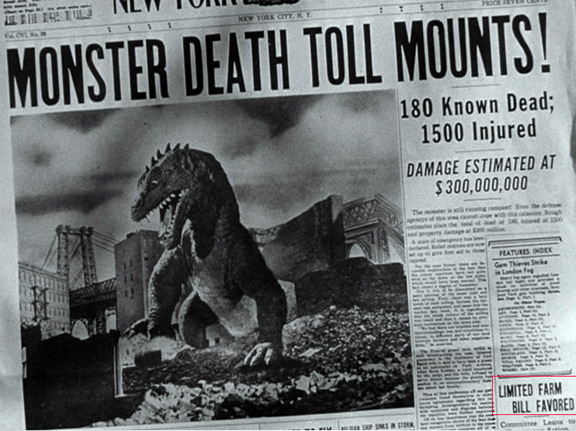
The Beast from 20,000 Fathoms toont een dualiteit in de representatie van wetenschap: wetenschappers zien het vergroten van wetenschappelijke kennis als een nobele zaak, die offers eist. Ze zijn op de hoogte van de risico’s die hun experimenten met zich meebrengen, maar verkiezen de consequenties te ondergaan. In dit geval leiden wetenschappelijke proeven tot grote schade: een monster wordt gewekt, richt enorme ravage aan waarbij honderden mensen omkomen en dreigt met een ziekte nog meer slachtoffers te eisen. Zo lijken wetenschappelijke tests de moeite niet waard. Desondanks wekt het einde van de film de suggestie dat deze conclusie voorbarig is. Want uiteindelijk wordt het monster ook teniet gedaan door wetenschappelijke kennis, in dit geval Nesbitt’s expertise met radioactiviteit. Deze kennis is opgedaan door proeven vergelijkbaar met de tests die het monster deden ontwaken. Zo toont de film het publiek dat zulke proeven mogelijk niet voor niets zijn, en we toch vertrouwen in de wetenschap en haar capaciteit de schade te herstellen kunnen hebben.
Ondanks de gelukkige afloop dwingt de film de kijker zich af te vragen of het vergaren van (potentieel) nuttige kennis de hoge prijs waard is: moeten we wel alles willen weten, ook als het ons gevaar oplevert? Deze gedachte wordt gereflecteerd in de trailer van de film. Hierin worden kreten geslaakt als ‘Are we delving into mysteries we weren’t meant to know?’, ‘Is mankind challenging powers behind the cosmic barriers?’, ‘Who knows what waits for us in nature’s nomansland…’ en ‘Will science unleash the fearsome forces of lost worlds?’. In zulke kreten is al een zekere animositeit jegens wetenschap en haar streven merkbaar: wetenschap gaat te ver in haar zoektocht naar kennis, waarop gevaarlijke consequenties de mensheid treffen (opnieuw een mogelijke metafoor voor de atoombom: deze werd als gevolg van het onderzoek naar atoomenergie ontwikkeld, en heeft veel levens gekost). 
In deze film zijn wetenschappers wel schuldig aan het wekken van het monster, en daardoor aan de ravage die het aanricht, maar komen ze ook met een oplossing die zo min mogelijk levens eist17. Zo neemt wetenschap zijn verantwoordelijkheid en blijft het integer. Het is niet slechts de brenger van dood en verderf, maar kan ook constructief gebruikt worden (waarbij het een element gebruikt dat in deze periode voornamelijk negatieve connotaties had, radioactiviteit). Tegelijkertijd verdient het monster ook enige sympathie, aangezien het zijn schuld niet is: hij volgt slechts zijn instinct. Maar de wereld die hij kende is niet meer, en daardoor moet hij wijken. Als wetenschap niet experimenteerde met atoomenergie, was hij niet gewekt. Zo waarschuwt de film via een metafoor, het monster gewekt door atoomenergie en uitgerust met prehistorische straling, voor de gevaren die echte atoomproeven en de daarmee gepaard gaande radioactiviteit opleveren.


1 Biskind 1983: 111
2 Biskind 1983: 106
3 Brosnan 1978: 95
4 Sobchack 1980: 46-47
5 Tudor, Andrew. Monsters and mad scientists: a cultural history of the horror movie. Oxford: Basil Blackwell Ltd., 1989: p. 147
6 Vieth, 2001: 62-63
7 Lucanio 1987: 25-44
8 Lucanio 1987: 46-52
9 Jancovich 1996: 16
10 Sobchack 1980: 45
11 Vieth 2001: 180
12 Baxter 1970: 138
13 Biskind 1983: 104
14 Vieth 2001: 158
15 Beast from 20,000 Fathoms, The. Reg. Eugène Lourié. Jack Dietz Productions Inc., 1953.
16 Lucanio 1987: 39
17 Jancovich 1996: 52

woensdag 30 mei 2012

Back in black... with vengeance


Men in Black 3: rating: ****/*****, or 8/10

In the midst of all the super hero action bombarding our cinemas this summer, you'd almost forget there's more to comic book movie adaptations than just superhumans epically fighting each other. However, just because super heroes are doing extremely well at the box-office, doesn't mean the Hollywood studios have given up on other type of comic book movies, especially when reinterpreting such comics for the big screen did very well financially for them in the past. Therefore, after “only” ten years of neglect, the Men in Black are finally back to once again protect us against the worst scum of the universe. Their last film turned out to be one of the worst sequels in recent history, almost ruining the franchise as a whole due to bad writing, bad chemistry between the lead actors and most of all, embarrasingly bad jokes, so this time their mission is to prove to the audience once again why we do want to watch their secret missions guarding us against extra-terrestrial violence. Fortunately, and surprisingly after a decade of inactivity, they succeed, making us fondly remember the first film and largely forgetting the debacle that was their second adventure.


Warning! Here be spoilers! Unlike the previous films, Men in Black 3 does not open in medias res during one of the coolest secret government agency's missions, or even on this planet, but instead witnesses a pretty nifty prison break on the moon's maximum security prison for dangerous aliens. It makes sense extra-terrestrial inmates are indeed locked up extra Terra, but apparently it would have been a more sensible move not to hire inapt, thick-headed, overweight human guards to handle security, as they all get viciously killed off, some in rather gruesome PG-13 ways, courtesy of the film's central bad guy, the one-armed Boris the Animal (thanks to the FX team an effectively scary and grotesque Jemaine Clement), who after reclaiming his freedom sets off to kill Agent K (Tommy Lee Jones). Mean while, to show a decent amount of time has passed between this film and the dismal previous MIB installment, we are re-introduced to Agents K and J (Will Smith), working closely together as partners, instead of one learning the intricacies of the job from the other like before. They're still not fully connecting emotionally, K being grumpy and cynical, while J is overly energetic and possesses a seemingly more complete range of human emotions, but such differences are only a good thing for the audience, since it makes the characters complete each other and play off one another perfectly, exactly as was the case in the first film, but was so painfully lacking in the second. And so the excellent chemistry between Jones and Smith is the best thing to return, as well as the most surprising considering it was absent last time, plus the two actors haven't worked together for a decade, but undoubtedly rediscovered their ability to bounce back witty dialogue and bizarrely funny gags between them with the help of a script that actually contained witty dialogue and bizarrely funny gags. It's a good thing the pair found each other again, since the relationship between them is the driving factor in Men in Black 3's plot line.


After spectacularly raiding a Chinese/alien restaurant for selling illegal extra-terrestrial animals as food, which also is used to remind the viewer just how well K and J work together on cases like these, K receives word Boris has broken out of jail, puzzling J as to what the deal is between them and K of course withholding information from him since it's not his damn business. Next day, J returns to the office only to find K missing and none of their colleagues remembering their top agents ever working together. Turns out Boris travelled back in time to successfully murder K and change history, so his people, the Boglodites, a dangerous parasitic race of aliens scouring planet after planet and killing all life in the process, can conquer Earth in the present after all, instead of being doomed to extinction thanks to K foiling their evil schemes in the past. With the invasion starting, J has no choice but to time-jump after Boris to 1969 in order to save his partner, and the future of planet Earth. Introducing time travel into a franchise that never seemed to revolve around it previously is often a bad sign (I can think of a TV show that did pretty good until messing with time proved to be the first stage in its undoing, as well as a beloved Sci-Fi franchise which got completely reset/screwed over because time travel offered just such an irresistibly easy cop-out solution), but in the case of Men in Black 3, it's more like an added bonus, since it opens up the possibility for having J and a younger K (now played by Josh Brolin) teaming up to save the future, making their relationship feel fresh, familiar and funny all at once. 

Brolin proves to be the perfect casting choice for the role of replacing Jones for most of the movie, having skillfully copied his accent, mannerisms and natural charm, and thus pulling off this less experienced but more human K both fully convincingly and compellingly. Plus, Smith and Brolin prove as good a combination of acting and action talent as Smith and Jones did, while keeping the existing levels of humour and character compatibility intact. Thanks to Brolin, who also cleverly uses this opportunity to remind us why he's often called one of the most acclaimed American actors at this moment, we don't miss Jones for a second, because we're totally buying he is Jones. Also, because of the now minimal age difference between the two characters, K and J are finally on a believably equal level, both of them knowing things the other does not and actually sharing them, instead of the much older K supplying all the knowledge, and J most of the resulting action, while the former keeps important stuff to himself for the latter (and the audience) to figure out.


Aside from reinvigorating the K & J relationship, the plot also utilizes the chance for laughs offered by the fish-out-of-water element of a guy from the present visiting the odd world of the past, though it does not make as much use of this opportunity as one would have expected, appropriating the date of July 1969 mostly for plot reasons because of the Apollo 11 mission to the Moon, which does not allow the film to linger too much on other, more cultural events of the same era which would have made for great comedic moments. Fortunately the jokes that do jump at this occasion work well, incuding older incarnations of MIB technology being of elephantine proportions compared to Smith's pocket size equipment, or Andy Warhol revealed to be a MIB agent who's tired of his own visual art and requesting to be allowed to fake his own death to get away from it. Most of the best temporally related jokes though are claimed by the alien Griffin (Michael Stuhlbarg in a hilarious role), a survivor of the previous Boglodite act of genocide who offers the Men in Black a device to protect Earth from the imminent invasion, and, as a five-dimensional entity in disguise (i.e., a silly hat), can foresee any and all possible futures, making him ramble on and on about the various possible outcomes and the unlikeliest random elements effecting them.

Armed with Griffin's plethora of foreshadowings, K and J set out to deploy his device (by attaching it to the Apollo 11 so it can create a safety net around the planet) and defeat Boris, of which there are now two, the one from the present (that is, 1969) and the one from the future (don't worry, the time travel does not lead to overly complicated situations but remains fairly straightforward, which also works only in the movie's favour). The existence of two Borises simultaneously, both of them hating the other for what they perceive to be their weaknesses, could also have used more fleshing out, making the threat feel more real since future Boris knows exactly what will transpire and could steer past Boris away from his own mistakes, while both MIB agents are not fully aware of the precise order of happenings due to Griffin's mental incoherence; the plot however, fails to fully capitalize on this chance and has each Boris fighting a single MIB agent alone. At least the plot delivers some stunning action scenes on top of a missile launch tower to make up for this oversight, which is also deployed to make some good use of the 3-D effects (yes, this summer blockbuster too is released in 3-D), though it's the time-jump scenes that provide the most impressive displays of depth.

Overall, Men in Black 3 offers everything Men in Black 2 did not, the most important thing being the status of a worthy successor to the (still superior) first installment in this franchise, despite containing some minor plot imperfections. Director Barry Sonnenfeld, responsible for all three films, redeems himself for his previous failure, while Smith and Jones prove they can still work together to great results if aided by a good script. Brolin only adds more depth to their existing relationship by exploring it in more detail and straying away from the previously used master-apprentice dynamic between both characters. And at the same time, we get more aliens (new species, but also some old fan favorites including the obnoxious worm guys), more cool gadgets (like the much advertized gyro bikes) and a lot of new jokes, most of them actually funny this time around. Now, if we could only time-jump and erase Men in Black 2 from history somehow, this franchise would have a much better overall track record...

And now back to superhumans epically fighting each other.


And watch the trailer here:


woensdag 23 mei 2012

A dictator late for his own funeral


The Dictator: ***/*****, or 6/10

At least there's one thing to be said for dictators: they make for bizarrely colourful characters, and their regimes often feature such ludicrous rules of conduct the rest of the world cannot do anything but wonder just how seriously these tyrants should be taken. It seems like a natural ingredient for a comedy, though given the subject matter most people don't dare to make a feature film out of it. Charles Chaplin's The Great Dictator, already 72 years old, still rules supreme as the number one example as to how a brutal oppressive government can successfully be made fun of, though after WW II Chaplin admitted in hindsight he would not have made the movie had he known just how atrocious Hitler's reign of terror had been, making the film taste sour when watching certain scenes spoofing situations that in reality would have cost hundreds of lives. It can be said The Great Dictator was made too early, making it a light take on history that had yet to occur. The opposite now happens with Sacha Baron Cohen's latest raunchy comedy, simply called The Dictator, which, when compared to recent history, feels it was released a little too late to feel like it's truly up on current events.


The dictator is question is Admiral-General Aladeen (of course performed by Cohen), Supreme Leader of Wadiya (a fictional North-African country), who was born in power thanks to his father who violently seized control. Having ruled his nation since the age of seven, Aladeen is a typical 'spoiled brat' type of overlord, who views his country as his own private playground and has everybody who disagrees with him executed without mercy. Aladeen does whatever he feels like doing, including hosting and competing in the Wadiyan Olympics, which he wins by shooting his fellow contestants, as well as sleeping with celebrities who prostitute themselves for substantial fees (and the movie makes it clear there's a lot of those, which makes for the funniest roles both Megan Fox and Edward Norton have ever played). Like any rogue nation, Wadiya has its own nuclear programme, which according to a loudly snickering Aladeen will only be used for peaceful purposes. Of course, the UN won't fall for his not so convincing performance, so he's requested to address its representatives in New York or face air strikes. And thus, Aladeen heads to the USA, the birthplace of AIDS as he calls it, to ease the international community.

Warning! Here be spoilers! So far The Dictator doesn't seem much unlike Cohen's previous projects, Borat and Brüno, both of which also opened with a string of fairly random scenes applied to establish the film's main character and the bizarre world he inhabited, leading to a trip to the States that made the protagonist come into conflict with American extremities and himself, in yet more loose scenes that felt mostly like separate sketches instead of a progressive narrative. The Dictator however has a more consistent storyline. Soon after arrival at his New York hotel – where they charge an outrageous 20 dollars for Internet! – Aladeen finds himself victim of a conspiracy and carried off for torture and vicious death, only to be replaced by his most recently installed doppelganger, a very simple minded goat herder whose only job it is to be shot in the head. The plot against his life is planned by his uncle Tamir, who means to use the decoy Aladeen to move Wadiya towards a democracy only to sell off its oil reserves to foreign contractors and get excessively rich in the process, over the backs of the Wadiyan populace. Tamir is played by Ben Kingsley, a seemingly surprising bit of casting considering his unwavering status as one of the world's greatest actors, someone who most people would never expect to see in a raunchy comedy like this. However, for every masterpiece like Schindler's List or Gandhi, Kingsley has done a Thunderbirds or Love Guru, revealing he's up for anything if the money is right, not unlike the Megan Foxes of the celebrity world this film also pokes at with hilarious results.


Due to his experience in torture, Aladeen escapes his imprisonment only to be left on the streets of New York to fend for himself. When trying to get into the UN building he meets Zoey, a bisexual feminist activist (played by Anna Faris made unrecognizably boyish) who offers him a job at her eco-collective, where every employee is a political refugee, offering Cohen the full potential to make politically incorrect fun at every conceivable ethnic, gender or demographic minority. In the New York neighbourhood of Little Wadiya, Aladeen also meets Nadal (Jason Mantzoukas), the former chief of his nuclear program who he thought he had executed for disagreeing over the shape of Wadiya's first nuclear missile (Aladeen wanted it pointy, since a rounded shape would make it look like a giant flying dildo). In exchange for returning to his old job, Nadal agrees to help Aladeen get back to power. Though it seems rather gullible of a scientist sentenced to death to trust the one who gave the order, Nadal and Aladeen work together more effectively for story purposes than Aladeen does with Zoey, who's cooperation seems mostly an excuse for dirty gags, many of them funny, all of them sexist, racist or generally offensive (as we're used to from Cohen). However, in the latter case, the comedic result is much more convincing, while Mantzoukas unfortunately proves himself to be inexperienced when it comes to the gift of timing, making many of the funny situations he participates in sadly miss their mark.

Hilarity aside, the audience expects Cohen to make at least some political comments when it comes to dictatorships in an age where one after the other bites the dust. In this regard, The Dictator seems to have been produced a little too late to feel in any way relevant. Many of the much despised people Cohen, either implicitly or explicitly, refers to in this movie, have fallen victim to the results of their own tyranny by now, including Osama Bin Laden, Khadaffi, Charles Taylor and Berlusconi, yet the movie presents them, either in character or only in dialogue, as still active, or even still alive. Though the movie opens with an 'in memoriam' to Kim Jong-Il, this feels like a simple last-minute addition, done mostly to make the film appear to be more up with the times than it eventually turns out to be. The Dictator, alas, is revealed to be an already outdated project by the time it hit movie screens. Of course, there's still plenty of dictators left presently, but none of these remaining tyrants are either well known enough, disturbing enough or simply funny enough to be made (ab)use of in The Dictator, not even in late post-production additions like Jong-Il. It seems all the cool dictators have already passed away, or at least been forced to step down, just before Cohen could effectively spoof them in his hommage to oppressive regimes.


And an hommage it is, even if only for comedy's sake. In the end, Aladeen succeeds in foiling uncle Tamir's evil schemes, publicly tearing Wadiya's new constitution to pieces in front of the UN delegation, resulting in a speech applauding the many virtues of dictatorships over democracies, of course referring to America's insidious and slow, but poignantly present move towards the former in the recent decade, in which we again spot Cohen just missing the appropriate time frame in which to state his 'j'accuse', considering the level of repression in the USA has at least diminished under Obama compared to the Bush doctrine. While the anti-Jewish, anti-Islamic and anti-gay slurs Cohen revealed as ever present in American in his previous projects, seem ever prevalent (this movie resorts to exposing them too, to a minor extent), his views on America's level of democratic decline seems at the least outdated, undermining the point he makes on America appropriating anti-democratic behavior which it critiques in other nations (that is, if you feel Cohen ever bothers to make such points, which is also debatable). Like the way Cohen praises the wonderful grotesqueries of tyranny a little behind schedule, so to arrive his allegations towards the “American regime” too late to make them feel all that relevant to audiences. Oh well, at least we still have the jokes.

And at least in terms of comedy The Dictator delivers some positive results. Of course, many remarks and situations result in extremely crude, deviant sexual gags, as we've come to expect from Cohen, nor would we have it any other way by now. Some of them are genuinely funny despite their obviously adult content – why this movie only got a '12' certificate in the Netherlands is beyond me – while others are glaringly embarrassing to watch, including a woman giving birth and Aladeen coming to her aid by accidentally jamming his fist up her butt. Fortunately the cringe-worthy moments form a minority, while several instances of great humour undoubtedly will prove memorably hilarious, and quotable for years to come. The greatest gags involve Wadiyan life under Aladeen's rule, like many words having been replaced by the term 'aladeen', including 'positive' and 'negative', resulting in confusion when a doctor informs his patient of 'aladeen news' since he's 'HIV-aladeen'. Plus, we'll never forget the sight of a wall adorned with thousands of photos of Aladeen posing with a celebrity he has had sex with (including Oprah Winfrey and Arnold Schwarzenegger). Whatever point The Dictator has missed thematically, it compensates for the most part in terms of humour.

Overall, The Dictator will certainly never reach the status of an undying classic like The Great Dictator did, despite both films missing the mark historically. Even if the former had reached theatres, say, a year earlier, it would still contain various painfully unfunny gags taking the momentum out of the overall picture (which is already running short with only 83 minutes). However, like Borat and Brüno before it, the film also contains enough good jokes to make it a decent enough watch, and it proves that with every vile dictator gone, the world of comedy remains a little less colourful.


And watch the trailer here:

maandag 21 mei 2012

Date Night


Rating: ***/*****, or 6/10


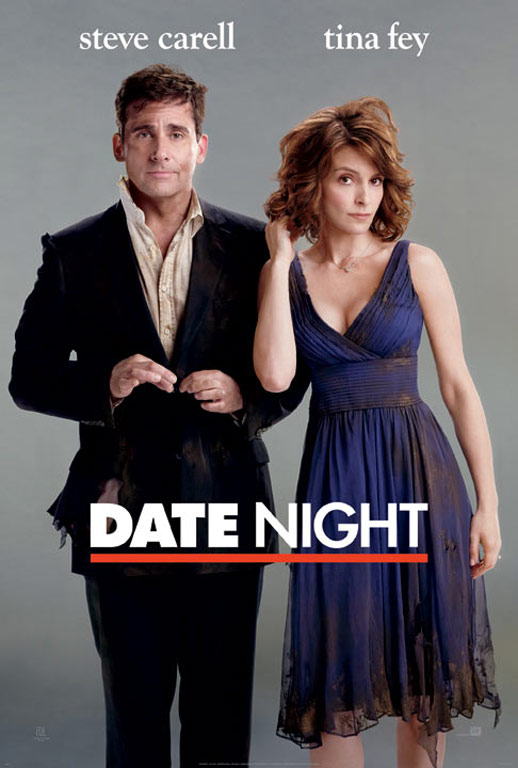
Adequate feel-good comedy about a bored married couple (Tina Fey and Steve Carell) who try to do something else for a change and go to an expensive fancy restaurant where they pretend, because the place is totally filled up, they're another couple that reserved a place (but didn't show up), which leads to a severe case of mistaken identity as they soon find themselves on the run from shady characters. This basically is a supposedly funny variation on Hitchcock's classic thriller North by Northwest, except the level of humor never rises above average, despite decent performances by the leading couple who at least show convincing chemistry in their roles as the protagonist pair who are confronted with car chases, break-ins and silly strip routines as they try to return to their not-so-bad status quo. Also includes an ever shirtless Mark Wahlberg as an ex-spy good samaritan and William Fichtner as a corrupt, sexually obsessed government official. Director Shawn Levy, from both Night at the Museum movies and The Pink Panther (remake) fame, adds yet another fairly entertaining but quickly forgotten flick to his repertoire.


Starring: Tina Fey, Steve Carell, Mark Wahlberg


Directed by Shawn Levy


USA: 20th Century-Fox, 2010

Dark Victory


Rating: ****/*****, or 7/10


Typical but classic 'weepie' (or 'women's film') from the late Thirties, a star vehicle for Bette Davis who was nominated for an Academy Award for her performance but didn't win (no matter, since she was Oscar-nominated a whopping eleven times in total and took home two such trophies during her career). Davis portrays a young wealthy woman who enjoys life in a frivolous manner, drinking, smoking and sporting too much, until she is diagnosed with a terminal illness that will kill her within a year. Instead of crying over it (which is left to the audience), she chooses to concentrate on the important things in life, finds love with the doctor examining her and keeps her dignity until the very (bitter) end, thus going out in a 'dark victory' in her acceptance of the inevitable as she embraces her death instead of needlessly living in fear for the unavoidable for the remainder of her days. The final scenes in which she says goodbye to her new husband as he leaves for a business trip while she, unknown to him, is in the final stages of her physical collapse – in order for him to remember her as she wants him to – is a serious tearjerking moment like only the Thirties could provide; hence the genre nickname 'weepies'. Despite the emphatically tragic occurrences and strong performances making it feel compelling, the general level of melodrama is overly high for many (male) audience members, which is a reason films like these were mainly marketed to the female spectators. Co-starring Humprey Bogart in a pre-Casablanca role, not as a bad guy in this case.


Starring: Bette Davis, Geraldine Fitzgerald, Humphrey Bogart


Directed by Edmund Goulding


USA: Warner Bros., 1939


Dark Star


Rating: **/*****, or 5/10


Very low budget Sci-Fi comedy, the result of a student project done by John Carpenter (Halloween, The Thing) and Dan 'Bannon (screenwriter of Alien), which eventually was released in a small theatrical run through low budget producer Jack H. Harris. The simple look and obviously largely absent production values make this a dull watch for the uninitiated, though it remains a cult favorite of many Sci-Fi aficionados. In the distant future, the crew of the starship Dark Star, on a mission to destroy unstable planets threatening human colonies, encounters various problems, among others a smart bomb with a God-complex, the infiltration of the vessel by an unknown alien life form resembling a beach ball (a plot element that would later form the basis of O'Bannon's much acclaimed space horror, except for its silly shape) and the usual computer faults. A few good ideas are found here, but some of them are hard to take seriously due to the lack of believable sets and effects. Nevertheless, they hint at the talent behind the film's creators, which would indeed grow to successful careers for the both of them in later years.This movie might very well warrant a remake, since there's a lot of intriguing material that would definitely benefit from some improvement.


Directed by John Carpenter


Starring: Brian Narelle, Cal Kuniholm, Dan O'Bannon


USA: Jack H. Harris Enterprises, 1974

zondag 20 mei 2012

Someone please sink this battleship...

Battleship: Rating **/*****, or 3/10

It seems the alien invasion subgenre of science fiction is in full decline as far as quality is concerned, though when it comes to quantity, it's rarely done better. The last few years numerous alien invasion films have invaded our movie theatres trying to rule the box-office, but most of them failed due to humanity's natural resilience against bad movies. Last year's examples include Skyline, Cowboys & Aliens, The Darkest Hour and Transformers: Dark of the Moon, but on the 'badness' scale none of these were a match for the stupendously dismal World Invasion: Battle Los Angeles, which chronicled the fight of a rag-tag group of marines against a vastly superior extraterrestrial intelligence. It was a complete defiance of logic and a total waste of everybody's time and money, particularly for the audience – okay, so I can get in for free, but I'd still like those two hours back...– Now Battleship comes sailing into the cinemas to pull off the same trick (i.e., bore the audience some more at the expense of their no doubt hard earned cash that had better be spend on something more worthwhile), except it takes the fight to the seas instead of rehashing the land based routine. And in the process it manages to defile the name of a classic board game, on which it claims to have been based, though the connection is hardly ever present, other than in the simple presence of a battleship.


Apparently using the concept of one fleet of ships being pitched against another and taking each other out was either not politically correct in the current climate, or the studio executives considered it too boring. So the line of thought seems to have been that if there's no human adversaries to combat, the threat must come from outer space. Battleship opens with an expositional scene explaining the existence of large radio telescopes on Hawaii which are used to send signals to a distant solar system that might contain an Earth like planet. Lo and behold, the signals are received and the resident aliens return our call of hospitality by sending in an invasion force which crashes into the Pacific – except for one starship which hits downtown Hong Kong instead, resulting in the typical levels of destruction à la Armageddon, spectacular but devoid of emotion – around the same time a huge international naval exercise is underway in that area, featuring participants from many countries, and of course led by the good ol' United States ready to gallantly defend our freedom from foreign agressors seeking to take it from us (think Independence Day, except with less impressive results on all fronts).

Naturally, a face must be put on the heroic side to make the resulting drama (what little of it there is amidst all the action anyway) feel compelling, and that face belongs to Taylor Kitsch, in the role of Lieutenant Alex Hopper. Kitsch recently managed to save Mars from internal political turmoil by uniting warring factions against a common enemy in the epic space opera John Carter, so this next task should prove easy enough for him. Alex is kind of a rebel, a loudmouth screw-up with problems adhering to authority, who is about to get kicked out of the navy, much to the chagrin of his more responsible and successful older brother Stone Hopper (portrayed by everybody's favorite True Blood vampire actor Alexander Skarsgard, no fangs) who hoped the navy would provide some much needed stability for his loose gun kid sibling. To complicate matters, Alex is madly in love with the daughter of Admiral Shane (Liam Neeson in a typically commanding performance, something we're used to in his case), so the admiral holds him in great contempt and is all too eager to dismiss him from the service. Fortunately for Alex, aliens conveniently come and provide an opportunity to prove his worth and set things right, saving his love life and his career.


Warning! Here be spoilers! During the navy war games, strange objects are spotted in the ocean, at which point the admiral dispatches three vessels to investigate, including Alex's. Upon closer inspection, the objects turn out to be (very digital) alien spaceships which immediately deploy a huge force field, which envelops the Hawaii islands, and cuts the fleet off from the three destroyers locked within, after which a cat and mouse game ensues between the human and alien warships involving a lot of gunfire and explosions. Why the aliens can't simply protect themselves with separate force fields instead of proving to be all too easy to destroy with simple cannon fire is just one of the many questions the conflict raises over the next hour and a half. Within ten minutes two out of three navy ships have been destroyed and all officers including bloodsucker Eric Northman have been killed off, so Alex gets his chance to shine and kick some alien ass, accompanied by his distrusting crew who give him the benefit of the doubt only to find he can do the job after all. Among the ranks we find the recording artist Rihanna, offering some female empowerment in her first film role. Don't worry, she doesn't sing, and neither does she do much acting.

The aliens' interest in the Hawaii islands, other than their stunning natural beauty and fantastically sensual beaches of course, is focused on the presence of the aforementioned telescopes, which the aliens mean to commandeer so they can call in reinforcements from their home planet, since their space craft downed in China apparently was the only ship capable of communicating with home base (yeah, that makes perfect sense, if you take your audience to consist solely of morons). The action of Battleship therefore is not limited to the ocean, but also witnesses a struggle on land between the aliens and a small group of valiant braves consisting of Alex's girlfriend, a local telescope scientist and a crippled marine with prosthetic legs, attempting to foil the evil schemes of the invaders. Of course the girlfriend is total eye candy, the scientist is a stereotypical hairy nerd who turns to cowardice (after all, science created this mess which the navy must now clean up) and the ex-marine feels like an uncomfortable attempt to give credit to the many battle scarred troops in the armed forces who might not be compatible with the hard business of soldiery anymore but can still prove to be useful human beings when it comes down to it. A noble sentiment, but not the best time to express it if you want the audience to take things seriously.

The movie proceeds to press the latter point too much when the plot calls for a new ship to save the day after the three destroyers have met the fate their class name suggests they should have done to the enemy. Only one true battleship remains, the near legendary USS Missouri, and though it's a museum piece she's still ready for action, as is the sturdy crew of very old veterans who preserved her and get called upon for active duty once more. And so the movie reaches its lowest point when we see these seniors walk down the decks in excessive slow motion as truly heroic characters, reporting for duty in order to save the day. Any sense of seriousness this movie might have offered before this point now gets completely undone in a single moment of utter camp, while it remains unclear whether this is what director Peter Berg (also responsible for the not so funny superhero spoof Hancock) intended.
And so the final battle for the fate of the planet begins, when the Missouri squares of against the vile extra-terrestrials all by itself guns fully blazing. It proves to be as tiresome and overly loud a confrontation as the rest of them, and all too soon forgotten when the lights in the theatre go on. In fact, though the action might deliver some minor entertainment during the course of the movie, none of it proves memorable, also due to the obvious levels of computer generated imagery that never makes the invaders, be it the aliens themselves or their vessels, feel convincingly real. What's worse, in the heat of battle even the battleships feel overly pixelized at times. The design of the extra-terrestrial aggressors is also lacking originality, except for the silly beard like appendages on their face which makes the threat and thus the film itself that much harder to take seriously (if the platoon of old folks hadn't ruined it completely yet). And when you take into consideration that their motives for attacking humanity are never explained and clearly badly executed, it's obvious Battleship is yet another pointless addition to the plethora of lame alien invasion films that have plagued moviegoers for the last few years. Being based on a much beloved board game does not excuse studio executives to regurgitate their recent failures.

The original Battleship board game was a game of wits and skill, but the resulting movie employs neither and appears to be nothing but a haphazard attempt to out-Bay Michael Bay by applying his noisy and irritating style of action to yet another Hasbro owned toy franchise (as if the Transformers trilogy wasn't headache inducing enough), undoubtedly also intended to sell more Hasbro products. The latter might not be a bad suggestion, since saving the money for two tickets for this film can buy you the board game instead, which is guaranteed to make for more fun for two than watching the Battleship movie could ever hope to achieve.

Oh well, at least we still have The Avengers to remind us alien invasion films can still be done right occasionally...


And watch the trailer here: