Posts tonen met het label giant monsters. Alle posts tonen

maandag 9 juni 2014

Today's Review: Godzilla


Godzilla: ****/*****, or 7/10

You can't keep a classic monster down. All you can do is keep him locked in the fridge for a while, until the time is right to introduce him to a new generation. And so it is with that most iconic King of Monsters, Godzilla. Toho, the Japanese studio behind the creature, hasn't released a new Gojira flick of its own ever since his big 50th anniversary showdown Final Wars in 2004. As the Big G is turning 60 this year, it seemed about time to revamp him once more for an international audience. Teaming up with studio Warner Bros., making audiences forget about the previous American remake, the dreadful 1998 Roland Emmerich movie, proved the least of challenges. This time, the director's chair was given to somebody who had proven experience carefully balancing human drama and monster action, the man behind the guerrilla style low budget Monsters, Gareth Edwards (whose credits until that point included only that movie). His take on the giant reptilian behemoth makes for one of the finest Godzilla movies yet, but it also frustratingly illustrates just how little you can do with the character.

Thematically, Godzilla has always been an obvious case of 'man versus nature' and this time proves no different. Man's folly playing with powers (usually atomic) beyond his control that end up wrecking civilization has been a prime franchise message since day one, but as it has been a decade since it was last sent to audiences, this is as good a time as any to reapply it to Godzilla's latest origin story. However, Edwards opts to focus most of the plot's attention not on examining Godzilla's existence, but his foe's instead. This story thread is neatly interwoven with the fate of the Brody family. Living in Japan in 1999, father Joe (the always formidable Bryan Cranston) and mother Sandra (Juliette Binoche) work at a Japanese nuclear power plant, where things soon mysteriously go awry, leading to the plant's destruction and Sandra's dramatic death before her husband's eyes. The area is soon declared a quarantine zone, but Joe can't stop investigating the strange events of that fateful day for the next 15 years, alienating him from his son Ford (a rather bland and forgetful Aaron Taylor-Johnson).


When his father once again causes trouble with his illegal excursions into the forbidden zone, the now adult Ford, a US Navy officer, indulges him to present his case or shut up about it forever. Their father-son bonding trip into the zone makes for a frightful, haunting return to their old family house in a now abandoned, rundown city. Alarming news imagery of the Fukushima area in the wake of the terrible tsunami and the nuclear disaster that followed is successfully evoked by the ruined town set to give this Godzilla movie a 21st century update that accordingly makes it feel sufficiently current and underscores Godzilla's original themes still claim merit. Stumbling onto a secret government operation, the Fords are confronted with the 'MUTO', a giant insectoid creature, millions of years old, that has laid dormant for countless ages, but is now waking up. And all the military might in the world is not gonna stop it from following its natural instincts to feed on atomic energy – it eats nuclear bombs, which kinda sounds like a solution really – and procreate. To the latter end, it has signaled a wake-up call to its mate and the two beasties proceed to hook up again, likely to humanity's demise, with more tragic consequences to the Fords, directly caught in its wake.

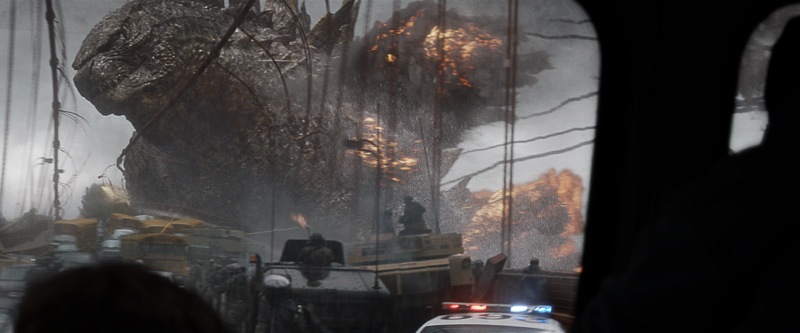
Edwards spends quite some time setting up the MUTO's motivations and the plight of the Ford family, soon making you ask a most pertinent question: where is Godzilla? It must be stated that there is surprisingly little scenes of the actual Godzilla in this movie, but when he finally does appear, he does so with a vengeance. The giant reptile is the MUTO's natural enemy of ages past and as one big bug called the other, so too their predator woke up to find its prey, as expert Dr. Serizawa (Hollywood's obligatory Japanese actor, Ken Watanabe) explains, while donning a foreboding look of concern and alarm that irritatingly stays for the entire film. The name Serizawa will sound familiar to Godzilla aficionados, and is just one of many little tidbits Edwards has lovingly thrown in as an hommage to the Japanese movies. The MUTO's, however, are a new invention specifically for this film, but they serve their purpose adequately for resurrecting Godzilla and providing for a good old-fashioned Kaiju brawl at the movie's climax. Just like the Godzilla themes of old have hardly changed, so too does the audience's taste for big monster battles remain, as Edwards all too clearly understands. It just takes quite a while to arrive at that point in the film where the fight finally goes down. We have to sit through many a scene of human character drama that ultimately doesn't make us really care about their plight before we get what we want. Though patience is required, it cannot be denied that the introduction of both Godzilla and his adversaries is slowly but surely built to a crescendo. When the Big G finally does appear for the first time, it will be hard for fans to repress a chill at this reunion with their old friend. It would have been even more effective had the classic Godzilla score been applied, but the current soundtrack proves effective enough.


It's clear Edwards sees no point in redefining Godzilla's look, as Emmerich did before, as this new incarnation of Godzilla stays rather true to the recognizable Japanese forms. Of course, this being a big blockbuster movie, the beast has grown in size considerably to accommodate the humongous budget and the expected onslaught it wreaks on both human cities and the military forces thrown at him. Edwards' respect for the classic Kaiju movie approach of men in suits playing the monsters shows, as you'd almost be inclined to think Godzilla is brought to life again in just that manner. Even the MUTO's motions seem decidedly human at times, but make no mistake: all three monsters are fully digital creations, not guys in suits smashing cardboard sets. Nevertheless, Edwards' ode to sixty years of 'suitmation' is well appreciated. Still, the notable differences in Godzilla's appearance compared to his predecessors, particularly his rather obese bodily features, are bound to tick off some fans.

Unjustly so, as this Godzilla, both the execution of the titular character and the movie as a whole, form a vast improvement over the previous American capitalization of the Japanese property. That said, in terms of story Edwards adds little novelty to the previous fifty years of Gojira. The message remains the same, and is delivered in a rather serious fashion, as this particular Godzilla is certainly one of the darker takes on the character: for Edwards, giant monster movies are a serious business and there isn't much room left for levity. The usual tendency towards flat human character development interspersed between delightful monster battles remains. The fact is, there's only so much you can do with a giant monster. Edwards will be hard pressed to find innovative angles to take his successful reboot in for the next installments. However, as this movie demonstrates, times haven't changed enough for the cautions against man's tampering with nature to subside, nor has the audience changed to such an extent they can't appreciate a good ol' titanic monster clash on the big screen. Even if the upcoming sequels fail to deliver notably new directions for the franchise, clearly Godzilla has enough of a fight left in him for another fifty years.


maandag 7 april 2014

Today's Double News: less than yesterday


Let's resume posting news in the usual frequency, shall we?

http://www.moviescene.nl/p/154917/marvels_dreadstar_wordt_bioscoopfilm

http://www.moviescene.nl/p/154916/nieuwe_uitgebreide_trailer_godzilla

I had only vaguely heard of Jim Starlin's Dreadstar, which is not surprising as it didn't get a Dutch translation, unlike many other Marvel comics. It's not a part of the regular Marvel Universe, instead being featured on the pages of Epic Illustrated, a semi-independent Marvel imprint where creative talent could show off their own ideas and keep more of their royalties accordingly. Now that Marvel is a really, really hot brand, it's a no-brainer studios, big and small, are looking for as yet unexploited Marvel properties, even in more obscure corners. It's good to see lesser known franchises are also eligible for cinematic adaptations, though in Dreadstar's case, it's hard to sell to a financier since the story is so unlike the existing Marvel movies, not to mention wholly outlandish and definitely expensive to produce. Audience expectations of super heroism when hearing the name Marvel might also work against the project, as this is totally different conceptually from the Marvel style people have come to know and love from the movies. Don't expect crossovers with already established characters, even the cosmic ones like Thor or the upcoming Guardians of the Galaxy. Dreadstar is a whole different animal. Which is what makes it exciting as a movie project, but a tough sell for the small studios that now own the rights. Whether Dreadstar will truly make it to the big screen only time will tell. I'm hoping there's room for unusual Marvel off-shoots like these though. There's more to Marvel than superheroes, you know? I can live without an adaptation of Millie the Model though.

I could also live without another American remake of Godzilla, but Hollywood is presenting us with one of those regardless, and I gotta say, it doesn't look so bad. Considering how few of the original Japanese movies can actually be called 'good', that's not so hard to pull off. This new 'extended look' isn't as extended as you might at first be inclined to think, and basically serves as yet another trailer, with about half of its material shown before and the other half new stuff to keep us interested. And since Breaking Bad, I'm always interested in Bryan Cranston, even is he is playing second fiddle to a giant digital reptile. It seems the trailer is telling us that the human element to the story is not neglected - good thing to, if you have an actor of Cranston's stature on your payroll - though of course the creature is still of greatest interest and therefore, not shown as much as you would like, confined to shapes and silhouettes. It keeps the audience in suspense as to what this latest incarnation of the King of Monsters will look like. Though those who really want to find out need only take a look at the movie's merchandise, which has already been released. Wanna see what the new Godzilla looks like? Click this link. That's right, he's fat. And his spikes are rather small. And there's a million other things fans might hold against this design, but hey, at least he doesn't look like his silly Sixties' Japanese counterpart seen here, which could be seen merrily cavorting in kids' movies, dancing around and such. You wonder how this beastie could have grown so iconic despite doing a bunch of these terrible kiddie pictures.


zondag 23 februari 2014

Today's Poster: the big G returns to do what he does best


I found another neat new poster to post on MovieScene:

http://www.moviescene.nl/p/153929/nieuwe_poster_godzilla

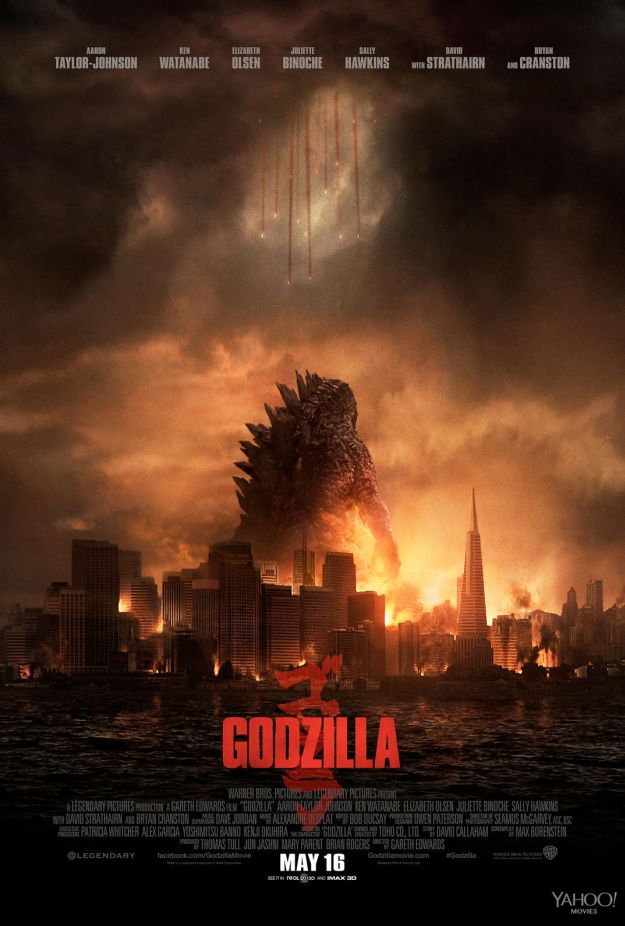
This is how you do a good poster, at least in the case of a remake (which is sort of what this movie is, though there's plenty of room for new material). You refamiliarise your audience with the character in question, in a setting that brings about a shock of recognition. It reminds you what you remember most about what you liked about the original character, which is thrashing cities in Godzilla's case. If you like Godzilla at all, that is; which a lot of people apparently do, considering the 28 original Japanese movies and the two American remakes, this being the second. It's a giant monster movie staple, but spectators still get a kick out of seeing human habitat laid to waste at the feet of some ferocious, titanic creature. Especially if the city being demolished is familiar to them (hence why these movies usually tend to favour big landmark cities, obviously). At the same time, this movie makes you curious enough not to get overly negative about this iconic character being milked again for a new generation, by adding the element of curiosity. What are those falling lights above Godzilla's head? Is he gonna get mixed up with alien lifeforms with nefarious schemes again, maybe? This poster also adequately displays what Godzilla is all about (or at least, should be), functioning as the ultimate nuclear nightmare destroying human lives by the thousands after having been resurrected by man's folly of playing with powers too big and volatile for his control or understanding. Nevertheless, if Godzilla will indeed fight extraterrestrial antagonists or rivalling giant mutations, he may also be mankind's only hope. Whether 'Kaiju' enthusiast Gareth Edwards (Monsters) will opt for either take on Godzilla, or just go for both, remains to be seen. That he gets Godzilla however seems clear from this poster. Plus, unlike what happened to the previous Godzilla, he honours the original Japanese design by staying close to it, instead of giving him a giant make-over as occurred in 1998. That also can't hurt.

maandag 26 augustus 2013

Today's Article: Destination God, Part 3: Chapter 3

Hoofdstuk 3: Religie in de terrestrial creature en altered human subgenres

Hoewel religie zeker aanwezig is in zowel het ‘terrestrial creature’ als het ‘altered human’ subgenre, zal ik beide genres hier samen kort behandelen. De reden hiervoor is dat religie in beide genres in grote lijnen op dezelfde manier naar voren komt en een vergelijkbare boodschap beschrijft. Als geheel is zij minder prominent aanwezig dan in de ‘man into space’ en ‘alien invasion’ subgenres. Desondanks, religie is wel degelijk aan te treffen in beide subgenres, waardoor een beschrijving van haar rol hierin niet in dit paper mag ontbreken.


Het met religie verbonden thema dat als rode draad door beide subgenres loopt is het spelen of rommelen van de mens met machten die buiten zijn begrip en controle liggen, vaak letterlijk aangeduid (zowel in de films zelf als in dat wat over de films geschreven is) als ‘playing God’. De wetenschap bedoelt het niet slecht en is slechts uit op nieuwe uitvindingen en inzichten die het leven van de mensheid er beter op maken: men is zich bewust van het gevaar, maar acht het de moeite waard het risico te nemen ten bate van de vooruitgang. Zoals gesteld wordt in Monster on the Campus (USA: Jack Arnold, 1958):

Man can use his knowledge to destroy all spiritual values and reduce the race to bestiality. Or he can use his knowledge to increase his understanding to a point far beyond anything now imaginable. [my emphasis]

Maar door gebrek aan inzicht en vooral overmoed lopen dergelijke experimenten uit de hand, met rampzalige gevolgen. De termen die de subgenres volgens mijn benaming aanduiden reflecteren deze gevolgen: in het ‘terrestrial creature’ subgenre wordt Amerika bedreigd door reusachtige monsters, in het ‘altered human’ subgenre wordt de mens zelf vervormd. In beide gevallen wordt frequent gesproken van een straf van God, of in ieder geval een hogere macht, voor het rommelen met krachten die alleen Hij beheerst en mag beheersen: ‘divine retribution’, noemt John Brosnan het.1 De mens leert zijn les: aan het eind van bijna elke film uit deze subgenres wordt opgemerkt dat men arrogant en onverantwoordelijk was om met goddelijke machten te rotzooien. Zulke machten, van het atoom of van de natuur, hebben opnieuw bewezen niet te bedwingen te zijn: eens te meer beseft Amerika dit.2 ‘Humanity acknowledges that it has been arrogant in presuming upon its role in the cosmos’, zo omschrijft Lucanio dit besef, wat hij aanstipt als eindpunt in een vastliggende narratieve formule die welhaast constant gebruikt werd in het ‘terrestrial creature’ subgenre.3
Het voornaamste verschil tussen beide subgenres ligt hem in de schaal van het experiment en haar gevolgen. In het ‘terrestrial creature’ subgenre is deze schaal collectief: de omvang van het experiment en de daarbij gebruikte krachten (meestal verbonden met de atoom- of waterstofbom) genereert een kolossale ramp – op te vatten als zowel de grootte van de monsters als de omvang van de door hen aangerichte ravage – die hele steden verwoest en duizenden bedreigt (voorbeelden: It Came from Beneath the Sea (USA: Robert Gordon, 1955), The Deadly Mantis (USA: Nathan Juran, 1957)). Vivian Sobchack citeert Joe Kane, die spreekt van het ‘Bestial Invocation theme’: ‘…the creatures are seen as instruments of punishment for nuclear misuse’.4 Hoewel niet de hele samenleving direct verantwoordelijk is ligt de schuld bij het collectief: de geleerden in deze films werken nooit alleen, maar altijd in groepsverband in dienst van de regering. Het mandaat voor hun experimenten ligt bij de politiek en het leger dat hun werk goedkeurt en zelfs aanspoort in naam van het volk, waardoor in feite iedereen indirect schuld draagt aan de monsterlijke gevolgen. De schuld is collectief, als reflectie op de angst voor het atoom (de belangrijkste oorzaak voor het ontstaan van de creaturen) die immers ook collectief is.5
Hiertegenover plaatst het ‘altered human’ subgenre de individuele schaal van de eenzame wetenschapper die afzonderlijk werkt aan een experiment dat grote gevolgen kan hebben voor het welzijn van de mensheid. Lucanio duidt deze variant aan als de Prometheustekst.6 De ramp voltrekt zich en alleen deze wetenschapper zelf wordt getroffen en vervormd. Hierna valt hij op kleine schaal, vaak op persoonlijk niveau (de mensen in zijn directe omgeving, degenen die hij liefheeft), de maatschappij aan. Lucanio, voortbouwend op de rol van de ‘scientist hero’ als de ‘American Adam’ (zie Paragraaf 2.2), omschrijft deze ongelukkige ‘scientist hero’ als ‘Adam falling’:

He is tempted and seduced by the serpent of curiosity, and he invariably partakes of the forbidden fruit of scientific experimentation. […] the scientist’s acquisition of knowledge is at the expanse of his own life, a reflection of God’s curse upon Adam that “in the day thou eatest thereof thou shalt surely die.”7

Deze ‘misguided scientist hero’ alleen draagt schuld: vaak hebben zijn naasten hem gewaarschuwd tegen het voor God spelen en sloeg hij hun advies in de wind wegens zijn hoogmoed (voorbeelden: The Fly (USA: Kurt Neumann, 1958), Monster on the Campus). De wetenschappers in het ‘terrestrial creature’ subgenre zijn daarentegen minder blasfemisch en uiten zelf hun angsten voor het experiment en de krachten die daarmee gepaard gaan, maar gaan er toch mee door aangezien ze hun werk van groot belang achten. Twee citaten onderstrepen dit. Het eerste citaat, uit The Fly:

Helene: ‘It’s frightening. It’s like playing God.’
André: ‘God gives us intelligence to uncover the wonders of nature. Without that gift nothing is possible.’
Helene: ‘Oh André, I get so scared sometimes. The suddenness of our age; electronics, rockets, earth satellites, supersonic flight. And now this. It’s not so much who invents them, it’s the fact that they exist.’
André: ‘But you’re not frightened of TV, or radio, or X-rays, or electricity, or that the Earth is round.’
Helene: ‘No, but everything’s going so fast, I’m just not ready to take it all in. It’s all so quick!

Dit citaat refereert expliciet naar God en het ‘playing God’ motief, waarbij de vrouw van de wetenschapper haar angst verwoordt en haar man waarschuwt: deze heeft hier echter geen oren naar en wijst naar de positieve resultaten van andere wetenschappers als excuus voor zijn eigen experiment. Vergelijk het tweede citaat, uit The Beast from 20,000 Fathoms:

Nesbitt: ‘The world’s been here for millions of years. Man’s been walking upright for a comparatively short time. Mentally, we’re still crawling. This test will add to our knowledge.’
Ritchie: ‘Every time one of these things goes off I feel as if we were helping to write the first chapter of a new Genesis.
Nesbitt: ‘Let’s hope we don’t find ourselves writing the last chapter of the old one.’
Evans: ‘You sound like a man who’s scared, Tom.’
Nesbitt: ‘What makes you think I’m not?’

Dit citaat omhelst een dialoog tussen wetenschappers die zelf hun bedenkingen verwoorden en niet gewaarschuwd hoeven te worden door buitenstaanders: er wordt verwezen naar de Bijbel, maar niet naar het opperwezen zelf. In het eerste citaat wil de wetenschapper van geen wijken weten, terwijl de wetenschappers in het tweede citaat zich wel bewust zijn van het gevaar en er daarop zorgvuldiger mee omgaan.


Hoe wordt God gezien in deze subgenres? In het ‘terrestrial creature’ subgenre wordt zelden direct melding gemaakt van God: er wordt doorgaans gesproken van ‘hogere machten’ of ‘Moeder Natuur’ die wraak nemen voor de transgressies (het tweede belangrijke thema in dit subgenre is ‘man against nature’, maar de natuur en God spelen hier eenzelfde rol). Immers, God stond in het Amerikaanse denken aan de Amerikaanse kant dus Hij zal zich niet tegen Amerika keren (zie Hoofdstuk 1). De precieze benaming van degene die de straf oplegt blijft in het midden op het gebruik van vage termen na, maar de boodschap is hetzelfde: spelen met goddelijke machten is ‘not done’, ook niet voor de natie die Gods zegen draagt. Hiertegenover plaatst het ‘altered human’ subgenre het individu dat gestraft wordt voor ‘playing God’: God wordt hier vrijwel altijd met name genoemd als de benadeelde die wraak neemt voor de zonde (zie het citaat uit The Fly). ‘Playing God’ levert hier een letterlijke straf van God op.
Hoewel God zelf zelden bij naam genoemd wordt in het ‘terrestrial creature’ subgenre, worden de monsters die de mensheid bedreigen in Bijbelse context getrokken, vooral verwijzend naar de Apocalyps. Een klassiek citaat uit Them! (USA: Gordon Douglas, 1954):

We may be witnesses to a Biblical prophecy come true: ‘And there shall be destruction and darkness come upon creation, and the beasts will reign over the earth.’

Dergelijke citaten worden frequent gebruikt in het subgenre. Zo maken deze films de omvang van de verwoesting die zulke wezens kunnen aanrichten duidelijk voor het Godvrezende Amerikaanse publiek door het in een context te plaatsen met de Dag des Oordeels. Niet voor niets komt een archetypische variatie op het ‘terrestrial creature’ vaak terug in het subgenre: de slang, het serpent, het reptiel, symbool voor het kwaad (o.a. in The Giant Behemoth (USA/UK: Eugène Lourié, 1959)8 en The Beast from 20,000 Fathoms (USA: Eugène Lourié, 1953)).9 Gelukkig laat de wetenschap (of misschien God) het niet werkelijk zo ver komen, maar de bedreiging voor de mensheid wordt onder krachtige verwoording gebracht.
Het Amerikaanse individu wordt wel direct door God gestraft, de Amerikaanse maatschappij niet. Niet voor niets is de straf tegen de samenleving in het ‘terrestrial creature’ subgenre slechts van tijdelijke aard, aangezien de wetenschap uiteindelijk altijd het middel geboden wordt de straf (de monsters) te vernietigen zodat ‘normality’ hervat kan worden (voorbeelden: Them!, The Beast from 20,000 Fathoms), terwijl de straf in het ‘altered human’ subgenre fataal is en de zondaar zijn transgressies met de dood moet bekopen (voorbeelden: 4D Man (USA: Irvin S. Yeaworth Jr, 1959), War of the Colossal Beast (USA: Bert I. Gordon, 1958)): ‘death takes him for looking upon the face of God’, zo omschrijft Lucanio dit thema.10 God vergeeft het collectief, maar nooit het individu, in het sciencefictiongenre.

De narratieve formule van de wetenschapper als Prometheus die voor zijn hoogmoed gestraft wordt door God is prominent in het ‘altered human’ subgenre en vormt het grootste deel van het subgenre. Er zijn echter enkele ‘altered human’ films die geen gebruik maken van deze formule en een andere verhaallijn hanteren, waarin ook de relatie met God anders ligt. In deze variatie op het thema wordt niet een wetenschapper, maar een doorsnee burger veranderd door krachten die hij/zij niet zelf in werking heeft gezet. Voorbeelden van dit afwijkende narratief zijn aan te treffen in onder andere Attack of the 50 Foot Woman (USA: Nathan Juran, 1958) en The Incredible Shrinking Man (USA: Jack Arnold, 1957).
De relatie tot het goddelijke wordt in dit type films minder besproken dan in de Prometheustekst. De vervormde protagonisten zien hun lot niet als veroorzaakt door de hand van God, maar als een onverklaarbaar fenomeen, dat mogelijk het werk van de wetenschap is (wat niet bewezen kan worden). In The Incredible Shrinking Man wordt de transformatie bijvoorbeeld veroorzaakt door een mysterieuze nucleaire nevel die over zee drijft en waar de hoofdpersoon mee in aanraking komt; de oorsprong van deze nevel wordt verder niet ter discussie gesteld. Aangezien deze personen hun lot niet opzettelijk over zichzelf hebben afgeroepen, in tegenstelling tot de wetenschappers in de rest van het subgenre, worden zij niet gestraft door God. Waar de wetenschappers hun verandering met de dood moeten bekopen, is dit voor de burgers in deze variatie vaak niet het geval.
Het belangrijkste thema dat dit type films aanspreekt is de relatie tussen het veranderde individu en de conformistische maatschappij. De maatschappij ziet de ‘altered human’ als een freak, een mogelijke bedreiging voor de conventies van ‘normality’. In dit thema is maatschappijkritiek op de conformistische Amerikaanse samenleving in de jaren vijftig te herkennen. De angst voor dergelijk conformisme was reëel in deze periode. Mark Jancovich legt uit dat

There was a deep-seated anxiety about social, politic, economic and cultural developments which led many to argue that America was becoming an increasingly homogeneous, conformist and totalitarian society; that the basis of individualism was being eroded: and that the possibility of resistance was disappearing.11

Het ‘altered human’ subgenre bekritiseert dit conformisme, door te stellen dat het individu dat zich niet conformeert naar de samenleving met argwaan wordt bekeken. Men dient zich te schikken naar de principes van de massa waardoor een ‘loss of self’ ontstaat: het individu mag zich niet ontwikkelen in een gewenste eigen richting. Echter, in het ‘altered human’ genre is de non-conformistische ontwikkeling niet gewenst door het individu, maar is sprake van een ongeluk. De samenleving, vooral de naaste omgeving, kan begrip opbrengen, maar als het veranderde individu een bedreiging vormt dient ermee afgerekend te worden zoals met elke andere bedreiging. De empathie van het publiek ligt echter bij de getransformeerde en niet bij de conformistische samenleving.


Na het ongeluk resulteert de positie van de veranderde in de existentiële vraag hoe hij/zij tegenover de maatschappij staat. Hier komt ook het religieuze aspect - indien aanwezig, want niet iedere film uit deze variatie betrekt religie in haar verhaallijn - bij kijken. Laten we The Incredible Shrinking Man als voorbeeld houden. In deze film komt de vraag naar de plaats van het individu, Scott Carey, het meest tot uiting, aangezien de veranderde in dit geval geen bedreiging is voor de maatschappij en er daardoor geen strijd losbarst hem te vernietigen voordat hij mensen doodt. Dit in tegenstelling tot die films waarbij de transformatie gigantisme als resultaat heeft waardoor er letterlijk ‘geen plaats is in de samenleving’ voor de ‘altered human’ (zoals in Attack of the 50 Foot Woman en War of the Colossal Beast. In The Incredible Shrinking Man blijft zijn begripvolle naaste omgeving Scott hoop bieden tot het eind toe (althans, tot het moment dat men meent dat hij opgegeten is door de kat). Het is Scott zelf die stelt dat er voor hem geen plaats is en die het hardst is in zijn oordeel over zijn relatie tot zijn directe omgeving:

I felt puny and absurd, a ludicrous midget. Easy enough to talk of soul and spirit and existential worth, but not when you're three feet tall. I loathed myself, our home, the caricature my life with Lou had become. I had to get out.

In dit citaat komt zijn relatie tot het hogere en ondoorgrondelijke (‘soul and spirit’) al tot uiting, maar de connectie met het goddelijke wordt pas op het eind gelegd. In de klassieke slotmonoloog brengt Scott zijn nieuwe positie tegenover God en het universum tot uitdrukking, en vindt hij vrede met zijn verandering, als hij krimpt tot in de oneindigheid:

I was continuing to shrink, to become... what? The infinitesimal? What was I? Still a human being? Or was I the man of the future? If there were other bursts of radiation, other clouds drifting across seas and continents, would other beings follow me into this vast new world? So close, the infinitesimal and the infinite. But suddenly, I knew they were really the two ends of the same concept. The unbelievably small and the unbelievably vast eventually meet - like the closing of a gigantic circle. I looked up, as if somehow I would grasp the heavens. The universe, worlds beyond number, God's silver tapestry spread across the night. And in that moment, I knew the answer to the riddle of the infinite. I had thought in terms of man's own limited dimension. I had presumed upon nature. That existence begins and ends is man's conception, not nature's. And I felt my body dwindling, melting, becoming nothing. My fears melted away. And in their place came acceptance. All this vast majesty of creation, it had to mean something. And then I meant something, too. Yes, smaller than the smallest, I meant something, too. To God, there is no zero. I still exist! [my emphasis]

Scott begrijpt dat, hoewel dit niet geldt voor de conformistische en daardoor beperkte menselijke samenleving, God alles accepteert voor wat het is (hoe groot of klein ook). In deze kijk op de relatie tot het goddelijke vindt Scott verlichting en betekenis. The Incredible Shrinking Man is de enige ‘altered human’ film die deze blik op God hanteert, en vormt zo een uitzondering in een subgenre waarin God doorgaans gezien wordt als wraakzuchtig en waarin Hij transgressies afstraft, maar in dit geval barmhartig is en het veranderde individu verlossing schenkt door hem in eenheid met het universum te brengen.12

 
1 Brosnan 1978: p. 95
2 Baxter, John. Science fiction in the cinema. New York: A.S. Barnes & Co., 1970: p. 138
3 Lucanio 1987: p. 44
4 Kane geciteerd in: Sobchack, Vivian Carol. The limits of infinity: the American science fiction film 1950-75. New Jersey: A.S. Burnes and Co. Inc., 1980: p. 46
5 Sobchack 1980: p. 47
6 Lucanio 1987: p. 46
7 Lucanio 1987: p. 89
8 De titel van deze film verwijst op zichzelf al naar de Bijbel, naar de ‘Behemoth’, het grootste monster ooit.
9 Lucanio 1987: p. 55
10 Lucanio 1987: p. 105
11 Jancovich 1996: p. 22
12 The Incredible Shrinking Man wordt door alle critici die het ‘altered human’ subgenre bespreken als meesterwerk beschouwd, terwijl de andere films uit de hier besproken variant van het subgenre verguisd worden als matige, oppervlakkige B-films. Als zodanig is deze film niet alleen een uitzonderlijke film in mijn corpus, maar in het gehele subgenre. Hoewel ik niet alle films uit het ‘altered human’ subgenre gezien heb (hoofdzakelijk vanwege beschikbaarheid), kan ik met zekerheid zeggen dat The Incredible Shrinking Man de enige film uit het subgenre is die deze kijk op de relatie tussen God en het individu bespreekt. Als zodanig vond ik niet dat de film, hoe summier beschreven dan ook, in deze scriptie mocht ontbreken.

woensdag 24 juli 2013

Today's Mini-Reviews: giant robots, Kaijus and super-villains


Pacific Rim: ****/*****, or 7/10

Guillermo Del Toro's epic hommage to the Japanese 'Kaiĵu' movies, produced on a bigger budget than all such giant monster movies of the last fifity years combined. Del Toro obviously has a great love and respect for the genre, resulting in a very catchy action flick, undoubtedly the best American counterpart to its Japanese predecessors. One might almost say Hollywood has redeemed itself for the 1998 version of Godzilla, but such a statement had better be held back for another year, until the next American reboot of Godzilla hits theatres in 2014. In the meantime, Pacific Rim works well as an appetiter to the big G's resurrection. An extra-dimensional rift opens on the bottom of the Pacific and huge beasts come pouring out, wreaking havoc on mankind as they lay waste to cities and obliterate our armed forces. Humanity quickly sets aside its internal differences and joins forces in creating big robots to fight the creatures on their own terms. Piloted by a pair of human Avatars, these so-called 'Jaëgers' effectively combat the beasts, but the life of a Jaëger pilot as Del Toro reveals is filled with personal loss. When the monsters emerge ever more rapidly from the Breach, as it is named, Jaëger command develops an intricate and dangerous plan to halt the Kaiĵu threat once and for all. Del Toro briefly explores the history of the first Kaiĵu assaults and the development of their robotic antagonists and afterwards spends more time getting us invested in the human characters than is usual for this type of film. It does make the movie feel like its dragging its feet for a while, until he unleashes the action the audience craves with a vengeance, resulting in over an hour of nigh endless monster bashing. Unfortunately he cannot help but inserting a few characters that are supposed to deliver some much needed comic relief to make sure we don't take it all too seriously, but sadly these characters – stereotypical geeky scientists as ever we've seen them – are so mind-boggingly annoying (Charlie Day particularly) they make you wish for a Kaiĵu to step on them to end their endless whining. Del Toro's talents are beter suited in delving deeper into a world where Kaiĵus are not only a threat to world peace but also big business: toy companies produce action figures of them, creepy cults worship them and in Hong Kong, a 'Bone Town' is established, a black market for Kaiĵu products for shady purposes, similar to the disgusting existing South-East Asian trade in animal parts. Run by Ron Perlman (always a joy when paired with Del Toro), some of the funniest, wittiest and anatomically most unsettling scenes take place here. Though the dealings and the history of the Jaëgers are fleshed out to the fullest, their enormous alien adversaries, ever the most important ingredient in a Kaiĵu film, do remain somewhat underexposed by comparison. Unfortunately their motivations – they're really foot soldiers out to cause as much damage to mankind as possible, in order to pave the way for an invasion from their (smaller) intelligent overlords – remind us of the recent Shyamalan flop After Earth, a movie we'd rather forget entirely. Usually, Kaiĵu are more antiheroes than full-out villains, but Del Toro opts to keep them a simple threat to be wiped out instead of embuing them with a more sympathetic character like their forebears Gojira, Gorgo and Rodan, who were always the victim of human (nuclear) folly, transforming them into avenging gods to remind us of our place in the world. The movie is dedicated to Ray Harryhausen and Ishiro Honda, two people who only too well understood the need to layer their creatures and make them charm you so you feel more for them, but in this instance, Del Toro decided not to go with such wisdom. As a result, Pacific Rim at best is a highly likeable action flick, but not necessarily an apt lesson for western audiences into the true nature of the Kaiĵu genre. Then again, there's only so much you can do with the notion of giant robots bashing giant monsters. Let's say Guillermo gets as much out of that premise as we could hope for.


Despicable Me 2: ****/*****, or 7/10

Simply fun sequel to the animated surprise hit of 2010. Gru and his legions of minions are back, but no longer driven by the need to exact evil schemes on an unsuspecting world, as Gru (still voiced with a outrageously hilarious accent by Steve Carell) has taken to his role as a father figure for his three orphan girls Edith, Agnes and Margo quite seriously. The big question on the girls' minds of course is – much to Gru's chagrin – 'when will there be a surrogate mother too'? Apparently several thousand minions are not enough to fill that particular role, so Gru has to endure countless matchmaking on their part. Fortunately for him, he quickly finds himself abducted by agent Lucy (Kristen Wiig returning for the sequel, but voicing another character) of the AVL, the American Vampire League Anti Villain League, who means to recruit him to smoke out a threat to world peace apparently hiding in a shopping mall, potentially posing as one of many goofy shop owners. Gru hesitantly accepts the job, if only to escape his girls' endless romantic pestering. Needless to say, Lucy and Gru soon get romantically entangled while attempting to stop the outrageously stereotypically Mexican baddie El Macho (Benjamin Bratt) from completing his vile scheme to unleash thousands of vicious purple monsters (most of them harvested from Gru's own minions) on mankind. Though the plot leaves little room for narrative surprises, the infectious charm of the characters and a plethora of witty jokes for young and old make for a thoroughly enjoyable animated flick. As before, it's the endearing minions that steal the show – a fact that has already been confirmed to deliver them their own movie next year, which may not be such a good idea – but thanks to the effective emphasis on Gru's own plot line, including a flashback to his youth which is both sad and superbly funny, it also becomes ever more evident just what a droll character he is himself, considering he spends most of his time without his minions and vice versa, while the movie doesn't end up either boring or less hilarious whenever either party takes center stage (also thanks to Wiig's obvious enthusiasm). Though more attention on an original plot would be welcome for the unavoidable next installment, I can unabashedly say I'm looking forward to a Despicable Me 3 regardless. Preferably with both Gru and minions together once more instead of one or the other.