John Carter :
****/*****, or 8/10
Remember the time when the science
fiction and fantasy genres were less clearly delineated then they are
now, and science fiction asked for much more suspension of disbelief
and far less techno babble to sell its grandiose stories? You
probably don't, since we're talking before the actual birth of the
science fiction genre in movies, which would be the 1950s. In the
thirties so-called 'space operas', displaying epic story telling in
exotic locales with strange creatures (insofar as the budgets and
effect allowed, both of which were usually pretty limited) were a
staple of the Saturday matinee serials in movie theatres, where
people could shake off their worries brought along by the Depression
for a little while and transport themselves to the world of the weird
and wonderful. Then along came the fifties with the usual rocket
science, nuclear weapons and misguided scientists and the space opera
vanished until Star Wars revamped it in the late seventies and
made it nigh impossible to get away with a believable universe on
anything but the highest of budgets, which is the reason that
Hollywood rarely dares to return to the subgenre. Under Andrew
Stanton's direction, Disney now takes the gamble with John Carter,
the first of what will hopefully be a series of huge, marvelous
sci-fi movies based on Egar Rice Burroughs' classic Barsoom novels.
Stanton, of Finding Nemo and Wall·E
fame, delivers a grand, old-fashioned science fiction spectacle, on
an enormously high budget that also makes expectations for both the
audience and the studio itself rise to the roof (I myself surely was
stoked for this project for quite a while). Fortunately, Stanton
seemingly knows how to make an epic sci-fi flick with the right
balance of action, humour and stunning visuals, though at times he
unfortunately misses a few beats when it comes to storytelling.

Ironically, it's the segments of the
movie's plot that are Earth-based that form the weakest links of the
overall plot, feeling somewhat randomly intertwined and devoid of
coherence, both opening and closing the movie on an unsatisfactory
note. Around the turn of the nineteenth century, young Edgar Rice
Burroughs (Daryl Sabara) is called to his uncle's estate, where he
learns the good man, John Carter, has died and left everything to him
in his will, including his journals, which Eddie starts to read. They
tell of Civil War Confederate vet John (Taylor Kitsch, who previously
played a not too shabby Gambit in the otherwise forgettable X-Men
Origins: Wolverine) seeking a cave of gold in the Arizona
territory, where he's hindered in his efforts by a grumpy US Army
officer and several Apache indians, before stumbling upon said cave
by accident where he is transported to Mars via an odd medallion.
This is where the movie really kicks into gear and the fun truly
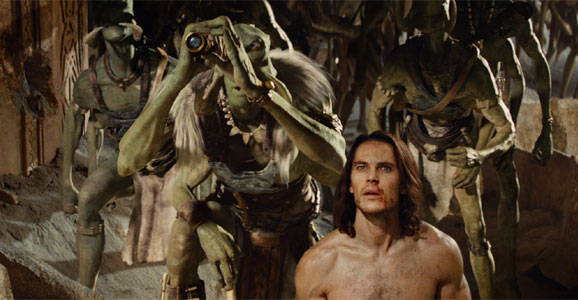
begins, as John is captured by a band of four-armed, green aliens
called Tharks, under the command of Tars Tarkas (performed by the
ever ingenious Willem Dafoe).
The Tharks turn out to be a warrior
race of noble savages, Tarkas being noble and the rest of them
savage, as is demonstrated effectively when they destroy their
unhatched eggs so weak offspring won't infect their tribe's strength,
while the overly cute newlyborns are subjected to very harsh
treatment, as is John. Because of the different gravity on Mars, he
finds himself to have superior speed, agility and strength over the
natives of Barsoom, their name for their red planet, making him a
force to be reckoned with, were it not for the fact he doesn't care
about anything other than returning home.
Meanwhile, unrest rules other parts of
Barsoom, as the great city states of Helium and Zodanga are at war
over dominance of the planet. However, a third party secretly
controls the war by supplying Zodanga's ruthless prince Sab Than (a
gnarly Dominic West) with a secret weapon, the Ninth Ray, which has
crippled Helium's fleet and forces its ruler, Tardos Mors (Ciaran
“Caesar” Hinds) to marry off his beautiful daughter Dejah Thoris
(Lynn Collins, also an X-Men Origins: Wolverine veteran) to
his nemesis to save his city from utter ruin. Dejah naturally feels
differently and flees, only to be hunted down by Sab and his minions,
which ends in a sensational battle between very impressive, awesomely
designed Barsoomian air crafts and Dejah's near-death, of which she's
saved by John who literally leaps to her rescue, after which Dejah
eventually convinces John, indifferent at first until he gets to know
the gorgeous princess a little better, to stay on Barsoom and help
her noble cause, with the aid of Tarkas and his daughter Sola
(Samantha Morton, but pixelized). The various key players now have
met and set off on a quest to save Helium from the Zodangan forces and
their insidious hidden overlords, the Therns, a race of immortal
beings who consider themselves gods and have a long term plan to rule
both Barsoom and Earth, though they did not account for the anomalous
John Carter and his great power. With the help of the Tharks, only
won over by Carter surviving a nasty Arena fight with two giant white
apes, a big battle between good and evil over the fate of Mars
ensues.
So there you have it: clearly defined
good guys, typically sinister bad guys, a band of brigands with a
vicious temperament but a heart of gold, a beautiful princess, a
nefarious prince being governed by shadowy puppeteers, all manner of
wildly fascinating creatures, big battles, a few chase scenes
involving atypical flying machinery and some mystical elements
involving powerful forms of energy and faux religion thrown in, all
come togther to form this elaborate space opera (though admittedly,
there's little 'final frontier' type space), simply called John
Carter. Thanks to Star Wars and many many many other works
of science fiction leeching off Burroughs' original works (at least,
original back in 1912) for decades, there's nothing really new to be
found here, but the end result is tremendously entertaining all the
same. The movie boasts a bunch of talented actors, including the
afore mentioned Dafoe and Hinds, as well as Mark Strong playing yet
another unbelievably bad, naughty man in the shape of the Thern
leader Matai Shang, something with which he can be thoroughly trusted
as always (has the man ever not played bad guys, you have to
wonder). The cast also includes James Purefoy amongst its ranks as
the dashing and sarcastic Kantos Kan, Captain of Helium: it will
please fans of the brilliant HBO series Rome to see Hinds and
Purefoy together again in the exact same type of relationship as they
had in the first century AD (and you get Polly Walker as a bonus,
playing another absolute bitch in the guise of Sola's rival Thark
Sarkoja). Kitsch and Collins, though playing the movie's leads, are
surrounded by better actors, but let's face it: so were Mark Hamill
and Carrie Fisher in Star Wars, and Sam Worthington plus Zoe
Saldana in Avatar. Overall they fare simply adequately, which
is enough for John Carter: it leaves some room for improvement
for the sequel. Overall, Collins' beautiful and sexy but strong,
smart and independent Dejah Thoris kicks Kitsch' human ass with ease
though.

Of course with an epic movie come epic
visuals, and John Carter delivers in spades, not only thanks
to the VFX department, which undoubtedly has been working overtimes
to get this project completed in time, but also thanks to the
beautiful natural vistas provided by the Grand Canyon location
shooting. As beautiful as the clear waters of the sacred river Iss
are the digital shots of the walking city of Zodanga or the spiral
tower at the center of Helium. However, it's the various digital
creatures that stand out the most, of which the most prominent are
the Tharks. They look very well rendered and don't attract attention
to themselves for being digital, which is a testament to both the
skill of the pixel pushing VFX artists as to the talent of the actors
performing and voicing these humanoid extraterrestrials. The Tharks
provide for the most memorable scenes of the film, not just because
of their bizarre look – green skinned, four armed and endowed with
big tusks on their cheeks – but also due to their fascinating
warrior culture, of which we would have loved to have seen more. Once
a proud and accomplished race, the struggle for survival amongst the
various Thark clans on the dying surface of Barsoom has slowly driven
them into barbarism, with the strongest specimens ruling the tribes
with an iron fist. However, as Tars Tarkas shows in his intelligent
and merciful leadership, they are not beyond redemption, still
revealing shreds of “humanity” (the word isn't particularly
sufficient here) and hope for returning to their former state as a
force to be reckoned with, an opportunity John eagerly provides them
with. Plus, there is the added bonus of a dark sense of humor to
Thark behavior, as we see them all too happily plundering a downed
Zodangan space craft or wryly saluting their new found Helium allies
in the final battle in the typical American fashion, proof that we
shouldn't take this movie all too seriously.
The same applies to the other digital
creatures in the film, most notably John's new Barsoomian pet Woolla,
a toad like dog creature (sort of a cross between Jabba the Hutt and
a squirrel) with an unlikely capacity for speed that provides for
most of the comic relief, but fortunately never gets to become a true
JarJarism as would have been possible, also owing to the fact he
can't speak. Woolla could easily have been a wholesomely annoying
sidekick as we've seen all too often in recent Hollywood
blockbusters, but Stanton thankfully seems determined to keep his
shenanigans down to a respectful minimum. Less funny and in fact a
real threat to our protagonists are the Barsoomian white apes John
has to face in the Thark arena to win the hearts of the crowd and
convince them to join Helium in its conflict for the good of all
Martian races. The arena fight is probably the movie's most sold
concept, displayed on many promotional materials and forming big
chunks of the various teaser spots and trailers. Though of course it
hearkens back to the simply stunning huge arena fights in Star
Wars Episode II: Attack of the Clones (which
remain unsurpassed), John's special powers make it at least
distinct instead of simply a pale copy. Leaping over these creatures
and smacking them with big boulders and chains proves to be a whole
different strategy of dispatching alien monsters than chopping their
limbs off with lightsabers. However, the arena fight is not the
climax of the film: that honour is reserved for the grandiose battle
between the Zodangan army and the combined Thark and Helium forces,
though the speeder craft chase between the giant mechanic legs of the
moving city of Zodanga and the aerial battle between Dejah's air
craft and her Zodangan pursuers that first has her team up with John,
also claim their equal share of sticking out as particularly well
executed dynamic action scenes that John Carter will be most
remembered for.

Unfortunately, even on Barsoom, plot is
far from everything, though it's not nearly as messy and forgetful as
the few Earth scenes which open and close the film. The story element
which fails the most here is the existence of the Ninth Ray, a
supposed energy force that serves as Zodanga's weapon of mass
destruction after having been given to this conquering nation by the
scheming Therns. It's obviously a great source of power as showcased
when it destroys air ships and ground troops alike, but what exactly
it is and how it works is largely left under-explained. Dejah Thoris
at first is revealed to work on her own Ray which is stated by her to
have great potential for good as well as bad, but the movie never
picks up on this loose end later on. Things get even more complicated
when the Ninth Ray is brought into context with the nine planets in
the solar system, as if that's how it derives its power of
transporting the Therns, and John Carter himself, between planets,
but this plot twist too is left undeveloped. Either expositionary
scenes explaining the Ninth Ray energy were omitted for pacing
reasons, or the writers decided not to bother too much with the
specifics so as not to bore the audience needlessly, which sadly
makes this otherwise quite important story element, somehow
connecting Earth with Barsoom, the weakest link of the overall film.
At least the Therns, wielding its stupendously awesome power which
makes them consider themselves untouchable gods among the insect
inhabitants of both worlds, prove to be an intriguingly crafted race
of antagonists, pulling the strings of both the Zodangans by
directing their moves in battle and the Tharks by being their
uncompromising deities in a heartless religious relationship that
forces its subjects to abandon everything and sail forth on the river
Iss towards an uncertain vision of paradise. It would have been even
better constructed in a narrative sense if the Therns also secretly
manipulated Helium as well, thus “Palpatining” all sides in the
struggle for Barsoom and setting them against each other just so
eventually they could pick up the pieces and declare themselves the
true victorious party in the aftermath of the global war they
instigated, but their shady plan works well regardless just
controlling two races. Given the established Thern presence on Earth
which is largely brushed over in this film, it's highly likely we'll
be seeing more of them in the sequel, which has already been
announced to be aptly titled John Carter: The Gods of Mars.
This movie ends clearly leaving room for further trips to Barsoom, as
we see John's death was only a ruse on his part to return to Mars in
a somewhat confusing fashion, while a sequel would do well bringing
closure to some of the more feebly written plot elements in its
predecessor.

Overall,
John Carter has its
narrative weaknesses, but otherwise succeeds perfectly in introducing
us to the wonderful realm of Barsoom, a world slowly dying because of
a lack of natural resources and the in-fighting of its natives, which
is only brought to a halt when introducing the random element of the
outsider John Carter. The movie provides for a solid combination of
dynamic pace coupled with magnificent visual sights, grand scale
battles between various fascinating cultures, all sorts of grotesque
alien creatures and superb art design (did I mention the wicked Helium and Zodangan costumes yet?). Whether it will captivate
general audiences, who might not be aware of the impact of the
Barsoom novels as written by Burroughs a century ago on science
fiction in literature and motion pictures since, remains to be seen,
as many of its once unique characteristics have been appropriated by
other texts in the same genre. People might see too much
Star Wars
or
Avatar in this movie, but those films are well known to
have copied elements from other works themselves. In this regard,
John Carter is just a late entry into the cinematic world,
where is was among the first of its kind in the world of literature.
People should not judge it too harshly for that and just accept it
for what it is, a genuine space opera that deserves to be embraced as
an old friend late to a party. I for one have, and I already look
forward to returning to Barsoom in the future.
And watch the trailer here:
http://trailers.apple.com/trailers/disney/johncarter/