zaterdag 12 oktober 2013

Today's Double News: survive these Nymphomaniac posters


Not one but two whole pieces of MovieScene news today, thanks to neglicence on my part in the last two days:

http://www.moviescene.nl/p/150732/milla_jovovich_en_pierce_brosnan_gecast_voor_survivor

http://www.moviescene.nl/p/150765/nieuwe_posters_van_lars_von_triers_nymphomaniac

An action thriller starring Milla Jovovich... what's next, a romcom starring Jennifer Aniston? Jovovich is basically one of the obvious go-to gals if you want a tough girl shooting people up in your film. In this regard Survivor is sure to deliver what the term 'action' usually promises, since Jovovich's catchy enthusiasm in all her roles of this type (and there have been few memorable movies in her resumé that don't fit that bill) carries those films, if nothing else does. Brosnan, once quite an action star himself but in the last few years choosing the route of diversification to show his capabilities as an actor instead of a moviestar, is not an unlikely choice for a film like this, though of course his exact role has yet to be revealed. My guess would be the mentor of the heroine, since he's not exactly villain material (though I wouldn't mind if he was for a change). James McTeigue is an interesting pick as director for this project, indicating this will either be a totally over-the-top action flick (like his Ninja Assassin), or a more serious and intelligent drama similar in approach to The Raven and the excellent V for Vendetta, both also by his hand. At this point, Survivor can go in any direction so there's little point to idle speculation.


Speculation however, is exactly what drives us when talking about Nymphomaniac. The carefully developed marketing strategy certainly keeps fueling our expectations and imagination as to just how this film, controversial from the get-go, will pan out. It's about sex and it contains explicit sexual material that deliberately borders - or indeed simply crosses that border altogether - on the pornographic, despite starring established actors. This is what we've been hearing for over a year now, but we have yet to see any fleshy substance. So far we've been treated to a single clip from each of the eight chapters the movie will be composed of every month (four in total at this point), and none of them revealed the steamy sex scenes we have come to anticipate are in store for us (which of course is the point, since we're expected to pay for them by going to the cinema). However, we have been provoked by excessively teasy promotional material, including the infamous original poster. And now the film's marketing campaign unleashes fourteen new character posters on us, all of them telling us the same single thing: male or female, this is gonna be a sexually charged film for every spectator. Wheter it will actually be a good film on its own merits remains to be seen, but it undoubtedly will be fascinating to behold what a rebel like Lars von Trier has to say about the nature of human sexuality and its role in contemporary society. And I can imagine these particular promotional materials becoming cult commodities in future years, since you don't find many theatrical posters this thought provoking, daring and suggestive. Hopefully the movie will be able to live up to the hype its advertising campaign is creating, instead of ending up hurt by it as our expectations have grown too outrageous to be satiated by the actual final content.


vrijdag 11 oktober 2013

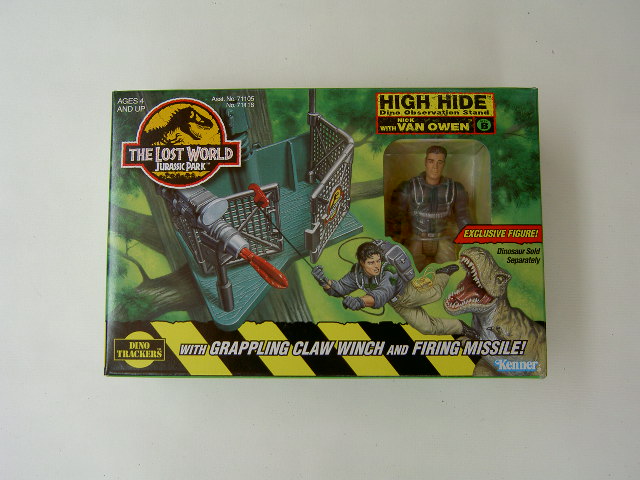
400th Post!: The Lost World Series 1: High Hide with Nick van Owen


Year of release: 1997

Accessories:
-Nick van Owen figure
-Backpack
-High Hide with missile launcher and missile


Description: the High Hide is basically a small dark green platform with a mechanism attached to it which allows it to be pinned to anything strong enough to hold it: most convenient thing would be the edge of a table, no more than five centimetres thick. The parts of the mechanism that clamp to the table are covered with black rubber, to make sure the structure doesn’t slip loose. Some small silvery grey fences can be pinned to the green platform, so the figure doesn’t fall off. One of these fences on the front side of the set is a door which can be opened and closed, and has a TLW logo sticker on it. A metal framework can be pinned to the fences on either side of the set, so the High Hide can also hang onto things. Additionally, this set comes with a missile launcher, sporting a paint job consisting of dark grey and silvery grey highlights and a red button on top to fire the missile, also coloured red. The missile launcher is attached to a pole standing on the green platform, allowing it to be turned 360 degrees.
The missile launcher has a hole in it. This allows the backpack, also coloured in a dark grey paint job with silvery highlights, to be attached to it via a red hook, which is attached to a piece of black string coming out of the pack. This string can be pulled out of the pack to an extent of about 20 centimetres. The backpack has a red button sticking out its right side. Pushing this button inwards makes the string get stuck so it can’t be pulled out further. Pulling the button out makes the string be yanked back inwards with force. This system allows the Nick figure to hang onto the High Hide set via the pack attached to the missile launcher; the pack can be pinned onto Nick’s back. Pulling the red button then causes Nick to shoot upwards to the platform, away from hungry predators on the ground.
Nick himself sports gloves and a sweater with the same dark grey paint job as the missile launcher and the backpack, but now adorned with dark green highlights, same colour as the platform. He does have a silver harness with a hole in it on his back so he can be pinned to his backpack. The sweater has a yellow JP: Site B logo patch on the right upper sleeve. Nick’s pants are coloured beige with a non removable yellow rope and hook on the left leg’s side. On his right upper leg he’s got a knife and a pocket coloured in the same beige so hardly noticeable. It’s simple ornamentation, you can’t do anything with it. Nick’s shoes are dark greyish brown. Nick has dark hair and eyebrows. He stands in an active pose, with his left leg positioned in a forward motion and his right leg in a slight backward stance.

Analysis: this is a great small play set and a welcome relief from small vehicles with exclusive figures. It adds some variety to the toy line. The mechanism that pins the High Hide to a surface works well, even though it has a limited range. The missile launcher is a somewhat predictable action feature, but also works fine: it’s always handy to have the option to fire missiles to ferocious creatures lurking beneath your observation post, in case they come to close. And it’s just fun to shoot at action figures with launchers like these.
The backpack with its up-and-down system is a neat feature, but unfortunately breaks easily. This is mostly due to the force by which the pack is pulled upwards, which makes the wire slip loose or even snap in half. The pack also crashes into the platform quite roughly, especially with Nick attached to it, which may cause paint wear. It’s a fun action feature, but could have used a better design. After all, nobody wants a broken backpack.
Nick himself is a decent enough figure. The paint job isn’t too exciting, but clearly sets it apart from the regular TLWS1 Nick, and as far as the colouring is concerned it’s obvious this figure and this play set belong together.


Playability: the High Hide itself provides for some great playability, though if you don’t want the backpack to break you should be careful with it, thus limiting options. Still, the various ways in which this set can be attached to things, hanging or clamping, increases playability possibilities. The set is largely detachable (otherwise it wouldn’t fit in its box). The missile launcher can also be detached from the pole, though it’s too large for Nick to handle properly. Nick himself has the usual range of poseable body parts, but the way in which his legs are positioned may hinder things a bit, though the figure would have looked silly and not at all life like dangling from the High Hide in a completely neutral pose.

Realism: Nick’s head sure looks a lot like Vince Vaughn’s, just as with the hatless variation of the regular TLWS1 Nick figure. His outfit is totally different from what Nick wore in the film, but since Nick didn’t use the High Hide anyway some poetic license is permitted. The High Hide itself is a typical action figure version of the High Hide seen in the film. It’s considerably smaller, basically a one man observation post, and not a place of refuge for a small group of people, like intended in the film. Of course the missile launcher is totally made up: the humans in the film used guns only. They also didn’t use a backpack to get up and down from this set, but a cable system instead. Still, this is a good toy version of the High Hide as seen in the TLW movie.

Repaint: no. None of the components of this set would be repainted for later toy lines either.

Overall rating: 8/10. Despite the fragility of the backpack, this is a great set with a good enough figure and several interesting action features. It’s also a good addition to the larger play sets. It’s relatively easy to find in some territories, but was never released in others, making it much harder to find there. Ebay is a good solution as always. It may not be cheap, but this set is worth every JP toy fan’s while.

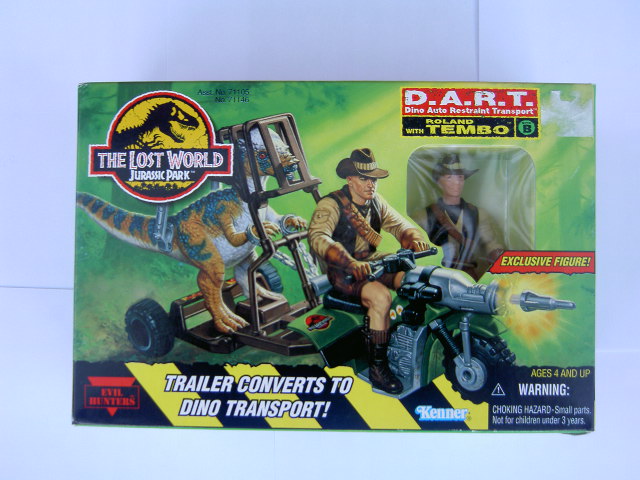
The Lost World Series 1: D.A.R.T. With Roland Tembo


Year of release: 1997

Accessories:
-Dino Auto Restraint Transport with capture gear and missile launcher
-Missile
-Roland Tembo figure 


Description: the Dino Auto Restraint Transport (i.e., D.A.R.T.) is a vehicle with bike like qualities, which features a fold-out platform on its back part equipped with capture gear for holding a dinosaur figure during transport. When the restraints are not in use, the platform can be folded in so it saves space and makes the vehicle quicker. Up front, the transport carries a small, shiny silvery painted, missile launcher which comes with a single missile, coloured in a more diffuse shade of shiny grey. When folded out, the D.A.R.T. measures about 25 centimetres in length, reduced by about 7 centimetres when folded back in. The capture gear on the platform can also be folded in somewhat when not is use instead of hideously sticking out.
Most of the “bike” part of the transport up front is painted dark green, with silver highlights including the chassis and foot supports for the driver. Additional parts are coloured black, including the steering handles and the saddle. It's adorned with various stickers, including a TLW logo and InGen logo sticker and various logos of dinosaur skulls with red X-es through their eyes, indicating kills or captured prey. The platform at the back of the vehicle sports a metallic brown paint job, with the restraints and/or their supports coloured in either a light or darker shade of metallic grey. Most noticeable are the head restraints, which look a bit like a cage (which it basically is of course). Via a smaller support this piece holds a grappling arm for subduing the torso of any prey the D.A.R.T. carries. There are also small restraints for holding creatures' arms, attached to the back part of the platform, which is adorned with yellow/black stickers carrying a red sign that says 'Caution'. The vehicle has three black tires, one up front, two on the back part of the trailer.
This set comes with an exclusive Roland Tembo figure. It stands in a neutral posture, legs spread apart somewhat to accommodate him mounting his transport without looking silly. For that reason, Tembo also features bendable knees, instead of only having poseable arms, head and legs. He sports a beige shirt under a black vest, adorned with a brown utility belt around his torso, a brown strap over his left shoulder, another brown belt around his waist, brown gloves, shorts in a darker shade of brown including a gun holster over his right upper leg, and even darker brown boots with a knife of the same colour strapped to his right lower leg. He also wears a dark brown hat with a beige band on top and an InGen logo on its right side. His facial expression is bland and emotionless, and his eyes are also coloured brown.

Analysis: this is an unusual but original new vehicle. Though it looks much like a big bike at first glance, it's more than that: it's really a fairly large single creature transport for moving captured dinosaurs around from the place where they were caught back to base camp for processing. The really neat part is the foldable platform which saves both box space and shelf space, without making the transport look less menacing. The vehicle also comes with a small gun for shooting creatures it happens to run into: there's no visible button, the firing mechanism is activated by pressing the steering handles instead. It's only a short range rocket launcher, but it works well enough.
The downside of the D.A.R.T. is the fact it can only carry a handful of dinosaur figures (not all at once I mean, but different figures). It's usually pictured carrying a young Pachycephalosaurus or Junior T-Rex, which are indeed the figures that work best with this transport. Other potential TLW figures are the Dilophosaurus and regular Raptor, but the other figures of this toy line don't fit due to either their size or their shape. Similarly, few human figures can really ride this car. The exclusive Tembo figure it comes with was definitely designed for it, judging from the bendable knees. Most other figures just don't fit on the saddle or look plain silly while riding it.
Now for the Tembo figure that completes this set. It's definitely one of the cooler and more desirable human figures of the TLW lines, which is explained by its more realistic outfit (no dinosaur skin for this Tembo!) and the rarity of having a Kenner figure with poseable knees. The knees make him look butch while sitting on the D.A.R.T., a great white hunter triumphantly carrying his prey on a big bike for all the world to see. Also, if Tembo's knees weren't poseable, the figure would ride the vehicle with legs outstretched, making him look ridiculous. Though the D.A.R.T. is a pretty decent but eventually flawed vehicle, this Roland figure is more than likely the main attraction of the set.


Playability: decent enough. The back part of the transport being able to fold in and out creates extra playability options and also saves space when needed. The various capture devices on the trailer can only hold a single dinosaur, and there's just a limited amount of creature figures that really fit, which narrows possibilities somewhat. The gun works fine but has a limited firing range (about 40 centimetres) and it's a light weight missile so the impact force isn't very great; only smaller figures, like hatchlings, will truly be knocked off their feet. The Roland Tembo figure is one of the more successful TLW figures, not only because it looks realistic and even movie accurate to some point, but also because it has bendable knees, which is something rarely seen on JP action figures (in fact, this Tembo figure is the only Kenner figure equipped with this feature) and thus only adds to playability. Tembo also has the usual range of poseable body parts, namely legs, arms and head.

Realism: the D.A.R.T. is a vehicle made up by Kenner and not seen in the actual TLW movie. Though it's a fun transport, it's not very realistic. The smaller dinosaurs being seen captured in the TLW movie were subdued and tranquillised on the spot, and carried in cages in the Humvee transports. However, since this toy line's Humvee vehicle lacks such cages, this is a decent alternative for people who want an explanation as to how the dinosaurs were transported. Roland Tembo by comparison is quite a life like figure, sporting both a realistic and movie accurate (not fully, but more so than other TLW figures) outfit and paint scheme, and also a facial sculpt quite similar to Pete Postlethwaite, who played Roland in the TLW movie.

Repaint: no. Tembo's head sculpt is identical (except for the paint job of the hat) to the head of the regular Roland Tembo figure of this toy line though (depending on which variation of the latter you have). Neither the bike nor the figure would be repainted for later toy lines, though a repaint was once planned for the unreleased Chaos Effect: Night Hunter series.

Overall rating: 7/10. It's a nice and original addition to the TLW range of vehicles, but it's nothing particularly special, except for the excellent human figure that comes with it. The D.A.R.T. got a wide release in the USA, but only a limited one, or none at all, in other territories. It can easily be found in the States and on Ebay for relatively low prices, the latter being the best shot for people who can't find one.

donderdag 10 oktober 2013

Today's Top-10: Audio Commentaries


Here's another first for me: a top-10 list. I had been tempted to do one for ages, but I never could find a (fairly) original subject. Eventually I settled on the topic of audio commentaries, which - though not unique - is not a commonly discussed subject, despite the wealth of informative anecdotes, first-hand experiences and overally funny stories they often contain. So that's what I decided to make a top-10 about, and this link will show you the result:

http://www.moviescene.nl/p/150432/top_10_audiocommentaren

It really was more a case of narrowing these ten movies down, than writing stuff about them down. For every movie I picked, there's three more that didn't make the cut. And of course this remains a subjective list, since it only covers audio commentaries I am familiar with (but fortunately there's still a lot of those!). I could of course have scoured the Web for popular commentaries, but I didn't want to be influenced too much by what I found, so undoubtedly there's a few terribly fascinating or notorious commentary tracks I missed out on, but that's not necessarily a bad thing, since other seasoned movie veterans can now patch in and name some more noteworthy commentaries, while I may likewise have pointed them in the right direction to expand their own knowledge. It makes top-10 lists a rather mutual process: either you wholly agree with my picks (unlikely), you disagree and point out material better suited in your opinion (which could be a learning curve for me), or you were not familiar with the ones I mentioned and decide to check them out for yourself. Everyone's a winner.

Incidentally, I did do some online checking in hindsight when my top-10 was done, and found out that many similiar lists include the delightful Tropic Thunder track. Guess that one comes reommended by more people than just me. You might want to watch that one then. Or more precisely, listen to it.

woensdag 9 oktober 2013

Today's Article: Destination God Part 6


Hoofdstuk 6: casestudy Red Planet Mars

Ter illustratie van wat ik in Destination God beschreven heb zal ik mij in dit laatste hoofdstuk concentreren op een analyse van de film Red Planet Mars (1952). Als er één film is in het sciencefictiongenre van de vijftiger jaren die religie expliciet betrekt in zijn verhaal, dan is het deze film wel. Wat heet, de film is een welhaast propagandistisch pamflet voor het geloof. Door de simplistische benadering van haar religieuze aspecten is de film minder serieus te nemen dan andere sciencefictionfilms die religie expliciet als thema behandelen, zoals Conquest of Space of The Day the Earth Stood Still. Desondanks geeft zij een bruikbare kijk op de verhoudingen tussen wetenschap en religie en tussen godsdienst en het buitenaardse, die terugslaat op eerder behandelde thema’s in dit paper. 
 
Red Planet Mars is een ‘alien invasion’ film, maar op een heel eigen manier. De film maakt geen gebruik van wezens die naar de Aarde komen: hier komt de Aarde naar hen, en dan slechts via radioboodschappen. In de hele film is geen buitenaards wezen te zien, laat staan ruimteschepen, veldslagen of andere soortgelijke signifiers die typerend zijn voor het genre. Invasie moet in deze film begrepen worden als een ideologische invasie, waarbij een religieus concept (een Utopia dankzij het Woord van Christus) de Aarde verovert. In zekere zin is de film ook op te vatten als ‘man into space’ film, waarin een wetenschapper de ruimte “verkent” door middel van radiosignalen en zo in contact raakt met het buitenaardse, en uiteraard het goddelijke dat daarmee gepaard gaat: ‘a touch of the divine’ zoals in meer ‘man into space’ films het geval is (zie paragraaf 2.2). De film laat zich dus niet concreet in een subgenre plaatsen, wat een reden is dat veel van mijn bovenstaande beweringen qua wetenschap en religie in het sciencefictiongenre erop toepasbaar zijn.

Het verhaal van Red Planet Mars draait om Chris en Linda Cronyn (Peter Graves en Andrea King), een getrouwd stel en beiden werkzaam in de wetenschap. Chris heeft een interplanetaire radio-installatie gebouwd, volgens de blauwdrukken van Calder (Herbert Berghof), een Nazi-wetenschapper die verdwenen is, maar in de loop van de film in Russische dienst blijkt te werken door verwarrende berichten naar de Amerikanen te sturen via zijn eigen radio-installatie. Chris hoopt met zijn uitvinding radiocontact op te kunnen nemen met Mars, waar inderdaad een beschaving blijkt te bestaan die een Utopisch niveau heeft bereikt. Aanvankelijk leiden de berichten die van Mars teruggezonden worden naar Chris van kwaad tot erger: verhalen over de driehonderdjarige levensduur van de Marsbewoners doen de verzekeringsbranche instorten, terwijl de industrie ten onder gaat als blijkt dat Mars gebruik maakt van atoomenergie voor al hun energievoorzieningen. Door dergelijke berichten wordt de mensheid in chaos gedompeld. Totdat de Martianen het volgende bericht sturen: ‘You have been given knowledge and have used it for destruction. Seven lifetimes ago [zeven keer driehonderd jaar, dus meer dan 2000 jaar geleden] we were told to love goodness and hate evil. Why have you denied the truth?’

Vervolgens blijkt Mars, onder leiding van een ‘Supreme Authority’, een paradijs te zijn vanwege het Woord van God, hetzelfde woord dat Christus op Aarde verkondigde zo’n 2000 jaar geleden. Op Mars heeft dit blijkbaar een perfecte wereld opgeleverd. Hierop maakt een spirituele revolutie zich meester van de mensheid. Ook de communistische regering in Rusland wordt omvergeworpen door de Russische bevolking die een orthodox-christelijke priester instelt als nieuwe leider. Al snel herstelt de mensheid van de oorspronkelijke chaos dankzij de nieuwe geest van gelijkheid en broederschap onder het Christendom en lijkt ook de Aarde een Utopia te worden. Chris en Linda worden als helden vereerd, maar Calder brengt hen een bezoek en beweert dat alle buitenaardse berichten door hem verzonden waren: Mars is dus geen perfecte samenleving en dat zal hij iedereen laten weten zodat het Aardse Utopia weer in zal storten. Calder claimt een handlanger van Satan te zijn en verlangt niets dan chaos en wanhoop. Vervolgens komt er echter toch een bericht van Mars, hoewel Calders radio vernietigd werd in een lawine, waardoor zijn verhaal een leugen blijkt en Mars wel degelijk een Christelijk paradijs is. In een laatste poging de waarheid te verdoezelen schiet Calder op de radio van Chris, en de daaropvolgende explosie kost hem, Chris en Linda het leven. Het laatste radiobericht kon gedeeltelijk vertaald worden door de Amerikaanse regering (waarvoor Chris werkte) en luidt: ‘Ye have done well, my good…’, waarop Chris en Linda als martelaren worden vereerd door de nieuwe Utopische Aardse samenleving die zij tot stand hebben gebracht. De film sluit niet af met het gebruikelijke ‘The End’, maar met ‘The Beginning’.

Wat wel duidelijk zal zijn na het lezen van deze synopsis is dat religie in deze film als iets zuiver positiefs wordt beschouwd dat de mensheid kan helpen een perfecte samenleving te creëren. Over wetenschap is de film minder eenzijdig positief. Vooral in het begin van de film, als er nog geen contact met Mars tot stand is gebracht, worden de consequenties van Chris’ uitvinding al met angst geanticipeerd. Vooral Linda (van wie gezegd wordt dat ze evenals haar man een wetenschapper is, maar wiens contributie tot de wetenschap in de film beperkt blijft tot het op hoge toon waarschuwen voor technologisch misbruik) lijkt te vrezen voor het mogelijke gevaar, zoals blijkt in de volgende dialoog:

Linda: ‘Fear, Chris. Always eating fear. The whole world is scared. Why shouldn’t I be? Every woman in the world, we all live in fear, it’s become our natural state. Fear our sons will have to fight another war, or fear they’ll face worse. We’ve lived on the edge of a volcano all our lives! One day it has to boil over.’
Chris: ‘Me talking to Mars won’t effect Vesuvius, Lin.’
Linda: ‘Chris… How can you be so sure? Don’t you understand? Science has made the volcano we’re sitting on. Nobel invented dynamite to ease man’s life. It’s eased a good many into annihilation. Einstein split the atom to create energy. Is terror energy?!’
Chris: ‘That’s rubbish, Lin! Scientifically we’ve advanced further in the past 60 years than in the previous 2,000. Radio, television, automobile, aeroplane, atomic fission, jet propulsion, and now… […] If we can once talk to Mars, we may be talking to brains as far ahead of ours as ours are ahead of monkeys. In one moment we may be able to leap ahead another 2,000 years!’
Linda: ‘And you’ll have done it! You’ll be the next to advance science, and maybe up… right into oblivion!’

Linda verwoordt hier de angst van velen voor de snelle technologische ontwikkelingen van deze tijd. Zoals eerder vermeldt (o.a. in Hoofdstuk 1) wisten veel mensen niet wat te verwachten van de wetenschap die op veel punten het leven gemakkelijker had gemaakt maar ook zulke verschrikkingen als de atoombom had voortgebracht: ‘the fear for and of the future, associated with the fear that science has crossed the dividing line separating healthy progress from the apocalypse’, stelt Vieth die hierbij ook bovenstaand citaat uit deze film aanhaalt.1 Wetenschappers, zoals de optimistische maar naïeve Chris, hebben goede bedoelingen maar denken niet genoeg na over de consequenties van hun uitvindingen. Teveel van hen zijn te geobsedeerd door de mogelijkheden van hun werk en de belofte van een betere wereld die het brengt, als een ‘American Adam’ die zal vallen als hij niet nadenkt over de mogelijk nadelige gevolgen van zijn wetenschappelijke creaties, ondanks zijn pogingen een betere wereld te bereiken. Religie is nodig om wetenschap in het gareel te houden en haar een ethiek op te leggen. 


Linda wordt in de film als tussenpersoon voor religie en wetenschap ingezet, en zij wordt als Godvrezend en idealistisch afgeschilderd. Zij blijkt het meest ontvankelijk voor de Christelijke berichten van Mars en weet ze zowel voor haar man als de regering die hem ontbiedt in de juiste context te plaatsen. Chris en Linda worden voor een spoedberaad naar de president gebracht om de gevolgen van de eerste berichten die chaos brachten te verklaren, als het eerste expliciet Christelijke bericht arriveert. Linda accepteert het direct en spoort haar man aan zijn ongeloof als wetenschapper opzij te zetten en de boodschap te omarmen:

Linda: ‘Sermon on the Mount… on Mars.’
Chris: ‘Don’t talk nonsense, Linda.’
Linda: ‘Love goodness and hate evil? What else would you call it?
[…]
Chris: ‘It doesn’t make sense, it’s not scientific!’
Linda: ‘Maybe it’s the one scientific truth we’ve forgotten!’

Linda overtuigt Chris en de president ervan hun ongeloof opzij te zetten. In de queeste naar een betere wereld hoeven wetenschap en religie niet met elkaar in conflict te zijn. Zoals Linda laat zien kunnen ze elkaar ook aanvullen, waarbij geloof een noodzakelijk ingrediënt is om het enthousiasme van de wetenschapper (dat bij vlagen aan onverantwoordelijkheid grenst) in toom te houden. Religie overstijgt wetenschap, alsmede politiek: ook de president geeft Linda gelijk en schikt zich naar de buitenaardse boodschap. Zowel Chris als de president zien in dat geloof het krachtigste bindmiddel voor alle maatschappelijke instituties is om een staat van Utopia te bereiken.

Tegenover Chris, de idealistische Amerikaanse wetenschapper die zijn werk doet in naam van het welzijn van de mensheid, plaatst Red Planet Mars Calder, een ex-Nazi als wetenschapper die niets dan wrok jegens de mensheid koestert en de wereld wil zien branden. Hij is de vleesgeworden wetenschapper-als-Antichrist die zijn werk willens en wetens aanwendt voor dood en verderf. Calders status als zodanig wordt niet slechts geïmpliceerd zoals vaker gebeurt in het genre, maar hij verklaart het expliciet:

Better to reign in hell than to serve in heaven. My favourite poem, Mrs. Cronyn. The unconquerable will and study of revenge, the immortal hate, and courage never to submit relief. That’s my God, Mrs. Cronyn, Satan, Lucifer is my healer. God beat him, but I’ll have beaten God!

De dwalende wetenschapper wiens werk verwordt tot instrument des kwaads wordt hier expliciet als een kwaadwillend stereotype neergezet. De omvang van zijn kwaad wordt benadrukt door zijn affiliatie met niet één vijand van het vrije democratische Amerika, maar twee: de nazi’s en de Sovjets. Twee grote ideologieën, antireligies zelfs, die Amerika en haar idealen het licht in de ogen niet gunnen, belichaamd in één persoon die niets goeds met de mensheid voorheeft: een duidelijker Antichrist treft men in het sciencefictiongenre niet aan.


Met betrekking tot het Rode Gevaar, de communisten, is het opmerkelijk dat Red Planet Mars de Russen daadwerkelijk in beeld brengt. Waar andere sciencefictionfilms alleen metaforen leggen tussen de communisten en de indringers die Amerika bedreigen, worden ze in deze film nadrukkelijk getoond. Zoals de film een pamflet is voor religie, zo is zij dat tegen de Sovjets. De Sovjetleiders worden, als in een klassiek staaltje propaganda, getoond als decadente mensenhaters die hun tijd doorbrengen met feesten en het beramen van plannen om het Westen te verwoesten. ‘We will build our new world on the ruins of the west!’, roept een partijleider als het nieuws over het instorten van de democratieën (naar aanleiding van de eerste buitenaardse berichten) hem bereikt. Tegelijkertijd is de Russische bevolking al bezig de oude religieuze iconen die verstopt moesten worden voor de Sovjets in ere te herstellen. De film toont de Sovjets als verachtelijke mensen, maar levert niets dan sympathie voor de arme gewone bevolking, het slachtoffer van de waanbeelden van de antireligie die het communisme is: de communistische ideologie beloofde hen een betere wereld maar bracht hen niets dan ellende. Nu keren zij terug naar de oorspronkelijke situatie: ze vervangen het communisme met het Christendom en stellen een priester aan als leider, de nieuwe Tsaar. De doorsnee Russen zijn ook maar mensen met wie wij Amerikanen medeleven kunnen voelen, zegt de film.2 Als zij erin slagen het communisme in te ruilen voor hetzelfde Christendom dat zo sterk heerst in Amerika, dan is er mogelijkheid tot vrede voor de gehele mensheid.

Tegenover de communistische antagonisten en de Antichrist Calder voert de film uiteraard Christusfiguren op, namelijk Linda en Chris (bij Chris zit het Christusgehalte al praktisch in zijn naam “verstopt”). Via Chris’ machine bereiken de buitenaardse boodschappen hen, en zij verspreiden het Woord verder onder de mensheid. Zo dragen zij actief bij aan het bouwen van een Aards Utopia. Als Calder dreigt hun werk ongedaan te maken tonen zij zich bereid martelaar te worden voor hun geloof: de ruimte waarin de radio-installatie zich bevindt is gevuld met brandbaar gas, en door een sigaret op te steken hopen zij dat de machine explodeert en daarbij Calder, en desnoods henzelf, vernietigt. Immers, alles is beter dan de nieuwe hoopvolle toekomst van de mensheid te laten verwoesten door iemand die beweert Satan te aanbidden. Een laatste boodschap van Mars komt echter binnen en bewijst Calders ongelijk: vervolgens verwoest hij de machine en vernietigt hij zichzelf maar ook zijn tegenstanders. In de nasleep van de dood van de Christusfiguren spreekt de president de wereld toe in een lange toespraak die hun martelaarschap bevestigt:

We do not know and never shall what caused the destruction of that laboratory in California. We only know that Chris and Linda Cronyn are gone and that in our time there will be no more messages from Mars. For God in his infinite wisdom has decreed that the revelations which came through them, His servants, were sufficient to fulfill His purpose. At the very moment when they were snatched up in that chariot of fire into the bosom of truth everlasting a final message was being received. Only the first few words of that message were recorded before the explosion cut it short. Those words were: ‘Ye have done well, my good…’ The rest is silence. Silence? No. No, for as I speak the bells of a million churches in every far corner of the Earth ring out in salutation to the Earth’s new day of hope. The voices of the joyful rise in a thousand hymns: hymns, not of grief, but of thanksgiving, and mankind, kneeling in gratitude for its redemption prays for the spirit of this man and this woman, of them as of no mortals before them. It may be said the whole Earth is their sepulchre. And so the message does not remain unfinished. The miracle we have beheld has cleansed our souls and wiped the scales from our eyes. With the new vision given us, we who are left can complete that message: ‘Ye have done well, good and faithful servants. Enter ye, into the joy of your moment. Thy monument is a world of peace.’

Zo worden Linda en Chris praktisch tot heiligen benoemd, dienaren van God die hun leven opofferden voor de goede zaak. 
 
Evenals voor Conquest of Space geldt dat de film in zijn weergave van religie zich niet overgeeft aan figuurlijke Christelijke symboliek (zoals The Day the Earth Stood Still dat wel deed), maar het hoofdzakelijk illustreert in de dialoog. Desondanks maakt ook Red Planet Mars op enkele momenten gebruik van beeldmateriaal, zij het op een weinig verhullende toon. In het laatste shot van de film, direct volgend op bovenstaande toespraak, richt de camera zich op een raam en vormt het frame van het raam in samenwerking met de compositie van het shot een kruis, met daaroverheen de woorden ‘The Beginning’. Onder de toespraak zelf wordt stock footage van mensen op Christelijke bijeenkomsten (zoals een grote menigte voor het Vaticaan) getoond in een montage sequence waarin de gevolgen van het werk van de martelaren, een Aards Utopia, getoond worden. Ook in andere momenten in de film is vergelijkbaar materiaal te vinden. Boven het bed van Chris en Linda hangt een schilderij van Maria met het kindje Jezus. Voorts begint de Russische bevolking hun opstand al psalmen zingend en getooid met orthodox-christelijke gewaden en kruizen. Zulke beelden zijn allemaal nogal voor de hand liggend. Ingewikkelder symboliek is niet aan te treffen. Wellicht dubbelzinniger is het Christusbeeld buiten het huis van Calder in de Andes (van waaruit hij de Amerikanen valse berichten toestuurt). Calder dicht zichzelf duidelijk geen Christelijke waarden toe, het beeld lijkt eerder een kloof tussen hem en Calder te impliceren dan een nabijheid, waar Christus de activiteiten van de Antichrist nauwlettend volgt. In de loop van het film wordt Calders huis verwoest door een lawine, maar het beeld blijft fier overeind: een voorbode van de op handen zijnde overwinning van de Christusfiguren op de Antichrist wellicht? Of een afstraffing van God op diegene die rommelt met zijn plannen met de mensheid (die verlopen via de Christusfiguren)?


Red Planet Mars is overduidelijk als propaganda te zien, gekeken naar de simplistische weergave van het geheel en het heldere onderscheid tussen Goed en Kwaad, waarbij het Goed glasrijk wint en een glorieuze toekomst aanbreekt voor de mensheid. De film presenteert zich als zuiver pro-religieus en anticommunistisch. De vraag is: voor welke variatie op het Christendom is de film dan propaganda? De film ademt een Evangelistische atmosfeer. De ‘sermon on the Mount’, een rede van bijna 2000 jaar oud, wordt gepresenteerd als toepasbaar op de huidige situatie (huidig voor de jaren vijftig, dat is), als een onveranderlijk Woord dat te allen tijde geldt. Het is universeel in deze film, in de zin dat het zowel tijd en ruimte overschrijdt, waarbij het zelfs aangetroffen wordt op een andere planeet. Onderwerping aan het Woord, door het individu en maatschappelijke instituties, levert een Christelijk Utopia op waarin geen problemen bestaan. 
 
Hoe zit het me de ‘Supreme Authority’? Is hier sprake van een persoon die fungeert als spreekbuis voor de goddelijke wetten zoals deze in de Bijbel staan, zoals de Paus dat is in het Katholicisme? Of is het God zelf, die zetelt op Mars? In het laatste geval krijgt de notie van de ruimte (en de planeten die zich daarin bevinden) als territorium van God een zeer letterlijke invulling. Generaal Merritt had dan zijn gelijk, betreffende de godslastering van de mens om Mars te veroveren, in letterlijke mate gekregen. Het is een dubbelzinnig concept waar verder niet op ingegaan wordt, want het gaat immers om de boodschap van deze ‘Supreme Authority’.

De boodschap die Red Planet Mars voor ogen heeft, is die van een vreedzame symbiose tussen religie en de maatschappij, maar vooral wetenschap, waarbij de eerste de angst voor de laatste wegneemt. Angst beheerst de wereld aan het begin van de film dankzij wetenschap, en religie vormt hiervoor de oplossing, via de ‘reassuring voice of a superior being’.3 Het is een conservatieve oplossing, zoals de film een antiliberale film is die uit angst de wetenschap haar gang niet durft te laten gaan, maar propageert haar met behulp van traditionele waarden als geloof in bedwang te houden, en daarbij meldt dat wetenschap en religie elkaar niet hoeven uit te sluiten maar elkaar aan kunnen vullen om de mensheid vooruit te helpen. Het is niet de enige sciencefictionfilm uit de vijftiger jaren met een dergelijke boodschap (The War of the Worlds is wat dat betreft vergelijkbaar), maar door de simplistische propaganda tegenover de Sovjets, de stichtelijke sentimentaliteit die van de dialogen afdruipt, en het weinig serieus te nemen uitgangspunt van een buitenaardse beschaving die zich laat leiden door een tot in de puntjes Aardse religie is het helaas een minder effectieve boodschap in een weinig geslaagde B-film uit het sciencefictiongenre, een curiosum uit het tijdperk dat een dergelijke film kon voortbrengen.4 Zoals Carlos Clarens de film omschrijft:

Science fiction is bound by its very nature to contemporary anxieties and the interest of Red Planet Mars lies today in its own irresponsible, extravagant reflection of the times.5

Desalniettemin, de film leent zich prima voor een lezing aan de hand van de in deze scriptie langsgekomen concepten omtrent de representatie van religie in de sciencefictionfilm uit de jaren vijftig.


Conclusie

Gezien de algemene tendens in de Amerikaanse politiek en samenleving in de jaren vijftig om God als beschermer van de vrije democratische Amerikaanse staat te zien, is het niet verwonderlijk dat religie, direct of indirect aangekaart in het sciencefictiongenre, als overwegend positief gezien wordt in de sciencefictionfilm. Religie is dat wat ons bindt tegen de gevaren voor de Amerikaanse samenleving, is de boodschap, ook al was het in werkelijkheid niet zo eenduidig, gezien de diversiteit en in enkele gevallen rivaliteit tussen de verschillende invullingen van het Christelijk geloof. Desondanks, hoewel spanningen tussen de diverse religieuze opvattingen te voelen waren in dit decennium, zijn ze zelden terug te vinden in het genre (met slechts een enkele uitzondering, zoals Conquest of Space, waar twee variaties op religie worden opgevoerd: de één krijgt gelijk, de ander gaat ten onder aan zijn eigen waanbeelden). 
 
Harmonie is immers wat religie de mensheid brengt. Maar in het genre blijft het niet bij de mensheid, sinds ook het buitenaardse leven zich in enkele gevallen schikt naar de regels van religie. Dit gebeurt echter niet vaak, aangezien de meeste indringers niet het beste met de mensheid voor hebben. In zo’n geval kan geloof de mensheid helpen, zij het puur in geest, of zij het letterlijk als het werk van God dat indringers terug dringt (zoals in The War of the Worlds). De indringers staan in veel gevallen immers voor het communisme (of de monsterlijke waarden die de angstige Amerikanen de communisten destijds toedichtten). Het communisme, als de antireligie die het was, mocht immers niet winnen van echte religie (ondanks een enkel historisch moment waarop even het tegendeel gevreesd werd, zoals Spoetnik). Amerika, gesteund door God, wint altijd, van elke indringer en diens ideologie.

De belangrijkste functie van religie in het sciencefictiongenre blijft echter als waarschuwer, die de mensheid in het geheel, maar hoofdzakelijk de wetenschap, ervoor tracht te behoeden niet voor God te spelen, maar nederig met het onbekende om te gaan of zich er in het algemeen niet mee te bemoeien. Een dergelijke poging het onbekende, wat vaak letterlijk als werk van God getypeerd wordt, te doorgronden leidt alleen tot catastrofes. De rampspoed kan massaal zijn (zoals in het ‘terrestrial creature’ subgenre), waarin wetenschap vergeven wordt door haar tijdige bezinning en conclusie dat zij te ver is gegaan: vervolgens wordt het destructieve werk dat zij veroorzaakt heeft gecompenseerd met het vinden van de oplossing en redt zij de maatschappij. Wanneer de rampspoed tot persoonlijk bereik beperkt blijft (zoals in het ‘altered human’ subgenre) wordt het veroorzaakte kwaad ook uitgeroeid, door de vervormde te vernietigen (waarbij wetenschap als redder het veld moet ruimen voor meer traditionele factoren als moed, kracht of geloof): God vergeeft niets en straft hier de transgressie, wat leidt tot een tragisch einde. Wetenschap kan tot kwade resultaten leiden, maar de wetenschapper zelf heeft altijd goede bedoelingen: wetenschap representeert niet het Kwaad dat religie (als het Goede) moet vernietigen, maar een onverantwoordelijke, naïeve institutie die door religie geholpen kan worden zichzelf in de hand te houden om de goede bedoelingen te kunnen verwezenlijken.

Religie en wetenschap zijn dus soms in conflict, maar kunnen elkaar ook aanvullen, waarbij religie en de normen en waarden die zij uitstraalt echter altijd de boventoon voeren en zorgen dat wetenschap niet uit de hand loopt. Een dergelijke symbiose kan Utopische gevolgen hebben, zoals in The Day the Earth Stood Still en Red Planet Mars. Het is dan aan de “gewone” mens, die zich zo bedreigd voelt door de excessen van de wetenschap, deze angst opzij te zetten. In vergelijkbare gevallen lijkt wetenschap zelf de religie te vormen: met eenzelfde werkwijze als de principes van een godsdienst leidt zij de mensheid naar een betere wereld, vaak uit noodzaak omdat de wereld die men kende ten onder dreigt te gaan. Dit gaat gepaard met Bijbelse situaties en citaten die onthullen dat religie nog steeds de achterliggende gedachtes overheerst en de wetenschap zelfs leidt in haar doelstelling. Het resultaat van ‘wetenschap als religie’ is immers hetzelfde resultaat dat religie zelf voor ogen heeft: een betere wereld voor de mensheid. Deze wereld wordt vaak aangetroffen in het genre dankzij wetenschap, maar de gedachte van het misbruik van technologie blijft even overheersend (niet vreemd gezien de beangstigende resultaten die wetenschappelijke ontwikkeling had bereikt in dit tijdperk). Wat dat betreft kan het publiek slechts hopen dat de wetenschapper gelooft: dat hij door moraliteit en/of letterlijk belijden van een godsdienst op het juiste pad gehouden wordt en het doel nastreeft dat zowel religie als wetenschap tracht te bereiken: een Utopia.


Bibliografie

Baxter, John. Science fiction in the cinema. New York: A.S. Barnes & Co., 1970: p. 102-144

Biskind, Peter. Seeing is believing: how Hollywood taught us to stop worrying and love the fifties. New York: Pantheon Books, 1983: p. 101-159

Brosnan, John. Future tense: the cinema of science fiction. New York: St. Martin’s Press Inc., 1978: p. 72-105, 118-138

Clarens, Carlos. Horror Movies: an illustrated survey. Londen: Secker & Warbury, 1967: p. 147-168

Cowan, Douglas E. ‘Intellects vast and cool and unsympathetic: Science, Religion and the War of the Worlds.’ The Journal of Religion and Film, vol. 11, nr. 1 (april 2007)
http://www.unomaha.edu/jrf/vol11no1/CowanWarWorlds.htm

Ellwood, Robert S. The Fifties Spiritual Marketplace: American Religion in a Decade of Conflict. New Jersey: Rutgers University Press, 1997

Etherden, Matthew. ‘The Day the Earth Stood Still: 1950’s Sci-Fi, Religion and the Alien Messiah.’ The Journal of Religion and Film, vol. 9, nr. 2 (oktober 2005)
http://www.unomaha.edu/jrf/Vol9No2/EtherdenEarthStill.htm

Jancovich, Mark. Rational fears: American horror in the 1950’s. Manchester: Manchester University Press, 1996: p. 9-79

Kirby, Dianne. Religion and the Cold War. Hampshire en New York: Palgrave Macmillan Ltd., 2003: p. 1-22, 77-102, 211-231

Kozlovich, Anton Karl. The Structural Characteristics of the Cinematic Christ-figure.The Journal of Religion and Film, vol. 8 (september 2004)
http://www.usask.ca/relst/jrpc/art8-cinematicchrist.html

Lucanio, Patrick. Them or us: archetypal interpretations of fifties alien invasion films. Indianapolis: Indiana University Press, 1987

Sobchack, Vivian. ‘The alien landscapes of the planet Earth: science fiction in the fifties.’, in: Atkins, Thomas R. Science Fiction Films. New York: Monarch Press, 1976: p. 49-61


Sobchack, Vivian Carol. The limits of infinity: the American science fiction film 1950-75. New Jersey: A.S. Burnes and Co. Inc., 1980: p. 43-55, 120-147

Vieth, Errol. Screening science: contexts, texts, and science in fifties science fiction films. Londen: The Scarecrow Press, 2001: p. 55-83, 141-182

Vieira, Mark A. Hollywood horror: from gothic to cosmic. New York: Harry N. Abrams Inc., 2003: p. 139-168



1 Vieth 2001: p. 158
2 Tony Shaw geeft aan dat Red Planet Mars en haar verhaal een goed voorbeeld is van ‘solid effective propaganda by offering simple, easily digestible, emotive messages in highly charged, usually action-driven formats’. Shaw, Tony. ‘Martyrs, Miracles and Martians’: Religion and Cold War Cinematic Proaganda in the 1950s. In: Kirby 2003: p. 226
3 Vieira 2003: p. 154
4 De critici waren destijds verdeeld over de film. De één noemde het een ‘fanciful science fiction melodrama with a bit more meat to the plot than most’ (http://en.wikipedia.org/wiki/Red_Planet_Mars), de ander ‘a grotesque, almost insane fantasy, told in deadly earnest’ (Shaw, in: Kirby 2003: p. 211). Shaw zelf zegt over de film: ‘By implying that extra-terrestrials might share the same God as human beings […] it might be argued that Red Planet Mars stood as much a chance of bringing Christian piety into disrepute as persuading cinema-goers of the contemprary resonance of the Gospel’ (Shaw, in: Kirby 2003: p. 225).
5 Clarens 1967: p. 158

maandag 7 oktober 2013

Today's Mini-Review: Mud


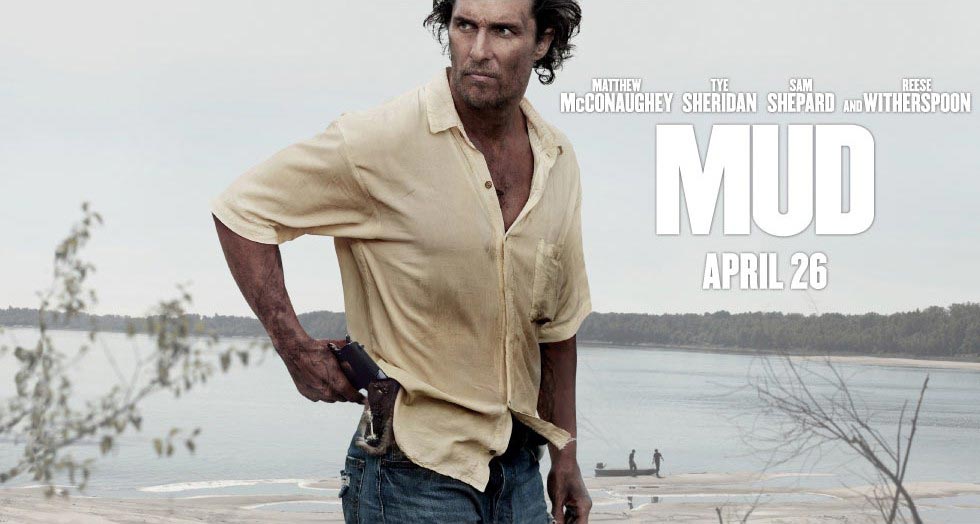
Mud: ****/*****, or 8/10

Gritty and stern coming-of-age drama set on the banks of the mighty Mississippi in a poor, rural community where you get nothing for free, love least of all. Young boys Ellis and Neckbone (marvelous acting from newcomers Tye Sheridan and Jacob Lofland) try to make the best of a harsh life, having fun as well as their situation will allow them. Their latest find to ensure a good time: an abandoned boat swept into the treetops by a flood on a small, neglected river island. Soon someone else encroaches on this idyllic place of theirs though, a mysterious drifter named Mud (impeccable performance by Matthew McConaughey, almost making you forget the numerous lousy romcoms he has starred in in recent years by showing he can still do more demanding bits of acting). On the run from the police, Mud weaves a sympathetic tale of drama and romance which ensnares the boys into making a deal with this stranger: if they provide him with food, tools and information in his ploy to elope with his sweetheart Juniper (a battered but ever beautiful Reese Witherspoon), they can keep the boat, and, thrown in as a bonus, his gun. The boys swiftly find out Mud may be more dangerous than they at first anticipated, as his archenemy arrives in town wist a posse of bounty hunters, poised to kill their new secret associate at all costs. The audience has no illusions that Mud's stories about his life and situation are nowhere near the whole truth, if not a bunch of bald faced lies and baloney. But like the young protagonists, we cannot help but be entranced by Mud's Southern charm and seeming sincerity, especially when much of his wild tales seem to be verified as the film progresses. For Ellis, the love between Mud and Juniper is a refreshing taste of the good things in life he himself sorely lacks, as his own parents cannot get along and are moving increasingly towards a divorce which may end Ellis' life as he knows it, and not necessarily for the better. Just hitting puberty and taking his own first steps in the minefield that is love, Ellis so badly wants to believe in true love that will make people do anything to maintain it, he is blind to any hints that suggest Mud is nothing but a con man. Of course, things are indeed not as they seem, and everything points to Mud having used the boys for his own shady purposes. Despite the eventual exposure of his web of lies though, Mud gets his fair chance to redeem himself in the eyes of his former acolytes, as his nemesis and his band of brigands are moving in on him with no moral qualms of taking out anyone that has come to his aid of late, putting Ellis and Neckbone in grave danger too. A violent conclusion and an unavoidable number of deaths seems inescapable, and love seems unlikely to save the day as Ellis so firmly desired. Director Jeff Nichols (Take Shelter) doesn't go easy on his juvenile main characters and adds plenty of misery and bad luck to their already hard life, shattering their illusions and dreams for the future, but never going so far as to eliminate hope entirely. A child's notions of love and life never quite come to fruition as it had expected, he states, but good things can still come from a bad situation in the long run (which does lead to a happy ending that cannot fully avoid a bit of sentimentality). His point is made with help of a great supporting cast of excellent actors, among them the likes of Sam Shepard, Paul Sparks and Michael Shannon (the latter both Boardwalk Empire veterans). Despite the hardships their characters suffer, the swamp lands surrounding the Mississippi that Nichols introduces us to remain a place of simple beauty and hopeful dreams that no violence, betrayal or lies can hurt. And those who hope for shirtless scenes of McConaughey, as is his routine he pulls one off (literally) in this film as well.

zondag 6 oktober 2013

The Lost World Series 1: Glider Pack with Ian Malcolm


Year of release: 1997

Accessories:
-Ian Malcolm figure
-Glider Pack
-Missile


Description: Ian Malcolm sports a black jumpsuit, including black boots, gloves and of course sunglasses. From the shoulders down to the upper legs the suit is covered with blue and green straps, giving Ian a typical hang glider pilot look, though I don’t know much about aviation so I might be mistaken here. The suit has a yellow JP: Site B patch on the left shoulder. There are two variations of this figure, like with the regular TLWS1 Ian Malcolm figure: Ian’s hair is either smooth or curly, but in both cases black.
The Glider Pack can be folded in to look like a large backpack, but pressing the large blue button on top makes the wings fold out, in which case the glider measures a good 20 centimetres across. The wings are basically black cloth held together by a dark grey plastic frame attached to the Pack itself, which is also painted dark grey with light green highlights on top. The figure can hold on to the glider via two extendable frames, one which can be clamped around its waist and one which it can grab with its hands. Blue highlights indicate the various options of the Glider Pack: a large blue button for unfolding the wings, a smaller button for launching the missile, two clamps for attaching the figure to the pack and two additional clamps at the bottom for holding the wings together when they’re not folded out. The missile, a yellow dart, can be launched by pressing the smaller blue button on top of the pack: it has a firing range of almost two metres.

Analysis: this is a decent set, nothing too special, but fun enough. The Malcolm figure it comes with looks good, still sporting a mostly black paint job including sunglasses as is Malcolm’s custom. The paint job of the pack itself is a bit dull, but not annoyingly so. The yellow dart sticking out of it makes it look a bit odd, as if the two don’t belong together. The firing range is one of the largest of any JP figure’s weapons, though it does little damage from too great a distance. At close range it’s more lethal, though not as much as most other missiles since it’s so lightly built. Smaller dinosaur figures will easily be knocked over though.
The ‘unfolding wings’ system of the Glider Pack works fine, though when folded in the wings occasionally flap out on their own accord, since the clamps holding them together are a bit small. It also saves some space when the wings aren’t folded out and makes the cloth less susceptible too dust. The cloth is a nice touch and adds some realism. However, it’s more easily damaged then it would be if it was all plastic. You better not play too rough with it if you want to keep it intact. The figure can be attached to the glider in such a way it looks pretty realistic. However, its hands often slip loose from the frame it’s holding on to.


Playability: Malcolm has poseable arms, legs and head like most Kenner figures have. His hands are positioned in a forward gripping move to support him holding on to the frame of the pack. Therefore he holds things, like weapons of other figures, differently then usual. The pack itself doesn’t offer too much playability, though the wings unfolding increases the number op options. The missile launcher, though it has some setbacks, works properly.

Realism: like the regular Malcolm figure of this toy line, this Malcolm looks more like the one we saw in the first JP movie than the older Malcolm from TLW, but the black sunglasses are still a dead giveaway, so it’s hard to mistake him for another character. There were no hang gliders in the TLW movie, though originally the script did have a scene involving them. This was cut out before production of the movie started though. Still, it’s nice Kenner added this set to the TLW toy line as a reference to that scene, though they may not have done that consciously.

Repaint: Malcolm’s head is, for both variations, a reuse of the regular TLWS1 Malcolm figure. The head variation sporting curly hair is a reuse of the JPS2 Malcolm’s head. Other than that, this figure, as well as the Glider Pack, are news sculpts. Neither would be repainted for later toy lines.

Overall rating: 6/10. It’s a fun addition to the TLWS1 line, but nothing particularly special and certainly of less interest than the other small vehicles/play sets with human figures of this toy line. It’s not hard to find and shouldn’t be too expensive.