
Posts tonen met het label Jeremy Irons. Alle posts tonen

donderdag 13 april 2017

Today's Review: Their Finest


Terwijl Christopher Nolan voortploetert aan het werk voor zijn epische oorlogsfilm Dunkirk, brengt het bescheidener Their Finest die veldslag maanden eerder ter herinnering in de bioscoop. Het romantische drama heeft echter noch het budget, noch de pretenties van Nolans monumentale klus. Their Finest is bovenal een eerbetoon aan de vrouwen die achter de schermen het moreel van de belegerde Britten hooghielden, maar daar amper waardering voor kregen. Die krijgen ze nu alsnog in een lichtzinnig drama waarin romantiek en humor geslaagd hand in hand gaan met oneerlijkheid en oorlogsgruwel, zonder het laatste te bagatelliseren. Met dank aan een Britse topcast die alle inhoudelijke twijfel moeiteloos wegneemt.

Als het moreel van de Britse bevolking tijdens de Blitz beneden alle peil zakt, is het aan het medium film om de gemoederen weer op te peppen. Dat is niet makkelijk, want de meeste mannen vechten voor het vaderland terwijl de vrouwen hun positie in de industrie hebben overgenomen. En schrijven voor een overwegend vrouwelijk publiek blijkt niet iets waartoe Britse scenaristen overtuigend in staat zijn. De muizige Catrin Cole wordt ingehuurd om het vrouwelijke perspectief te belichten. Al snel blijkt die klus grootser dan verwacht, als haar idee voor een dramatische propagandafilm goedkeuring krijgt van het ministerie. Terwijl ze zich staande moet zien te houden in een onverbiddelijke mannenwereld, groeit haar project over de heroïsche evacuatie bij Duinkerken al gauw voorbij alle verwachte proporties. Met de film moet ze niet alleen de Britse strijdbaarheid opkrikken, maar ook de Amerikanen tot de geallieerde zaak verleiden. Tussendoor moet ze leren omgaan met ijdele acteurs, jaloerse scenaristen en wispelturige producenten. Om nog maar te zwijgen van een romantische driehoeksverhouding. Want ook Their Finest zelf is vanuit een overwegend vrouwelijk perspectief gemaakt.


Romantiek, humor, oorlogsdrama, propaganda, vrouwenrechten... Their Finest neemt een hoop hooi op haar vork. De Deense cineaste Lone Scherfig weet het echter tot een sympathiek geheel te breien. De film vertelt immers niet over de ellende in het platgebombardeerde Londen of Duinkerken, maar over de mentale strijd via de kracht van het medium film om het nationale defaitisme een halt toe te roepen. Om ons scepticisme omtrent humor tegen een oorlogsachtergrond te sussen, verzamelde Scherfig een indrukwekkende verzameling Britse acteurs. Jong talent als Sam Claflin en Jack Huston wordt aangevuld met veteranen als Bill Nighy en Helen McCrory, waardoor de kwaliteit van het acteerwerk verzekerd is. Spil in het verhaal is Gemma Artertons Catrin, een aanvankelijk naïeve jongedame die zich als ridder van de Britse zaak moet opwerpen en daarbij vooral mannelijke tegenwerking tegemoet ziet. Is het niet het onrecht van haar lagere salaris, dan wel de strijd met haar man om het recht van kostwinner. Arterton is altijd een genot om naar te kijken en haar ontwikkeling van overdonderde copywriter naar vastberaden producente in Their Finest vormt geen uitzondering op die regel.

Arterton krijgt effectief hulp bij haar lovenswaardige prestatie van haar tegenspelers, waarbij vooral Nighy de show steelt als een voormalig steracteur die zich door zijn leeftijd geconfronteerd ziet met een gebrek aan respectabele rollen. Zijn verontwaardiging over het vertolken van een aan lager wal geraakte zeeman zorgt voor hilarische momenten, evenals diens coachen van een talentloze Amerikaan in een essentiële rol. Het rijke acteursensemble neemt de clichés over de zelfingenomen filmwereld met zichtbaar plezier op de hak. Their Finest vormt een liefdevol eerbetoon aan de aloude kunst van het filmmaken. Bijzonder charmant is de scène waarin een grootse troepenmacht op het Franse strand onthuld wordt als schildering, waar een acteur in close-up doorheen banjert en de illusie verstoort. Feitelijk weinig verschillend van Nolans Dunkirk, waarin bordkartonnen troepen de figuranten moesten aanvullen. Zoveel is er sindsdien niet veranderd in de filmindustrie, bewijst Scherfig op aanstekelijke wijze.

Gelukkig geldt hetzelfde niet voor de positie van de vrouw. Their Finest kent vrouwelijke aanwezigheid in alle sleutelrollen. Hoewel de film niet gebaseerd is op een daadwerkelijk propagandaproject, doet dat geen afbreuk aan de voorgangers van de huidige generaties filmvrouwen, die zich omringd zagen door hun jaloerse en vijandige mannelijke tegenhangers. De angst voor het groeiende feminisme dat de industriële aanwezigheid van vrouwen in de hand werkte, wordt helaas slechts en passant aangestipt in Their Finest. De film trekt liever tijd uit voor een geforceerde driehoeksverhouding tussen Catrin, haar echtgenoot en haar naaste collega, waarin haar eigen wensen niet voorop staan. Hoewel dit subplot afleidt van het hoofdverhaal, kent het toch een verrassende wending die illustreert hoeveel vrouwen opgaven voor het landsbelang, ook nadat de strijd was gestreden. Dat vrouwen niet actief waren aan het front wil niet zeggen dat ook zij niet alles opofferden voor de goede zaak. Een vlugge blik op de castlijst van Dunkirk verraadt de vrouwelijke afwezigheid in Nolans film, waarmee het belang van die boodschap van Their Finest treffend onderstreept wordt.

zaterdag 16 juli 2016

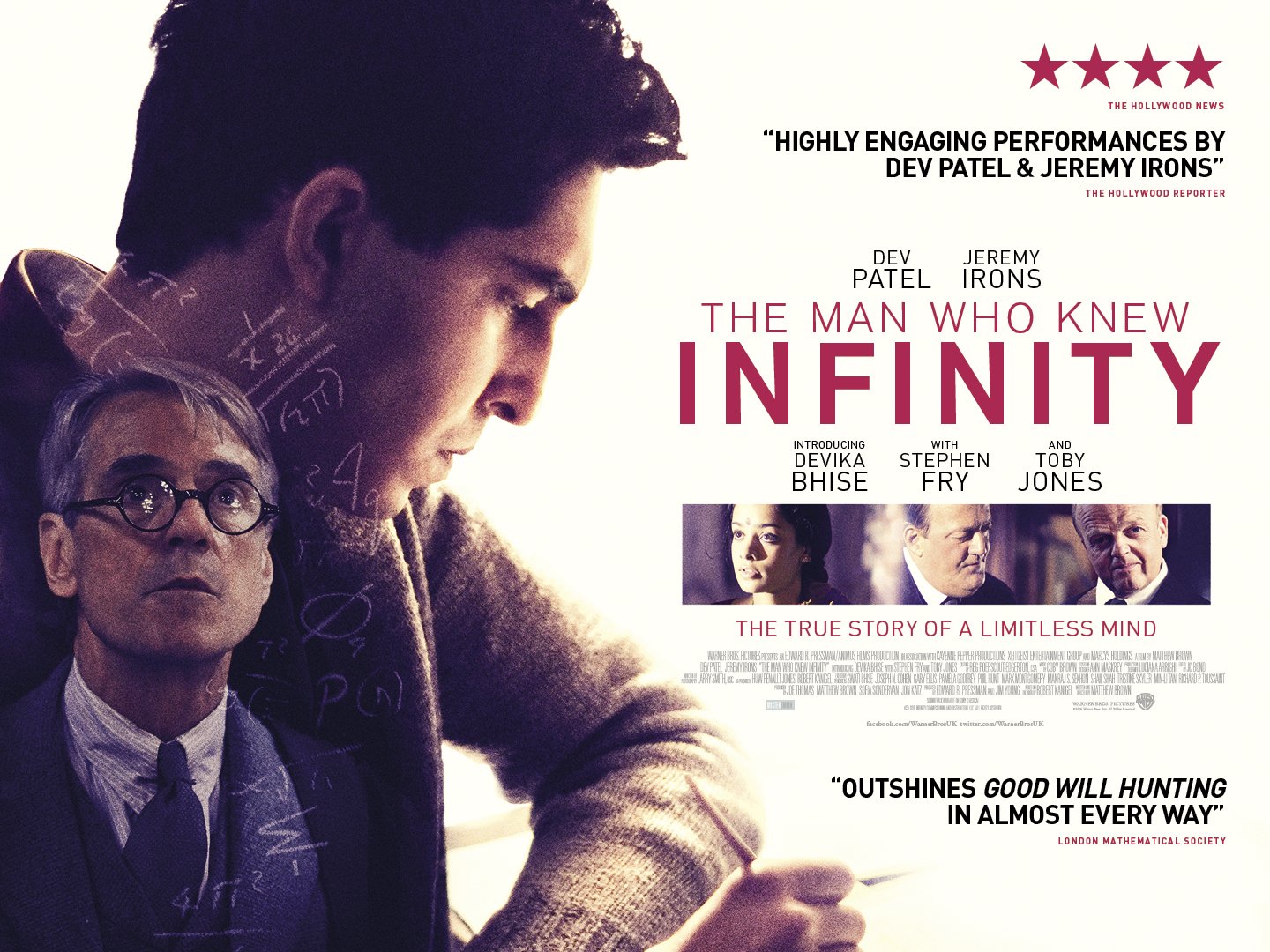
Today's Review: The Man Who Knew Infinity


Took a while (vacation will do that), but here's a long overdue review for your approval:

The Man Who Knew Infinity - recensie

Mathematics is generally considered by mainstream audiences as a rather dull topic, but movies about mathematicians often have little trouble finding an audience. There's an odd fascination with the socially awkward minds of geniuses who spend their entire live crunching numbers, or so the success of A Beautiful Mind or more recently The Theory of Everything and The Imitation Game has proven. However, with the success of such films, there's a risk of such biopics finding themselves limited to a specific formula. A misunderstood genius+a harsh, unaccepting society+British acting talent=boxoffice success, such a formula might state. Problem is, these geniuses in question were anything but formulaic people so there ought to be a little more to it than generic writing to make modern audiences fully appreciate their work. Case in point, the legendary Srinivasa Ramanujan and the feeble The Man Who Knew Infinity.

The mathematical wonder Ramanujan was born a poor Indian with an uncanny gift for understanding numbers and dreaming up formulas way beyond the comprehension of his social environment in the early 20th Century. It took a while for his talent to be recognized and even longer for it to be put to good academic use, when he finally moved to Cambridge. There he baffled the minds of his fellows in the short years that remained to him. What made this incredible mind tick? The Man Who Knew Infinity unfortunately is more concerned with focusing on the culture of discrimination Ramanujan faced at academia. In the movie, the misunderstood genius spends most of his time being subjected to racist exclusion rather than getting any work done. And so he stays mostly misunderstood to the audience, who can't begin to comprehend just how unusual his formulas were and what grand ramifications they had for the world of mathematics. Ramanujan is just repeatedly stated to be a genius, and that's that.


Dev Patel portrays this specific genius and does an adequate job carrying the movie as such, but his talent is basically wasted as the ongoing victim of racial slurs who just keeps looking miserable and unhappy. As the genre's conventions have it, it's up to the assembled British talent to keep the movie alive beyond that. With Jeremy Irons as Ramanujan's close friend Hardy, the film does have one great card to play in keeping us interested both in Ramanujan's plight and mathematics in general. The movie is as its most interesting when Irons graces the screen, guiding us and the protagonist through the academic world and mathematical lore of the early 1900s and sharing many an intriguing anecdote about both. These scenes make for the film's most interesting moments, which are constantly hindered by Ramanujan facing yet another insult regarding his cultural roots or skin colour. We get it, racism is bad. Unfortunately, more emphasis is put on this particular message than we would care to hear. Suffering is after all a trope of the genre and worked for its predecessors: as Turing struggled with his homosexuality in The Imitation Game and Hawking with his debilitating condition in The Theroy of Everything, so Ramanujan is subjected to the racism of the day.

Which is too bad, since an unusual mind like Ramanujan's didn't deserve to be explored in such a generic period piece as The Man Who Knew Infinity. The movie carefully stays within the boundaries of the genre rather than, like the man it honours, exceeding such boundaries. It drones on endlessly about the poor man's plight rather than making us fully appreciate his work, his field of expertise and his lasting legacy. The Man Who Knew Infinity, sadly, is rather a predictable and dull movie, which hinders general moviegoers to consider mathematics something other than just that exactly. Well, at least Jeremy Irons tried...

zaterdag 20 juli 2013

Today's Mini-Reviews: Man of Steel goes on a Night Train to Lisbon


Night Train to Lisbon: ****/*****, or 7/10

Adaptation of the original novel of the same name by Pascal Mercier, chronicling the life and times of a young Portuguese doctor named Amadeu de Prado during the years of the oppressive Salazar regime. His political and philosophical trials are recounted through his journals as read long after his death by a Swiss professor played by Jeremy Irons. A timid and dull man, Irons one day saves the life of a woman attempting to commit suicide, who walks out on his life as sudden as she entered it, leaving him the diary and a train ticket to the Portuguese capital. Impulsively leaving his life behind, the professor takes his chances and travels to Lisbon in order to explore this life so different from his own. The vast dissimilarities in life style and character of the boring old professor compared to the adventurous, politically engaged young doctor are rather overstated to carry the point across that freedom and personal convictions are wasted if one does not make ample use of them during one's life, as Irons does not but Amadeu did: though it led him to an early death, he did live a wild and challenging life as the professor soon realizes when he seeks out those that knew him personally. Now all in their old age, his remaining family and friends enlighten the old man as to who Amadeu really was and what he accomplished. Many a great character actor is encountered as the movie progresses through the various view points of Amadeu's inner circle, including Charlotte Rampling, Christopher Lee, Bruno Ganz and Tom Courtenay. Interestingly enough (and potentially insulting towards the people of Portugal), none of them are Portuguese and nor is Jack Huston who plays the young Amadeu. However, their contribution as highly capable actors to informing us about the harsh and dangerous life of political dissidents under the brutal rule of Salazar and his secret police makes for a compelling glimpse of past Portuguese history, which isn't a subject of movies as often as it deserves to be. The movie also serves as a not so subtle tourist brochure to present day Lisbon, with its beautiful sunlit cityscapes and its treasure trove of historical architecture, ancient churches and appetizing dinner establishments. And unlike in Amadeu's time, there's no sinister right wing agents out to arrest you for disagreeing with the current political powers-that-be. No wonder Irons' character eventually opts to stay to escape his own dreary, disillusioned life in Switzerland, which is only shown as grey and rainy during the course of the film.


Man of Steel: ****/*****, or 7/10.

Under the producing talents of Christopher Nolan, Superman undergoes the same treatment to make him grittier – or more 'with the times' – as his fellow DC veteran Batman underwent for Nolan's Dark Knight trilogy. Director Zack Snyder has shown to be rather talented in adapting the works of more ingenious men into big blockbuster movies, e.g. 300 and Watchmen. As a result, Man of Steel proves a slick, dark and modern look at the iconic comic book character, the most 'super' of all superheroes. Nevertheless, the movie still leaves something to be desired, as illustrated by the fact the film works best during its quiet moments of comtemplation as to how a near omnipotent alien life form walking amongst us humans would live and act. Raised by human foster parents after his biological ones got blown to smithereens along with his home planet of Krypton, Clark Kent/Kal-El (Henry Cavill beefed up considerably) has carefully learned not to show off his awesome powers, as they would make him an outcast, a mutant destined to be hated and feared by the society he means to protect (if some of these thematic ingredients sound familiar, it's because Hollywood has jumped on this bandwagon before in other superhero franchises). Moving from one false identity to another in search of inner peace, Clark soon finds the exact opposite when firstly a sexually attractive female raporter named Lois Lane (Amy Adams) and secondly some of his fellow Kryptonian survivors pay him a visit, the former in seach of the truth about this mystery man, the latter desperately after a weird skull shaped MacGuffin that would give Krypton a second chance, but only at the expense of humanity. Clark soon has no choice but to reveal himself to everybody and fight for his surrogate fellow species against his own kind led by the ruthless General Zod (Michael Shannon having a ball playing a rather bad man who can't stop shouting), who has a personal score to settle with the last remaining member of the -El family. What started as a thoughtful and intriguingly calm, impressionistic superhero movie exploring the nature of superhuman powers in an all too human world (similar to the likes of smaller budget films á la Chronicle) soon erupts into a huge, undoubtedly super-expensive visual effects extravaganza as a big battle between Earth's armed forces against the vastly superior extraterrestrial legion commences, with Clark caught in the middle, forced to finally accept his otherness from both parties and donning the traditional red and blue garb we all know (sort of, as there's no underpants in Nolan's world). This time his father Jor-El (Russell Crowe) was kind enough to save the knitting patterns for the suit in his son's spaceship computer banks, probably anticipating a hugely muscled guy in a super tight suit would be just what Earth required to convince its inhabitants of the practicality of a 'Super-man'. Unfortunately the film is released mostly in 3D, while the movie is shot largely through handheld means, rendering the majority of the battle sequences' 3D effects a failure, if not excruciating on the eyes. And sadly those battle scenes make up nearly all of the film's final hour. Overall, Man of Steel is a crystal clear attempt to rejuvenate the Superman franchise applying the Dark Knight's formula, driven by its uncanny ability to bring in the biggest bucks, crafted in an all too similar style that leaves the titular character devoid of his usual comic book feel and charm (not to mention sense of humour), maybe for the better too considering the alternate approach attempted in Superman Returns didn't work out so well. This tactic doesn't prove to be as appropriate for Supes as it was for the Caped Crusader, but works well enough, though definitely more so in the bold first half of the film that relies more on the subtle exploration of a lonely Superman's place in the contemporary world than it does on the overabundance of loud digital action that follows it. One thing is for sure: with this particularly dark brand of superheroes, the upcoming Justice League movie is gonna be pitch-black.

dinsdag 6 maart 2012

Appaloosa


Rating: ****/*****, or 7/10


Ed Harris both stars in and co-wrote this second movie he directed. A ruthless rancher (Jeremy Irons) terrorizes a small town for his own purposes, after which the townspeople hire two lawmen (Harris himself and Viggo Mortensen) for their protection. This Marshall and his deputy capture the rancher and set out to deliver him into the hands of justice, but the shrewd ruffian has more tricks up his sleeve complicating their quest to uphold the law. Further troubles are provided by a young widow (Renée Zellweger) who falls in love with the Marshall, but there's more to her than would appear. A thinking man's neo-western featuring some damn fine acting and a few solid shoot-outs, but also moments where the story drags on and a bit of a cumbersome romantic subplot frustratingly getting in the way of the main story.


Starring: Ed Harris, Viggo Mortensen, Jeremy Irons


Directed by Ed Harris


USA: New Line Cinema, 2008