zondag 29 december 2013

Today's Mini-Review: Daybreakers


Rating: ****/*****, or 8/10

Starring: Ethan Hawke, Willem Dafoe, Sam Neill
Directed by Michael & Peter Spierig
USA: Lionsgate, 2009

You'd think that after 80 years of vampire movies there's little 'fresh blood' to be added to the genre, but Daybreakers proved such pessimist thinking wrong. Containing one of the most intriguing premises I've ever come across, this film puts a wholly different spin on the notion of the undead thriving on the blood of their human victims. In the not too distant future, a viral outbreak has turned most of the world population into vampires, while regular human beings have become quite the endangered species. Since the vamps need human blood to survive while they are as immortal as usual, blood shortages are increasingly threatening the societal status quo (which remains remarkably human in appearance). A hematologist (Ethan Hawke) works tirelessly on a synthetic blood substitute, experiments which continue to fail, partially because the CEO of the company that controls the 'real deal' (a deliciously sinister Sam Neill) is rather keen to keep making the big bucks off rich vampires that can afford genuine blood. Vampires or not, money is still the driving factor behind it all, to the detriment of civilization. The situation is getting ever more untenable as poorer vampires are so desperate they start feeding on each other or even on themselves, causing them to mutate into crazed bat people (a funny take on the ever present relationship between vampires and bats, which otherwise plays no significant part in this film); freaks that are brutally exterminated by the authorities. Hawke's sympathetic scientist, made vampire by his brother against his will, proves a guilt ridden person determined to change this upside down world for the better and sympathizes with what few humans remain free, continuously hunted by the vampire military as they are. After aiding a group of humans evade capture, he is contacted by an underground resistance movement, led by ex-vampire Willem Dafoe, that aims to develop a cure for vampirism, the only viable way for both humans and vampires to survive their impending doom. Hawke accepts their invitation and joins their cause, which soon pits him and the rebels against Neill's profit driven tyranny.


Daybreakers' strongest moments are found in its first half, as we explore a world where vampirism is the normal state of being and society has evolved to accomodate it. Since the vampires of Daybreakers adhere to many of the archetypal characteristics of the genre, they also cannot abide ultraviolet light, and therefore “life” takes place at night, so commonplace items like houses and cars are designed to protect against sunlight. In other regards, this world differs little from our own, as the vamps work in order to pay their bills, buy their blood and live their immortal life. The disturbing imagery of humans forcefully strapped to transfusion tubes and slowly drained of their life essence in huge factory like environments successfully evokes comparisons to how we ourselves as a species treat animals in the bio-industry for our own basic needs without allowing them any shred of dignity and natural behavior. The vampire world is living in its 11th hour, close to self-annihilation caused by plain and simple greed of those in power who prove unwilling to change for the common good, in some regards echoing our own inability to alter our ways for the better in fear of loosing what we gained. In the second half of the movie, Daybreakers sheds such symbolism and largely replaces the exposition of its fascinating dystopia in favor of more trite and true action scenes and an overabundance of traditional gore (it's still a horror film, you know!), including some almost orgiastic blood baths of famished vampires feeding. Whether society is ultimately changed for the better is left somewhat ambiguous, as the movie underscores the notion that vampires, for all their superior physical strength, are still always all too human in their limited line of thinking. Though it's a pity the movie doesn't end as strongly as it started, it doesn't undermine Daybreakers' position as one of the more ingenious vampire films to date, a far cry from the currently popular image of these undead as sexy hunks to appeal to teenage audiences.


zaterdag 28 december 2013

Today's Top-10: Dinosaur Movies


Wrote another Top-10 list (sort of) for MovieScene:

http://www.moviescene.nl/p/151798/historisch_tiental_dinosaurusfilms

I started this one as an intended 'companion piece' to my review for WWD 3D, before I had the actual displeasure of suffering that abysmal flick. Nevertheless, it now serves as a reminder to those who contemplate visiting that film in theaters, as well as to those that already have wasted 87 minutes of thier lives watching it, that there's plenty of good dinosaur movies in existence too. Why torture yourself with bland talking dinosaurs on the big screen if you can re-experience true tearjerking emotion in an all too similar plot at home with The Land Before Time? Why bother with talking dinosaurs at all, instead of seeing them fight cavemen and scantily clad ladies in Harryhausen's classic One Million Years B.C.? Or why not enjoy a movie that takes dinosaurs seriously while still delivering a solid suspenseful cinematic performance in that greatest of all dinosaur movies, Jurassic Park? Walking with Dinosaurs 3D may have been a true dud, but dinosaurs have survived bigger extinction events and will also recuperate from this severe blow to their image. And we still have Jurassic World to look forward to.

Incidentally, there was some editorial controversy about this particular Top-10 list of mine, as it didn't wholly fit the parameters. A true 'Top' list would rank these films from worst (10) to best (1) instead of in chronological order as I have done here, in an attempt to illustrate the evolution of the views of dinosaurs in cinema, as well as the techniques necessary to bring them to new life. It would have been jarring to read these ten expositionary pieces in another order, so I decided against that. Also, I think there's something inherently arrogant and egocentric about Top-10, since everybody is bound to have another opinion as to which one is best and which one is worst. So on MS, this article isn't called a 'Top-10', but a 'historical group of ten': who knows, it might inspire similar pieces from mine own hand or those of my fellow writers on the site and start a new category of article. Or it might prove to be soon an extinct form of arranging ten movies, because it was solely done for my personal convenience.


donderdag 26 december 2013

Today's not-so-mini-review: The Hobbit: The Desolation of Smaug


The Hobbit: The Desolation of Smaug: ****/*****, or 8/10

The middle part of a trilogy is always said to be the hardest part to finish successfully to everybody's approval and acclaim, since it it cursed with the absence of both beginning and end, while it must feel like a coherent piece on its own. In the case of Peter Jackson's Hobbit trilogy, this adage is once again proven fact. Whereas The Two Towers established itself as a perfect bridge between both other Lord of the Rings movies while remaining equally convincing and enjoyable on its own merits, the same cannot wholly be said of The Desolation of Smaug. Though a thrill ride of a movie, in many ways it feels simply too much like a set-up for a conclusion, ending in a frustratingly grave cliffhanger which leaves every story line unresolved. At the same time, its tone and style are much darker and more serious than its predecessor's, the wonderfully lighter themed An Unexpected Journey. And I'm positive the Tolkien fanatics amongst the audience have a thing or two to comment about the loose manner in which Jackson and his co-writers have adapted both the Hobbit novel proper and material from Tolkiens' various other works for their own narrative advantage, since, especially in the second half of this film, many creative licenses have been permitted, some of them dubious to say the least. The first half of The Desolation of Smaug however follows the novel more closely, admittingly racing through the original source material with more speed than feels appropriate or desirable.

Picking up where the previous movie left us, we find 'the Hobbit' Bilbo (Martin Freeman) and Thorin Oakenshield's (a brooding, increasingly torn Richard Armitage) company of Dwarves still on the run from Azog the Defiler's murderous band of Orcs-on-Wargs. Fortunately, shelter is found at the house of Beorn, an enigmatic, hairy giant of a man, who is said to be a skinchanger specializing in bears. Little is done with both this notion and this persona as he insists the band moves on swiftly, allowing the intriguing character only a mere few minutes of screen time (undoubtedly more to follow in the third installment). Soon after the sickly forest of Mirkwood is crossed, giant spiders (creepy ones too!) are combatted and angry Elves are confronted, the latter scene re-introducing another LotR character not present in the novel but added for the sake of convenience and pleasing the (female) audience, in this case Orlando Bloom's Legolas. Still an angry Elf skilled with a bow and looking gorgeous, Bloom's look and traits remain the same as his lack of notable acting skills when first we met his character. Nevertheless, his personality is fleshed out in regards to his forest home (another impressive design feat) and his fellow Elves, including his stern father Thranduil (Lee Pace overacting a bit) and his socially adventurous female captain-of-guard Tauriel (Evangeline Lilly), a character as completely made up for this film as her soon developing romantic interspecies relation with Kili (Aidan Turner), echoing the Arwen/Aragorn affair of the former trilogy, no doubt convincing certain demographics to stay tuned to see where this is going exactly. Not very hospitable, Bilbo is forced to save his friends from the Elves' jail, unleashing a memorable escape scene via barrel and river, with foes on all sides as the Orcs return to plague both Elf and Dwarf, effectively giving Bombur a chance to prove you shouldn't mock comic relief centered around fat people, which also provides us with one of the few grand moments of comedy (Jackson style) this film features, as it is a grittier movie as a whole. Said chase leads to the company meeting Bard the Bowman (Luke Evans) of Laketown, a reluctant smuggler and rebel against his city's corrupt regime under the command of the ragged Master (Stephen Fry!). Now also getting mixed up in the politics of Men – and already intertwined in the affairs of several clans of Elves, Orcs, Goblins, Eagles, skinchangers, Wizards and other Dwarves, for those keeping track – matters are complicated even further for Thorin and his companions, making the story both more substantial and increasingly convoluted. Basically it comes down to this: everyone wants dragon gold, but all fear dragon fire. Someone has to start the ball rolling, and of course that sorry job falls to the titular Hobbit. 


And where is Gandalf (the great Sir Ian McKellen), you may wonder? He leaves Bilbo and the Dwarves at the start of the movie, setting on his own adventure in search of the identity of the rumoured Necromancer. As was the case with The Two Towers, The Desolation of Smaug incorporates multiple story lines that won't come full circle until the final film. Gandalf and Radagast travel to the ruined fortress of Dol Guldur in search of much needed answers, a quest which feels like getting in the way of the main plot more than is comfortable, but which still follows the novel, except this time also showing Gandalf's voyage, which was only briefly mentioned in the literate version of the story. Gandalf's journey proves a narrative element which will greatly enhance the feeling of cohesion between both Tolkien trilogies, but forms an uncomfortable plot obstacle in this movie, only enlarging the bleakness of the overall film and adding more characters and plot to the piece, which was already bursting in that regard.

Simply said, a lot is going on in The Desolation of Smaug, as many characters and their various motivations are introduced into the story, while those of others from An Unexpected Journey are pushed to the back a little (no White Council politics in this one, but undoubtedly more to follow in the third installment). Naturally, not everything is given equal opportunity to shine and we would liked to have seen more of many elements, getting to know these characters a little better, which we will next year. Until that time we have to make do with the set-up for said scenes to follow, while an extended cut of this second part is indubitably also to be expected (and definitely called for!), considering we are treated to the bare necessities of all these characters without delving too deeply in their motivations and aspirations, often making us wonder whether additional material was cut to keep up with the fast pace of this film, which still runs a whopping 161 minutes. However, desolation is far from our mind when we finally encounter the big lizard himself, the dragon mentioned on countless occasions so far, even in Jackson's previous trilogy. It cannot be denied Smaug is an astonishing creation, an erudite, intelligent and charming, but naturally ruthless and temperamental dragon of fabulous size and strength, everything we expected him to be if not more so. Credit has to be given to both Benedict Cumberbatch's vocal and mo-cap performance and the Weta design team reponsible for bringing the mighty beast to life so utterly compellingly, resulting in one of the most fantastic and impressive computer generated characters in the history of film. A good thing too, since the reliance on computers over more traditional FX methods is overtly evident in this film's case, giving many scenes a bit too much of a green-screen vibe. Like his golden hoard similarly is the focal point of the entire story, the dragon is the big pay-off for the audience, and Jackson and co. triumph in this department, also succeeding in forging a cliffhanger that is sure to vex spectators to such extent they will return next year in even more record-breaking numbers. In the dragon's case, this may give cause to disappointment though, as those who have read the book will soon come to realize as they remember Smaug's ultimate fate. Fortunately that portion of the audience still has the conclusion of the Kili/Tauriel relationship to look forward to and guess over all year long. Yes, that is a bit of sarcasm there.


The Hobbit: The Desolation of Smaug is a flawed middle part of what may still end up to be another masterpiece trilogy. While there's many a plot element that leaves much to be desired, in terms of good fun, spectacular vistas, grandiose action scenes and fabulous dragons it still proves a great blockbuster movie which leaves us craving more. Unfortunately not holding up on its own so solidly as An Unexpected Journey, it may prove to be a fine piece of work when the trilogy is completed as a whole and everything that is set up in this film is resolved to our satisfaction in the upcoming There and Back Again. One cannot help but keep wondering whether splitting up The Hobbit in three pieces as opposed to two was a good idea. Forging the last two films into one may have resulted in a more agreeable second movie, albeit a very, very long one.

dinsdag 24 december 2013

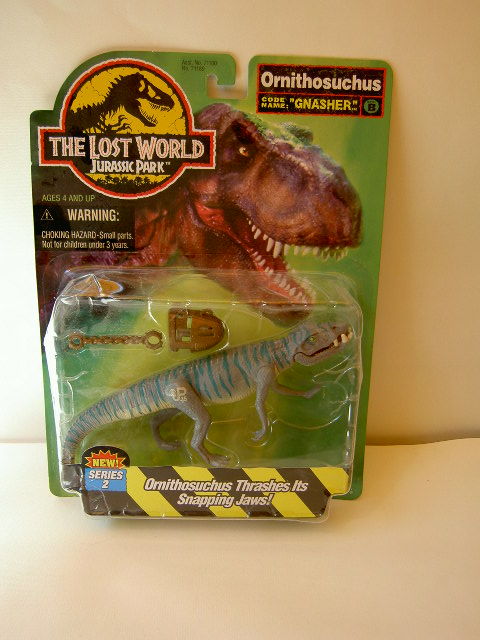
The Lost World Series 2: Ornithosuchus


Year of release: 1997-1998

Accessories:
-Two pieces of capture gear
-Dino damage tail section


Description: this bizarre slender reptilian creature assumes a walking posture, with its left leg and right arm positioned in a backward move and its right leg and left arm moved forward. This critter sports a greyish blue paint job for the most part: this colour is located on the animal’s back, flanks, tail, neck, limbs and head. The underside of the figure (its belly, lower part of the tail, part of the lower jaw and throat) are coloured beige. A large number of greenish blue stripes run over its back, tail, neck and head, supplying the overall creature with a bit of an aquatic look. Its big mouth sports a red tongue and white teeth, including a total of six large teeth, almost fangs; two of these stick out of the upper jaw, four out of the front of the lower jaw. The Ornithosuchus has small bright green eyes, and carries a beige JP: Site B logo with the number .35 next to it on its right upper leg. The creature’s claws are not painted in a colour different from the greyish blue.
The Ornithosuchus is equipped with a thrashing action: moving the right leg forth makes the head spin round to the left. Additionally, the beast’s lower jaw snaps back when pulled down and released, making it possible for this sculpt to clasp other figures between its jaws. Ornithosuchus also comes with dino damage: it features a removable tail section, revealing blood tissue and a white pin (resembling a bone) sticking out on which the tail can be pinned back.
The figure also comes with two pieces of capture gear, a small chain to restrain the limbs (though only two of them at the same time, not all four), as well as a large muzzle to keep the creature from biting. It doesn’t stop the Ornitho from thrashing its head though. Both pieces sport a shiny metallic brown paint job.

Analysis: Kenner once again in a bold move decided to add an almost totally unknown non-Saurian prehistoric creature to their list of JP figures, though it took some time before it finally got a release (see ‘repaint’ section of this review). This particular sculpt turned out quite well and is much appreciated by most collectors for being both original and plain cool.
The Ornithosuchus sports a fine paint job, though a bit monotonous: the greyish blue is somewhat overused, but not in such a way that it’s gotten ugly or boring. However, it’s unfortunate the claws aren’t painted.
The creature comes with a thrashing action, which makes it capable of moving its head around. On its own this looks a bit odd, but in combination with other figures it gets a lot more impressive and vicious: imagine a helpless hatchling trapped between those strong jaws and being violently thrashed about the place. Or how about a human figure’s leg? This feature makes Ornithosuchus a foe not to be underestimated when encountered in the wild. The card mentions snapping jaws, however this is saying a bit too much: the jaws only snap when you pull them down and let them go, not on their own accord or in combination with the thrashing action unfortunately. Still, it doesn’t totally keep the fun out of this figure’s action features.
Another option this monster sports is some good old dino damage. Usually dino damage is applied to larger figures, so it’s interesting to see it on a smaller figure like this. The damage is quite severe though: the last seven centimetres of the tail (about three quarters of the entire tail) can be pulled off, as if torn off by some ferocious bigger predator, or maybe a rival of Ornitho’s own species. Of course the designers weren’t afraid to show some blood and bone (sort of), making it look like a nasty wound from which the poor creature might not recover. Unless it’s like a lizard, capable of regrowing its tail.
The capture gear is fun, but doesn’t add all that much. Unlike most other smaller dinosaur figures, this particular sculpt doesn’t feature a dinosaur-breaks-free-of-restraints action. 


Playability: high enough, Ornithosuchus has a full range of poseable body parts, namely limbs, head and lower jaw. The breakaway tail also adds to playability options, as does the capture gear. The thrashing action is quite neat, but hampers poseability of the right hind leg and the head somewhat. Also, the figure has some problems standing up straight because of the leg supporting the attack action.

Realism: Ornithosuchus has not been featured in the TLW movie nor any of the other JP films. It is purely a creative creature on the toy designers’ part, to add some creativity to the toy line, something much applauded by the majority of JP toy fans.
From a palaeontological perspective, the design of this figure isn’t too far off from the real thing. The overall size compared to the human figures, as well as the body shape are about right, including the front limbs which can be used as hands and feet, making it both a bipedal carnivore and a quadruped. Though the head sculpt resembles Ornitho’s real head, the large teeth make it somewhat inaccurate. For your information, Ornithosuchus was not a dinosaur itself but actually a primitive crocodilian, yet still a relative of the dinosaurs.

Repaint: yes. This figure is a repaint of the JPS2 Ornithosuchus, which sadly never saw a release. Fortunately Kenner decided to release it for this TLW line after all, like they did with the Bull T-Rex, also originally a JPS2 figure. Repainted along with it is the capture gear which came with the JPS2 Ornitho. Both the animal and the restraints were repainted for the first JP Dinosaurs toy line. Apart from that, the capture gear was also featured in other repainted sets, including the JPD1 Dimetrodon and Electronic Dilophosaurus, as well as the exclusive JP III Dino Tracker Set. A second JPD1 repaint along with a human figure, the Ornithosuchus with Dino Trapper set, was planned to be released but was scrapped eventually. Lastly, it was also planned to be repainted for the JP Chaos Effect: Night Hunter Series line, but that entire line was scrapped.

Overall rating: 9/10. This figure is highly original, has a fun action feature and a solid paint job. It may have a minor flaw or two but it’s one of the more interesting TLW figures released and definitely worth your attention. It borders on being rare though and can be hard to find as well as relatively expensive, so be warned.

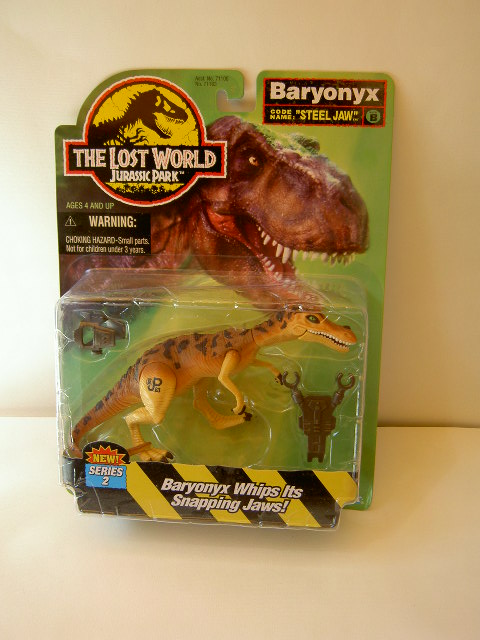
The Lost World Series 2: Baryonyx


Year of release: 1997-1998

Accessories:
-Two pieces of capture gear


Description: this smaller dinosaur figure sports a lighter, earthy paint job, with predominant brown and yellow tones. A light brown colouring is found on its back, flanks, neck, head, upper part of the tail and the very upper part of the limbs. This brown gradually shifts to yellow, which is located on the underside of the creature (belly, throat, lower jaw, lower part of the tail) for the most part, as well as on the rest of the limbs. The figure carries black spots all over its back, neck and upper tail, and features what appears to be a small black horn on its snout, as well as black spots around his green eyes. The claws on both arms and legs are also black, and a black JP: Site B logo is seen on the right upper leg.
The Baryonyx assumes a walking posture, with its left leg moved forward and its right leg backward. Its tail is bent towards its right leg, so this figure fits on its card. The figure is equipped with a whipping action: pulling the right leg back and forth makes the head spin around, as if the creature is thrashing its head. This also accommodates a dinosaur-breaks-free-of-restraint-gear action: when the capture gear is on, the Baryonyx can break free by thrashing its head. Additionally, the beast’s lower jaw snaps back when pulled down and released, making it possible for this sculpt to clasp other figures between its jaws, though the mouth can’t open really wide so most figures won’t fit.
This Bary comes with two pieces of capture gear, which form a sort of harness around the creature’s upper body and restrain its arms and head. However, it wouldn’t stop the creature from running away. Both pieces are painted in a metallic dark grey colour.

Analysis: this figure provides for a totally different take on the Baryonyx, a popular creature among dinosaur aficionados. The JPS2 Bary featured a totally different look: it was somewhat bigger and walked more upright. There are similarities though: both figures have a long snout for catching fish and a large claw on each hand. Both figures are bipedal with their tail towards the ground in a sort of tripod position with the legs, and they both have a tendency to fall down because the front part of the body is heavier than the back. And unfortunately neither of them are very successful figures.
The main concern with this particular Bary is the attack action. It’s virtually identical to the action the Ornithosuchus from this same TLWS2 toy line features, and since these two creatures are the only new dinosaur figures of this line (excluding the hatchlings that is), this attack action lacks originality (I blame the Bary for this because Ornitho was planned to be released in the JPS2 toy line but never made it to stores until the TLWS2 line was released, making Ornitho the more original figure of the two). Baryonyx can thrash its head around by pulling on its right leg. It looked cool on the Ornithosuchus, since it had large jaws capable of gripping other figures, but it doesn’t work on this Bary because its mouth is too small to grab most figures. Basically, Bary looks silly when whipping its head. And like with the Ornithosuchus, it doesn’t snap its jaws on its own, you have to do it by hand, so there’s no improvement of this action feature either.
However, unlike the Ornithosuchus, the thrashing action combined with the capture gear does provide for a dinosaur-breaks-free-of-restraint-gear action option. It actually works quite well, and redeems the otherwise lousy whipping head feature to some extent. It’s a shame the figure doesn’t come with capture gear to restrain its legs though, seems a bit illogical.
This Baryonyx sculpt also isn’t a great design. It’s head sculpt is pretty ugly, and it often falls down because it’s too heavy on the front and its legs are positioned at the end of the body. Also, the tail gets in the way of activating the action feature because it’s bend in such a way the figure can fit on its card, which otherwise wouldn’t be the case. It would have been preferable if the attack action could be activated by moving the other leg instead. The paint job of this Baryonyx is decent enough, though the yellow is a bit ugly and could have used more detailing. And the dark-spots-on-creature’s-back pattern has been done before (and would be done again). So overall, this creature could have used a more appealing design.


Playability: relatively high. This dinosaur features a total of six poseable body parts, namely the arms, legs, head and lower jaw. However, the right leg and the head support the snapping action and swing right back when moved, as does the jaw. This diminishes playability options somewhat. The two pieces of capture gear add something however, especially since they can also be used in a dinosaur-breaks-free-of-restraints action. The tail can get in the way at times, since it’s bent in such a way to accommodate the way this figure is packaged. However, with loose Baryonyxes the tail usually bends back over time.

Realism: this figure is certainly reminiscent of a real life Baryonyx (or at least the way palaeontologists think it looked like), due to its crocodilian head sculpt and a single large claw on each hand. It’s not totally realistic though: the claws on the hands are a bit small, the animal itself is quite skinny and it’s unlikely this particular Bary could walk on all fours, like most scientists believe Baryonyx was capable of. Also, the head sculpt isn’t totally accurate, and compared to human figures this Bary is on the small side (Bary’s could grow twice as big).
Baryonyx has not been featured in any of the JP movies, TLW or otherwise. It has been rumoured Baryonyx originally was going to get a role in JP III, but the producers opted for Spinosaurus instead.

Repaint: no. However, this figure would be repainted twice for the first JP Dinosaurs line, once on its own, and again in a 2-pack with a human figure (Baryonyx with Dinosaur Tracker). In both cases it would come with the same capture gear as this figure, though repainted. It was also planned to be repainted for the JP Chaos Effect: Night Hunter Series line, but that entire line was scrapped.

Overall rating: 5/10. It’s not the best TLW figure, sporting a bit of a lousy paint job and unoriginal action feature. It has some positive aspects, but is overall disappointing. Unfortunately, it’s also relatively rare and usually fetches higher prices. If you don’t care much for it, don’t bother.

maandag 23 december 2013

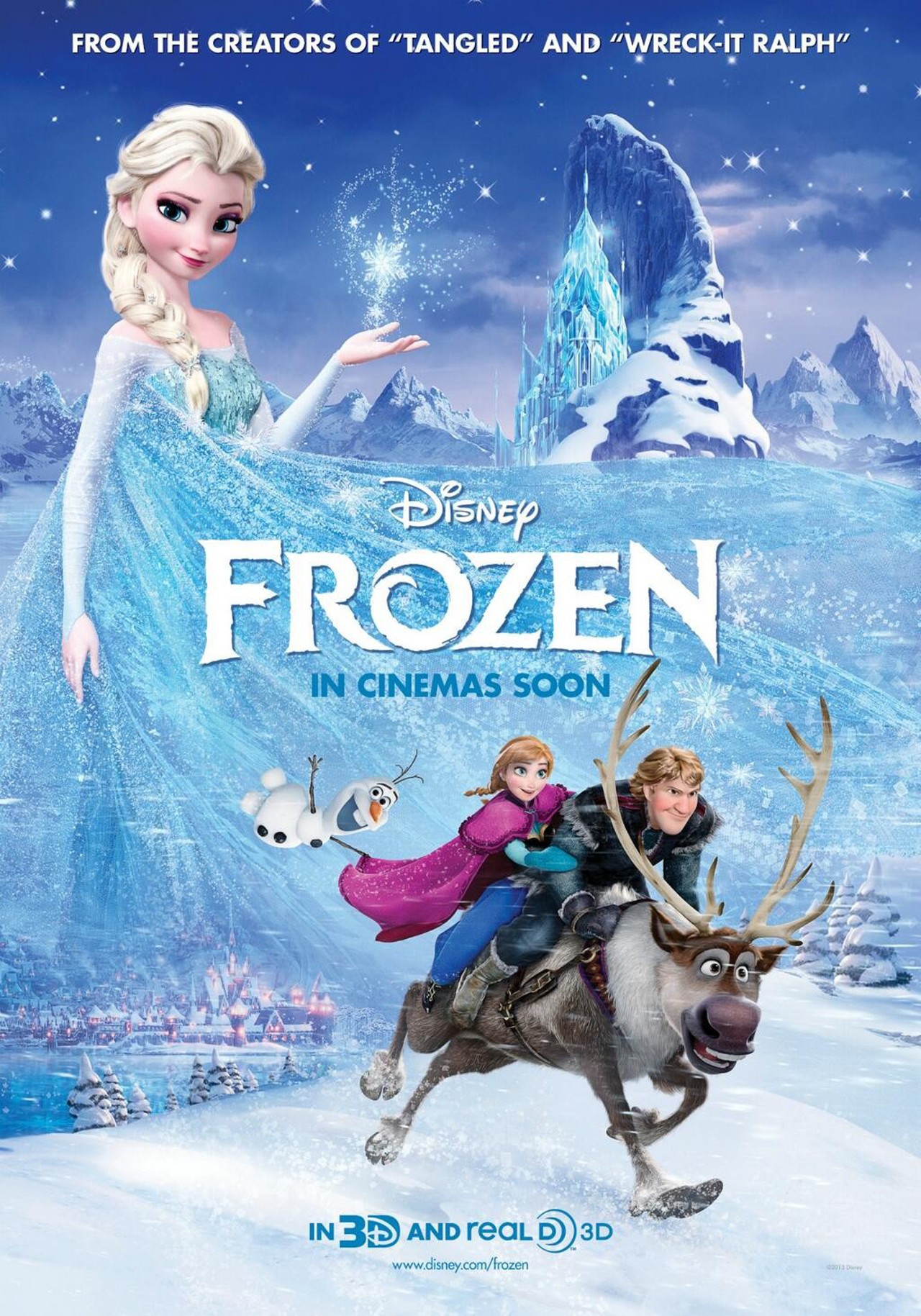
Today's Mini(?)-Review: Frozen


Frozen: ****/*****, or 8/10

Say what you will about conservative Disney, there is some form of modernization in progress in that studio. You might even label it a feminist wave of sorts. Frozen marks Disney's first feature length animated film (co-)directed by a woman and only the second whose screenplay was written by such a creature. Not counting Pixar, since then it would have to contend with Brave, a movie where the girl power backfired, as did the quality of the piece as a whole. And while Frozen largely stays within the trite-and-true boundaries we've come to expect from Disney's fairy tale movies, including princesses, charming princes, faraway lands, comedic (animal) sidekicks and plenty of catchy songs, enough of such regularly exploited material is directionally changed to make the film feel as fresh and cool as the imagery the title inspires. Jennifer Lee's directorial debut introduces not one, but two beautiful young princesses, Elsa (voiced by Idina Menzel) and her younger sister Anna (Kristen Bell), heirs to the kingdom of Arendelle. Both are kind, independent and energetic spirits, but the older girl carries a terrible secret: she's basically a mutant with the power to control ice and snow, except she doesn't control it at all, since her fear to wield it controls her instead. She has cause to be afraid of her powers, as she nearly killed Anna at play as a child. Her parents tried to keep her out of harm's way by largely keeping her confined to her chambers, much to the dismay of her sister, who had her injury and memory of the incident erased by a nice wizard troll (this is a work of fantasy, need I say more?). After the death of their parents and the coming-of-age of the elder sister, a coronation takes place where Elsa is crowned queen and where Anna – hilariously – meets her apparent groom-to-be, the latter event uterly disrupting the former as Elsa unwittingly gets pushed so far she sparks an endless winter that covers the entire kingdom in frost. Fleeing the palace to built her own on a high mountain precipice where she finally starts to accept her powers in her moments of isolation, Anna is determined to bring back her sister and get her to undo her unintentional damage to the realm, which leaves her land vulnerable to the shady ambition of certain visiting foreign dignitaries. Accompanied by a simple but reliable young backwoods man named Kristoff, his carrot obsessed reindeer Sven and a wacky living snowman named Olaf, Anna sets out on a tough voyage to reunite with her wayward sister and bring summer back to Arendelle. And, in typical Disney fashion, to discover True Love in the process. But not in the usual sense of old.


Frozen proves a worthy successor to the similarly themed, equally wonderful Tangled (2010), which also re-established Disney's formidable talent to craft charming, adventurous and romantic fantasy films for all ages after over a decade of creative drought, as well as updating its female characters to the 21st century, a time in which the main focus of a woman is no longer a man to marry (but also not excluding the possibility as not to upset the traditionalists in the audience). Frozen introduces two solid female characters who care first and foremost about eachother, though one of them does not allow herself to show said fact. Both women are sizzling with recognizable character flaws and strengths, familiar emotional family conflict and the talent to burst into song, so despite their ultimately antagonistic nature (though the traditional 'good versus bad' set-up is carefully avoided in their strained relationship), you root for them and their sibling affection both to survive against all odds. Simultaneously, while the sterotypical good looking prince to wed is not an image to be discarded, it develops into quite another direction than is usual, and the expected notion of cheesy True Love messages doesn't end up covering the usual sexual connection between boy and girl. The voice cast delivers impeccable acting and shares an audible chemistry, standout performances including a hilarious Scandinavian tradesman (jå!) and Olaf, the token sidekick, who is not nearly as irritating as he could have been and actually warms everybody's heart with his simple but unattainable desire. Similarly enjoyable are the clan of stone trolls, Kristoff's surrogate family, a group of Smurfesque creatures with the ability to succesfully camouflage themselves as rocks, and who unfortunately don't nearly have as much screen time or background exploration as we would have liked. And if you're afraid the reindeer talks (since animals with the ability to speak are an oft dreaded Disney staple still), fear not: his master does so for him to witty, almost self-reflective results. The songs are a welcome return to tradition; though for a moment at the start of the film they seem to comprise most of the dialogue, better balance to the music is applied later on. Apart from pleasing the aural senses, Frozen offers a delightful visual feast as well with its wondrous winter landscapes and ever present snow motifs, but considering the darkness of many scenes coupled with the obligatory 3D effect, not all the imagery ends up looking as amazing as it could have been. However, many of the 3D shots in the lighter scenes hit their mark, especially those involving snow and icicles, so seeing the 2D version instead isn't wholly recommended either.

In a time where Pixar is increasingly going down the drain creatively because of its lack of inspiration and its current focus on prequels and sequels, a thoroughly wonderful and ideologically original pure Disney film like Frozen is a welcome sight. Even the coolest minds and the coldest hearts will find it hard not to melt due to this film's built-in warmth, and with the dominant motif of snow and ice, Frozen proves to be a perfect Holiday movie for old and young alike.


zondag 22 december 2013

Today's News: Paquin gone rogue


A little flash of news from mine own hand today:

http://www.moviescene.nl/p/152605/anna_paquin_uit_x-men_days_of_future_past_geknipt

I'm not surprised at this occurrence: considering the vast number of returning characters, not to mention a bunch of new ones, there were bound to be a few left in the cold. Apparently Rogue was only in this one single action scene, so it appears there was little substance to her character anyway. If it helps the pace and flow of the movie, sacrifices have to be made. 'Kill your darlings' is a well established editorial practice, and many a film has fallen prey to scenes featuring fan favorites being chopped out. Compare The Lord of the Rings: The Return of the King for example, where everyone's preferred evil wizard Saruman was excised, despite being played by the formidable Christopher Lee (blasphemy says I!). At least that movie had an extended cut upcoming, which I doubt will be the case for Days of Future Past. At least Bryan Singer assures us we'll see the scene on the home cinema release regardless, albeit not reintegrated in the movie proper. It is always a hard thing for actors to swallow when they hear they haven't made it into the final film - the Saruman incident for instance resulted in a brief falling-out between Lee and Peter Jackson - but apparently Paquin is enough of a professional to be cool with it, even though it means she did the whole Comic-Con press thing last summer for nothing. That is, Singer tells us she agrees with the decision: we have not had confirmation of her own opinion yet, so maybe it's just a marketing tactic to assure us that despite the change everything has been resolved amicably. Something which I am inclined to believe, considering the director and actress have worked before twice, so they're probably dear friends as these things go. And as for the fanboys, get over it: there's still plenty of mutants around in Days of Future Past to make for an X-travaganza like nothing seen before. Unless Singer goes all Sentinel and terminates a few more to make the movie run more smoothly. It's Marvel, anything can happen.