The second review by my hand posted on FilmTotaal this year (but more is well underway!):
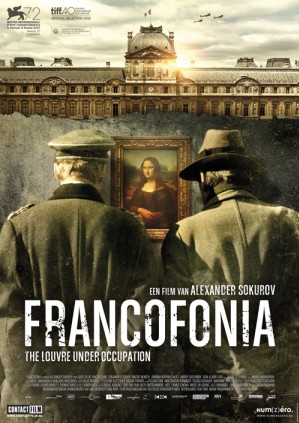
Francofonia - recensie
This is an intriguing compendium piece to Sokurov's breakthrough film Russian Ark, though it lacks the stylistic punch of that particular film. Of course, doing another 100-minute one-take shot would have felt repetitive, as if the director attempted to capitalize on his own past glory. So there's none of that in Francofonia, but that's not to stop Sokurov from pulling a few more cinematographic tricks out of his hat. That, and the overall message, matters more to him than following conventional narrative expectations. Which is made clear a bit painfully, as Francofonia is literally all over the Louvre, rather than sticking to the single time frame that one would have expected to be the primary focus. Even though the museum's survival of the war years during WW II appears to be the subject at hand, Sokurov has a lot more to tell about the place's long history, not to mention sharing his personal thoughts on both the Louvre's background, its place in art history and the treatment of art in general. That's a lot to tackle for a 90-minute movie...
And of course, as a result, not every episode of the Louvre's story proves as interesting. In fact, all of the film suffers from Sokurovs tendency to change subjects, drone on about the abuse and capitalization of art works and sudden jumps to different time periods. Nevertheless, the message remains clear: museums should not be reduced to pawns of commerce, politics or dictators. They are time capsules that tell all of human history and should be carefully preserved, kept well away from the power hungry. The German occupation is just an example of and an hommage to a period in history where the joining of forces between two like minded men, who by all accounts ought to be diametrically opposed, preserved countless artifacts for posterity. Sokurov thanks both men for their assistance to cultural history. But he also isn't afraid to remind us that the origin of the Louvre itself is steeped in conquest and theft. After all, the emperor Napoleon captured many pieces of art on his campaigns abroad and had them shipped to the capital of his empire. Hitler simply attempted to do the same and failed in the Louvre's case, while succeeding in a lot of other cases. Art and politics certainly aren't mutually exclusive.

It's a point Sokurovs makes with the help of various stylistic choices, some proven in prior works, others applied for the first time in his case. Though there are no excessively long takes used as there were in Russian Ark, his introduction of historical characters sharing their insights and motivations with us is taken straight from that film. In this case restricted to only two characters (Marianne, the French Spirit of Freedom and Napoleon), rather than many. This is not a coincidence of course, as Francofonia's main tale also deals with two characters, the museum director (representing the side of French freedom) and the Nazi officer (the conquering party, the Napoleonic figure). Their story is intercut with historical footage, while it is itself disguised as historical footage by its old fashioned framing and the many print scratches applied. It would have worked even better if it was in black and white, but apparently Sokurov disagreed. He disagrees with a lot of things in Francofonia. Like art being shipped over seas as any other piece of cargo in containers on large freighters, its very existence threatened by a violent storm. Why does art suffer so much indignity and indifference today, he laments. No matter how fragmented his thoughts as shown in Francofonia, it's hard to disagree with him, when ancient buildings and statues are demolished left and right by zealous barbarians, who are also eager to simply sell such cultural heritage to the highest bidder to fund their cause. World War II may have ended seventy years ago, but art remains ever in danger at the hands of subversive ideologies. Francofonia serves as an cautionary reminder of what could be scrapped from the history pages forever if we are not careful and respectful of art's place in our cultural mind.


