Posts tonen met het label pteranodon. Alle posts tonen

zondag 30 oktober 2016

Jurassic Park 2009: Dino Trackers: Dino Glide Billy Brennan VS Pteranodon


Year of release: 2009
Accessories:
-Hang Glider

Description: Billy wears a grey sleeveless shirt adorned with dark blue spots, dark blue trousers with some tears on them, a black belt around his waist and brown shoes. He has red hair and eye brows and black eyes. He has some asymmetric details, including belts around his torso, a wristband (right arm), a glove (left arm), a shoulder patch (left arm) and a backpack with a hole in it so the glider can be attached to the figure: all this detailing is coloured black. Most notably, his left arm can move differently from the average human figure, not only forward and backward, but also up and down. The figure stands in an odd position with its legs wide apart and appears to be looking down. The glider is coloured black, covered in various light blue spots and shapes on both sides, revealing a yellow frame work around the edges. It basically resembles a large triangle. Billy can carry it on his back, so it appears he's hanging onto it.
The Pteranodon is positioned with its claws open and its head looking to the right, the left wing raised significantly upwards compared to its right wing. It's mostly coloured light yellow, while the back, most of the legs and feet, the arms and the fingers, the neck and most of the head are painted orange. On their top side the wings feature several brown stripes. The beak is painted brown, except for a triangular area around the nostrils which is pink instead. The figure sports two small brown bands around its head crest. The Pterosaur has small black eyes, a pink tongue and a black JP logo on the underside of its left wing.


Analysis: apart from Alan Grant, the only other actual character from any of the JP movies to reappear in JP 2009 is Billy Brennan. As before, he comes with a hang glider (inspired by the para-sailing scene from Jurassic Park III no doubt) and a left arm that has additional poseability options compared to the other human figures produced by Hasbro. His paint job is quite close to the one used on the original JP III Billy figure (though he's a red head now), except a little darker and more detailed. He looks pretty gritty and tough, as does his hang glider, which features a radically new and detailed paint job compared to its previous incarnations. At least it looks good this time, even though its actual use is still limited: Billy can carry it on his back and pose his arms like he's flying with it, but it looks totally unrealistic and rather goofy.
His Pteranodon companion also got a new paint job, which is far more brightly coloured and cheerful by comparison. It has vague echoes of the JP III Pteranodon paint jobs (the regular ones, not the Alpha Pteranodon sculpts'), but that seems a mere coincidence. Apart from the various colours on the head and the stripes on the wings, this paint jobs is less detailed than the rest of the set. The odd posture of the Pterosaur doesn't help playability, though it can still use his feet to grab a hold of the glider or Billy's left arm. For originality's sake, it's good to see this particular sculpt pop up after it's been neglected for eight years while almost all of the other JP III miniature creatures got countless repaints. There's plenty of Rexes and Raptors already in this toy line...

Repaint: yes. This set is identical to the Billy Brennan set of the JP III line (Wave 1). Billy himself has been repainted once before for JPD2 (along with his hang glider). The Pteranodon is a first time (and until so far, last time) repaint though.

Overall rating: 6/10. Billy remains a fairly good sculpt, though not overly originally repainted. While the hang glider is a bit of a silly thing, it features a splendid new paint scheme. The little Pteranodon has a less appealing paint job, but it's nice to see this sculpt again for a change. Otherwise there's nothing new to be found here. This set is not rare and can still be found with little effort. Since this set was a Toys'R'Us exclusive that might change eventually, but probably not for the next decade.

zaterdag 9 juli 2016

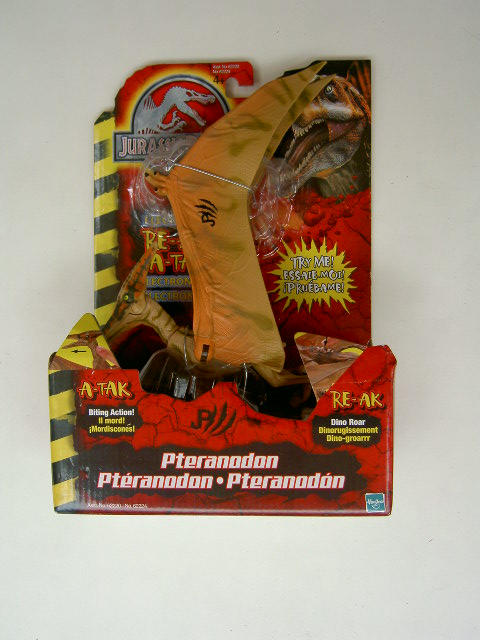
Jurassic Park: Dinosaurs 3: (Ultra) Pteranodon


Year of release: 2005

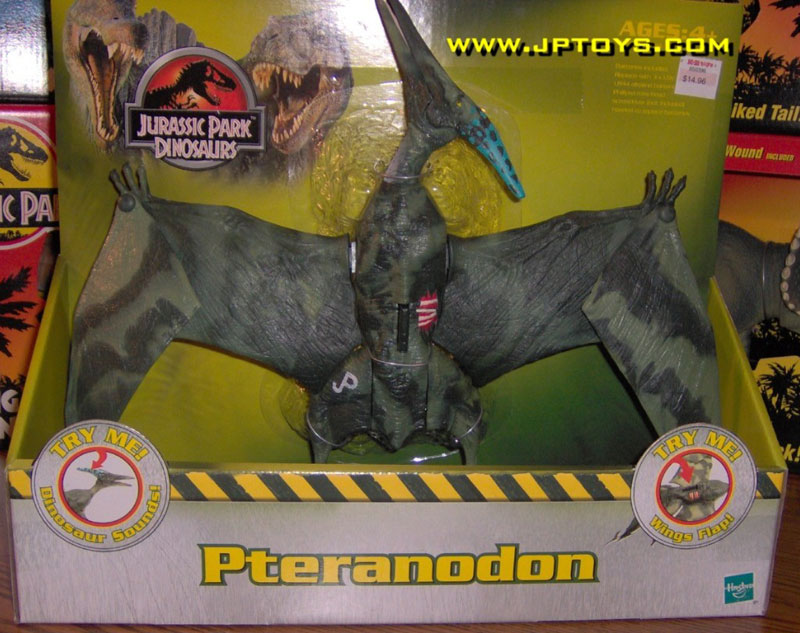
Description: measuring almost 50 centimetres in wing span, this flying behemoth is undoubtedly the largest Pteranodon figure of all the JP toy lines. Because of its size there’s also room for a broader range of actions and sounds, making it a very playable toy. It also has poseable legs to match. Qua action features it’s not particularly imaginative: it's mostly the usual Pterosaur options. First, there is the biting beak: pressing the crest makes the beak open as if the animal is snapping at some poor piece of prey. Second, there is the wing flapping mechanism. Third, the fold-in wings: the outer half of each wing can be folded inward (outward too, but that just looks silly), as if the creature is adjusting its flying pattern. It looks very much like the Pteranodon is diving towards its victim when the wings fold inwards. Additionally, there are the sounds, four in total. The attack screech can be heard when activating the biting action by pressing the beast’s crest. The wound noises are produced by pushing the button in the dino damage wound (located on its right flank, revealing four white ribs and red muscle tissue). The other two sounds can be made by pressing the button on the back which makes the wing flap. Pressing it once and releasing it, or pressing it several times over, produces flapping sounds, while pressing it a bit longer activates a swishing noise, as if the Pterosaur is swooping down on its prey.
Green is the colour of choice for this Pteranodon. Except for its underside (lower half of the throat and belly), which is painted white, virtually all of the body is green. The torso, hands on the wings and base of the wings are coloured dark green for the most part, while shapes, spots and stripes of this colour are also found on the rest of the figure, most notably on the wings. Light green covers the remaining body parts, most obviously on the rest of the wings, the head and the legs. Neither shade of green could be called dominant though, both gradations of green play an equal part. The top half of the crest on the head is painted blue, covered with dark green spots, while below this blue colouring blue spots are found on the base of the crest. The figure has a long pink tongue, small yellow eyes with black pupils and a large white JP logo on its left upper leg.


Analysis: just a year after its JPD2 repaint release, this big Pteranodon sees the light of day again for JP Dinosaurs 3. Why ignore a good sculpt if you can milk it dry after all? But if repainting has to happen, then it's preferable seeing good sculpts getting a makeover. This Pteranodon has a solid new paint job: though green is an unusual colour for Pterosaurs, it suits it well enough. The paint scheme is not that dissimilar to that of its JPD2 predecessor, but not an exact match either and the colour use is definitely a completely different thing. The random interplay between both shades of green works well and gives it a sort of natural chaotic look. The blue coloured crest is also a good addition, maybe hinting at this Pterosaur's social status or desire to mate (though that's undoubtedly not the feeling Hasbro was aiming for). Overall, some extra detailing might have been nice, like differently coloured claws on hands and feet, or the inside of the mouth, but this paint job looks good regardless. Too bad the dino damage wound remains ever present, but surely we got over this nuisance by now. All original action functions are also still in use, including the biting beak, flapping and folding wings and the four different sounds. However, as is the case with the other electronic Hasbrosaurs from JPD2/3, the used electronics are of poor quality, making it increasingly difficult to find specimens in working order. A real shame, but this sculpt provides enough fun otherwise.

Repaint: yes. This is a repaint of the JP III Ultra Alpha Pteranodon figure. The sculpt has been repainted for JPD2 prior to this third release. So far, it has not been repainted since.

Overall rating: 8/10. This is still one of Hasbro's finest sculpts, impressively sized and loaded with playability features. The new paint job is quite different, but also rather good. Like the other big JPD2/3 electronic dinosaurs, this figure was common a few years back, but, insofar as availability, its numbers are in swift decline. With luck, you can still find one for a decent price, but don't expect this situation to last much longer.

zaterdag 18 juni 2016

Jurassic Park: Dinosaurs 3: Electronic Velociraptor with Micro Pteranodon


Year of release: 2005

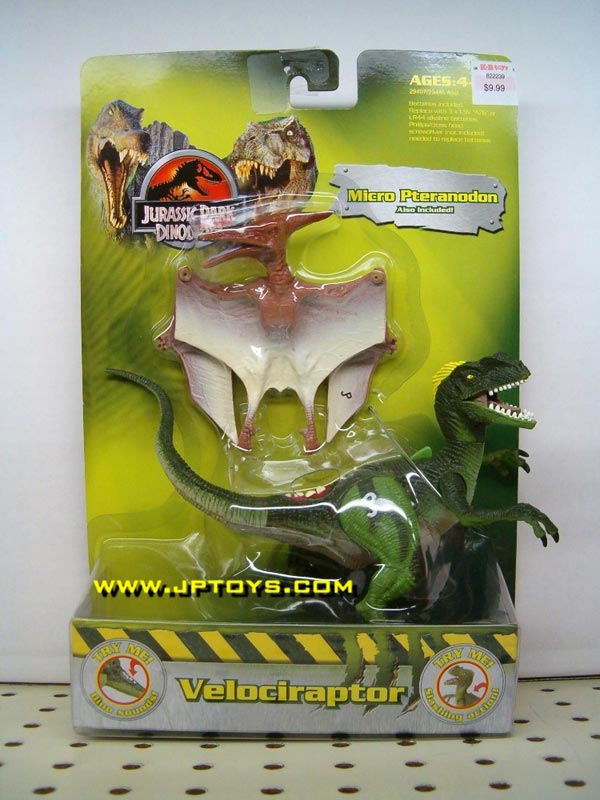
Description: this Raptor figure stands in a dramatic pose when boxed, showing all its primal predator prowess, its body straight upwards, its legs wide apart and its ferocious claws ready for action, while its head faces upwards and is turned to the right, jaws wide open (and not capable of being closed). The tail is bent in a sort of 'S' shaped fashion. This sculpt has proto-feathers on the back of its head, following the design change of the Jurassic Park III Velociraptors as compared to the Raptors seen in the first two movies. Accordingly, it has a nasal ridge on each side of its head. A dino damage wound is located on the upper base of the tail, revealing some of its tail bones and dark red muscle tissue. Inside the wound a button is found: when pressed this produces a snarling sound. On its back this creature has a small lever, activating the slashing claw action feature. This also produces an eerie shrieking noise.
Apart from the figure's underside (the belly, most of the lower part of the tail, the inside of the upper legs and part of the throat), which are coloured beige, this Raptor looks quite green. Most of the animal is coloured dark green, most notably all of the head apart from the lower jaw, the back and the upper side of the arms and tail. The remaining body parts are painted in a much lighter shade of green, which is found mostly on the legs, underside of the arms and part of the neck. Dark green stripes also run over the legs. The proto-feathers on the back of the head are yellow, as are the eyes (with black pupils). The tongue and parts of the side of the mouth are pink and the teeth are white. The claws on both hands and feet are painted black while the figure carries white JP logos on both upper legs.
The Pteranodon is rather large for a creature that originally came with a human figure. The second half of each wing can fold in and out, and when folded to their full (realistic) length, the figure has about a 15 centimetre wing span. It has a small hand on each wing, which however is situated far too much towards the end of the wing and should have been placed closer to the body. The Pterosaur has two long legs which end in claws that can grip human or dinosaur figures' limbs as if it is lifting them off the ground. It has a rather thick plump head on a rotatable neck. Most of this figure sports a brown paint job, mostly a darker shade of brown, though there's also a lighter shade mixed in on various parts of its body (most notably on the chest, arms and head). The underside of the figure (lower side of the wings, tail and most of the legs) is white, which gradually shifts into light brown the closer you get to the arms. The claws on the hands are painted black, while the Pteranodon has red eyes, a purple tongue and a small black JP logo on both the upper and lower side of its left wing.


Analysis: once again it seems Hasbro thought a JP toy line would be incomplete without a decently sized Velociraptor figure, so they bashed out yet another repaint (instead of creating a new figure). This sculpt was used only the year before, but either Hasbro forgot, didn't care or thought kids wouldn't remember (but most likely all three options combined). This Raptor is very green, which actually suits it rather well, considering green was never really a “Raptor colour” as the previous Raptor figures in this colour indicated. The dark, murky quality of the used combinations of green is rather reminiscent of the scrapped Camo-Xtreme Tropical Velociraptor and so this latest try might make up a little to some people for the loss of that particular figure. The creature is also pretty detailed, as all the claws and the proto-feathers have been taken care of. The yellow on the Raptors' back of the head is a nice little touch, and it would have been nice if a similar colour scheme would have been added to the head (particular the nasal ridges) since this still looks a bit dull. Compared to the Camo-Xtreme Night Raptor, the two sounds have been reversed again, so they're in the same order as they were on the original JP III figure. And the good old slashing claws remain the same: cute, but not particularly effective.
The Pteranodon is much more disappointing, considering it is a total reuse instead of just a repaint. If you already own the Pteranodon and Compsognathus two-pack of this toy line you'll find it a boring and unneeded addition to your JP dinosaur collection. And the paint job is, again, very bland. It makes good prey for the hungry Raptor, if the Pterosaur was ever stupid enough to get too close to it's vicious claws.

Repaint: yes. Both figures are repaints of JP III dinosaur sculpts. The Pteranodon originally came with Eric Kirby, while the Raptor was originally the Alpha Velociraptor of the JP III line. The Raptor has been repainted before for Camo-Xtreme and JPD2, and the exact same Pteranodon (identical sculpt and paint job) was featured in the Pteranodon and Compsognathus two-pack of this line. The Raptor would be repainted again for JP 2009, but for the Pteranodon, this would be its last appearance (so far).

Overall rating: 5/10. The Raptor looks decent and is fairly detailed, but otherwise no different than before. The Pteranodon, already suffering from a lousy paint job, unfortunately is identical to the other Pteranodon figure of this toy line, making it redundant and uninspired. Like the other JPD2/3 electronic dinosaur figures, this two-pack was very common a few years ago, but has since become increasingly hard to find, despite not being a very popular set. If you really want one, patience is certainly required, but fortunately it doesn't necessarily require a lot of cash once you've found it.

woensdag 20 april 2016

Jurassic Park: Dinosaurs 3: Pteranodon/Compsognathus 2-pack


Year of release: 2005

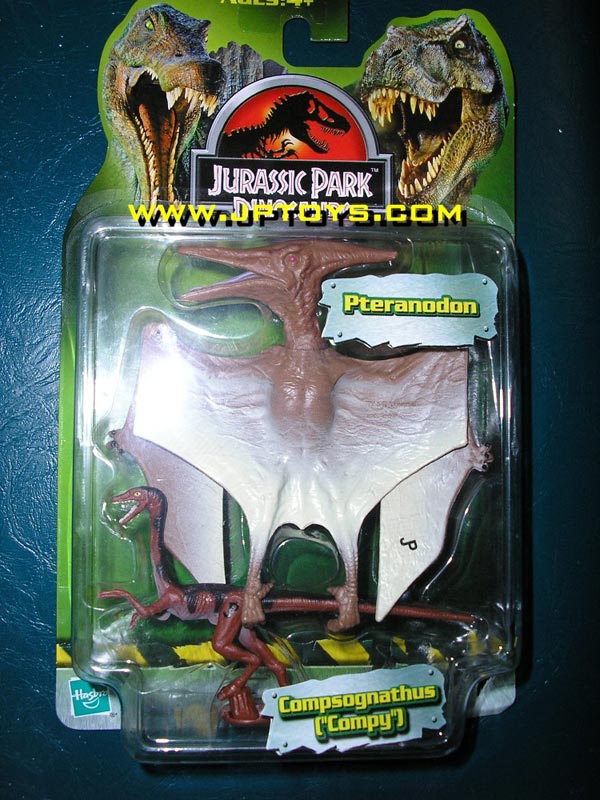
Description: the Pteranodon is rather large for a creature that originally came with a human figure. The second half of each wing can fold in and out, and when folded to their full (realistic) length, the figure has about a 15 centimetre wing span. It has a small hand on each wing, which however is situated far too much towards the end of the wing and should have been placed closer to the body. The Pterosaur has two long legs which end in claws that can grip human or dinosaur figures' limbs as if it is lifting them off the ground. It has a rather thick plump head on a rotatable neck. Most of this figure sports a brown paint job, mostly a darker shade of brown, though there's also a lighter shade mixed in on various parts of its body (most notably on the chest, arms and head). The underside of the figure (lower side of the wings, tail and most of the legs) is white, which gradually shifts into light brown the closer you get to the arms. The claws on the hands are painted black, while the Pteranodon has red eyes, a purple tongue and a small black JP logo on both the upper and lower side of its left wing.
The Compsognathus is a rather skinny little critter, much smaller than the Pteranodon. It stands on a small base resembling a log or a rock, posed in an aggressive stance as if it's leaping off the base onto its prey, its mouth opened and its left arm outstretched. Its underside (most of the throat, belly and inner parts of the limbs) is coloured beige, while the rest of the body is mostly dark brown (particularly the tail, flanks and limbs). A tick black stripe runs from the back of the head over the neck and back almost to the end of the tail, with round shapes running out of it over the neck, flanks and tail. The Compy's teeth and inside of the mouth are white, while its eyes are yellow with black pupils. It has a black JP logo on both upper legs.


Analysis: haven't seen these figures in a while! After the countless repaints of the Rex, Raptor and Spinosaurus figures from the JP III line we've seen so far, you'd tend to forget Hasbro actually made other creature figures to team up with their human figures back in 2001. Two of these are packaged here together: the result is a mixed bag. It's good to see both figures again for a change, but the Pteranodon is still not a very good figure, especially considering the wonderful job Hasbro did on the other Pterosaur figures (why couldn't they just have repainted those...!?). It's larger then most of the other dinosaur two-pack figures since it originally came with the smaller Eric Kirby human figure and it was supposed to lift him into the air. This “action feature” (i.e. gripping claws) has been retained and still hardly works since prey figures just slip out all too easily. The folding wings feature also has been kept intact, saving space but looking silly and unrealistic. And the Pteranodon's new paint job is just ugly. Brown and white just don't go well together, and there's little variety or detailing in this figure otherwise (except for the eerie and weird purple tongue and red eyes).
The Compsognathus faired better for this set, but is also not as good as before. The signature green paint job which looked quite good on it has been replaced by a rather dull and uninspired brown paint job with black colouring on top, something we've seen before all too often. Details have been neglected (claws, inside of the mouth, etc.), but at least the sculpt is still pretty good and a lot different from the other smaller dinosaur figures JPD2 and JPD3 offer. As to who would be most likely to survive a conflict between the two, it depends on the situation. If the Pteranodon managed to swoop down on the Compy with stealth and speed it might be able to grab it or peck it to death easily enough, but the tricky little bastard would probably see it coming well in advance and choose to run and hide. It's probably better if both creatures stuck to eating what they eat best: know-it-all boys for the Pterosaurs and cocky Marlboro men for the Compies to feast on in large numbers.

Repaint: yes. Both figures are repaints of dinosaurs that originally came with human figures for the JP III line. The Pteranodon originally came with Eric Kirby, while the Compsognathus is one of two different Compy sculpts that teamed up with Alan Grant (the Wave 2 release). Both figures are first time repaints, and ironically enough also last time repaints in the case of these sculpts, though the exact same Pteranodon (identical sculpt and paint job) was featured with the Electronic Velociraptor figure of this toy line.

Overall rating: 6/10. There's nothing new to both sculpts, nor are these paint jobs especially appealing. However, it's nice to see different sculpts repainted for a change instead of the same old Rexes and Raptors all the time. The Compsognathus is still a fairly good figure, the Pteranodon less so. Like most dinosaur two-packs from JPD2 and JPD3, this is one of the more common releases and it can still be found with little effort, usually for low prices – not surprisingly – because they're just not very popular sets.

dinsdag 22 maart 2016

Jurassic Park: Dinosaurs 2: (Ultra) Pteranodon


Year of release: 2004

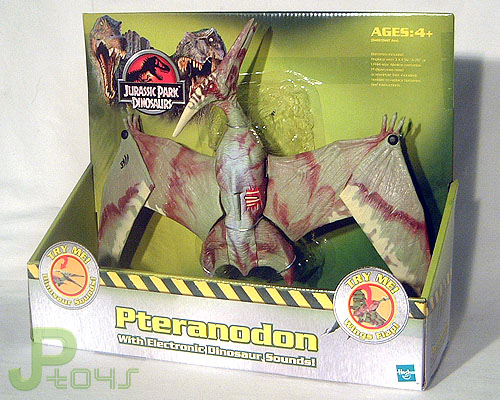
Description: measuring almost 50 centimetres in wing span, this flying giant is undoubtedly the largest Pteranodon figure of all the JP toy lines. Because of its size there’s also room for a broader range of actions and sounds, making it a highly playable toy. It also has a pair of poseable legs to match. Action feature wise it’s not particularly imaginative: it's mostly the usual Pterosaur options. First, there is the biting beak: pressing the crest makes the beak open as if the animal is snapping at some poor piece of prey. Second, there is the wing flapping mechanism. Third, the fold-in wings: the outer half of each wing can be folded inward (outward too, but that just looks silly), as if the creature is adjusting its flight style. It looks very much like the Pteranodon is diving towards its victim when the wings fold inwards. Additionally, there are the sounds, four in total. The attack screech can be heard when activating the biting action by pressing the beast’s crest. The wound noises are produced by pushing the button in the dino damage wound (located on its right flank, revealing four white ribs and red muscle tissue). The other two sounds can be made by pressing the button on the back which makes the wing flap. Pressing it once and releasing it, or pressing it several times over, produces flapping sounds, while pressing it a bit longer activates a swishing noise, as if the Pterosaur is swooping down on its prey.
The main colour for this large Pterosaur figure is a greenish beige, which can be found all over the body, except for the very top of its back, which looks to be more light grey. Dark red stripes and shapes of various sizes cover this main colour, mostly rather diffused to make it feel more natural. Most obvious are the lines on the wings, while obvious concentrations of red are found around the legs and on the head. White colouring is located on the lower part of the wings (on both sides). The pins in the poseable parts of the wings, just under the fingers, are painted black. The top of the crest on the head is painted light yellow, while spots of the same colour are found right under this, running from half way of the crest to the nostrils. The Pteranodon has small yellow eyes (with black pupils), a pink tongue and a black JP III logo on its left wing.


Analysis: apart from the T-Rex, another big prehistoric creature returns for JP Dinosaurs 2. This fabulous Pteranodon sculpt might have been neglected for Camo-Xtreme, but at least it didn't remain totally forgotten. It's still one of Hasbro's best works, very large and rather detailed, as well as equipped with various cool action features and sounds. Aside from the paint job, it offers nothing new of course, but with a sculpt this good, that can be forgiven. The new paint scheme is quite original and imaginative. The overall pale colour adorned with dark red gives the flying beast a touch of death, underscoring the danger of a Pterosaur this big (certainly compared to the small Hasbro human figures, which look minuscule in comparison to this critter!). The way most of the red paint is applied, in rather vague smears instead of the more usual definite lines and shapes, gives it a more naturalistic, authentic look instead of the obvious artificiality of the usual paint job. The white colouring on the lower side of the wings feels redundant though. It seems such an odd place for extra colouring, unlike the yellow on the crest which could indicate the animal's social status, willingness to mate or age (though it seems unlikely Hasbro actually considered such realism).
Even the best Hasbrosaur has a few downsides though, and this figure sadly does too. Most obviously there is the annoying dino damage wound which can't be covered up, making this Pteranodon scarred for life (literally). More attention could have been given to the claws on the toes and fingers, as well as the inside of the mouth, though it's acceptable as it is. The most lousy thing are the screws that hold both halves of the wings together, right under the creature's hands. They should have been coloured to match, but were woefully ignored, making them feel hideously out of place. Overall, this is a fine, solid paint job, but there's just a few irritable little things. It's an excellent figure regardless and definitely worth your while if you don't own this sculpt yet.

Repaint: yes. This is a first time repaint of the JP III Ultra Alpha Pteranodon figure. The creature would be repainted again for JPD3.

Overall rating: 8/10. This is still one of Hasbro's finest sculpts, impressively sized and loaded with playability features. The new paint job is quite different, yet pretty appealing. Like the other big JPD2/3 electronic dinosaurs, this figure was common a few years back, but now it's running out fast. With luck, you can still find one for a decent price, but this may very well change in the not too distant future.

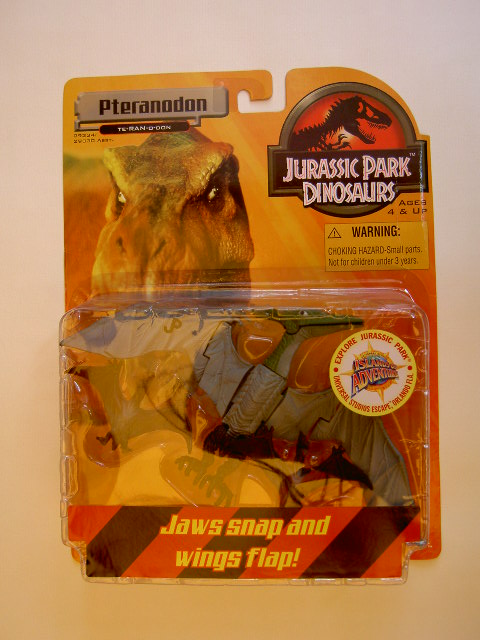
vrijdag 12 juni 2015

Jurassic Park Dinosaurs: Pteranodon


Year of release: 1999

Accessories:
-Two Pteranodon hatchlings


Description: this flying reptile is positioned in a neutral and almost symmetrical posture. It measures about 15 centimetres from the tip of one wing to the other. It has a small body with equally small legs and a tiny tail (if you can even call it that). It has a large head with a blunt elongated crest sticking out and a pointy beak with no teeth (which is accurate). Pulling the crest makes the beak open, while releasing it makes it shut with a snap. Like any Pterosaur it has a pair of large wings on the side of its body, basically arms (including fingers, bent inward) ending in one very long finger which holds the skin of the wing together. Each wing consists of two moveable parts. On its back the Pteranodon features a large button: pressing it makes the wings flap. The claws on its legs are posed in a gripping posture.
No blue for Pteranodon this time. This Pterosaur sports a more varied colour scheme. Most of the upper side of its body (back, tail, arms and claws, and the lower part of its wings) are painted dark brown, while the rest of the top part of the wings, the fingers, the neck and the head are all green. The figure's underside (throat, belly and underside of the wings) are all grey. The inside of the mouth (including the tongue) is also dark brown, while the figure has white eyes with big black pupils and a black JP logo on the underside of its right wing.
Along with this figure come two adorable little Pteranodon hatchlings. These animals can stand on their legs and have their wings outstretched, ready to take flight. They sport a very simple paint job, being almost entirely painted in a dark brown paint job, except their chests are coloured beige. They do not have a JP logo, since they're nothing but accessories to this set.


Analysis: yet another golden oldie finally got a makeover for the first JP: Dinosaurs line. And this one is not alone! He got company from two identical hatchlings last seen in the TLWS1 line. This is undoubtedly done to fill in the void left by the absence of capture gear. It's an original move, though the choice of hatchlings seems odd. The TLWS1 Pteranodon babies are made in a different style than the JPS1 Pteranodon and apart from the basic features they're not the best match, especially the head sculpts. The JPS1 Alan Grant's Pteranodon hatchling would have made a more likely choice.
They share similar paint jobs though. And sadly, both are rather dull. The hatchlings are almost entirely monochromatic, except for the chests. They're also exactly the same, which is rather boring though of course cost effective. Applying different paint jobs on them, even with only minor differences, would have given them more character. The adult Pteranodon also isn't much of an improvement over its predecessor. Its underside isn't that different from the original, and the combination of green and brown gives it a kind of swampy look, not reminiscent of an airborne creature. The eyes look wholly fake, and more detail (mouth, claws) would have been welcome. To sum up, this is just an overly simple and ugly paint job, though the hatchlings still got it worse. The adult Pteranodon's action features are left unchanged. The biting action is decent enough, but the flapping wings still look somewhat silly. Overall, not a very successful makeover for this figure.

Repaint: yes. This is a repaint of the original JPS1 Pteranodon, with repainted hatchlings from the TLWS1 Nick van Owen figure (which only came with one hatchling). The figure would not be repainted again, nor would the hatchlings.

Overall rating: 5/10. A classic figure returns, but it wasn't the best then and it isn't now. The hatchlings are a nice addition and a welcome change from capture gear, but the paint jobs in this set leave a lot to be desired. It's certainly one of the lesser sets in the first JP: Dinosaurs line. As a Wave 1 release this figure wasn't hard to find, though also not overly common.

donderdag 11 september 2014

Jurassic Park III: Ultra Alpha Pteranodon


Year of release: 2001

Description: measuring almost 50 centimetres in wingspan, this flying giant is undoubtedly the largest Pteranodon figure of all the JP toy lines. Because of its size there’s also room for a broader range of actions and sounds, making it a very playable toy.
Qua action features it’s not totally original: there are the usual, somewhat cliché, Pterosaur options. First, there is the biting beak: pressing the crest makes the beak open as if the animal is snapping at some poor piece of prey. Second, there is the wing flapping mechanism. Although this is new for the JP III toy line (the other electronic Pterosaurs have poseable wings too, but they can’t flap them), it has been seen on the JPS1 Pteranodon as well as on the TLWS1 Giant Pteranodon (which was less of a giant than this beast is). Something not featured with earlier larger Pterosaur figures is the foldable wing option: the upper half of each wing can be folded inward (outward too, but that just looks stupid), as if the creature is adjusting its flying pattern. It looks very much like the Pteranodon is diving towards its victim when the wings fold in.
Additionally, there are the sounds, four in total. Though two of them (the attack screech and the wound noise) were also featured on the smaller Pteranodon of this toy line, the other two are new. The attack screech can be heard when activating the biting action by pressing the beast’s crest. The wound noises are produced by pushing the button in the dino damage wound. The other two sounds can be made by pressing the button on the back which makes the wing flap. Pressing it once and releasing it, or pressing it several times over, produces flapping sounds, while pressing it a bit longer activates a swishing noise, as if the Pterosaur is swooping down on its prey.
Compared to the regular JP III Pteranodons, this creature sports a rather dark paint job. It’s primary colour is dark blue, which can be found about anywhere on its body. It also has black spots mixed in the blue, most notable on the wings. A lighter shade of blue is found on the hind part of the wings, as well as on the throat and belly of the beast. The Pterosaur’s back is adorned with metallic brown hues. It has small yellow eyes in scarlet red sockets, and a long pink tongue in its beak. The creature’s crest is yellowish beige, with small dark blue spots and stripes. The claws on the Pteranodon’s hands and feet are not painted in a different colour. A large dino damage wound is located on the giant’s back, showing red muscle tissue and white ribs. Like with other Hasbrosaurs, the wound cannot be covered up. Lastly, a small light blue JP III logo is found on the Pterosaur’s lower left wing.

Analysis: despite Hasbro’s poor jobs on most of their creatures, they totally got it right this time. This is by far the coolest and largest Pteranodon sculpt and makes one wonder why this figure is so great while the other Hasbrosaurs are such horrible abominations. The paint job, though rather gritty and dark, is not bad and provides a small glimpse into the conceptual artwork made for JP III (see the ‘Realism’ section of this review).
Granted, two of the figure’s sounds are recycled (something for which Hasbro is notorious) and none of the action features of this toy is really original, but it’s hard to think of something new when you’ve got five Pterosaurs in one toy line alone (most of them belonging to a species of which toys have been made for decades, the overly famous Pteranodon Ingens). Just be glad all of these features work properly. The biting beak is actually strong enough to hold figures, though Hasbro figures only (not Kenner’s because they are bigger and heavier). The wing flapping system is also a golden oldie and a first for this toy line. It’s great fun, and the sounds only make it more realistic. The folding wings were also featured on the small Pteranodon that came with the Eric Kirby figure, but look much better on this sculpt (and also save room, since this Pteranodon is big enough already). The quality of the sounds is quite good, and they can easily be produced. You don’t have to bash the figure to activate a certain sound, like with the stomping noise of the Ultra T-Rex. This decreases the risk of damaging this wonderful toy.
Unfortunately, even this beautiful sculpt has some downsides. Like with all of Hasbro’s work, it features a nasty wound on its back, which sadly cannot be covered up, so it’s damaged for all eternity. Also, the position of the feet looks a bit odd and due to the space required for the flapping mechanism and electronics, the figure’s body is a bit bulky. But other than that, it’s about as perfect a Pterosaur as you can get.


Playability: high. This is undoubtedly the most poseable and diverse Pteranodon sculpt of all the various JP toy lines. It can flap its wings and fold them in, has moveable legs and neck, it can open its beak and makes no less than four different sounds. It also helps this figure assumes a totally neutral pose. These elements combined make for one of the most playable Pterosaurs ever. However, it’s still an electronic figure, so if you want to keep it in working order you should take some caution handling it.

Realism: this figure is mostly accurate, though it’s quite oversized. Compared to Hasbro’s human figures (or even Kenner’s) this Pteranodon is stupendously huge. It’s not called an ‘Ultra’ Pteranodon for nothing it seems… Its paint job is very different from the Pteranodons featured in the JP III movie. However, concept art of that movie reveals an ‘Alpha’ Pteranodon character was conceived for the film, but was eventually dropped for some reason. The concept art’s colours look very similar to this creature’s paint job, so it seems Hasbro based this figure on the artwork for the Alpha Pteranodon that never made in into the final film. The smaller Pteranodon figure that came with Eric Kirby featured the same paint job, and was labelled an Alpha Pteranodon too, though it’s beyond doubt this large Alpha Pteranodon is the undisputed leader of the Pterosaurs.
Scientifically speaking, this figure is also quite accurate. There are some minor points of criticism though. The creature’s body is a bit large and plump, but this was of course done to accommodate the electronics and flapping mechanism. Also, the animal’s legs are a bit far apart and oversized. Interestingly enough, unlike the Pteranodons seen in the movie, this sculpt has no teeth, increasing accuracy, since Pteranodons did not have teeth in reality either (they’re called Ptera-nodon for a reason, meaning ‘wings and toothless’).

Repaint: no. However, the creature’s attack and wound sounds are reused from the regular electronic Pteranodon of this toy line, and would again be heard on the Tapejara figure of the JP III Wave 2 line. The Ultra Pteranodon itself would be repainted twice for the last two JP Dinosaurs lines.

Overall rating: 9/10. This is one of the coolest and most accurate Pterosaur models made for the JP toy lines, and it’s damn impressive due to its size and plethora of sounds and playability options. Also, it’s one of Hasbro’s finest pieces of work, which actually isn’t saying much since most Hasbro figures are rather disappointing by comparison. It’s highly recommended, though not always easy to get. It was given a wide release in the USA, but it’s sadly less common in other territories. Ebay usually provides a good and often relatively cheap solution.


vrijdag 25 juli 2014

Jurassic Park III: Pteranodon


Year of release: 2001


Description: a medium sized Pterosaur model with a wingspan of almost 40 centimetres. It’s mostly tan coloured, with some brown and green paint on the wings, including a JP III logo on the underside of its left wing. It’s got some black stripes on its back, as well as a dino damage wound: a red spot with some white points in it, making it appear as though this animal has been injured. The head has some orange and dark green spots on it, and its eyes are yellow. Three small fingers stick out of each wing, and it has a very small tail. This Pteranodon has two legs.

Analysis: this is one of the better Pterosaur figures of all the JP toy lines, and certainly one of Hasbro’s best models. It “stands” in a neutral position, unlike most of the Hasbro dinosaur sculpts, so it’s easier to play with. The colouring is good enough; not very detailed, but reminiscent of the colour the Pteranodons in the movie had. It has some moveable body parts, including the legs, but the wings get extra credit: they can move in almost any direction, so that the animal can take on various flying positions. There’s no flapping wing action like the previous Pterosaur models had, but with wings like this, that’s hardly a great loss.
The animal has a biting action: if you press on the crest on his head, the head will move forward and its beak opens, at which point the figure makes a screeching attack noise. A second sound can be heard by pressing the little white button in the middle of the dino damage wound on its back, allowing the figure to make two similar screeching noises.
Unfortunately the creature has a bit of a large belly, but that’s because it needs batteries to produce the sounds. Another little point of irritation is the fact the dino damage wound cannot be covered by a skin patch, like the Kenner dinosaurs featuring similar damage had. Both points are minor nuisances for such a good model.


Playability: the playability is quite high, mostly because of the almost omni-directional wings. The neutral pose it takes on is also a plus in this matter. One of his feet is oddly positioned though, making it appear this animal is pushing off on something. The other foot is positioned more traditionally, and it’s possible to have the Pteranodon clutch human figures with that foot. The two different sounds also enhance the playability possibilities, though playing too rough with this figure is out of the question if you want to keep the electronics working.

Realism: the Pteranodon looks a lot like the Pteranodons featured in JP III, both in shape and colour. It’s a little too large compared to the human figures produced for this toy line though, but that doesn’t really matter. Paleontologically speaking its also relatively accurate, but the legs might be a bit too big, and the arms certainly are too long: the hands (the point where the three fingers stick out of each wing) should be positioned closer to the body.

Repaint: no. This figure would not be repainted either. A repaint was planned for the JP III CamoXtreme line though, but it was unreleased.

Overall rating: 8/10. It’s a very good figure, and certainly one of the more realistic and playable Pterosaurs of the various JP toy lines. It comes recommended and fortunately isn't rare, so be sure to find one yourself, even if you’re not fond of Hasbro’s JP III toy lines, because it’s worth it.

dinsdag 17 juni 2014

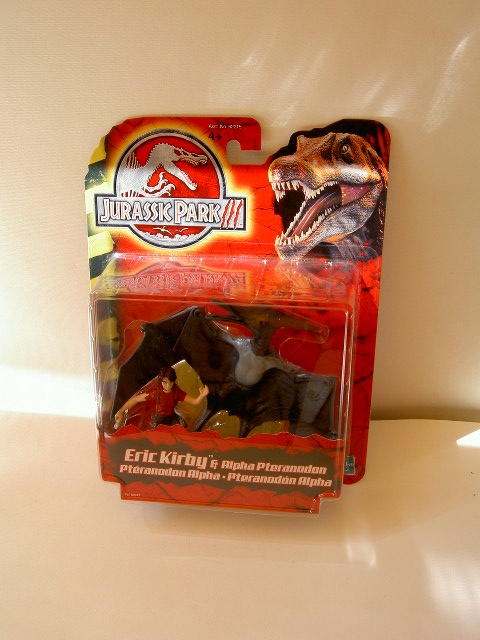
Jurassic Park III: Eric Kirby & Alpha Pteranodon


Year of release: 2001

Accessories:
-Pteranodon figure


Description: this somewhat smaller figure (it’s a kid after all) sports a red shirt (Beware the red shirts!), short blue pants and white sport shoes with red stripes on them. He’s got some nice details, like a brown backpack, a green belt, a silver flashlight in his hand, and what appears to be a Nintendo Gameboy on his hip. The figure has brown hair. One of his sleeves has a slight tear, like he’s been grabbed by something. The Pteranodon is mostly dark blue (almost black), with some black stripes, a white belly and brown colouring on his head and back. He’s got a JP III logo under his right wing. There are no accessories: no weapons like most figures have.

Analysis: the figure looks good, and is in fine scale compared to the other adult figures. The little details add some realism, but stand in the way of playability: the flashlight is attached to the hand and the backpack is not removable, unfortunately. The figure stands in an odd pose, with one hand stretched out and one leg in a forward move. Overall it looks like he’s looking down at something. He’s not able to move his legs, but he can move his torso, which is a poor substitute though.
The Pteranodon is at least twice as big as the Eric figure, which is unusual for human figures and their dinosaurs. It certainly isn’t a hatchling as it most common. The paint job is fairly decent, but nothing spectacular and different from the Pteranodons in the movie. This figure doesn’t have much moveable parts either. The wings are moveable in the middle, and its head can be turned round, but that’s it. This Pterosaur has long legs, and the idea is it can hold Eric in his claws. Sadly this doesn’t really work. Eric won’t stay in his claws and slips loose easily. Other than that these figures have no other action possibilities.


Playability: very little. Eric can only move his arms, which are in a weird position anyway, and his torso. Only his left hand can be used to hold things. The Pteranodon can move his wings and head, but nothing more. Quite disappointing.

Realism: this figure, despite its flaws, does resemble the Eric Kirby (Trevor Morgan) in the movie. His clothes are not too different, and neither is his face. The Pteranodon doesn’t look like his brown counterparts in the movie. However, there was an Alpha Pteranodon planned to appear in JP III, but this idea was eventually scrapped. This figure does resemble the concept art drawings of the Alpha that got out, so it offers an interesting little glimpse into JP III’s artwork. Unfortunately, the Pteranodon isn’t anatomically correct: the claws on his wings are much too far removed from his body, and the large fingers holding the skin of his wings don’t run in a straight line like they should.

Repaint: no. The Pteranodon figure would be repainted for JP Dinosaurs 2 though, and used twice.

Overall rating: 4/10. It’s not a very good figure. It just doesn’t offer much playability. It might be good for dioramas, but that’s it. The Pteranodon isn’t great either: again, little playability, and the colouring is bland. This set isn’t really rare, so should you want one, get it cheap. It’s not worth a lot.

dinsdag 10 juni 2014

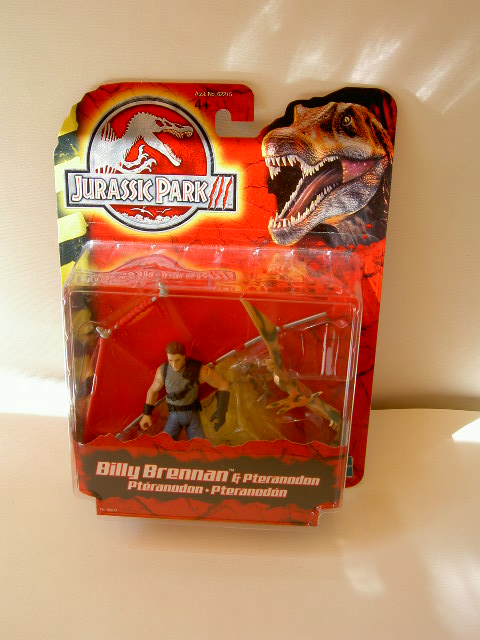
Jurassic Park III: Billy Brennan & Pteranodon


Year of release: 2001

Accessories:
-Pteranodon figure
-Hang glider


Description: this figure wears a grey sleeveless shirt, blue trousers with two scratches in it, and black shoes. He has brown hair and very bright blue eyes. He has some asymmetric black details, including belts, wristband (right arm), glove (left arm), shoulder cap (left arm) and a backpack with a hole in it so the glider can be attached to the figure. Most notably, his left arm can move differently from the average figure, not only forward and backward, but also up and down. The figure stands in an odd position with his legs wide apart and appears to be looking down. The glider is coloured bright red with silver highlights. It basically resembles a red triangle. The Pteranodon figure is tan brown with green spots and stripes, and an orange head. It’s got a black JP III logo on the underside of his left wing. It’s positioned with its claws open and its head looking to the right, its left wing raised upwards.

Analysis: this is an interesting figure. Though it still stands in an awkward position, like most of the JP III human figures, the left arm with additional movement possibilities is a plus. The figure is well painted, though the asymmetric detailing is a bit weird: why is he only wearing one glove and shoulder cap?
The answer lies in his relation to the Pteranodon figure, which can grab his left arm, so that it looks like Billy is holding it and looking at it, while the animal looks back at him. Sort of. It works nice when he’s holding him, but hinders playability options, since both figures are in an odd position when cut loose from each other.
The glider is nothing special. It’s little detailed and its colours are pretty dull. The glider can be attached to Billy’s back, but when it is, it doesn’t look like Billy is flying with it, but merely standing up with a large red triangle on his back. In fact, it looks very fake. The Pteranodon can also grab on to several parts of the glider with its claws.


Playability: it’s fifty-fifty in this case. Though the extra arm movement certainly adds some points, the fact that the figure stands with his legs wide apart and the odd pose of the Pteranodon takes some points away. The glider doesn’t add much unfortunately. Luckily Billy can hold stuff with both hands, though one hand is kind of pointing at something.

Realism: this figure does resemble the Billy Brennan (Alessandro Nivola) in the movie, even though his eyes are way too blue. However, this Billy sports an entirely different outfit than his movie counterpart. Billy’s lucky pack is unfortunately missing. There was no glider in the movie, but there was some parasailing equipment (like a parachute). It would have been a lot cooler if this figure has a parasailer instead of a glider, but that would have been harder to make, so undoubtedly Hasbro opted for this instead. Disappointing, but we’ll have to live with it. The Pteranodon looks similar to the adult Pterosaurs in the movie (except with more green), but doesn’t resemble the hatchlings we saw in the awesome bird cage scenes much. It looks more like a miniature figure of an adult Pteranodon. It also resembles the larger Reak-Atak Pteranodon figure released for this toy line, so at least there is consistency.

Repaint: no. Billy and his glider would be repainted once for JP Dinosaurs 2 though, and again for JP 2009, this time including the Pteranodon figure (making that its only repaint, unlike most other small Hasbrosaurs).

Overall rating: 6/10. It’s a fairly decent figure, and better than most of the JP III human figures, but as stated above it could still use some work in certain areas. It’s not really rare, so if you want one, you’ll find it relatively easily and probably not at huge cost. The only reasons I recommend it for are the cool left arm, nice paint job and the neat Pteranodon figure.

donderdag 20 maart 2014

Jurassic Park Chaos Effect: Ankyloranodon


Year of release: 1998

Description: bearing features of both the flying Pteranodon and the armoured Ankylosaurus, Ankyloranodon has a muscular small body with a pair of large wings and two legs featuring sharp claws. Its head is about the size of its body and looks very spiky due to the long curled crest sticking out the back of its head and the hook at the end of its beak. Its also has bumps on the side of the lower jaws. The wings sport a sort of bat pattern, consisting of muscular arms with long fingers sticking out which hold the skin forming the wings. Each wing also carries a sharp hook. This beast has a flexible tail that ends in a large solid club adorned with spikes. The tail section forms the basis of the attack action this animal is equipped with. On the middle of its back, right above the legs, a large green lever disguised as a spike sticks out. Pulling this lever makes the tail curl downward so the creature violently smashes its tail around to inflict damage. This monster’s back is covered in armour, running from the back of the head to the end of the tail. The armour carries spikes (though not very sharp ones), including two rows of black spikes on its back.
Ankyloranodon sports a mixture of purple and green colours. Most of the lower parts of the animal (legs, belly, throat, lower jaw, underside of the wings) is coloured bright green, as are the hook on the figure’s beak and the large crest on the back of the head. Also, the arms and fingers of the wings are painted this same colour. The upper parts of the creature’s body (the armour on its back and neck, as well as most of the upper jaw) are painted purple, with some purple spots adorning the lower jaw. The skin that forms the largest part of the wings is also purple, but strangely enough only on the top side. The figure’s tail is entirely coloured purple, but of a lighter shade (it’s also made of a softer material so as to enhance the flexibility needed for the tail smashing action). The club is mostly red, but for some black lines and stripes running between the spikes and bumps it’s composed of. Black can also be found covering parts of the head, mostly around the eyes, which are bright orange (no pupils), and around a large dark purple (again a different hue) spot on each side of the beak. Additionally, a thin line of black is found on either side of the crest, while the tongue is also black. Its teeth, which aren’t very fearsome (hinting at the herbivorous Ankylosaurus DNA, since Pteranodon had no teeth) are white. A large black JP Chaos Effect logo is located on the right upper leg, along with the number .48. Its claws are not painted in a different colour.
This figure does not come with any pieces of capture gear. However, it needs to be assembled first because the tail club and wings are separate components when the figure is carded; otherwise the figure, which takes up quite some space compared to the other smaller Chaos Effect dinosaurs, wouldn’t fit on its card.

Analysis: this is without a doubt one of the coolest new dinosaur sculpts devised for the Chaos Effect toy line. It features a great and original attack option and a wonderful overall design. The paint job is about average, but not necessarily bad. Bright green and purple are a typical colourful Chaos Effect paint job, but from an aesthetic viewpoint they’re not the most appealing combination. Especially vexing is the fact the underside of the wings isn’t painted like the upper side.
The design of this figure is quite neat. It definitely looks mean and nasty, not something you would want to mess with. The wings, which are quite poseable, and can swing in almost any direction, look somewhat battered and worn out, due to the way the fingers run between the skin, and the fact they feature small pieces of damage at the lower side of the skin, like some ferocious carnivore slashed at them. The creature comes with muscular legs and large claws on its feet: though not poseable themselves, Ankyloranodon can hold other figures (smaller dinosaurs, human figures) between them and carry them through the air. Adding to the creature’s horrific look are the various hooks, bumps and spikes found on its body. Though the beast’s teeth don’t look so imposing, the large hook on its beak as well as the black tongue make up for that. The only thing which makes this deadly hell spawn look somewhat silly, is the long thin, curled crest on its head. It lacks the feeling of sharpness and danger the other protrusions on this monster have.
The very best thing about this figure is the awesome tail pounding action. Pulling the lever on its back makes the tail swing downward, causing the club to viciously hit anything in its way. The tail is rotatable (though not very easily and it might cause damage to the action feature’s mechanism over time), so the creature can also swing its tail in other directions. The thrashing tail option works very well and knocks over most smaller figures. However, Ankyloranodon’s legs can get in the way, so you might have to move them in a different position. Despite this minor nuisance, the tail swinging works perfectly and is a lot of fun to play with. This particular action feature is also quite original, since it had not been featured on any figure before this one and wouldn’t be used in the same fashion again (though the JP III Brachiosaurus featured a similar, but definitely inferior, tail attack action).
Playability: quite high. The wings are particularly poseable due to the mechanism with which they’re attached to the body. They can move up and down, slightly back and forth and in a full circle. Also moveable are the legs and the head (from the neck up), though the beak unfortunately can’t be closed. The tail section is rotatable, though less easy than the other body parts. The tail swinging action adds a very playable and easy to perform attack option to this great figure.


Realism: Ankyloranodon is obviously as fictional as the rest of the Chaos Effect series, and is yet another fantastical addition to this imaginative toy line. The figure obviously carries features from both the Ankylosaurus (armour, tail club) and Pteranodon (wings, beak, crest). It may not be believable a large and heavily armoured creature like this, weighing nine tons according to the card, could ever take to the skies, but as a predator it has significant advantages over its fellow Chaos Effect monsters. This creature can swoop down unnoticed, quickly kill prey with a deadly hit of his lethal tail club and fly off again carrying its victim with its large claws. The armour and array of spikes over its body provide solid protection against any adversaries that might be dangerous to this beast, if any. Realism be damned, this is the perfect carnivore!

Repaint: no. This is an original sculpt designed specifically for this toy line and as such, it would not be repainted for later toy lines either.

Overall rating: 8/10. Though the paint job isn’t all that good, Ankyloranodon comes with a fun new attack option and great playability, making it one of the more successful new Chaos Effect sculpts. It’s not the easiest figure to find and you might have to search for it somewhat, especially in regions where it didn’t get a proper release. However, it should totally prove to be worth your while, if you're at all into Chaos Effect weirdness.


vrijdag 18 oktober 2013

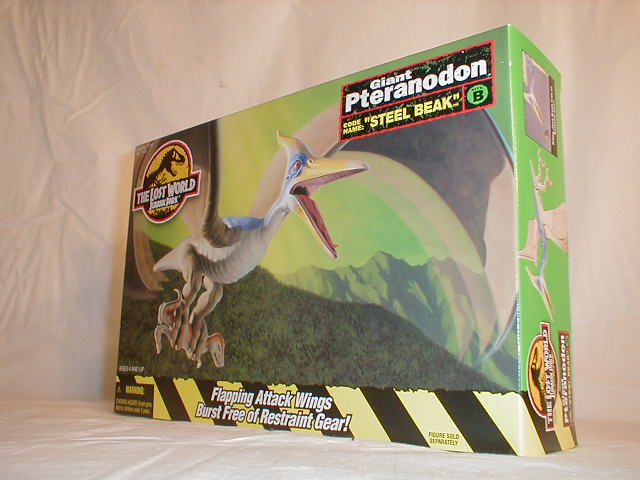
The Lost World Series 1: Giant Pteranodon


Year of release: 1997

Accessories:
-Two pieces of capture gear


Description: elongated and slender is the word for this Pterosaur. It features a long, skinny body ending in a small tail. Right under the tail it has a pair of thin legs with three claws on each. Two of these claws are poseable, with the third one positioned opposite the others, so the creature can grab things like human figures or small dinosaurs with these claws. On its left upper leg this critter is marked with a large black JP: Site B logo, numbered .22.
The front part of the body ends in a thin neck with a large head on top of it: this head is basically a long beak on one end and a large pointy crest on the other. The Pteranodon has three small protrusions on each side of its beak. Next to these are a nostril, bright red eye (with a black iris), and small ear on each side of the head. Pressing the crest will open the animal’s beak, showing a large red tongue.
Most noticeable are the wings of this Pterosaur. On each side of its body a blue clamp is positioned, to which a thick arm is attached, ending in four fingers, the last of which is very long and runs to the tip of the wing, where a small rectangular pin is found. The pins can be pushed into the small holes next to the creature’s legs, creating a wings-folded-in system. The wings can fold out by pressing the large button on the back, which also controls a flapping wings mechanism. The rest of the wings consists of a fine beige cloth, with a plastic strip in the middle of the wing holding it together.
This creature sports a mostly beige paint job. It’s wings, arms, inside of the mouth and legs are painted in this colour, with the animal’s belly and throat coloured in a lighter shade of beige. The upper parts (back, upper tail, neck and middle part of the face) of the Pteranodon are painted in shiny blue, including the large button on its back. The beak and crest are painted yellow.
This animal comes with two pieces of capture gear, both sporting an entirely shiny dark grey paint job. The smaller piece can be wrapped around the creature’s beak, right behind the protrusions which make sure the piece doesn’t fall off. The other piece can be clamped around the Pterosaur’s legs and tail.

Analysis: with regard to the Pterosaur figures, this is a rare case in which Hasbro’s figures are more realistic and playable than Kenner’s. The JPS1 Pteranodon wasn’t a great figure to begin with, and this larger Pteranodon, almost twice as big, isn’t much of an improvement. First of all, the paint job, though somewhat resembling the colours of the Pteranodon seen in the TLW movie, isn’t appealing. The beige is quite bland. The yellow on the head sculpt looks a bit silly, especially since the Pteranodon already has a goofy face (those eyes look ridiculous). This sculpt could have used a more elaborate and detailed paint job.
Second, the wings. They are too small, and though the cloth is a nice touch, it’s more susceptible to damage and dust. It gets spotty quite easily (in my case my cat once puked on it, after eight years the stains are still there…). Also, the arms are way too thick compared to the rest of the body, and thanks to the extra strip of plastic in the middle of the wings this figure has a sort of bat like quality to it, unlike real Pteranodons. The clamps next to the body make the wings look fake.
The capture gear, as if often the case, doesn’t add much either. You can put it on the animal but it’s hard to find other uses for it. The Pteranodon can rid itself of the beak piece by opening its mouth a few times so it slips loose. There’s no breaking-free action for the other piece. We’re to believe the V-shape structure of this piece causes the wings to stay folded in, but when the button is pressed the wings fold out: the animal can just take off and leave, it seems.
Still, this figure has some redeeming features. The claws on it’s feet are neat and can really hold a figure tight. They’re strong enough, so when “in flight” the figure doesn’t shake loose and fall to the ground. The flapping wing mechanism works better than the one the JPS1 Pteranodon featured, though as far as accuracy is concerned it’s commonly believed Pteranodons were gliders; their size made it hard to fly through flapping their wings, and they used air lifts and wind to glide instead. The unfolding system is a bit odd; though in real life Pterosaurs could fold their wings in some fashion too (in order to walk using their hands), it would probably not be very healthy for a Pteranodon to fold its wings in this position. But the unfolding looks cool, and it saves space when the creature’s wings are folded in. However, the right wing has some problems folding out sometimes, because the right leg gets in its way.


Playability: this figure provides for more playability options than you might be inclined to think. It has poseable claws and legs, its mouth can be opened, its neck twisted 360 degrees. The flapping mechanism works fine, and the folding of the wings is an interesting additional option. Added to this are the two pieces of capture gear, though their use is very limited.

Realism: like stated earlier, this sculpt does resemble the Pteranodons seen in the TLW movie to some extent. It has a similar paint job, though a lot less detailed of course. It’s also a slender skinny animal, as it was in the film. However, the wings are totally off: for one thing they should have ended on the base of the legs instead of halfway across the flanks. Its legs and claws are also disproportionate, as is the case with the head, which is just too big. Its crest has a different shape. Compared to human figures, this Pteranodon is somewhat oversized. Maybe that’s the reason this model is called Giant Pteranodon.

Repaint: partially. The capture gear and the creature’s head are new, but the rest of this Pterosaur’s body is a repaint of the JPS2 Quetzalcoatlus. It would not be repainted again.

Overall rating: 5/10. Though it has some fun action features, this sculpt isn’t very good. It’s not rare and can probably be found quite cheap, but my advice is to go for one of Hasbro’s various Pteranodons instead (undoubtedly the only time I pick Hasbro’s work over Kenner’s). Still, if you can get it for little cost it may be worth it.

zaterdag 31 augustus 2013

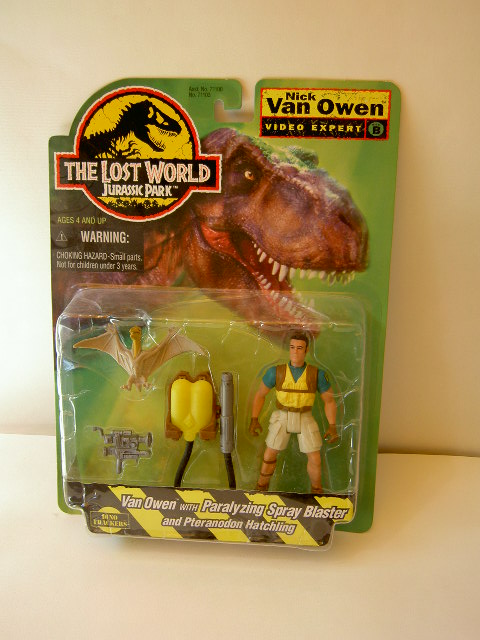
The Lost World Series 1: Nick van Owen


Year of release: 1997

Accessories:
-Spray gun with backpack
-Camera
-Pteranodon hatchling


Description: this figure sports beige shorts, brown gloves, shoes and utility belts, and a green shirt with a yellow vest over it. A brown knife is attached to the back of his right leg, while another knife is attached to the back of his left upper leg, coloured in the same beige as his pants so it’s hardly noticeable. The figure’s got black hair and eyes. He’s got a JP Site B patch on his left shoulder. It stands largely in a neutral position, except his right leg is stretched out somewhat. There is a variation of this figure: this particular sculpt wears a green hat with the JP Site B logo on it, while that logo is missing on his shoulder.
This figure comes with a small silver camera device, or at least something resembling a camera, which does nothing: it’s just an extra little gadget. The action of this figure is provided by the spray gun: it consists of a yellow pack with a black hose attached to it, ending in a silver gun. By putting the gun in water and pressing the yellow pack, the pack gets loaded with water. Pressing the pack again makes the gun squirt water at anything in its path. The pack can be put in a brown backpack, so that the figure can wear it on its back and hold the gun.
Along with this figure comes an adorable little Pteranodon hatchling. It’s coloured mostly beige, with some slightly shiny blue paint on its back, neck and crest. The throat and front part of the head are coloured in a yellow paint job, with black eyes and yellow pupils. The animal can stand on its legs and has its wings outstretched, as if it’s about to take flight. It has a black JP Site B logo on its right upper wing.

Analysis: this figures has its pros and cons. Nick himself looks pretty good, though the upper part of his outfit looks a bit odd and unrealistic. The two knifes are a bit out of place, since Nick didn’t have them in the movie. It’s also a shame one knife is hard to spot on this figure, making that one seem useless altogether. But other than that, this is a pretty cool figure with an okay paint job.
The spray gun isn’t very original. In fact, it’s a repaint of the weapon the JPS1 and JPS2 Dennis Nedry carried. It works the same too, so there’s no improvement or anything. This weapon may be good for people who like to play with water alongside their other action figures, risking paint wear and damaged electronics. For people who’re not keen on potential hazards to their figures the weapon is a plain redundancy. The camera thingy also doesn’t add much since it doesn’t feature any action. However, it helps Nick’s character as a video expert (which the carding claims he is, and people who’ve seen TLW know him to be) to be emphasized.
The Pteranodon hatchling is cute and sports a paint job very similar to the Giant Pteranodon figure of this toy line. The paint job is a bit bland, but the figure looks real cute. It’s also nice to see it can actually stand and not just lie down like the other small Pteranodon figures.

Playability: it could be better. The figure itself has the regular moveable body parts. The hatchling too, in the sense that it’s not poseable in any way like most hatchling figures are. The weapon does work, but it doesn’t look totally impressive and has little impact on any figures that get hit by firing water at them. Also, for people who don’t want to use water for fear of damaging other figures the weapon is more of an obstacle since they can’t do anything with it. The camera is a fun bonus gadget, but nothing more.


Realism: Nick’s face sure resembles Vince Vaughn somewhat, except it’s got less detail and his hair is too dark. The clothes this figure sports don’t resemble the outfit Nick wore in the movie, except his pants maybe. There wasn’t any type of weapon firing liquids in TLW, nor was there a type of camera similar to the camera device this figure carries.
The Pteranodon looks like a hatchling, and could very well be the offspring of the Pteranodons seen in the closing shot of TLW. However, it’s not entirely palaeontologically correct: for one thing, its crest is oversized. Another, even worse, mistake concerns the wings of this sculpt: they feature a bat like pattern, with multiple long fingers with skin stretched between them. However, real Pteranodons didn’t have wings like this. They basically has a hand with one extremely long finger and skin stretched between this finger and their body.

Repaint: the figure, hatchling and camera are new. As mentioned above however, the spray gun is a repaint from the same weapon carried by JPS1 and JPS2 Dennis Nedry. Additionally: the Pteranodon hatchling would be repainted for JP Dinosaurs 1, for a set containing a large Pteranodon figure and two of such repainted hatchlings.

Overall rating: 6/10. It’s a decent figure, but the weapon isn’t great or original. A new weapon, or even a repaint of another weapon that doesn’t require water, would have been preferable. Also, both the hatchling and the outfit of Nick himself could have been better. Both variations of this figure aren’t hard or costly to come by, so it should take little effort to acquire them if you wanted one, or both, of them.

maandag 10 juni 2013

Jurassic Park Series 1: Pteranodon


Year of release: 1993

Accessories:
-Collector’s Card # 7


Description: this creature is positioned in a neutral and almost symmetrical posture. It measures about 15 centimetres from the tip of one wing to the other. It has a small body with equally small legs and a tiny tail (if you can even call it that). It has a large head with a blunt elongated crest sticking out and a pointy beak with no teeth (which is accurate). Pulling the crest makes the beak open, while releasing it makes it shut with a snap. Like any Pterosaur it has a pair of large wings on the side of its body, basically arms (including fingers, bent inward) ending in one very long finger which holds the skin of the wing together. Each wing consists of two moveable parts. On its back the Pteranodon features a large button: pressing it makes the wings flap. The claws on its legs are posed in a gripping posture.
Pteranodon is painted in basically three colours. Most of the underside of the creature (lower jaw, throat, belly and underside of the wings) is light grey, while the upper parts of the animal (back, back of the wings, most of the neck, as well as both legs) are coloured dark grey. Additionally, most of the head (including the crest), upper part of the neck and the hands are painted light blue for variation. The creature has small red eyes with black irises. The inside of its beak is dark grey, no coloured tongue or anything. Its claws are not painted. On the underside of its right wing is has a dark grey (almost black) JP logo with the number .05 under it.

Analysis: though a memorable and recognizable figure of the first JP toy line, this is one of the lesser figures, both in paint job, design and quality. To start with the former, the colour scheme is just dull, there’s way too much grey and it’s distributed in unappealing proportions over the figure’s body (basically, the under side is all light grey and the upper parts dark grey, how imaginative). The blue doesn’t add much and isn’t really an aesthetically pleasing mix with the grey.
The overall design of this sculpt isn’t great either. The head is too big compared to the rest of the body but at least the snapping beak action works. Also, the beak snaps back with force and holds on tight to anything unfortunate enough to get clasped between its jaws. The same cannot be said for the claws, which are too small and not strong enough to really hold onto anything, let alone lift figures off the ground. Most irritating are the wings with their double jointed flapping mechanism. Though the flapping action works okay, it’s a very predictable feature and makes little sense since Pteranodon was a glider, not a flapper. Mostly, it just looks damn silly and unimpressive. If the wings had only one point of poseability, right next to the body, it might have been better, because now the wings just get in the way of the action. Also, the outward part of the wings isn’t connected to the rest of the wings in a very tight way. Over time as the figure gets more worn out, those parts of the wings tend to just fall off all the time.
Overall, this Pterosaur is just a poorly designed creature, certainly not as beautiful as the elegant beastie seen on the collector’s card it comes with. Kenner struggled with Pterosaur design for the TLWS1 line as well, again releasing a flawed Pteranodon. Interestingly enough, Hasbro did get it right multiple times, unlike with most of their other creature sculpts.


Playability: though the creature has a decent range of articulation points for a Pterosaur figure (legs, wings in four places, neck and upper jaw), playability could have been better. The large head tends to get in the way of the wings, while the wings themselves hinder other poses. Though the snapping beak action works, the gripping claws and flapping wings are a disappointment.

Realism: Pteranodon wasn’t featured in the Jurassic Park movie, so the toy designers had to work from scratch (which may be why this figure didn’t really work out). Overall, the creature is just too “compressed”, its body and legs are too small and the wings and head are too close too another. This Pteranodon just isn’t an elegant glider, but a plump pigeon like failure. It’s also somewhat undersized compared to human figures, considering Pteranodons could measure a seven metre wingspan, while this figure would be around four metres at best.

Repaint: since this figure is part of the very first JP toy line, it’s not a repaint in any way. However, it would be repainted for the first JP Dinosaurs line, but not for other toy lines.

Overall rating: 4/10. A poor design and lousy paint job probably make this Pteranodon the worst figure of the first Jurassic Park line. There may be some nostalgic values attached to it since it’s part of the classic JPS1 line, but other than that it’s not very appealing. Fortunately it’s not rare and can be found at low costs, should you really want one.