Posts tonen met het label dilophosaurus. Alle posts tonen

zondag 6 november 2016

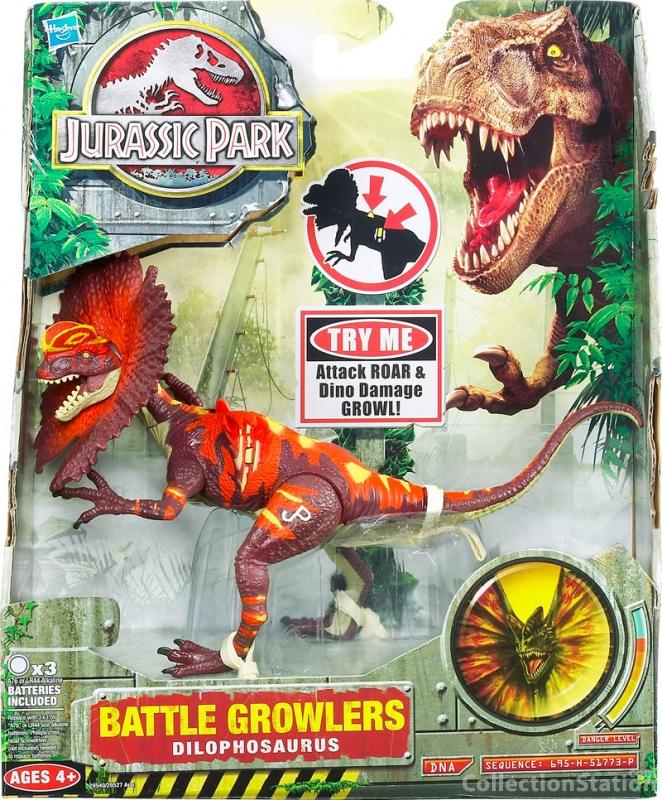
Jurassic Park 2009: Battle Growlers: Dilophosaurus


Year of release: 2009

Description: this dinosaur, a slender bipedal carnivore with a very characteristic head, sports two semi-circular ridges on top of its head, with a little spike behind each. Also, the large frill (not removable), which was a made up feature for the Dilophosaurus in the first Jurassic Park movie, makes it easily recognizable. The figure stands in a sort of stalking mode, with its body and tail bent, its legs and arms wide apart, its head posed to the left and its jaws opened. The figure has a large dino damage wound on its left flank, showing white bones and red muscle tissue, with a button inside it, which produces a hissing shriek when pushed. Also, an orange lever is located on its back: when pulled, the figure slashes its arms back and forth and makes a hissing, rattling attack roar.
This Dilophosaurus has a very fiery paint job. Its underside (lower jaw, throat, belly, underside of the upper arms, inner part of the legs and lower part of the tail) is coloured simply beige though. The rest of the body is covered in a reddish brown paint job. Its neck, back and tail are adorned with orange colouring which largely extends over the flanks (including the dino damage wound) and has various small rounded and spiky shapes running out of it, most notably on the hips and tail. Additional orange stripes and shapes are found on the limbs. In most cases, the orange colouring is accompanied by small yellow spots and shapes found in the middle of it. The top of the head and the crest are coloured red, with red stripes running over the face over the snout and ocular area. The crests are equipped with thin yellow lines running around its edges, and also forming a circular shape in the middle of each crest. Unlike the rest of the figure's bright colouring the crests are adorned in a symmetrical pattern instead of randomly. The big frill around the creature's neck is painted plain reddish brown, like most of the body, except for the centre of its front side, which is coloured orange and gradually shifts into aforementioned brown. The figure has a pink tongue and inside of the mouth, white teeth, small green eyes (with white pupils and black irises), black claws on both toes and fingers and a white JP logo on each upper leg.


Analysis: finally, the return of the Dilophosaurus sculpt! Too bad they didn't retool it like they did with the big T-Rex, since all of this figure's former faults remain intact. To start with, its frill still can't be removed, hindering not only overall playability and rendering its front side too heavy so it can't stand up straight, but also being in the way of the attack action of the arms, which has a very limited range because of this, and is otherwise rather unimpressive. Also ever present is the big dino damage wound on the flank which can't be covered up. At least it's partially camouflaged by the new paint job in this case.
Which brings us to this figure's only new feature: the elaborate colour scheme. If you ever wondered what a possible Camo-Xtreme Lava Dilophosaurus might have looked like, this could very well have been it. It gives this dinosaur a very dragon like feel, its already bizarre look being fused with colours which spawn a sense of fire and danger. The details are also nicely done, especially on the head, like the crests and the eyes. However, the frill should have gotten more attention, being so obviously there but hardly presented with a paint job to speak off, like the figure was factory painted separately from the frill and its paint job was largely forgotten (which may have actually been the case).
Overall, a good paint job, but a bad figure. At least its movie accurate sounds are still there (making the figure hard to play rough with if you want those to stay in working order).

Repaint: yes. This is a repaint of the JP III Dilophosaurus figure (Wave 1). It is a first time repaint (yes, those still exist in this day and age!) and, so far, a last time repaint too.

Overall rating: 5/10. Despite its effective and original new paint job, this is still not a very good figure due to its asinine posture, gaping dino damage wound and limited attack feature. This dinosaur figure is not rare and can still be found effortlessly. Since this set was a Toys'R'Us exclusive that could change some day, but probably not for the next few years.

maandag 5 oktober 2015

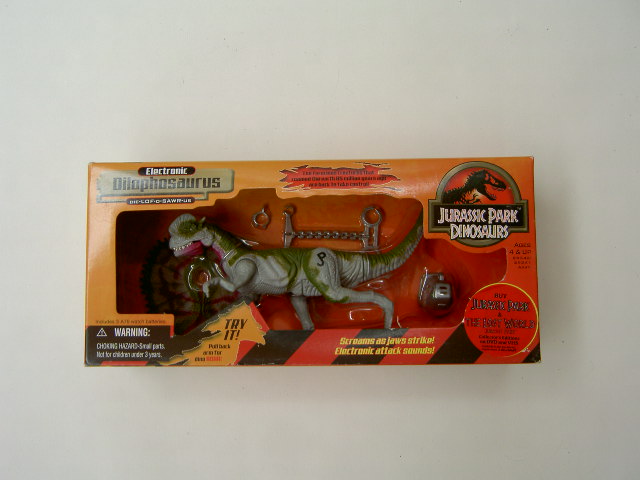
Jurassic Park Dinosaurs: Electronic Dilophosaurus


Year of release: 1999

Accessories:
-Removable frill
-Three pieces of capture gear


Description: this Dilophosaurus is electronic and sports a biting action. When pulling the left arm back the mouth opens and produces two short identical screeches which in no way resemble the rattling and hissing sounds this creature made in the movie. Most noticeably, this figure is equipped with a big frill, largely round in shape with serrated edges. The frill can be placed around the creature’s neck, making it look more aggressive and dangerous than it looks without. It can also be applied to various other figures, though more for fun than for realism. Like any good Dilophosaurus figure, this sculpt sports the same double crest with small spikes behind on its head. The creature stands in a largely neutral posture, though its tail is raised upwards. It has some trouble standing on its two legs since it’s not very well balanced, but making it lean on its tail in a tripod position solves that particular problem and makes it look more dominating.
This Spitter sports a fairly simple paint job despite the ample colouring possibilities the frill and crests offer. The lower parts of the sculpt (belly, most of the flanks, arms, feet, most of the legs, lower part of the tail and portions of the head, including the inward parts of the crests) are all light grey, while the rest of the figure (the back, upper part of the tail, the front sides of the upper legs, the neck and the area around the eyes) is dark green. Green shapes run out of this colouring over the flanks and sides of the tail and neck. Hardly noticeable, lighter green colouring runs around the edges of the darker shade of green on most of its body. Most of the lower jaw and throat are purple. The inside of the figure's mouth is also purple, including the tongue, while it has small white eyes with black irises and tiny white teeth. Its claws are not painted in a different colour. On its left upper leg it carries a black JP logo. The frill is also grey and is covered with green around the edges on both sides, including the aforementioned lighter green hue, as well as purple stripes and small lighter green spots on the front side.
This dinosaur comes with three pieces of capture gear. The first part is the standard tag which fits around various body parts. The second piece restrains both the arms and legs simultaneously, while the third piece covers the head, including its crests. All three pieces are painted in the same shiny metallic grey paint job.


Analysis: the classic Electronic Dilophosaurus from the very first JP toy line from 1993 also returns for the first JP: Dinosaurs line. Unfortunately, there's nothing this figure adds to the already existing sculpt. Both the paint job and paint scheme are largely identical to its predecessor, though the original white has been replaced with grey and this new release sports a darker paint job overall. Even the colour schemes on the crests and frill are practically the same, which is a real shame because body accessories like these provide great opportunities for wild colouration try-outs, but apparently no designer rose to this challenge. The only notable difference is the back of the frill, which also has coloured edges now. Furthermore, some details have been omitted, like the claws on both hands and feet, but the inside of the mouth at least is painted. The sound FX have been beefed up a few notches and sound more impressive than before. However, for some reason the mouth won't open as far as before, making for a less effective attack action. It could just be my particular specimen, but the feeling is raised that the designers tampered with its strike feature when improving the electronics.
Unlike the original JPS1 Electronic Dilophosaurus, this figure comes with capture gear. None of the three pieces were designed for it of course, but at least they fit. The limb piece works pretty well and does an adequate job of restraining arms and legs. The head piece is a near perfect fit, which is especially interesting knowing this particular part also comes with the Dimetrodon and Ornithosuchus figures of this toy line: it seems to be a fairly universal muzzle. The tag is just the standard little nuisance, the sort of thing people keep misplacing, severely irritating collectors who aim to get the figure complete when in loose condition, all the while not providing any real function but to tell people this is a Jurassic Park figure, which of course everybody can see by the JP logo on the figure's left leg.

Repaint: yes. This is a repaint of the old JPS1 Electronic Dilophosaurus, with repainted capture gear from the JPS2 Velociraptor and TLWS2 Ornithosuchus figures, as well as the typical tag found on many dinosaur figures from various JP toy lines. The figure would not be repainted again.

Overall rating: 6/10. It's still a fairly decent Dilophosaurus sculpt with greatly enhanced sound FX and usable capture gear, but the paint job is just a terribly big let-down and the attack option has lost its impact. This is one of the more common electronic dinosaurs from this line, but still not always an easy find, especially MIB or complete.

zondag 13 juli 2014

Jurassic Park III: Dilophosaurus


Year of release: 2001

Description: this dinosaur is a slender bipedal carnivore with a very characteristic head, sporting two ridges above the snout. Also, the large frill, which was a made up feature for the Dilophosaurus in the first JP movie, makes it easily recognizable. The figure stands in an almost stalking mode, with its body and tail bent, its legs wide apart, and its jaws open. The figure has a large dino damage wound, showing bones and muscles, on its left side, with a button in it, which produces a screaming hiss. Also, a lever is located on its back: when pulled the figure slashes its arms and makes another hissing and rattling attack roar. A black JP III logo can be found on its left leg. It’s coloured in various green tones, mostly dark green, but with several lighter green stripes. It has a large white stripe running from its tail to the crests on its head. Some minor grey can be found on its belly. The underside of the frill is coloured in almost exactly the same tone of darker green with lighter green stripes, while its upper side is a dazzling display of various tones of green, accompanied by four red twirled stripes. Its claws are black, and for once they didn’t forget to paint the tiny claws on the side of each foot.

Analysis: this is a damn crappy figure. Most of the positive aspects all have a negative aspect undermining them. The colours aren’t very bad, though the green gets monotonous. The head looks pretty cool, though it’s a shame the mouth can’t be closed. Not having forgotten to paint the claws is a positive point, but because of the hideous violent outburst of green it’s hardly noticeable. The sounds are pretty good, and very similar to the sounds the Dilophosaurus in JP made. But that’s where it ends as far as positive attributes are concerned. The rest basically sucks.
First of all: the pose this figure has taken on. Its legs are very wide apart and the figure stands in a bent position. This makes it hard for the figure to stand up straight, especially because the frill makes it heavier on the front side. The only way it can stand up is for the head to point straight upwards, making the figure look ridiculous.
Second of all, and most aggravating: the frill. It’s very disappointing, and sadly enough it can’t be removed (unless you slightly customize it, which I reckon a lot of people might have done). The only thing you can do with the frill is move it up and down the neck a bit. Strangely enough, the frill points outwards instead of inwards, unlike the frill we saw on the Dilophosaurus in the first movie, like they put it on backwards. Even worse is the fact the frill hinders the playability of the dinosaur action.
Which brings us to the third point: the dinosaur’s arm attack action. By pulling the little lever on the back the arms move up and down, but they are too short to stick out from under the frill, so it doesn’t look very scary, dangerous or convincing. A shame, because the accompanying sound is pretty cool.
Fourth and last point: the dino damage. Like all Hasbro figures sporting dino damage, it can’t be covered up, so this dinosaur has a large open wound on its chest all the time. Which is pretty irritating. The Dilophosaurus was a pretty cool dinosaur in the first movie, even though some of its features (its frill and its spitting venom, which we fortunately don’t see with this figure) were made up. But Hasbro totally and truly screwed this dinosaur up.


Playability: very limited. Like mentioned above the frill stands in the way of the dinosaur attack action and the position the creature takes on also isn’t a plus. Its arms and legs are poseable though, but that’s it. It would have been a lot better had Hasbro decided to make a removable frill, but for some reason which is totally beyond me they didn’t. Nothing a good pair of scissors can’t fix though…

Realism: despite all its flaws this creature is easily recognizable as the Jurassic Park version of a Dilophosaurus. Its head is a dead giveaway, and both the hissing sounds and the frill show us the designers of this toy didn’t forget the dinosaurs from the first movie. The colours are different from the ones that dinosaur sported though. As is the size, but the Dilophosaurus in JP was probably a juvenile, because a real Dilophosaurus could still grow to six metres in length. So in comparison to the human figures from the JP III toy line this figure isn’t far off as far as size is concerned. Real Dilophosaur fossils show no evidence of members of this species spitting venom or having large frills though: that’s all fiction. But the two crests are accurate. Incidentally, there was no Dilophosaurus in JP III.

Repaint: no. Not surprisingly, this figure wouldn't be repainted until JP 2009 came along (featuring an altogether different paint job, but sadly not improving the figure itself).

Overall rating: 3/10. Due to its ridiculous pose, awkward frill which can’t come off, and limited playability this sculpt is one of Hasbro’s worst dinosaur figures. Even the few positive attributes can’t help it be better. It’s not rare, so should you want one you’ll find it easily, but be warned: it’s not worth much. At all.

vrijdag 27 september 2013

The Lost World Series 1: Dilophosaurus


Year of release: 1997

Accessories:
-Three pieces of capture gear


Description: this dinosaur sports a simple paint job. Almost the entire animal is grey, except for some of its upper body parts. The back of the head, neck, back and upper side of the tail are coloured in a light blue paint which gradually changes into grey. A total of 12 darker blue stripes run down over its back and tail. Its throat and lower jaw are painted in a light green colour, as are both his crests (though only on the outer sides). The animal has a bright red tongue, white teeth and yellow eyes with frog like black pupils. On its right upper leg a JP Site B logo is found along with the number .69. The three pieces of capture gear are shiny black in colour.
This figure stands in a very neutral pose: only the tip of the tail is bent somewhat, so that it fits in its package. Its mouth is open and can’t be closed. The dinosaur has a spitting action. When dipped in water it’s necessary to squeeze its flanks so it takes in water. When squeezing it again, a spray of water is released through the mouth, as if the dinosaur is spitting venom. The dinosaur has three pieces of capture gear: one to cover the head, one to restrain the limbs (both its arms and its legs) and a third one that fits on multiple body parts, but the pictures on the card shows it’s to be put around its right leg for some reason.

Analysis: of all the repaints done for the TLW toy line, this is probably the most disappointing. This Dilophosaurus sports a very lazy paint job – it’s basically all grey except for some parts of his upper body – which is definitely inferior to the quite movie accurate paint job the original Dilophosaurs of JPS1 and JPS2 featured. Though it’s appreciable this figure was repainted at all (otherwise it would be the third time this figure sported the same paint job) they could have come up with a more interesting paint scheme, since it’s rather dull. The eyes look odd with the Kermit like pupil and its crests should have been painted on both sides. Other than that this dinosaur is the same as the classic Dilophosaurus figure. It features the same spitting action which blasts a venom spray at any target. It still works fine, though due to the involvement of water it’s better not to use it when there are electronic figures involved, since it might damage those.
This figure comes with the same three pieces of capture gear as the JPS2 Dilophosaurus had, except they’re not just reused as is most common with capture gear, but also repainted. Still, considering the other repainted dinosaurs sported new capture gear it’s a damn shame the designers didn’t bother to come up with new restraints for this dinosaur too. However, the capture gear still works fine, and unlike most new capture gear for this toy line, does actually restrain the creature: one piece covers the head so there’s no biting or spitting, the second piece makes sure the animal can’t use his arms or legs so there’s no scratching or running away, and the last piece still is rather redundant and gets lost quite easily causing complete Dilophosaurs being harder to find.


Playability: though the figure takes on a very neutral stance, it’s less playable than most dinosaurs, since only its legs are poseable. However, the arms can be used to hang onto stuff (human figures, other dinosaurs), so they aren’t a total loss. It’s a shame the mouth can’t be closed, but it’s understandable, since otherwise the spitting action might be impaired. The capture gear is a nice addition, though nothing too special. There’s no dinosaur-breaks-free-of-restraint-gear action here.

Realism: there were no Dilophosaurs in TLW, but one was seen in JP of course. Qua body structure this figure is very similar to that dinosaur, but the colouring is totally different. It’s a shame, since the Dilophosaurus from JPS1 had a paint job which was almost completely movie accurate. The spitting action is also reminiscent of the spitting the Dilophosaurus in the movie did. This figure is somewhat larger compared to the human figures, but since the dinosaur in the movie was hugely undersized, this size is more accurate.

Repaint: yes. This figure is a repaint of the JPS1 and JPS2 Dilophosaurus. The capture gear is a repaint of the restraints the JPS2 Dilophosaurus carried. This figure would not be repainted again.

Overall rating: 6/10. Though the paint job is a bummer, this is still a fairly accurate and fun figure. It’s harder to find than most TLW dinosaurs and wasn’t released in all territories, so if you want one you probably will have some trouble finding it (though Ebay often helps) and it may not always be cheap. But if you’re not a completist, stick to the JPS1 Dilophosaurus.

zondag 7 juli 2013

Jurassic Park Series 2: Dilophosaurus


Year of release: 1993-1994

Accessories:
-Three pieces of capture gear
-Collector’s Card # 36


Description: Since this Dilophosaurus figure is identical to the JPS1 Dilophosaurus figure, I’ll refer to the JPS1 figure’s review for details on its paint job and action features, playability and realism.

The most notable difference between the JPS1 and JPS2 Dilophosaurus is the inclusion of Capture Gear with the latter. It comes with three parts in total, a small cuff like JP tag, a muzzle, and limb restraints (which can be attached to both arms and legs). All three parts are painted in a shiny metallic paint job. When the Capture Gear is applied to the figure, it’s nearly totally subdued, being unable to walk, use its jaws or claws and of course, spit (though it may drool a bit). This figure does not come with any dinosaur-breaks-free-of-restraints action feature, like most of the JPS2 dinosaurs, since such action features were unusual until the TLW lines came along (though because the TLWS1 repainted Dilophosaurus came with the same capture gear, that particular TLW dinosaur lacked such an action feature). The small tag is just an extra gadget with no real function except to tell this figure is a JP dinosaur (hence the JP logo), and to annoy completist collectors who keep losing them.

Repaint: no actually. This figure is not a repaint, it’s a reuse. It features the exact same paint job as its Series 1 predecessor. It also carries the same number as the JPS1 Dilophosaurus.

Overall rating: 7/10. It’s a shame the designers couldn’t have been more imaginative, but it’s still a fine figure. The Capture Gear doesn’t add much, though it’s funky to apply. The Series 2 Dilophosaurus is rarer than its JPS1 predecessor, but still one of the more common JPS2 dinosaur figures and not that difficult to get. For those that live in territories where this figure wasn’t released, Ebay usually provides a solution at mixed costs.


maandag 1 juli 2013

Jurassic Park Series 2: “Jaws” Jackson


Year of release: 1993-1994

Accessories:
-Capture Trap
-Trap Backpack piece
-Flash light
-Dilophosaurus hatchling
-Collector’s Card # 51


Description: “Jaws” Jackson stands in a fairly neutral pose, though the way he holds his arms makes him look like a cowboy reaching for his guns in a main street shoot-out. His facial expression is quite grim and his face has a Native American quality to it, which hints at his part Blackfoot ancestry as mentioned on his collector's card. His blond hair and eyebrows (with black eyes) reveals his mixed heritage accordingly. He wears a red baseball cap with the classic T-Rex logo on it (though with an orange instead of yellow background). He wears a beige shirt with pockets on his chest and has shiny golden shoulder patches on with a sort of armour look to them. Additionally, he sports grey pants with similar patches of the same colour on his lower legs. He also wears black boots and a black belt around his waist.
His main accessory is the so called hair trigger capture trap, which is like a bear trap except a few sizes bigger. It consists of a boxy apparatus with two large rectangular “jaws” (hence Jackson's nickname) on each side and a big black pedal between them. When the trap is opened, pressing the pedal causes the jaws to close, trapping anything caught between them. Except for the pedal, the trap is coloured entirely in a shiny metallic grey colour, except for a small black antenna at the back which can be turned inwards. Though the trap has a small handle on each side so the Dino Tracker can hold it with his hands, it also comes with a black backpack (for lack of a better term) that can be attached to the back of the trap so Jackson can carry it on his back. It fits perfectly over Jackson's back, but can be carried by various other human figures too. As an extra gadget, this set comes with a large black flash light with a handle on top so figures can hold it, and a flat underside so it can stand stable on the ground.
A Dilophosaurus hatchling completes this set. It stands in a walking mode, with its left leg moved forward and the right leg back. Its mouth is opened and the creature stands upright which its head posed down, as if the creature is staring at the ground. This hatchling has an intricate paint job, consisting of a largely orange head, legs, arms and flanks, with a black stripe running from its snout over the head crest, neck and back to the end of the tail. The belly, throat and lower part of the tail are coloured pink, as is the small frill on both sides of its neck and parts of the crest on its head. The hatchling has small black eyes, tiny white teeth and a white JP logo on its left upper leg.

Analysis: another valued member of the Dino Tracker team is Jackson, who earned the nickname “jaws” due to his huge dinosaur trap. Jackson sports a simple but effective set of clothes, with less “armour” like highlights on his suit than team leader Turner, keeping him more mobile to scout for dinosaurs while still offering some protection in case things get rough. He seems like a very serious man, given his emotionless face. But then, trapping dinosaurs isn't an occupation you should take for fun, since such a view might cost you your life on a dinosaur infested island.
The dinosaur trap is an interesting and original new piece of equipment, though it's a bit bulky in size. It works quite well: pushing the pedal closes the jaws with enough force to sufficiently trap anything that comes between them. It looks best when it's used like regular traps sporting this mechanism, lying on the ground (preferably camouflaged, though that's unlikely with a trap this size), waiting for prey to pass along. However, Jackson can also carry it on his back (in both opened and closed states), making for an excellent defence mechanism in case some sneaky carnivore decides to attack him from behind. But considering the size and weight of this weapon, Jackson is hardly able to stand up straight when carrying it on his back; it would certainly hinder his mobility as a Tracker. Also, it just looks plain silly when he's carrying it around (the thing is almost as big as himself), but at least this trap has some options. The trap is capable of trapping almost any dinosaur, though it seems most suited for big figures: after all, smaller figures would be severely injured when they got stuck between this weapon's teeth (even though it's not very sharp material), while hatchlings would just be cut in half altogether. The flash light is just an extra gadget and has no action features of its own.
The Dilophosaurus, a repaint of a JPS1 hatchling, is still a cute and decent hatchling figure. Its paint job is more elaborate than on its predecessor (though the pink paint job on its underside is of little quality), but his posture continues to be less than impressive. His tiny legs don’t always support him, especially since his tail doesn’t hit the ground, making him fall over often. It's good to see the designers really made the crest and frill stand out this time, instead of painting it the same colour as the rest of the figure so it was hardly noticeable he even had them. Overall though, this is one of the less successful baby dinosaurs.


Playability: good enough. Jackson has the usual range of poseable body parts (arms, legs and head). The capture trap is a nice addition to the toy line, it works well and is made mobile because it can be carried on the figure's back, adding playability options. The flash light has no particular function but is a nice extra tool regardless. The Spitter hatchling, like other hatchling figures, offers no poseability of any kind.

Realism: Jackson is a character invented specifically for the Dino Trackers/Evil Raiders line, and as such wasn't featured in the movie. Therefore, he's not supposed to look like any particular actor. His outfit is slightly reminiscent of that worn by Dr. Gerry Harding in the first movie though, and as such Jackson makes for an excellent Park Ranger figure. The trap basically functions like real bear traps (though it's fortunately just a toy version and isn't in any way harmful), but its size makes it an unlikely instrument to carry on one's back (especially because it looks weird). The Dilophosaurus is recognizable by the crest on its head (which this type of dinosaur had in reality) and the little frills around its neck (which Dilophosaurus did not have in reality, but was invented solely for the movie). However, its paint job differs radically from the colour scheme the creature in the film featured, and also looks nothing like the paint jobs of other Dilophosaurus figures. It seems the designers just got imaginative on this one.

Repaint: no, this is an original figure with new accessories. Only the hatchling is a repaint, from JPS1 Dennis Nedry's Spitter hatchling to be precise. Jackson would be repainted whole once, for the TLW Exclusive Utahraptor set, along with reused accessories. Jackson's head sculpt would be repainted for the human figures from both the Pachycephalosaurus and Dinosaur Trainer and the Young T-Rex and Dinosaur Adventurer sets from the first JP: Dinosaurs line. The baby Dilophosaurus would not be repainted again.

Overall rating: 7/10. It's a nice new human figure with an interesting, though a bit cumbersome, new weapon. The hatchling still isn't anything special despite the funky new paint job. “Jaws” Jackson got a wide release in the States and a limited release in other territories, making this JPS2 figure relatively easy to get your hands on for decent prices.


zaterdag 15 juni 2013

Jurassic Park Series 1: Electronic Dilophosaurus


Year of release: 1993

Accessories:
-Removable frill
-Collector’s Card # 13 (alternate card (#66) for 1994 re-release)


Description: this second medium sized Dilophosaurus of the first JP toy line looks like a bulkier and muscled version of the first. This figure is electronic and sports a biting action. When pulling the left arm back the mouth opens and two short identical screeches are heard, which in no way resemble the rattling and hissing sounds this creature made in the movie. Most noticeably, this figure is equipped with a big frill, largely round in shape, with tiny spikes sticking out at its edges. The frill can be placed around the creature’s neck, making it look more aggressive and dangerous than without. It can also be applied to various other figures, though only for fun. Like the other Dilophosaurus figure of this line, this sculpt sports the same sort of double crest with small spikes at the back on its head. The creature stands in a largely neutral posture, though its tail is raised upwards. It has some trouble standing on its two legs since it’s not very well balanced, but making it lean on its tail in a tripod position solves that particular problem.
This Dilophosaurus sports a less varied and simpler paint job. The lower parts of the sculpt (belly, most of the flanks, arms, feet, most of the legs, lower part of the tail and portions of the head, including the inward parts of the crests) are all white, while the rest of the figure (the back, upper part of the tail, most of the upper legs, neck and the rest of the head) is green. Green spots in leaf like spots run out of the green colouring on the flanks and sides of the tail and neck. Most of the lower jaw and throat are red. The figure has a pink tongue, small yellow eyes with black irises and tiny white teeth. Its claws are not painted in a different colour. On its right upper leg it carries a black JP logo, along with the number .11 and the Spitter logo (a Dilophosaurus skull in a circle). The front part of the large frill is adorned with green colours on the inner and outer edges, while the inside is white and sports several red lines and green spots in more or less symmetrical patterns. The other side of the frill is plain white only.

Analysis: after the Velociraptor, a second creature which got itself an electronic figure was the Dilophosaurus with its infamous frill. Unlike the first Spitter figure, this sculpt did get a frill, which was fortunately removable so people could decide for himself whether the animal should wear this piece of fiction or not. This figure is not equipped with a spitting action, which is only logical considering the electronic functions it comes with. It also features several disappointing issues though.
First, there is the lousy paint job, which is much less appealing and inaccurate than the one seen on the other Dilophosaurus figure. There’s too much white and not enough shades of green. The colour patterns on the frill add some colour, but not enough to really make up for it.
Second, there’s the biting action. It’s just not scary or effective enough. It works well though: pulling the arm back does make the lower jaw move down easily, while releasing it makes it snap close. But it’s not strong enough to keep limbs of figures or other things that fit in its mouth trapped between its jaws. Also, the two screeches it produces sound more like a sheep than an aggressive and ferocious Spitter snarling at its prey.
Lastly, there’s the posture this figure takes on. When standing on its legs it often falls down because the tail is quite heavy. The frill does add some balance. Also, the upward pose of the tail looks somewhat odd (like it’s urinating), but makes sense when the creature uses it to keep standing. In that posture it does look more useful for dioramas than for actual playing though.


Playability: decent enough. The best thing is the fact the frill is removable, otherwise it would have been a severe nuisance for the overall playability of this figure. The arms and legs are poseable, though the left arm, which activates the biting action, is a bit stiff. The position of the legs and the tail hinders playability somewhat, making the dinosaur leaning on its tail the most convincing posture this creature can assume The lower jaw can open and close via the biting action. The screeches are a typical electronic addition, but not movie accurate or impressive unfortunately. Since this figure is electronic it would be best not to play too wild with it and keep it away from figures using water, including its regular spitting counterpart of this same line sadly.

Realism: this more muscular and fierce looking Dilophosaurus is a good partner to the more slender Dilophosaurus of the JPS1 line, but it’s also less movie accurate. Its legs and neck aren’t long enough. However, the head sculpt and the frill unmistakably make it a Dilophosaurus. Unlike the regular Dilophosaurus this electronic figure does come with a frill (purely an invention on the film makers’ part, since Dilophosaurus probably didn’t have one in reality), as seen on its movie counterpart. However, this one lacks any spitting actions. The sounds it produces are not reminiscent of the beast’s sounds in the movie in any way. Apart from the frill this Dilophosaurus is reasonably realistic, and ignores the small size of the Dilophosaurus seen in the movie so its size is more or less correct either.

Repaint: since this figure belongs to the first JP toy line it’s not a repaint. However, the figure would be repainted once, for the first JP Dinosaurs line including capture gear of various other figures than weren’t designed for this Dilophosaurus, but were a good fit nonetheless.

Overall rating: 6/10. Though offering slightly more poseability and a removable frill, this figure lacks the movie accuracy and interesting paint job of the other Dilophosaurus sculpt of this toy line. It also comes with a somewhat disappointing attack action and odd sound effects. It’s not at all hard to find, even MOC, and can likely be acquired at low costs.


maandag 10 juni 2013

Jurassic Park Series 1: Dilophosaurus


Year of release: 1993

Accessories:
-Collector’s Card # 6


Description: this figure sports an interesting paint job, consisting of a large dark line on its upper body parts (around the eyes, over its neck and back, upper part of the tail and upper legs) with beige lines and spots surrounding it for the most part, especially on the neck, tail and flanks. The underside of the animal (lower parts of the throat, belly and tail) are coloured beige as well, at some parts brighter too. The underside of the lower jaw and most of the throat are painted reddish purple, probably as a reminder of those areas being the location of the frill the creature had in the film, but this figure is lacking. Dilophosaurus has additional beige stripes running over the neck, as well as spots on the side of the frill and face. The rest of the figure, i.e. the head (including inner parts of the frill), flanks, sides of the neck and tail, all of the arms and most of the legs, is painted green. The claws are not painted in a different colour. The beast has small yellow eyes with black pupils, small white teeth and a snake like pink tongue. On its left upper leg a beige JP logo with the number .02 is located.
Dilophosaurus is a bit kangaroo like in stature. It’s a slender animal with a relatively long neck, small arms and sturdy legs with large feet. The creature stands in a totally neutral position, but with its jaws open. On its head a pair of half circle shaped crests can be found (with a small bony protrusion behind each of them), the hallmark of the Dilophosaurus and the origin of its name. This figure comes with a “venom” (water) spitting action. Dipping the creature’s head into water and squeezing its flanks makes the figure load itself with fluid. When fully loaded, pressing the flanks causes a blast of water to come from its mouth, with enough power to knock lightly build human and dinosaur figures over.

Analysis: another classic dinosaur many people remember well from 1993 and most kids used to own, Dilophosaurus is a well designed figure, but has minor downsides and a disappointing action feature.
The paint job is quite good though, and very reminiscent of the conceptual artwork used in the design of the Dilophosaurus seen in the movie. Fortunately, this particular Dilophosaurus is not as small as the one seen in the film, making it appear more menacing and sinister (thought its movie counterpart also made it quite clear Dilophosaurus should not be messed with). Also, this figure lacks the large frill around the neck as seen on the film’s Dilophosaurus. Though creepy and cool to see, it was a slightly ridiculous invention of the film makers, so the lack of the frill on this figure is not a great loss (especially because the Electronic Dilophosaurus figure of this toy line does come with a frill, fortunately removable). The posture of this figure is neutral and would help playability, but unfortunately only its legs are poseable. The arms appear poseable at first sight, but sadly aren’t. They can hook themselves around figures and other stuff though, which makes up for their lack of poseability to a small extent. This figure occasionally has trouble standing, since it’s not perfectly balanced.
Given the Dilophosaurus’ behaviour in the movie the spitting action feature is a bit predictable, especially because it would have been an unlikely feature on the Electronic Dilophosaurus (after all, water and electronics aren’t best buddies). The pumping system works good enough, and when squeezing the creature’s belly it does easily spray a water blast, but it doesn’t look really impressive, nor does it cause much damage on most figures. Only lightly build figures, or ones that have trouble standing up straight, would fall over. Others simply get wet. 


Playability: not great. The only poseable parts are the legs. The arms can’t be moved, nor can the jaws (meaning this figure constantly has its mouth open). However, the position of the arms gives the figure the ability to hang onto things and it can wrap its jaws around figures’ limbs as well, so it’s not a total loss. The softer material this figure is made off does make it more flexible, but not enough to be a great boost to poseability. Apart from the spitting this figure has no action features. Considering the use of water may be damaging to various other figures, especially the electronic ones, you should use caution and spit at water proof figures only, which decreases playability even further.

Realism: this is one of the most movie accurate dinosaur figures from the first two toy lines. Its design is very similar to the conceptual artwork of Crash McCreery and Stan Winston’s models. It also bears a good likeness to the Dilophosaurus seen in the first JP movie (at least, the parts of the scene where it didn’t display its frill) though its paint job is somewhat different and compared to human figures this animal is much bigger than its movie counterpart. In regard to the latter this figure is more realistic, since Dilophosaurus wasn’t a small dinosaur at all, but grew to be six metres in length. The absence of a frill also adds some realism, since that aspect of the JP Dilophosaurus was invented by the film makers: Dilophosaurus most likely didn’t have a frill at all. Another dramatic invention is the spitting, something this figure does do. Of course, it’s up to you whether it spits or not. Dilophosaurus’ most distinct feature, the double crest on the head, is firmly established on the figure’s head and makes its identity a dead giveaway.

Repaint: since this figure belongs to the very first JP toy line, it’s not a repaint in any way. However, the figure would be reused for the JP Series 2 line (meaning it’s the exact same figure and didn’t even get a new paint job), featuring a different collector’s card and capture gear. It would also be repainted for the TLWS1 line, featuring repainted capture gear from the JPS2 figure. A Chaos Effect Night Hunter Series repaint was planned but scrapped.

Overall rating: 8/10. It’s not the most playable figure, but it’s next to movie accurate and features both a cool paint job and good design. In any regard, it’s a classic dinosaur figure and one no dinosaur fan can do without. It’s still very common, both loose and MOC, and can be found with little difficulty for cheap prices.


zondag 9 juni 2013

Jurassic Park Series 1: Dennis Nedry


Year of release: 1993

Accessories:
-Tranq Spray Gun
-Dino damage arms
-Gas mask
-Backpack
-Dilophosaurus hatchling
-Collector’s Card # 14 (alternate card for 1994 re-release)


Description: Dennis Nedry stands in a neutral pose and is somewhat fatter than the other human figures. He sports a dark green sweater with a brown gun holster over it and a blue tag with the JP logo on his chest. The rest of his outfit, his gloves, pants, shoes and sunglasses, is all black. He has brown hair and a rather arrogant facial expression. Unlike the other JPS1 human figures Nedry comes with an action feature of his own (instead of solely in his accessories): both his arms are removable, as if they’re torn off by some vicious dinosaur. The arms can easily be put back.
Nedry comes with a Tranq Spray Gun. This weapon consists of a yellow sack, which can be carried in the metallic silvery grey backpack Nedry is also equipped with, attached to a gun (same shiny colour as the backpack) via a small transparent tube. Holding the gun in water and pressing the sack multiple times makes the sack be loaded with water. Pressing the sack when filled makes the gun spray water. The pack can be carried on Nedry’s back by strapping it around his upper body. Additionally, Nedry comes with a small green gas mask, which fits over his head.
A Dilophosaurus hatchling completes this set. It stands in a walking mode, with its left leg moved forward and the right leg back. Its mouth is opened and the creature stands upright which its head posed down, as if the creature is staring at the ground. The animal is painted in two different tones of green, the darker of the two running over the top parts of the body from half way the snout to the end of the tail (including the crests on its head). The belly, throat and lower part of the tail are coloured white. The hatchling has small black eyes, tiny white teeth and a white JP logo on its left upper leg. It also has a very small frill, hardly noticeable because it’s coloured in the same green as the rest of the body, attached to its neck.

Analysis: Nedry looks totally unlike his movie counterpart, even more so than the other JPS1 figures. It might as well not be Nedry at all, since there are more differences than similarities between both characters. Still, this figure is cool enough, though its outfit could have used some more detailing because its paint job is now on the dull side. The best part of this figure are the removable arms, which make for fun times when Dennis faces the dinosaur toys of this toy line in close encounters. Since he’s supposed to be the bad guy nobody feels guilty when making some nasty predator tear off his arms (especially since repairing the damage isn’t hard either).
Of lesser interest is Nedry’s Tranq spray gun. It has a bit of a Ghost buster feel to it, such a weird backpack attached to a large gun, spraying some fluid at non human adversaries. It’s not a success unfortunately. The impact of the water spray is quite small, and won’t do any damage to most dinosaur figures. Unless they’re electronic of course, in which case they’re sure to make those fun roaring creatures stop producing funky sounds. A weapon that didn’t require water would have been much preferable.
Nedry also comes with a gas mask to stop him breathing in those toxic fumes his weapon spreads, or to keep him from getting his face wet. It’s a neat little gadget with no additional options to speak off, similar to Tim Murphy’s night goggles. It’s also applicable to several other Kenner figures.
The Dilophosaurus is cute and a decent hatchling figure. Its paint job is cute, though his posture is less interesting. His tiny legs don’t always support him, especially since his tail doesn’t hit the ground, making him fall over often. This of course only serves the spray gun which has an easy target in this figure. 


Playability: the figure itself is quite playable, firstly because of the usual range of poseable body parts (head, legs and arms) and secondly because of the removable dino damage arms which make it a good target for combat with carnivorous dinosaur figures. The Dilophosaurus of course isn’t poseable in any way like all hatchling figures. The gas mask is a nice extra accessory; though it hasn’t got a real function it fits well over Nedry’s head, as well as on several other figures. The spray gun is the weakest part of the set and one of the lesser weapons of the first two toy lines. The filling and spraying system is adequate enough, but the spray blast itself isn’t really powerful and won’t knock over most figures, except for bipedal hatchlings (like the Dilophosaurus). Also, the water is a danger to electronic figures and even paint jobs of some other figures, so it’s better to keep in mind what figures you are using it on.

Realism: this Dennis Nedry figure is undoubtedly the least realistic of the original JPS1 human figures. It doesn’t look like Nedry as portrayed by Wayne Knight at all, it’s skinny by comparison. Also the outfit is different and the figure is adorned with sunglasses and a gun holster. This figure looks more like some secret agent than the greedy computer nerd seen in the JP movie. He makes for a nice JP security guard or dino tracker though. The dino damage arms aren’t too graphic: though the inside parts of the arms are red, they’re not bloody or gory in any way. Still, it’s good to have a human figure with damage options for a change: after all, why must dinosaurs always be the victims with those nasty wounds?
The Tranq spray gun with its water blasting makes the figure feel even more like a toy than the other figures. It’s not a very likely weapon to have been used in Jurassic Park. The gas mask is okay, but also doesn’t seem a first priority on a dinosaur infested island.
The Dilophosaurus hatchling has a paint job similar to the other Dilophosaurus figures and not too different from the movie creature either, though definitely simplified. Its upright walking posture is less realistic though, and it’s a shame the two crests on its head have been positioned together instead of separately. Fortunately the frill, a ridiculous invention on the film makers’ part, is hard to spot.

Repaint: since this figure belongs to the very first JP toy line it’s not a repaint. However, the figure would be repainted for the JP Series 2 line, featuring a new head sculpt but the exact same set of accessories (with repainted gas mask), though this time including a Pachycephalosaurus hatchling instead. The little Dilophosaurus would be repainted for the JPS2 toy line and included in a set with Jaws Jackson.

Overall rating: 7/10. Though this classic figure doesn’t look like Nedry at all, it’s still quite neat and has fun dino damage arms. The hatchling is okay, but the Tranq spray gun isn’t very interesting and potentially damaging to other figures. Like most JPS1 figures Nedry isn’t hard to find and shouldn’t prove very expensive either.