vrijdag 13 november 2015

Jurassic Park Dinosaurs: Stegosaurus with Dinosaur Hunter


Year of release: 1999

Accessories:
-Dino Damage skin piece
-Four pieces of capture gear


Description: as is usual for Stegosaurs, the most noticeable thing about this creature is the double row of plates running from its neck to halfway over the tail. In total, this sculpt carries 22 plates (one of them on the dino damage piece), all varying in size. Additionally, at the end of its tail there are the four spikes Stegosaurus uses to defend itself with. These spikes are also the main ingredient of the action feature this sculpt is equipped with. Pressing the two back plates behind the dino damage piece together causes the tail to swing around, giving this beast the opportunity to knock figures down. This mechanism works fairly well, though it gets damaged easily. This animal's dino damage piece is located right above the right front leg: removing this piece reveals white ribs, a shoulder bone and red muscle tissue.
The Stegosaurus assumes a sort of walking posture, its left hind leg in a forward move and its right hind leg moved backward. Its front legs are neutrally positioned though. His head is posed to the right, as if the animal is looking down at something. Green is the predominant colour of this figure’s paint job. The entire upper part of its body (upper part of the tail, back, neck, top part of the hind legs, upper part of the head) is painted dark green, including all the plates, though the larger ones on its back (not on its tail, since the figure’s tail section is composed of a different material to facilitate the attack action) are toned even darker green. The creature’s flanks, sides of the tail and head and most of the legs sport a much lighter shade of green, while its underside (belly, throat, lower jaw, lower part of the tail, inner part of the legs) is coloured bright beige. The spikes on the end of the tail are painted dark green at the base, which gradually changes into beige too. The Stegosaurus has very small yellow eyes (with black pupils and white irises), and a black JP logo on its lower right hind leg. The small claws on its elephant like legs are not painted in a different colour.
This figure comes with four pieces of capture gear, which can be assembled together to form a hind leg and tail restraint. It basically shackles the legs, which via a wire are connected to what can best be described as a box that goes around the tail, keeping the animal from using its spikes. This also makes the tail attack option a dinosaur-breaks-free-of-capture-gear action: pressing the plates together makes the Stegosaurus whip its tail, break free of the box and smash it in two. It doesn’t get rid of the shackles though. All pieces of capture gear sport the same shiny silver metallic paint job.
The Dino Hunter stands in a largely neutral pose, except for his right leg which is moved slightly forwards. He sports an almost military outfit, namely a light blue shirt with a black vest and dark blue straps over it, as well as light brown gloves, dark blue pants with light blue stripes in an asymmetrical pattern suggesting camouflage on them, and black boots. He also has a pair of black sunglasses on. He has a stone cold facial expression and brown Elvis like hair. He’s got some detailing on his pants, though it’s hardly noticeable because it’s coloured in the same blue as the pants themselves: on his left leg he’s got one pocket, while on his right leg he has a knife as well as some damage to his pants, indicating he’s had a close call with a hungry carnivore.


Analysis: the only other larger dinosaur figure of the first JP: Dinosaurs line is brought to you from the TLWS1 line instead of the original JP toy line. It's the Stegosaurus, and boy, did they do little with this figure! The sculpt itself remains unchanged, which is for the best compared to the Tyrannosaurus JPD1 brings us, which was recast so badly it had no action features to speak off left. Stegosaurus fares better in this regard: both the whipping tail action and Dino-Damage (Trade Marked, according to the box) wound work as well as they did before (which in the latter's case means it keeps falling off on its own accord). The paint job is very similar to the one seen before, but with different hues of green being used. Unfortunately, the green we had was fine, while these other greens are kinda ugly together. It also lacks painted details, like the big nails on its feet and such, but this is of course common for this line (though at least the T-Rex got more than its fair share of detailing). It would have been nice to see a Stegosaurus coloured something other than green for a change (this is the third time in a row!), but apparently the toy designers can't come up with different colour schemes for this species. A shame, but not a loss we can't overcome. The animal comes with the same capture gear as before, which still does what it's supposed to do: either contain the animal's tail or be destroyed by it, your choice.
The Dinosaur Hunter has undergone a small change compared to its original sculpt: he has had a head transplant. This does give us some variety, considering we already saw both the head and the body before in this toy line. Fortunately they go well together. The figure's paint scheme remains the same, but this time blue is used instead of grey. An interesting choice of colours, but not different enough to make it stand out next to the original figure, unlike the other Ajay body repaint from this line. Sadly, this figure does not come with a set of weaponry, so he can only hope the Stegosaurus' capture gear will keep the beast in line. Wishful thinking...

Repaint: yes. This is a repaint of the TLWS1 Stegosaurus figure, with repainted dino damage and the same capture gear as its TLW predecessor. The Dinosaur Hunter is a TLWS2 Ajay repaint, with a repainted head sculpt from TLWS1 Peter Ludlow. Both figures would not be repainted again.

Overall rating: 6/10. This Stegosaur's paint job is not as appealing as before, but not a complete atrocity either, and it's still a very nice sculpt regardless. The same thing basically goes for the Dino Hunter, though it's a shame he doesn't come with any weaponry like the other human figures of this line. This set is not the easiest find of this toy line, especially in MIB or complete condition. It could take quite some time to track it down, plus a decent amount of money to get your hands on it.

zaterdag 7 november 2015

Today's Review: The Green Inferno


Second review for FilmTotaal is up:

The Green Inferno - recensie

Another dud. Granted, a cannibal movie isn't for most audiences to begin with. The number of people with a morbid interest in seeing one human being graphically killed and devoured by another isn't particularly big. Of course, horror afficionados are the target audience here, but they too won't like what they see. For a movie that claims to want a return to the gore and social commentary of the Italian cannibal movies of the Seventies and Eighties, there simply isn't a lot of cannibalism in The Green Inferno. Number of people brutally murdered, cut to pieces and ingested, spoilers!: just one. A good fifty minutes into the film, which only lasts just over ninety to begin with.

But at least it's a particularly gory death that feels indeed strongly reminiscent to those old movies this movie is inspired by, like the infamous Cannibal Holocaust. Unlike most other deaths in the film, which are generally caused by arrows shot through the neck. But what of the social commentary on the appetite of the mass media, which also formed a strong ingredient back in the old days of cannibal gonzo? Problem is, the movies of the present day simply aren't as bloodthirsty as those in the early Eighties (unlike television, but that's another matter entirely). Sure, there's still plenty of gore in horror movies, but as graphic as the original cannibal movies? Not to mention acts of genuine animal cruelty are (fortunately!) outlawed today. So in The Green Inferno it's social media that is critiqued, rather than the violence in fellow contemporary movies and the audience's desire for ever more murderous thrills. The use of mobile phones and live streaming employed by naive activists that think their actions can actually change anything in the Third World where corrupt government officials and big corporations break their own laws for profit every day, backed by private militias. Activism via social media is no good in such scenarios, says director Eli Roth. Such comments on the use and abuse of the media are as far as The Green Inferno goes, before Roth finds it necessary to take a stand against female genital mutilation. A noble endeavour, but considering such acts are hardly practized in the Amazon rainforest, it feels awkwardly out of place, just an added sensational bodily horror show detracting from the actual cannibalism. As if eating people isn't horrific enough.


It certainly isn't in The Green Inferno. This is not a cannibal movie like its predecessors, it's a mixed bag that just happens to have a few acts of cannibalism in it. And it's a boring bag at that, with annoying cardboard characters you want to see chopped to bits but which you are denied to see die those expected brutal deaths (except for that one guy). Horror fans will be bored, while the rest of the audience won't bother anyway. If Roth thinks cannibal movies will return thanks to this flick, he's mistaken, his less than subtle hint at a sequel notwithstanding. Considering the movie had a hard time finding distributors and was shelved for the better part of two years before its release, tells you cannibal films are likely a thing of the past, and probably for the better.


vrijdag 30 oktober 2015

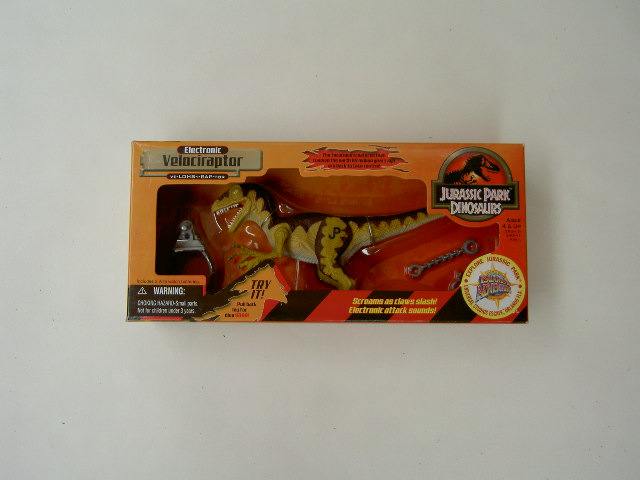
Jurassic Park Dinosaurs: Electronic Velociraptor


Year of release: 1999

Accessories:
-Three pieces of capture gear


Description: the electronic Raptor of the first JP Dinosaurs line sports a wholly different paint job than the regular Raptor figures of this series. Its back, topside of the tail, neck and upper part of the head are painted dark brown. This colour is also found on the sides of both upper legs. Triangular shapes run out of this colour over the rest of the body. The flanks, sides of the tail, rest of the legs, arms and most of the head are coloured dark yellow. The belly, throat and lowest part of the tail are painted beige. The creature has grey claws on both hands and feet, including the infamous sickle shaped claws on the feet. It has light yellow eyes with cat like black pupils, white teeth and a red tongue. The edges and inside of the mouth are also coloured red. On its left upper leg the figure sports a black JP logo.
This Raptor stands in a fully neutral pose, with its long tail slightly tilted up. It has a more robust look to it compared with the regular Velociraptors of this line and has a bigger, rounded head. Its mouth is opened and can’t be closed. Unlike with most other Raptor figures the claws on its hands are turned inward as if the beast is holding something. This was most likely done to make the creature look more menacing when the attack action is activated, and to help them grab other figures. Pulling the creature’s legs back (or pulling only one leg back, as the legs are interconnected) makes the arms move away from each other as if the Raptor is preparing to strike. Releasing the legs causes the arms to revert to their original position like the critter is clutching some prey between them. Activating this strike action also causes a loud attack scream to be heard.
This Raptor comes with three different pieces of capture gear. There's the typical cuff like tag with the JP logo on it, as well as an arm piece that can hold both arms together. The big third piece can fit over the Raptor's back. All three pieces are painted shiny metallic grey.


Analysis: this line doesn't only return old and familiar regular dinosaur faces from the classic days, but also some electronic ones, including this repaint of the often fondly remembered JPS1 Electronic Velociraptor. The sculpt has not been changed and comes with the same effective attack option as before, trapping unfortunate human figures between its arms, while producing a terrifying strike shriek. This sound has been greatly improved and is now very noisy, adding to the figure's overall intimidating feel. It's much louder than even the JPS2 Utahraptor sound, which was the same shriek but didn't sound loud enough to come over as really frightening despite that figure being a huge awe-inspiring Raptor. This JPD1 figure basically tells us what the Utahraptor's shriek should have sounded like.
The paint job of this electronic Velociraptor copies the paint scheme of its predecessor but uses harder colour contrast making the used colours stand out more. It's not a very original paint job (in fact, it's largely identical to the one featured on the regular JPD1 Wave 1 Raptor figure, which does add some consistency to this toy line), nor are the used colours very appealing together. Details, however, have not been omitted. Painting both the inside of the mouth as well as the edges around it is new for this line and a definite nice touch. The eyes could have used a different colour than yellow though, since the rest of the face is mostly the same colour, so they don't stand out much.
Unlike the original JPS1 Electronic Raptor, this figure comes with capture gear. None of the three pieces were designed for it of course, but at least they fit. The arm piece works pretty well, and even provides some dinosaur-breaks-free-of-restraints action. Pulling the legs back causes the arms to separate, which often (not always in one take) makes the arm piece detach as well. The tag is just the standard little nuisance, the sort of thing people keep misplacing, severely annoying collectors who try to get the figure complete when in loose condition, all the while not having any real function but to tell folks this is a JP figure, which of course anybody can see by the JP logo on the figure's left leg. The big back piece is an odd addition to the set. Though it fits, it doesn't really restrain anything. Originally a head piece was attached to it, but that didn't fit on this Raptor so they discarded that. Now it just sits there on the figure's back, feeling (and being) out of place.

Repaint: yes. This is a repaint of the old JPS1 Electronic Velociraptor, with repainted (and in the back piece's case, slightly retooled) capture gear from the TLWS1 small Pachycephalosaurus and TLWS2 Ornithosuchus figures, as well as the typical tag found on many dinosaur figures from various JP toy lines. The figure would not be repainted again.

Overall rating: 6/10. It's still a decent Raptor sculpt with excellently enhanced sound FX, but the paint job and capture gear aren't the best around. This is probably the most common electronic dinosaur figure from this line, but still not necessarily an easy find, especially MIB or complete.

woensdag 21 oktober 2015

Today's Review: Ramon en het Paard van Sinterklaas


Here's my first review for FilmTotaal. Same business, different employee.

http://www.filmtotaal.nl/recensie.php?id=45825

The first Flemish Sinterklaas movie is definitely modeled after the Dutch formula. Which is not surprising, since until so far, the Flemish kids had to make do with the myriad of Dutch Sinterklaas titles. And those proved succesful enough to finally convince Belgian producers to develop a Sinterklaas product of their own. And since only one Dutch Sint movie is produced this year - usually it's two, sometimes even more - why not return the favour and release it in Holland? They need not have bothered. Not that Ramon en het Paard van Sinterklaas is particularly bad (though it's certainly not a good family film that wins the hearts of all family members, as it's really only fun for kids), but it doesn't add anything to the slate of Dutch movies covering the topic, other than certain long running characters in Sint's Flemish entourage that the Dutch kids aren't at all familiar with. And most of them aren't so much fun to watch they'll stick in kids' minds for very long.


Aside from that, the film feels very much like its Dutch counterparts. Sint and co. are preparing for their trip up north, something goes awry - in this case, Sint's horse and its attendant are kidnapped - but all ends well and the festivities can procede as they always do, full of mirth and merriment. Add to that a cast of supporting characters (but no children, interestingly enough) to spice things up a bit and you have a thirteen-a-dozen Sinterklaas flick. In Holland, it's good to keep the kids occupied for a good 90 minutes. However, there's so many side characters in this film, that it ends up nigh two hours in length. Too long for the parents, and as it turned out at the press screening where the target audience was represented as well, also quite a challenge for the kids to sit through without getting overly restless. So there at least is a difference with the Dutch method: the Flemish take their time. Other than that, if it wasn't for the accents and the presence of Antwerp, you'd hardly think you were watching a foreign Sinterklaas picture. I would have preferred something more distinct from the Dutch takes on the subject.

The big question on most parents' minds of course is: how are the Belgians portraying Zwarte Piet? It's a white guy in make-up, the blackness explicitly stated to be the result of crawling up and down chineys, just as he was always supposed to be. Good approach. However, thicker layers of soot might have been applied, since this particular Piet (and there's only one of him here) obviously hadn't seen a chimney for months. Which might as well be true, as I doubt he's doing much chimney diving at home in Spain. Nevertheless, when you call a well established character Zwarte Piet and the first reponse he gets from a child is 'is that Zwarte Piet?' because there's so little black on him, you know you're confusing kids needlessly. I'll say no more on the matter than that I applaud the Belgian intentions but their execution still leaves room for unnecessary debate.


maandag 19 oktober 2015

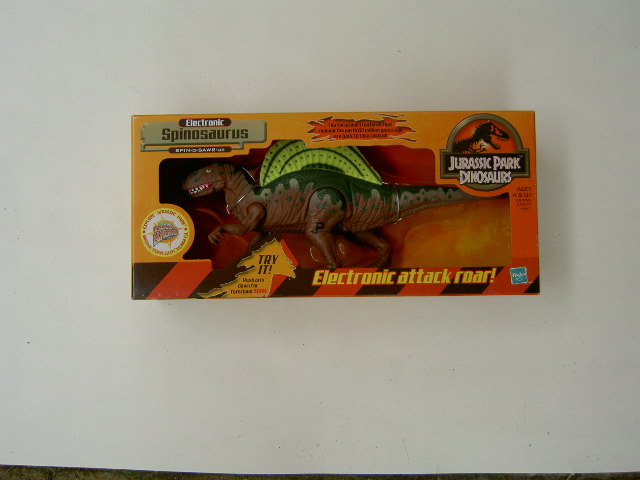
Jurassic Park Dinosaurs: Electronic Spinosaurus


Year of release: 1999

Description: this medium sized bipedal carnivore sports an elaborate paint job, though brown is the dominant colour, as it is found on the arms, most of the legs, underside of the tail, belly, most of the flanks, throat and most of the head of the figure. A dark green paint job covers the top of the head, neck, very upper part of the legs, topside of the tail and back of the creature, which runs out over the flanks, neck and tail in rounded shapes. Additional green spots are found on the animal’s head, flanks, upper legs and sides of the tail. The same shade of green adorns the otherwise mostly yellow sail in three stripes as well as three rows of tiny spots on each side of the sail. In between the brown and green colouring on the creature's body, a vague line of beige is located, running from the snout to the tip of the tail, though occasionally being interrupted by larger green shapes running out of the colouring on its back. A black JP logo is found on the left leg. The claws on the feet are painted white, but those on the hands are not coloured in a different paint job. The Spinosaurus has beige eyes with black pupils, small white teeth and the inside of the mouth, including the tongue, is coloured pink.
The creature assumes a walking stance, with the right leg posed in a backward move. This position causes problems: the sculpt can’t easily stand on its own accord (despite its large flat feet) and quite often must lean on something to stand up (though this tends to differ for each specimen: some have it worse than others). This dinosaur features an attack action: pull the left arm down so the mouth will open, revealing a snake like split tongue, as well as a not very impressive set of teeth. This also produces a roar, which is relatively high pitched, at least more than you might expect of a fair sized predator like this.


Analysis: the TLW line got some of its electronic dinosaurs repainted too, starting with this Spinosaurus figure. It was never the most successful TLW sculpt, though it was an interesting take on this species before JP III came along. The sculpt remains unchanged, meaning it still has balance issues and a rather unappealing and uninspired biting feature (in fact, identical to the one of the Electronic Dilophosaurus already repainted for this line). The sound is not as much improved as those of the JPS1 electronic repaints of JPD1, but still loud enough to make some impression. Unlike the Wave 1 electronic dinosaur figures, this dinosaur does not come with any capture gear, probably because it's already a bigger sculpt than its Wave 1 counterparts, so cost wise it didn't warrant any. As for size, it seems the reason the electronic Velociraptor and Parasaurolophus sculpts from the TLWS1 line didn't get repainted for this line because they were too big to fit in the designed packaging for the electronic figures of the JPD1 line. Too bad, since those were seriously the better electronic sculpts, but it's interesting to see a new take on this Spinosaurus too.
The paint job is really a fifty-fifty situation. On the one hand, the paint scheme is largely identical to the one from the TLWS1 Spinosaurus. On the other, the colours used this time around make you totally forget this. Its predecessor already had an appealing and interesting paint job, and fortunately this sculpt continues the trend with this new colour scheme. Brown and dark green fit well together, giving the beast a murky, earthy look, while the minimalistic use of beige is a good little addition. The yellow sail with the green specks and stripes makes it totally distinct from the light green with purple variation seen last time. It's good to see the claws on the feet are painted this time around, though it's a real shame the same can't be said for the claws on the hands. The beige eyes are a bit of a downer though, a brighter colour would have made them stand out more. So while it's still far from a perfect sculpt, the new paint job at least adds to its appeal, rather than bring it down ever further like we've seen on some other repaints of this first JP: Dinosaurs line.

Repaint: yes. This is a repaint of the TLWS1 Electronic Spinosaurus. The figure would not be repainted again.

Overall rating: 6/10. Not the best Spinosaurus sculpt around (though very different from Hasbro's later Spinosaurs), but it's decent enough. The paint scheme doesn't score high on originality, but at least the colours are different enough to avoid it being a total copy-cat. This Wave 2 electronic dinosaur is not the easiest find of this line and can fetch relatively high prices, but loose samples can occasionally be acquired at low cost.

zaterdag 10 oktober 2015

Today's Review: The Visit: An Alien Encounter


Some reviewing has been done again:

The Visit: An Alien Encounter - recensie

Aliens visiting our Earth: it can happen, you know?

This is without a doubt a very intriguing premise, but the end result leaves something to be desired. Blame it on the approach, stemming from the lack of archive material to cover, since The Visit: An Alien Encounter revolves around an event that hasn't happened yet and might not ever happen at all. Of course, some dramatization is required when there's little else to show but talking heads. Director Michael Madsen (not the American actor of the same name) opts for an enactment of a possible visit by extraterrestrials, but one that does not show said visitors so as to keep it a complete mystery what they look might like, since we are not likely to find out any time soon. The result is only one side of the visit in question is shown, and it's our own. Which fits the conclusion that whatever else, aliens arriving on our planet will first and foremost be a human affair.

First contact will change the way we look at ourselves. Whatever the visitors may look like - similar to humans or something far from it, something so devoid of human characteristics or even traits of other life forms that share our planet - they will place a mirror in front of us as to the questions of our expectations of the unknown, our control or lack thereof over the unknown, and the resulting dealing with the unknown in ways that are all too human. Fear, a very likely scenario, is a prime human condition Madsen addresses, which is why the governments that prepare for 'The Visit' would hope to keep it a quite affair, rather than a public one, considering the ways the public responds are more than likely to be far from calm and orderly. But however controlled those governments plan to keep things, there's so many possibilities provided by our complete lack of knowing what's coming (or what is not coming at all) that control itself is ever an illusion.


What's left out of the equation is wonder. Most of the scientists interviewed for this film are so busy delving into the ramifications of the visitors' arrival for humankind that they don't tend to pause and wonder over the eventual happening itself. The very fact that this may actually come to pass, in the distant or even close future. You can't really blame them, as they're sitting opposite a camera, addressing the audience as if they were the visitor and are asked to state the first questions regarding their field expertise that enter their minds considering the subject. And then they turn out the dutiful experts indeed. Though it makes for a scientifically intriguing and philosophically appropriate film, it's not the most inspiring one. Madsen hopes to hold off any stale science talk and lack of pace by adding a bit of action in a recreation of The Visit, complete with frightened mobs and charging soldiers, but his stylistic choices of extreme slow motion give it all an overly sensational and exaggerated feeling. Once again, blame it on the absence of actual extraterrestrials to point the camera at.

The Visit: An Alien Encounter is an ambitious and fascinating documentary on paper, but in actuality can't hold off moments of feeling tedious. Nevertheless, the point is well made: if there's aliens coming, be prepared for everything. Some of our governments and scientists certainly are.

maandag 5 oktober 2015

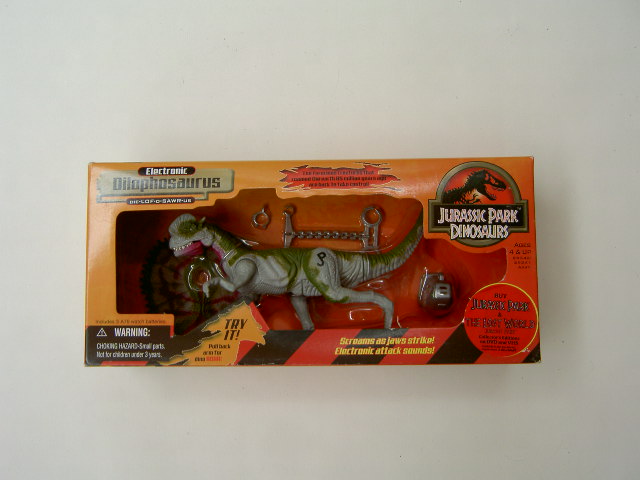
Jurassic Park Dinosaurs: Electronic Dilophosaurus


Year of release: 1999

Accessories:
-Removable frill
-Three pieces of capture gear


Description: this Dilophosaurus is electronic and sports a biting action. When pulling the left arm back the mouth opens and produces two short identical screeches which in no way resemble the rattling and hissing sounds this creature made in the movie. Most noticeably, this figure is equipped with a big frill, largely round in shape with serrated edges. The frill can be placed around the creature’s neck, making it look more aggressive and dangerous than it looks without. It can also be applied to various other figures, though more for fun than for realism. Like any good Dilophosaurus figure, this sculpt sports the same double crest with small spikes behind on its head. The creature stands in a largely neutral posture, though its tail is raised upwards. It has some trouble standing on its two legs since it’s not very well balanced, but making it lean on its tail in a tripod position solves that particular problem and makes it look more dominating.
This Spitter sports a fairly simple paint job despite the ample colouring possibilities the frill and crests offer. The lower parts of the sculpt (belly, most of the flanks, arms, feet, most of the legs, lower part of the tail and portions of the head, including the inward parts of the crests) are all light grey, while the rest of the figure (the back, upper part of the tail, the front sides of the upper legs, the neck and the area around the eyes) is dark green. Green shapes run out of this colouring over the flanks and sides of the tail and neck. Hardly noticeable, lighter green colouring runs around the edges of the darker shade of green on most of its body. Most of the lower jaw and throat are purple. The inside of the figure's mouth is also purple, including the tongue, while it has small white eyes with black irises and tiny white teeth. Its claws are not painted in a different colour. On its left upper leg it carries a black JP logo. The frill is also grey and is covered with green around the edges on both sides, including the aforementioned lighter green hue, as well as purple stripes and small lighter green spots on the front side.
This dinosaur comes with three pieces of capture gear. The first part is the standard tag which fits around various body parts. The second piece restrains both the arms and legs simultaneously, while the third piece covers the head, including its crests. All three pieces are painted in the same shiny metallic grey paint job.


Analysis: the classic Electronic Dilophosaurus from the very first JP toy line from 1993 also returns for the first JP: Dinosaurs line. Unfortunately, there's nothing this figure adds to the already existing sculpt. Both the paint job and paint scheme are largely identical to its predecessor, though the original white has been replaced with grey and this new release sports a darker paint job overall. Even the colour schemes on the crests and frill are practically the same, which is a real shame because body accessories like these provide great opportunities for wild colouration try-outs, but apparently no designer rose to this challenge. The only notable difference is the back of the frill, which also has coloured edges now. Furthermore, some details have been omitted, like the claws on both hands and feet, but the inside of the mouth at least is painted. The sound FX have been beefed up a few notches and sound more impressive than before. However, for some reason the mouth won't open as far as before, making for a less effective attack action. It could just be my particular specimen, but the feeling is raised that the designers tampered with its strike feature when improving the electronics.
Unlike the original JPS1 Electronic Dilophosaurus, this figure comes with capture gear. None of the three pieces were designed for it of course, but at least they fit. The limb piece works pretty well and does an adequate job of restraining arms and legs. The head piece is a near perfect fit, which is especially interesting knowing this particular part also comes with the Dimetrodon and Ornithosuchus figures of this toy line: it seems to be a fairly universal muzzle. The tag is just the standard little nuisance, the sort of thing people keep misplacing, severely irritating collectors who aim to get the figure complete when in loose condition, all the while not providing any real function but to tell people this is a Jurassic Park figure, which of course everybody can see by the JP logo on the figure's left leg.

Repaint: yes. This is a repaint of the old JPS1 Electronic Dilophosaurus, with repainted capture gear from the JPS2 Velociraptor and TLWS2 Ornithosuchus figures, as well as the typical tag found on many dinosaur figures from various JP toy lines. The figure would not be repainted again.

Overall rating: 6/10. It's still a fairly decent Dilophosaurus sculpt with greatly enhanced sound FX and usable capture gear, but the paint job is just a terribly big let-down and the attack option has lost its impact. This is one of the more common electronic dinosaurs from this line, but still not always an easy find, especially MIB or complete.